Blog

  • Herbal Hallucinations: is this all a dream?

    Herbal Hallucinations: is this all a dream?

    Earlier in the New Year, I was examining the contents of my “witch’s cabinet” (as the friend who gifted me the antique armoire named it), taking note of the herbs that should ideally be used up before spring foraging starts up again.

    IMG_20170501_084636_934

    I pondered starting a micro-dosing program. Not with psychedelics, of course, but I was playing with the concept using herbs, spices and novelty. This seemed a good alternative for those of us who cannot—or don’t want to—ingest consciousness-altering substances, but who still enjoy playing with our lived realities by changing patterns of consumption.

    IMG_20190913_163957_909

    It would also serve my fondness for do-able projects—taking on something subtle, like opening a window to let in fresh air rather than taking down a wall in order to build an addition to the house. Where the idea eventually landed was here: I would make at least one new recipe a week for the year.

    IMG_20180824_184239_013

    Fast forward a few weeks into late February. I returned to Whistler from Japan; COVID-19 was just beginning its global sweep out of China, and Japan was one of the early hard-hit countries. A few days after returning I developed a cough and sore throat, and was suddenly quarantined with the fear that I would be patient-zero in Whistler. After testing negative for the coronoavirus, however, I remained in quarantine with Influenza-A.

    Because of the flu, I couldn’t eat, but nevertheless started poking around the kitchen more intently. What exactly did I have in here to support health and immunity? (What did I have, given that the Canadian government was recommending we have two weeks worth of food and limit visits to the grocery store).

    OLYMPUS DIGITAL CAMERADue to a tiny pantry that comes with townhome living, I don’t have stocks of dried legumes and flour (yet!) but there is a substantial stash of otherwise semi-filled jars. There are herbs and spices galore, both from my personal interest in flavours and foraging, and because one of my sisters is a certified herbalist.

    20190706_190434

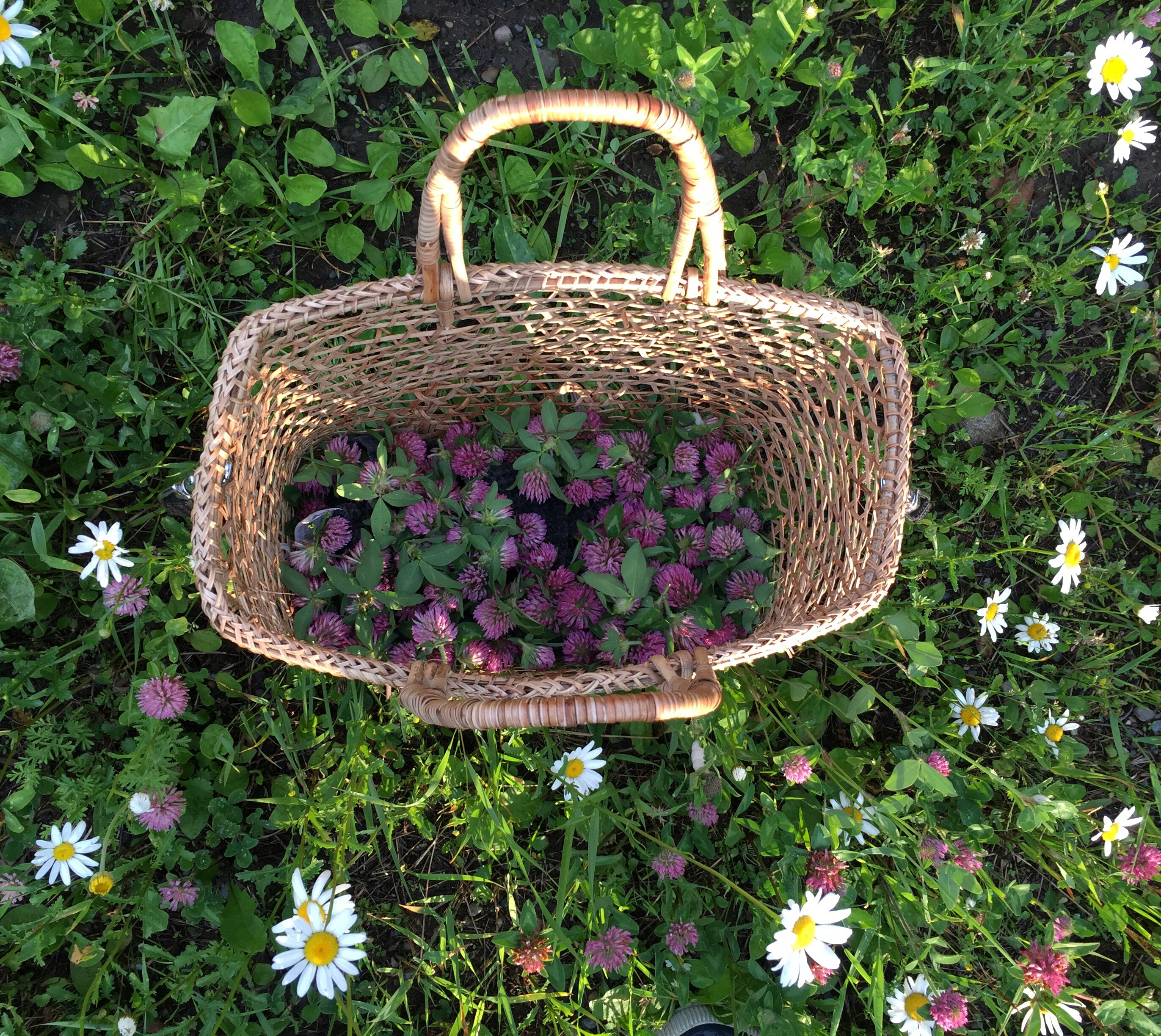
    In the fridge I found elderberry syrup and a stash of liquorice root and juniper berries (anti-virals). There was a jar of chaga from my parents property in the Cariboo, as well as clover flowers from their yard. My mother dehydrates kale by the wagon-load to crumple into soups, rice, or casseroles, and I found two bags as well as her dried apple-slices. The freezer contains steamed nettle that I’d completely forgotten about and a bag of chopped rhubarb to boot. My mini-stash was actually awash with interesting bits & bobs. Dandelion root, yarrow, calendula… harissa, nasi goreng mix and lemongrass. Local and exotic side by side.

    Now, what to do with it all?


    Screen Shot 2020-03-24 at 4.03.54 PM

    These are strange and stressful times. Most days I feel a strong need to create something— anything. And I’ll call it a win for the day even if it’s just making a nice cup of herbal tea or trying out a new soup recipe (**disclaimer, I don’t have young children; a friend with a young one told me her goal for the day was just peeing by herself, so fair enough**).

    OLYMPUS DIGITAL CAMERA

    Making all these concoctions is my way of coping with unprecedented circumstances. I know others are coping and working it out differently. Some need to chill out, eat chips and ice- cream, and soak up the stillness. I do that, too, but it seems that right now, tiny influxes of new flavours are foodie medicine for my beleaguered soul. Sage-and-lemon-balm tea. Cauliflower taco bowls. Lemony lentils. And yes, banana bread.

    My most recent experiment—a hibiscus infusion with ginger and citrus—is from a cookbook that I’ve had for years but have never used as much as in the past two weeks: Amy Chaplin’s At Home in the Whole Food Kitchen. That one book alone has delivered to my plate smashed baby potatoes with garlic & caper sauce, corn-grit blueberry muffins, a coconut curry and turmeric lemonade.

    I’ve even taken time to write the author to thank her for her recipes.

    What is happening to me? I didn’t even like to cook until I was 30 years old… but it turns out I’m a Taurus through and through. Ruled by the sensual. Now that I’ve got the time to appreciate the gifts of the senses, it’s grounding me. A little less news, a little more time to breathe in the smell of garlic, grind up coriander seed, or drop a bit of cardamom into my morning coffee.

    IMG_20180429_111422_544

    It’s simple, effective and delivers the variety I crave while we’re all house-bound more than normal.

    I wish you all well on your own journeys through this… oh, and please send any recommended recipes my way!

  • The Frogs are Croaking!

    The Frogs are Croaking!

    In these strange times I have been waiting (impatiently) for the frogs to start croaking. First come the pussy willows, next comes the frogs. And tonight I heard them – over on Urdal Road. They will slowly migrate west to Collins Road and Pemberton Meadows Road soon but for now you have to tilt your ears to the east. I always am excited to hear the first frogs, but this year I have been really anxious for them – a sign that outside of the human species, life goes on as normal.

    Thank you to our farmers. This pandemic and crisis has re-alerted me to the importance of food security. When I first moved to Pemberton 16 years ago Anna Helmer explained all this to me. I hadn’t a clue, being raised in Vancouver and buying my groceries at Safeway. I didn’t know what the ALR was. “Pave paradise, put up a parking lot”, sang Joni Mitchell in Big Yellow Taxi. More recently, she wrote in her song Shine: “Shine on fertile farmland buried under subdivisions”.

    We need farmers. We need farmland. This cannot be outsourced. Farmland must be protected. We are learning this now during this crisis. The hard way.

    When the Hellevangs recently announced that they were selling big 50 lb bags of Yukon Gold potatoes I jumped on it. And for the last 2 weeks we have been eating a lot of baked potatoes. I visited the UK for the first time nearly 30 years ago, and my Mum and I stayed with her friends who had a very young and “highly-spirited” (bratty in our view) child. She would only settle down with the promise of a “jacket potato”. At a village tea room or at their home these jacket potatoes seemed to have magical powers.

    Not sure why it’s taken me so long to embrace the simple but sublime jacket potato – but if you have some chili on hand (my recipe for deer chili is posted on this blog), plus sour cream, chopped green onions, butter and crumbled bacon, and of course some beautiful Pemberton Yukon Gold or Russet potatoes, you have such an easy and delicious meal.

    Frogs, farmers, potatoes. Pemberton we will get through this!

    Pemberton Baked Potatoes: (serves 4)

    4 large Russet or Yukon Gold Pemberton-grown potatoes, scrubbed well.

    Method: Using the tines of a fork, poke the potatoes in 5 or 6 places.

    Bake 1 to 1.5 hours at 350F. (Time depends on size of your potatoes.)

    Serve with butter, sour cream, green onions, bacon bits, or chili.

  • DIY – Maple Granola

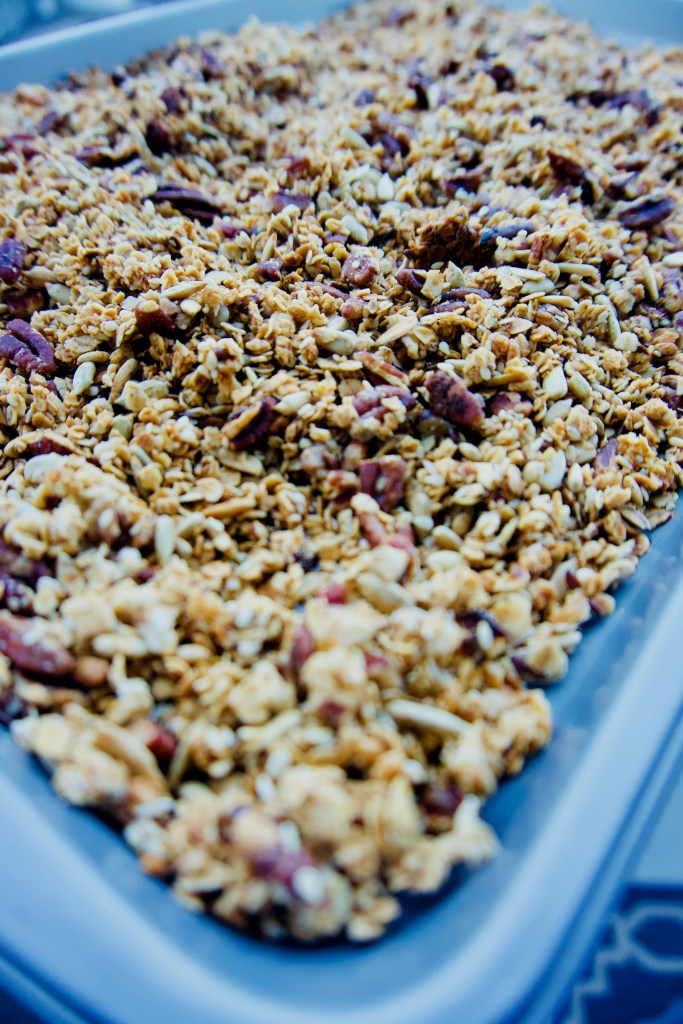
    DIY – Maple Granola

    The past few weeks, with the arrival of COVID-19 to our piece of the world, has caused me, as a normally un-anxious person, to become riddled with anxiety and a sense of foreboding, as I know is the case with many of my friends, colleagues and neighbours.

    Working in the hospitality industry in Whistler, with hotels temporarily ceasing operations and restaurants and bars closed to guests, means that is time to pull up the boot straps and find a way to both save money and release some of that tension.

    My go-to is baking and I do happen to have a banana bread in the oven as I type. But, as the hotel restaurant where I work had to close suddenly, there was a lot of food that was potentially going to go to waste and was instead given away to the staff, primarily to those who were just about to receive a temporary lay-off notice. 😦  I did, however, manage to get my hands on some yogurts and this recipe for Maple Granola is one that I have been meaning to make for a while. So now my daily breakfast consists of yogurt parfait with half a banana and, if I really needed a snack, the granola would work for that too.

    FYI I didn’t actually have any sunflower seeds in the cupboard but did have some linseeds so added those in instead. However, I’m pretty much sure you could add in whatever seeds, nuts and dried fruit you prefer and it would still taste delicious!

    Ingredients

    (Makes 8 cups)

    • 3 cups large-flake rolled oats
    • 1 1/3 cup natural almonds or pecans , chopped
    • 3/4 cups pepitas (pumpkin seeds)
    • 3/4 cups sunflower seeds
    • 1/3 cup sesame seeds
    • 1 teaspoon cinnamon
    • 3/4 teaspoons kosher salt or sea salt
    • 1/2 teaspoon ground ginger
    • 2/3 cups maple syrup
    • 3 tablespoons canola oil or melted coconut oil
    • 1/2 cup coconut chips (optional)1
    • /3 cup dried cranberries
    • 1/3 cup raisins

    Directions

    1. Preheat oven to 300°F.
    2. In large bowl, stir together oats, almonds, pepitas, sunflower seeds, sesame seeds, cinnamon, salt and ginger. Add maple syrup and oil, stirring to coat; spread evenly on baking sheet. Bake until golden brown, stirring every 15 minutes and rotating pan halfway through, about 40 minutes. Let cool completely in pan.
    3. Sprinkle with coconut chips (if using), cranberries and raisins.

  • Blissfully Homesteading through a Pandemic

    Blissfully Homesteading through a Pandemic

    I don’t intend to downplay the seriousness of the present situation nor am I arrogant nor ignorant enough to suggest this will not affect everyone, including ourselves. My partner and I have been laid off over 2 months early and we rely on this income to get us through the lean planting and prepping season where were busy working and buying supplies with little income. We will have to adapt – something we are familiar with. “We will get by, we will survive”: an anthem and lyric from my favourite band.

    Rural dwellers, being more isolated, have an advantage right now and farmers are optimists – they have to be, as every year poses new and unforeseen challenges. Different hits and misses, but things always seem to work out in the long run. Just planting seeds, building soil or incubating eggs is a sign you believe in the positivity for the future. Theres no short term gain. It’s all for a benefit sometime down the road.

    Homesteading, by definition, is literally staying and working from home, something all others are being asked to do, many out of their comfort zone. Many of the practises the general public are being asked to do are commonplace for us. Farmers can’t be germaphobes, they are constantly exposed to bacteria, both good and bad. They also understand that such exposure builds up their immune system, same goes for plants and livestock. At the same time most understand the importance of disinfecting propagation rooms, equipment, and keeping stables and coops clean to prevent an outbreak of pests and diseases, which can get out of hand quickly. Once a problem is identified, it’s important to act quickly as the situation increases exponentially. Organic farmers will resist the temptation to completely nuke everything with chemicals – the idea is to regain a sense of balance, so nature can do the rest. You never get it all, just slow down and manage the overwhelming progression. Patience and persistence are the key. Sound familiar?

    Quarantine is another age-old practice. It’s always a good idea to separate sick plants and animals for the greater good of the rest. The difficult decision to cull is something we all have to deal with.  As Darwin observed long ago, it’s the survival of the fittest that lets the strongest genetics evolve. Sometimes you you have to let something special go, so others can live.

    Organic farmers know that Mother Nature has a tendency to spank those who challenge her natural balance. The worst outbreaks occur in monocultures and factory farming. Mad cow disease, avian flus, E coli, listeria  and now Covid 19 (apparently originating a dirty Asian market) are all examples of problems from an overcrowded, unsanitary, misguided system and unnatural methods.

    Stocking up, preserving and being prepared are the cornerstones of homesteading. Pantries and freezers are like safety deposit boxes. It’s a currency that rarely devalues and becomes more valuable when times are tough. It’s something that is an ongoing process, not something you rush and do over a weekend. Toilet paper however, is not a survival item. Any naturalist knows water, newspaper, moss or leaves will do in a pinch, pardon the pun.

    I’ve sometimes questioned my decision to live off the land, knowing if I did the math it would be much more economical to use my skillset and work as a landscape designer or operate heavy machinery, and buy food with a regular salary from regular sources. These options however didn’t offer to feed my soul. Working outside with nature is my happy place. In times like these, I have no regrets.

    So it’s business as usual on the farm, with the always-lots-to-do list to keep busy. We will easily and naturally do our civic duty to self isolate, keep our social (media) distance, practice hygiene, stay active outdoors, and offer and accept help from the community.  I just cleaned the chicken coop, I washed my hands thoroughly.


  • Plant Yourself: A Recipe for Being Here

    Plant Yourself: A Recipe for Being Here

    I was originally going to call this post “A Recipe for Ordinary Wonder.” I’ve already written about wonder here, and while I think it’s essential, it remains a little ephemeral. It slips beyond the edges of our understanding. I feel the medicine of this particular moment needs to be earthy, grounded, real. Needs to be practical enough to lift us out of our fear and isolation. It needs to come in bite sized pieces, like good dark chocolate.

    I’m a horse and nature based teacher. Or rather I was, until the recommendations for social distancing led me to decide to cancel my spring break camps and enter self imposed quarantine as I’ve taught students from all over the Sea to Sky corridor (and the world, via Whistler) over the last two weeks. Yesterday while picking out the paddocks, I asked myself this question: if I’m not able to teach in person– to create the kind of meaning filled and deeply felt transformative encounters between horses, humans and land I feel we so badly need right now– what can I offer through other means that can give people the skills to create experiences for themselves?

    There’s a lot of writing swirling around about reconnecting and seeking stillness right now. What I think we’re being invited to do is to expand our consciousness past our own perspective. To broaden it past the narrow road of our individual lives and the lives of our families; to open to the collective whose voices move close against the boundaries we’ve made around ourselves. As I write this, an image comes into my mind of a dog shaking its head: one of those proper shakes where their ears flap up against the sides of their skull, and you can almost hear their brain rattling around in there, rearranging their neural pathways.

    These times we’re in are like that. We’re being shaken out of our patterns. We can choose to steel ourselves against what’s happening and create more rigidity in response to change (which we know we’re going to see a lot more of in this lifetime…) or we can get curious and explore it as an adjustment in our perspective, an ear shake that opens us to something wider than what we were.

    I want to give you a set of tools, something real and grounded and simple, that you can play with. Play with these with your kids. Pull one out each day and see where it takes you. You don’t need anything special. Just your body and the body of the world. Some of them might seem a little silly. That’s on purpose. They’re meant to enliven the younger parts of ourselves. That’s often where our biggest perspective shifts lie and where the more authentic parts of ourselves are buried. They’re also meant to give us the kind of connection we crave right now, an empathetic, felt sense of being known by an other. It’s just that, in this case, “the other” isn’t human. Even better! Nature is endlessly forgiving of our bumbling attempts to re-mind ourselves of our relationship with her. There’s no judgement here. Think of these exercises as lighthearted games, little valentines we can exchange with the more-than-human-world that surrounds us.

    If you try these, I’d love to hear about your experiences in the comments. Share your valentines with me. (I promise I won’t judge you either. ❤ )

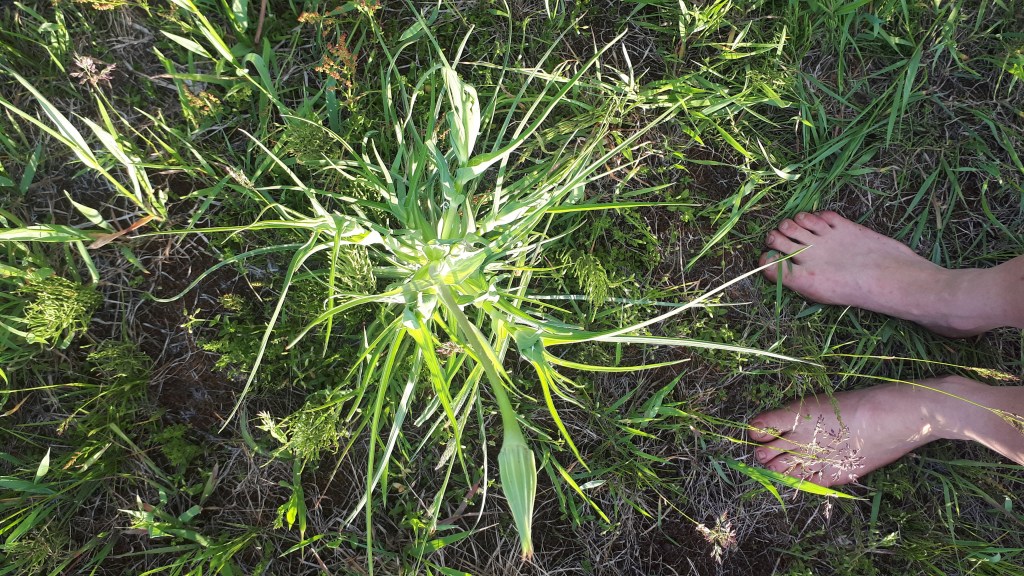
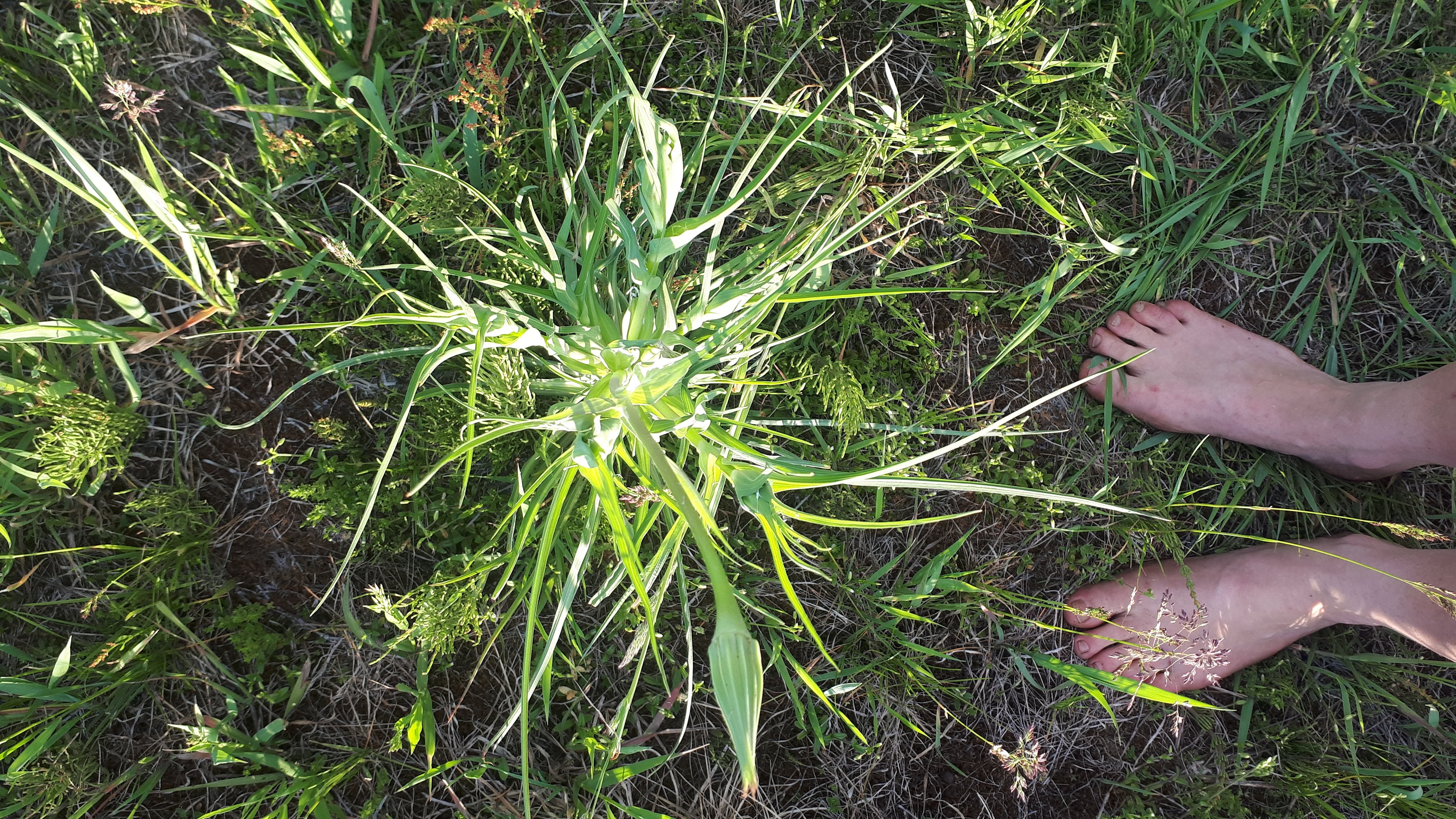
    1. Take off your shoes. And your socks. Find a patch of ground that looks warm and safe and inviting and stand on it. If you want more, go for a little walk. If you’ve tried a warm and inviting patch of ground already, try standing on snow. Try pavement. Try mud. Try exploring a liminal zone by walking from a shadow to sunlight, and track the differences in temperature with the bottom of your feet. Want to level up? Watch my video, “Place Based Walking,” for some ideas. Or walk on some gravel for a free acupressure session. (Top tip: touching the earth barefoot grounds and stabilizes the electromagnetic systems in the body. It literally rewires us to attune to the larger electromagnetic field of the earth, which helps us to come closer to a state of heart and brain coherence. Think of this as your antidote to all the wireless technology we’re saturated with, and the true savasana with which to end your online yoga class.)20190526_193441 (4)
    2. Let yourself be touched. The next time you’re out on a trail– or in your backyard, for that matter– notice the shrubs and trees that lean close to the edge of the path. It may be an errant twig that brushes across your cheek, or a cottonwood limb that’s come down across the over the course of winter. Or perhaps a low hanging cedar branch that brushes the top of your head and releases its scent. Just before you move out of the way, stop. Let yourself come into contact with this tree. You are nature touching nature. See how many different trees, bushes and branches you can let make contact with. Try not to do it on purpose. What happens if you turn off the path and into thick brush? Is it easier to find the gentlest way through? Is there something in your walking that becomes a kind of dance? An intimate exchange with the life forms we’ve believed to be inanimate all around us? What thoughts do we dance with in our psychic space in this same way? What reaches always toward us,  yet remains unnoticed? What do we cut through in order to continue to travel in the direction we want to go? What does it take for us to be touched by a different  part of nature in this way? A rock? A lake? How would we have to move our bodies to make contact?
    3. Fall in love with something small. Go outside. You can go to your favourite patch of woods or rock or field, or give yourself a challenge and start on a sidewalk or in the middle of your street. Your goal now is to wander. To meander with no destination in mind until something tiny calls your attention and makes you stop. Look down in the direction of your feet and keep your eyes soft. Look at the trunks of the trees. Look at everything without really looking at it. Keep your attention soft, like a photograph that’s not quite in focus. Wander until something, of its own accord, pulls your attention toward itself. It might be a bright green wolf lichen, or a pattern the compression of the snow has left in last summer’s dried grass. It might even be a chocolate bar wrapper with half of its colour worn away, held to the ground by a fallen stick. Once something tiny calls you awake, then give yourself to it entirely. Bend down and get close. Learn everything you can about it without causing harm. Then stand up, zoom out again, let your attention go soft, and start wandering again until something else calls to you. If you’re with your family or a friend for this, tell each other something you love about the tiny thing you discovered without giving away its identity. See if they can guess what it was. (Top tip: if you can cultivate this kind of “falling in love outside of yourself”, this sense of your attention being called to something of its own accord, it’s the best state of consciousness for finding mushrooms and other medicinal plants, and a profound way to activate our intuition. This form of listening to the being-ness of the world has been essential to the survival and evolution of human beings up until the last hundred years or so, when we started to place our emphasis on the rational, linear parts of our cognition.)
    4. Look up. Go to where there is nothing a human has made between you and the sky and look up. Bring a blanket and lie on a rock and look up. Let the sun heat your eyes behind your closed lids. Sit with your back against a tree and trace the line its trunk makes on the way to the sky with your gaze. Follow that line out into the crown of the tree, as if you were drawing the lines of each branch into the sky with your mind. Or look at clouds and then trace them in your mind’s eye in this same way. At night, look up at the stars. Imagine you are sailing on a ship a thousand years ago and this is the only map you have to guide you into the unknown. Learn a few constellations, or trace lines between the stars and make up your own patterns and give them names. Learn a star or a constellation as a family and know that every time you go outside and look up at it, you are connected. Look up. We need to remember the world is bigger than us again. (PS: I have a secret theory I have only anecdotal evidence to prove, but I’m still going to share it with you anyways: I think looking up in this way– actively tracing and engaging the muscles of our eyes in unfamiliar patterns of movement, specifically looking up into the worlds that exist above the plane human live on– causes our vagus nerve (and our autonomic nervous system, which governs our heart rate, breathing, digestion, hormone levels, AND THEREFORE OUR STRESS RESPONSE) to shift from fight/flight/freeze back to social engagement.)
    5. Leave a gift. Make something beautiful out of some bits of nature you find around you. (Three year olds are great at this, as they haven’t yet been trained out of this kind of reciprocity with their environment. ) Arrange a line of pinecones that marches across your street and makes someone else wonder. Create a spiral made out of pine needles for the wind to blow away. Line up twenty sticks from longest to shortest. Write “I love you” in pebbles across the valley trail. It doesn’t have to be profound, and it doesn’t have to be ‘Art’. Making and creativity are part of the basic tenants of humanity. Nature is always taking chaos and creating something more complex and more beautiful. How can we invite some of this elemental and playful creativity into our lives? How do we share our energy with others in ways that add to the glorious mystery of the natural world? Be inspired by the ephemeral earthworks created by Andy Goldsworthy or the morning altars offered by Day Schildkret, but don’t get trapped by the idea that your gift has to be a grand gesture. Gratitude, giving, and making are ancient parts of our being. Make something now, in this field where we’re standing, with just the materials of the field itself, for nature herself to wonder about. DSCN2734


  • Soil Matters

    Soil Matters

    Soil matters: Climate activists in our midst The regenerative agriculture movement is alive and well in Pemberton and beyond - LISA RICHARDSON

    “EVERY FARM HAS ITS OWN PERSONALITY,” says Amy Norgaard, a soil science student at the University of British Columbia, and former farmhand and market manager with Ice Cap Organics.

    Her two-year-long Master’s thesis, which she will defend in late spring, required her to travel between 18 different organic farms across southwest B.C., the Pemberton Valley, the Fraser Valley and Vancouver Island’s Comox Valley, to collate data about nutrients and soil amendments.

    At first, she thought this was going to give her the golden key to running the Ur-Farm, the perfect organic system, as she compiled tips and best practices from all the farms she was visiting and researching.

    But what she discovered is, there is no homogeny in small-scale, mixed-vegetable organic farming. And the idiosyncracies, in contrast to Big Ag’s monotony, work. “I’m working with this very niche group and yet none of these farms look the same!” she exclaims.

    Norgaard is an endearing combination of exuberance and intensity when she’s talking about her passions, of which snowboarding, soil and the tastiness of Pemberton-grown vegetables rank high. Now 27, she grew up in Merritt, hunting with her dad, and ripping around the mountain at Apex. She loved animals, worked at the local vet clinic, kept chickens as part of her 4H club program and captained every sports team she played on. She studied kinesiology for a while and hated it, took a season off to live in Whistler and snowboard every day and spent summers firefighting. Then, she stumbled into a soil science course. It was life-changing.

    She started learning about farming systems and their complexity and beauty and “the complete mess we’ve made with food production.” Two years later, she interned for eight months at Pemberton’s Ice Cap Organics to get her final six credits and dissolve what seemed to her to be a romantic idea about farming. It didn’t work: She loved it.

    Norgaard is still enchanted by the mystery of soil, and how, as much as we might have learned in the last 50 years, we’re realizing how little we understand of the infinite complexity of this system. “Soil is the basis of life,” she says. “This thin layer of topsoil we have on Earth is the medium for everything we depend on. Literally. For food and forests, for carbon cycles, for everything else it does like filter and hold water, and cycle nutrients. Literally, without soil we wouldn’t have a medium for decomposition.” And it’s one-metre thin—akin to a single cellular layer of skin on our bodies. And like our skin, it’s holding everything together. “Civilizations rise and fall with their soil management. It’s considered a finite resource in relation to our human lifespan.”

    The goal is not to measure soil quality, but orient towards soil health. Health is an important reframe, because soil is living. “It’s super offensive to a soil scientist to call it dirt, because dirt is inert. There’s no life in dirt. But soil is life.”

    And as much as a farm is a product of its landscape and its soil health, it’s also a reflection of the personality of its farmers, and the values and intentions they pour into it, liquidized as sweat.

    PHOTO BY GARRETT GROVE

    ‘FARMING WAS A WAY TO ALIGN WITH OUR VALUES’

    When I first met Delaney and Alisha Zayac, they had one season under their belt running Ice Cap Organics, their mixed-vegetable organic farm. They’d just bought an old house on two hectares in the Pemberton Valley between the Lillooet and Miller Rivers, and had a baby. Having tree-planted and run tree-planting crews for the last decade, they knew how to work hard. They’d read Vandana Shiva, the legendary food security activist, and Shiva’s writing prompted Alisha to transfer out of marine biology and into agroecology. An internship with Helmers Organic Farmhad put Pemberton on her radar. But at the beginning, it all seemed like a high-stakes gamble. Their five-year goal was ambitious, and yet not: they wanted to still be farming, and to work out how to have one day off a week.

    Fast forward to 2020. Would they tell their younger selves to change course, and try an easier life?

    “Definitely not!” says Delaney.

    “No!” echoes Alisha. “The other way around. It’s amazing.”

    It took some time to find the balance, between pouring everything into getting the farm going, and making time for themselves, for family. Ten years in, it’s manageable. But it’s still exciting, because the only constant is not-knowing. “You’re constantly making decisions,” says Delaney. “What amendments you’re using, what you plant where, how you’ll harvest different things, what tillage equipment you’re going to use. You’re doing it so constantly, and every decision has such weight in terms of outcomes, that you really feel you are part of the process. You’re connected to the ground. If I go out there and it’s time to start planting, and I till up a bunch of land too early and make it all crumbly and into little balls of mud, by making that one wrong decision I’m going to totally affect the fertility of that soil, and I’ve done that and seen what happens.” The farm becomes a literal manifestation of their intentions, decisions, and actions, for better and worse.

    One year, late in May, Delaney hiked up the ridge above Ice Cap Organics and looked down. He saw it suddenly, not as a manifestation of hundreds of decisions and learnings and missteps and logistics, but as a creative work, a personal expression of the two of them.

    It’s their version of marching for the climate.

    “Being an organic small-scale farmer, in some ways, is being a radical activist,” reflects Delaney. “It actually has more of a tangible impact on community and on ecosystem than protesting at the anti-world trade. I support that, too. I want to see change. I want to see big change in the world. We both do.”

    When they were in university, they realized that more than running around and talking about change, they wanted to be the change. They wanted to put their life’s work into something that manifested positive progress.

    “Farming was a way to align with our values,” says Alisha. “As soon as I started farming, I realized, this is actually enough.”

    But it’s not just a one-day march, after which you get to leave your signs in the gutter and go home. Small-scale organic farming is an all-in business—a complex one to operate at the level of intimacy that two hectares and a family operation demand. “Farming isn’t just a manufacturing business where you get 1,000 parts made in China and ship them over and sell them,” says Delaney. “You are actually producing. You’re managing the production on the farm, you’re managing sales, you’re managing all the systems—the irrigation system, soil-health system, greenhouse system, staff.”

    PHOTO BY GARRETT GROVE

    Ice Cap Organics plant, weed and harvest mostly everything by hand, pay fair wages and use farming practices that make the ecosystem healthier and more diverse. On their website, they explain the value their community-supported-agriculture (CSA) subscribers get when they sign up for a season (20 weeks) of harvest boxes. “It is cheaper to grow a head of lettuce on a 500-acre mono-crop lettuce farm in California with poorly paid migrant workers, massive capital infrastructure and harvesting equipment.” But, because buying direct from the farmer eliminates the middlemen in the supply chain, a consumer pays about the same.

    So the question is not just what are you having for dinner, tonight, but what system do you want to invest in? What world do you want to help manifest?

    Charles Massy, author of Call of the Reed Warbler, and a leading voice for regenerative organic agriculture—the use of farming to tend the soil and nurture living systems, rather than exploit, poison and deplete them as industrial monocropping tends to do—says regenerative agriculture is nearly two-and-a-half times better at burying carbon in the ground than anything else. “I see it as one of the very best solutions for global warming,” said Massy in a recent visit to Patagonia’s Ventura headquarters. “Since the Second World War, we humans have destabilized nearly all of the natural systems. We’re destabilizing things to the point where our own survival will become an issue. Yet because everything is integrated in a healthy system, with regenerative agriculture, there are all these positive knock-on effects—we store more water, we stop erosion, we encourage biodiversity. And it’s not just farmers that can get into this. The regenerative agriculture movement will only work when their products are supported by the urban community. It’s a two-way partnership and together we can really start addressing some of these major challenges tipping us towards [extinction].”

    The Zayacs can attest to how much more embedded in the climate and landscape they feel since starting their farm. “There’s something about just staying in one place and working the same land, for year upon year upon year,” reflects Delaney. “A big part of our being is invested in this ground here.”

    They’re also embedded in the community in a way they weren’t before.

    Explains Alisha: “Before the farm, we were part of lots of little bubbles, but here, you’re farming, harvesting your vegetables, putting your vegetables in the truck, taking them to people in Vancouver.” It’s an intimate, hand-to-hand transaction. She can easily imagine their customers cooking up dinner for friends later that night. Delaney says that, with a couple hundred people visiting them at market, he can mostly remember each face. It feels like mycelium, the exquisite interconnected branches of fungi that make soil healthy, through which plants communicate and share nutrients—a living network.

    It’s deeply meaningful. And yet, it’s constantly humbling. “Little things happen all the time to let you know you don’t have it all figured out,” says Delaney. “Farming is a lifelong learning process. And at the end of the day, we’re just growing some veggies.”

    ‘OUR SUCCESS IS ALSO EVERYONE ELSE’S SUCCESS’

    Rootdown Organics started the same year as Ice Cap—and both benefitted from mentorship and enthusiasm of the Helmers. The organic ecosystem of the Pemberton Valley has since expanded to include community-supported-agriculture (or harvest box) offerings from Laughing Crow, Plenty Wild, Blue House Organics, and Four Beat Farm. The Pemberton Farmers Market has been named the Farmers Market of the Year in the medium (21-to-60 vendor) category, organic flower farms are sprouting up, North Arm Farm is still a stalwart, and using the metric of residents per brewery, Pemberton was just voted the Best Beer Town in B.C. by The Growler, thanks to the Pemberton Brewing Company and the Miller family’s farm-to-tap offering, The Beer Farmers.

    As small, mixed-vegetable organic farms have sprung up in Pemberton, the growers have had to work out how to micro-target within the regional market—selling to restaurants versus Vancouver markets versus Squamish and Whistler markets—so they’re not competing directly with each other. “This farming gig is hard enough,” says Kerry McCann and Andrew Budgell, farming partners at Laughing Crow Organics,“without stepping on one another’s toes. We are in competition, even though all our businesses are slightly different. But our success is also everyone else’s success. If the other farms in the valley can’t thrive and be successful as humans and enterprises, that reflects on our ability to achieve success, too. Everyone is pretty good at finding their specialty and overlapping as little as possible.”

    Laughing Crow started eight years ago in a leased front field on Meadows Road on “a tight budget and a lot of hope.” They expanded each season, thanks to a Trojan work ethic and landowners Scott Lattimer and Lynne Menzel, who were willing to support their vision. It was exhausting, but the vision was strong: create a livelihood that would give back to the community, allow them to work for themselves, and not create a burden for the future generation to inherit. Last April, they moved their operation to 2.4 leased hectares at the Millers’ farm, which meant relocating and re-installing all their infrastructure—greenhouses, irrigation, washing and packing stations—from scratch, just as planting season was underway. On the plus side, it meant being able to tap into decades of farming know-how and the Millers’ intimate familiarity with the subtleties of the ground that Kerry and Andrew were now working. Not to mention, Bruce and Brenda Miller pioneered some of the first CSA mixed vegetable harvest box offerings in Pemberton almost 15 years ago.

    With the Millers’ newest farm experiment, the wildly successful Beer Farmers, having turned their new address into a destination, it made sense for Laughing Crow to try their hand at agritourism, so last season, they set up an honour stand, planted out a huge maze of sunflowers and grew what would become known as “The Grand Majestic Pumpkin Patch of Pemberton.” Of course, it was all an experiment.

    “We had a moment in July,” reflects McCann, “when we thought the sunflowers were going to bloom too early.” In their nightmares, the stunted maze would have suited only toddlers, but as it turned out, the sunflowers exploded into the most Instagrammed, beloved and feted event of the summer. “It turned out to be far more amazing than we anticipated. Neither of us had ever been in a field of flowers that big. The spectacle was really wonderful to be around and walk through. On top of the general beauty, the reaction from the community was really awesome. Everyone was so happy. It was infectious.”

    PHOTO BY GARRETT GROVE

    It felt like a win, to not only feed people through farming, but also be able to entertain and educate. “We know firsthand how thought-provoking it is to wander through the fields, to appreciate the plants and wonder about the food, the soil and the bugs,” says Budgell. Often their day will start or end with a walk around the fields, taking notes to create the next day’s to-do list.

    Inviting people onto the land itself—school groups, families, pumpkin hunters and sunflower lovers—was a way that Laughing Crow thought they could grow not just food, but activists and allies of the Earth and soil, as well.

    “We’d like to think that a visit to our farm and a wander through a field of sunflowers loaded with bees will crank up the urgency knob the next time someone is faced with the hard data on how we are endangering these very things,” says Budgell, “maybe in different a way than reading something on the internet or attending a climate march in Vancouver. Humans are always far more likely to protect what they feel connected to. Plus, what better way to build community than to meet up at a local farm brewery, on a local farm, chat with your local buddies and farmers and go home with some local food from the farm stand?”

    FEEDING THE SOIL, FEEDING THE WORLD

    Project Drawdown makes the case for taking up your knife and fork for the climate. “The world cannot be fed unless the soil is fed.” At least half of the carbon in the Earth’s soil has been released into the atmosphere over the past centuries. Putting it back, through regenerative agriculture, is one of the greatest opportunities to address human health, climate health and the financial well-being of farmers.

    One thing Amy Norgaard can say with certainty, having dug deep into soil health for the past two years, is that the Pemberton Valley hit paydirt when it came to soil. “You’re sitting on an amazing expanse of soils, which is a really valuable resource, not only for food production but for the ecosystem services that farmlands provide to society.” Don’t squander it, she urges. “It’s important for those soils to be managed well. That is often more expensive for the farmer, so as consumers, we need to be willing to pay for that land stewardship. We have to allow for the food to cost more. If farming isn’t a viable occupation, then those lands won’t be used for farming. Those beautiful meadows will become billionaires’ playgrounds and vacation homes.”

    When regenerative farming is economically viable, Norgaard concludes, farmers do the hard work of protecting and stewarding the resource. It’s probably the yummiest way of contributing to positive climate action.

    Earth activism needs fighters, warriors, protestors, policy makers, lobbyists, dreamers, repairers, regenerators. It needs us all. And as much, if not more, than anything else, it needs people to stand for the planet who know the smell of dirt under their nails, of sun on their skin and sweat on their brow, who know the joy of planting a seed and tending it, and harvesting it when it transforms into fecund and vibrant life. It needs us to sustain and nourish ourselves and each other, and to gather around tables of fresh healthy food, just plucked from the bed, still trailing the heat of the sun. It needs us to be attuned to the rhythms and cycles of the seasons. It needs us to know, with a deep cellular knowing, that even when you can’t see it, the life force is thrumming within, just waiting for the conditions to be right, just waiting for the right ally to come along.

    PHOTO BY GARRETT GROVE

    And that is how you can eat your planet whole again. The formula is simple: Soil is life. Support those who keep it healthy. And by way of return on your investment, they’ll keep you healthy too.

    This feature ran in the Pique on February 27 2020 and was a follow-up to a story I wrote for the Patagonia Journal. All photos by Garrett Grove.

    Follow the Pemby farm scene on instagram:

    @laughingcroworganics

    @icecaporganics

    @thebeerfarmers

    @amyyellen

    And photographer @GarrettGrove


  • Food Security in the Sea to Sky corridor is not just about farmland

    Food Security in the Sea to Sky corridor is not just about farmland

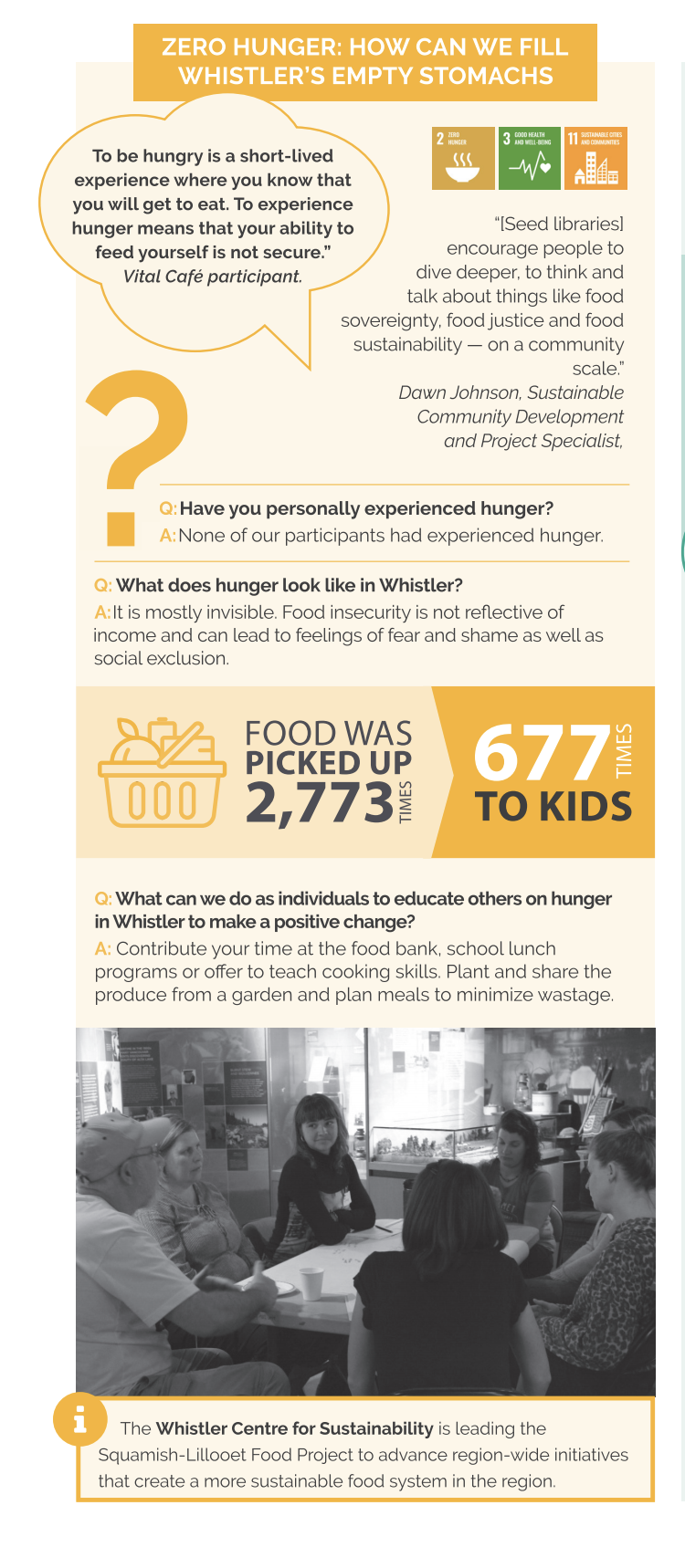
    Traced Elements contributor, change-agent and local gardening guru, Dawn Johnson spoke recently on food security in this podcast with host Kim Slater, for the Community Foundation of Whistler’s Vital Signs project.

    Listen to the conversation here.


    Global food security is not looking great, shared Dawn, so we need to look at building our resiliency, on a grassroots level, right now.

    Screen Shot 2020-03-05 at 11.54.31 AM

    Food security is a complex issue that touches the entire food system – it’s about a lot more than answering the question: “In our area do we have enough food to feed our people?” 

    It’s about people being able to access food, and in BC the biggest barrier for food security isn’t related to how much food we can grow here, or what the food cost is, but to how much income people have available to spend on food.

    Some great organizations are working on this through the corridor and that’s a strength – Helping Hands Society in Squamish, the Whistler Food Bank, the Pemberton Food Bank, Stewardship Pemberton Society. 

    1 in 6 children in BC belong to families who are concerned that they don’t feel they’re feeding them as weak as they could.

    Food production is getting more challenging for growers, with climate being more erratic.

    Food costs in BC have been increasing by 10% in the past 10 years, but over that time, our wages have only increased by 2.5%. People with lower incomes are spending so much more of their income on food. Someone on social assistance spends 44% of their income on food. There’s a clear correlation between income and food security. We need to support people to have better income in order to address food security.

    Screen Shot 2020-03-05 at 11.53.53 AM

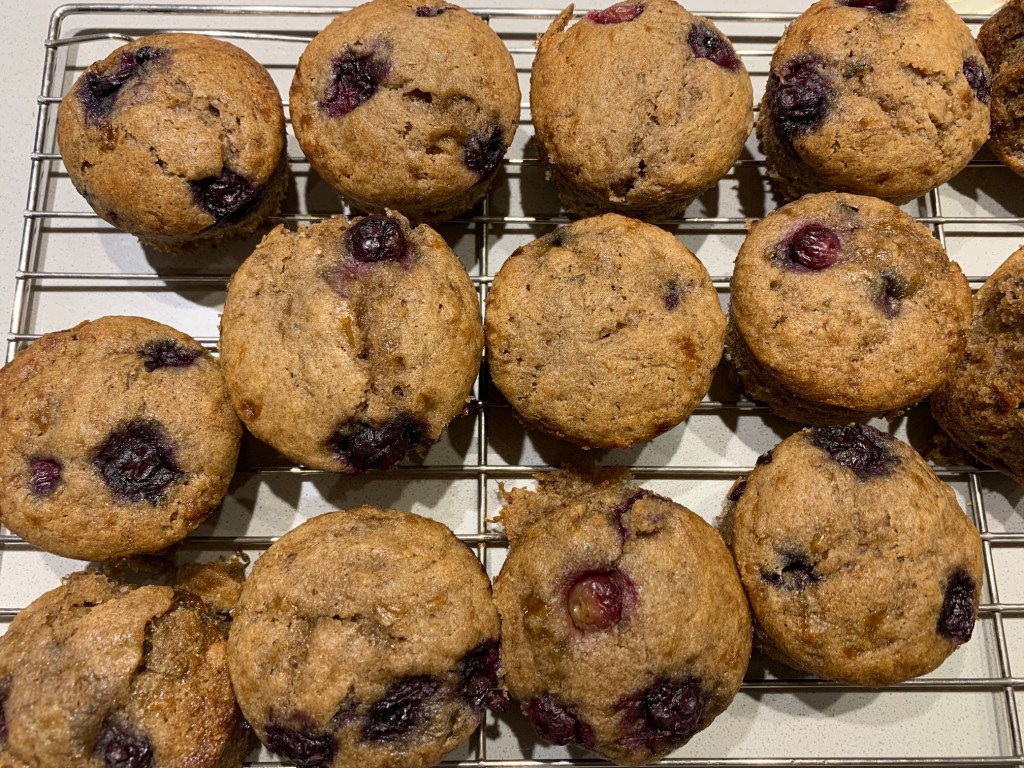
  • Pemberton Blueberry Banana Muffins

    Pemberton Blueberry Banana Muffins

    These muffins are a great staple to have on hand at any time of year. And they make good use of “all the Pemberton blueberries you froze last summer”. You did that of course.

    Lisa has asked me to explain why I substitute spelt for wheat flour on every occasion. Well, a number of years ago my mother warned me that wheat is inflammatory and can cause arthritis-like symptoms in people after the age of 40. And like clockwork, after I hit 40, sure enough, my hands got stiff after I ate wheat. Didn’t matter if it was crackers or bread: after I ate wheat my hands were stiff the next day.

    So it was a no-brainer to switch to spelt. If you can get to Costco, some locations sell Anita’s Sprouted spelt flour which I really like. Some brands don’t work well. I tried the Everland brand from Amazon and my muffins did not hold together at all.

    Thank you Mum for this invaluable advice. I hope others will give it a go. Stiff hands and fingers are no fun at all, and it really is an easy switch to transition to spelt. I have no time for white flour anyway. No nutrition content and I prefer the nutty, complex taste of whole grains in most of my baking – with the exception of brownies and birthday cakes!

    Pemberton Blueberry Banana Muffins (yield: 15-18 muffins depending on size)

    Ingredients:

    1 cup plus 2 tbs whole grain spelt flour

    2 tbs corn meal

    1 tsp baking soda

    2 eggs

    ½ cup grapeseed oil

    ½ cup white sugar

    2 large very ripe bananas, mashed

    3/4 cup blueberries

    1 tsp cinnamon

    1/4 tsp sea salt

    Method:

    Place mashed bananas, oil, eggs, sugar, cinnamon and baking soda in stand mixer and beat well until combined. Add flour and cornmeal and mix until just combined.

    Preheat oven to 350F.

    Use a 3 tbs spring-loaded cookie/muffin scoop (I like the OXO brand) to place scoops of batter into buttered muffin pans. (I like silicone muffin pans as they clean easily in the dishwasher.)

    Press 3-4 blueberries into top each muffin. (I prefer adding my blueberries this way as then they look nicer but you can always add during mixing process.)

    Bake 20 minutes and check for doneness. May need another 5 minutes. Oven temperatures vary so baking times are not set in stone. Enjoy!

    ** Coming Soon: another cookbook review – thanks to Lisa. I tried one recipe from a very recently-published Japanese cuisine cookbook, but the result was ho-hum so it needs some more time and patience!


  • Perfect for a cold day – Slow-Cooker Creamy Chicken With Biscuits

    Perfect for a cold day – Slow-Cooker Creamy Chicken With Biscuits

    You know those days.

    The ones that are cold, wet and miserable and you walk the dog only to feel chilled to the bones. Or it’s snowing so hard you just want to curl up in front of the fire with a good book and a huge mug of coffee. The ones when all you want to do is eat comfort food, but with the least amount of effort to make it.

    Well I found it in this recipe for Creamy Chicken with Biscuits. 🙂 Place all the ingredients (except the biscuits) in the slow cooker and leave it to do it’s thing for 3 to 6 hours, depending on the temperature setting you choose! Isn’t the slow cooker magic?

    And what makes this recipe even better are those biscuits. You could go the extra easy [ie lazy] route and buy some store-bought ready-made biscuits OR you could make up the simple recipe that’s included for Easy Drop Biscuits. Just put all the ingredients in a food processor and mix together. I ended up bringing mine together on the counter so I really felt that I had put the effort in, and because all I really have is a hand blender chopper thing so it doesn’t work quite as well! 😉

    Anyway, boy were they worth it! They made the dish even better and merited the 10 minutes it took to make them. Flaky, buttery and oh so yummy.

    Ingredients

    • 2 cups all-purpose flour, spooned and leveled
    • 1/2 cup (1 stick) cold unsalted butter, cut into small pieces
    • 1 tablespoon baking powder
    • 1 teaspoon kosher salt
    • 1 cup whole milk

    Directions

    1. Heat oven to 400° F.
    2. In a food processor, combine the flour, butter, baking powder, and salt; pulse until pea-size clumps form.
    3. Add the milk and pulse just until moistened.
    4. Drop 6 large mounds of the dough (about ½ cup each) onto a baking sheet.
    5. Bake until golden, 18 to 20 minutes.

    Now you know what to throw in the slow cooker on the next cold, wet, miserable day. You’re welcome!

  • Take Only What We Need

    Take Only What We Need

    It was 1989, I was in Grade 12.

    It was right around the time when David Suzuki started showing up outside the Nature of Things to talk of global warming (or climate change as it is now more accurately reported). Leaders around the world were taking steps toward protecting our environment – even H.W. Bush went on to ban CFCs to protect the ozone layer.

    I was lucky – or admittedly privileged – because I had access to a car. This privilege meant that I could choose a co-op work term outside of town limits. I got my first choice: an outdoor education centre for local elementary schools.

    I learned a lot about our world that year. My mentor was a devout naturalist, conservationist and environmentalist, but also, incredibly kind, engaging and completely immersed in the challenge of changing people’s minds.

    He propelled people to think zero waste. Especially when it came to food. Every day-long lesson included a pre-planned low-waste lunch for 30 people – and a lesson about compost.

    He had built the most interesting compost box that reminded me of an old tickle trunk replete with finished edges, a latch, and a key. He told stories of his months spent finding the perfect reclaimed materials.

    For maximum insulation (to keep the compost hot) during big snow months, each wall of the compost trunk was built from two pieces of metal that sandwiched several inches of yellow spray foam inside – I remember because he kept a small slice of the material pasted to one of his many super cool tri-fold science displays.

    When he lifted the lid of the compost trunk in the middle of winter, the steam from the compost billowed toward the little faces of wonder. The fanfare was inescapable. In truth, he even made shoveling compost fascinating.

    The interactive lesson ultimately left the kids yearning to contribute some of their lunch to the steaming heap. But once he realized their interest in throwing food away for the sake of contributing to a process, he quickly changed the game.

    He would first show the new kids the previous group’s food waste, and then turn the compost to bury yesterday’s remnants. Next, he challenged them to leave a pure rich black mostly untarnished soil canvas for the next group to admire and match. It was a certain lesson in take only what we need. Of course, a child’s food was exempt if they accidentally dropped it, so as not to ruin a perfectly good streak out of simple misfortune.

    This lunch hour entertainment was just a small segment of his bigger plan to change the world. I often think about that mentor and wonder if he feels nearly as cynical about the limited change as I do. That was 31 years ago.

    He made zero waste feel immensely important then, but now I’m just not sure where we’re at in this world.

    I’m conflicted about standing up – and acting as he acted. It’s hard to lead in the face of what seems like a stagnant world. But, to be fair…

    There are a million cool tools out there now to measure your impact and to guide you in prioritizing your changes. The most interesting tool I’ve found so far, is the CNN Green House Gas (GHG) emissions quiz.

    Take it right now, if you’re looking for a challenge: www.cnn.com/interactive/2019/04/specials/climate-change-solutions-quiz/

    *SPOILER ALERT*

    I reveal a section of the quiz in my words below.

    In the food portion of the quiz, you’re asked to drag the solutions to rank the ones you think would have the biggest effect on curbing climate change. As spoil-alerted, I’ve cheated and given you the solution here.

    1st – throw away less food – this would be similar to taking 511 million cars off the road.

    2nd – eat a plant-heavy diet – this would be similar to taking 479 million cars off the road

    3rd – cook over clean stoves – this would be similar to taking 115 million cars off the road

    4th – compost your waste – this would be similar to taking 16.5 million cars off the road

    Now, when you saw “cook over clean stoves”, it might have led you to think, “I can make a difference if I wipe my stove down every day… really?” Well, that’s not what they mean.

    They are talking about half the world population cooking over gas, wood-fired stoves, or even the deemed-deadly open fire pit.

    So, clean stoves might seem like a place for improvement, but throw less food away creates nearly 4.5 times an impact over reducing “dirty” stoves, and it amounts to no small numbers. Plus, reducing waste is a shocking 30 times better than simply composting.

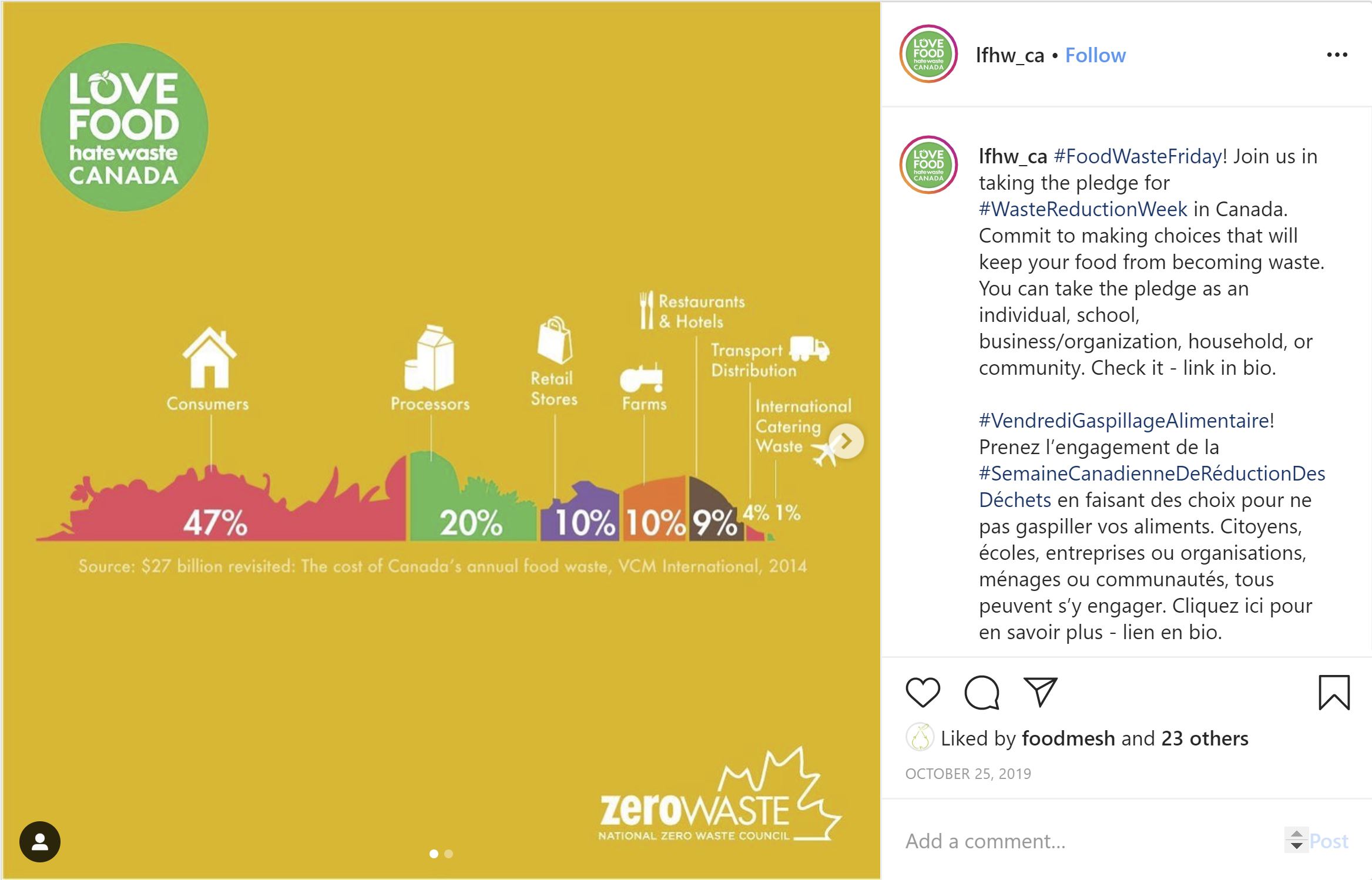
    The unfortunate thing is that a lot of avoidable waste in North America comes down to excess. Sure, in some cases, this is food left in fields, retail stores and processors but according to Love Food Hate Waste Canada, 47% of avoidable food waste in Canada is from consumers tossing goods that they don’t eat.

    47 percent avoidable

    I’m not saying that I’m not guilty. I am. Some weeks, our compost bin is 90% unavoidable food waste (e.g. corn husks, eggshells) and the very next it’s 90% avoidable food waste (e.g. moldy bread, risky rice). And sometimes it takes us 3 weeks to fill a bin and the next bin is full in 3 days.

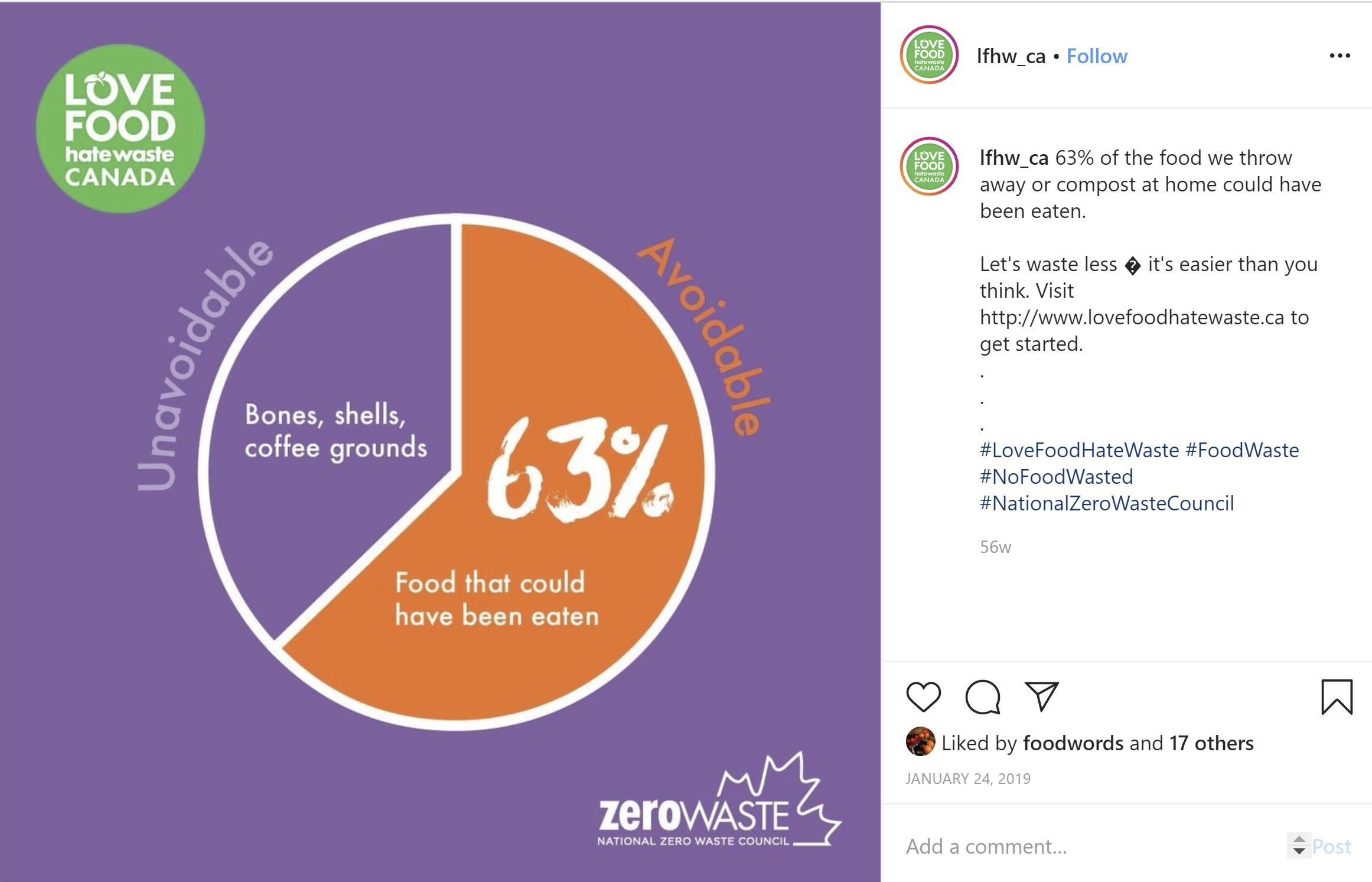
    Avoidable vs Unavoidable

    Sure, life goes sideways sometimes and you’d do better to throw out those suspicious leftovers. But, for the most part, avoidable food waste stems from over purchasing — or not processing and storing the food when it’s on the edge of no return (e.g. freezing bread or making clean-out-the-fridge soups for the freezer).

    And, did you know the number of GHG emissions for avoidable food waste is completely dependent on the type of food that we waste. For example, processed foods, meats and cheeses have higher inputs, and therefore we are wasting more GHGs in the entire process of growing, processing, packaging and even cooking them. Not just the GHGs in getting them to our home, chilling them, driving the compost to centralized composting and the processing of that avoidable compost.

    Milk waste

    So, if you’re cutting the questionable edges off of your cheese every week, it’s time to cut back on cheese purchases.

    I hope this is a certain lesson, if not simply a lesson to myself, to take only what we need. After all we might just remove the equivalent of 511 million cars from the road. Wouldn’t that be cool!

    Writer and cook Lisa Severn is making a refrigerator soup this week.