Author: Lisa Richardson

  • A festival of weeds: eat more dandelions

    A festival of weeds: eat more dandelions

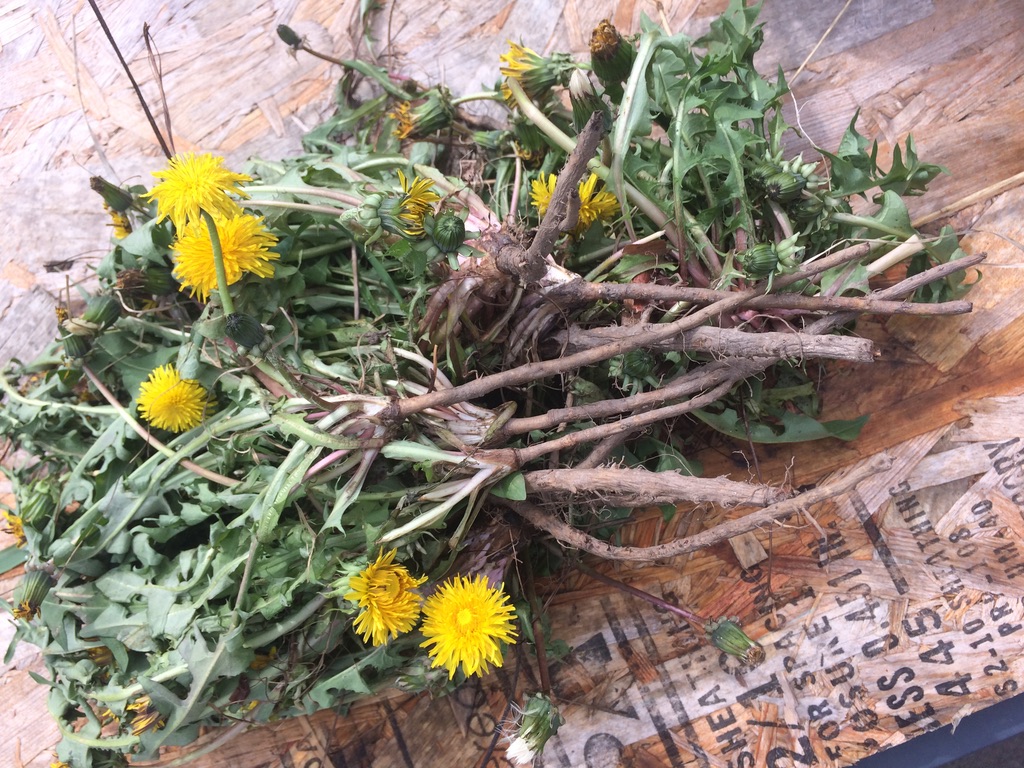
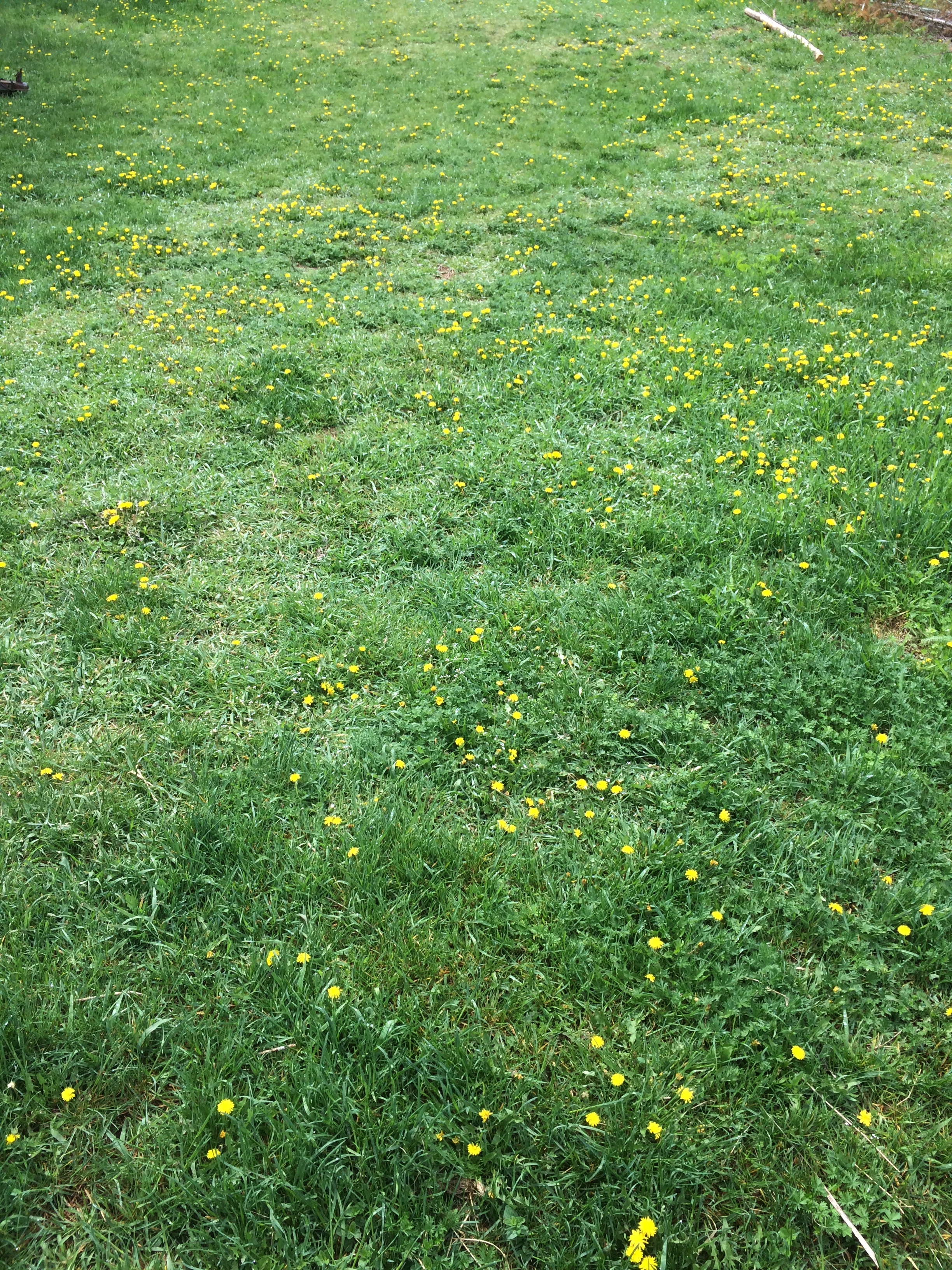
    Could a food chain that whispers of global vulnerability make me reconsider the value of my yard as part of my personal supply chain? I cultivate weeds better than anything. My yard is a festival of dandelions.

    IMG_9770

    There is nothing to be gained by declaring war on this. But everything to be gained by researching all the medicinal and nutritional benefits of dandelion and declaring it my most successful garden crop ever. So, with a nudge of encouragement from Natalie Rousseau, whose plant ally for early spring in her 13 Moons course was dandelion, I cooked up a dandelion saute, as the evening’s serve of greens.

    It tasted… so… weedy.

    The seven year old sniffed and said, “No.” Husband’s verdict: “not for the permanent recipe collection.”

    I went to instagram to announce this state of affairs.

    IMG_9074

    And was encouraged by friends not to give up.

    So I did some more research. They are SO GOOD FOR YOU. My coffee-to-wine IV line slash coping technique has short term effectiveness, (upping and downing me as required), but I’m not in love with the long term consequences (like looking haggard. I embrace witchiness but I’m not ready to be a hag just yet.) The promise of clear skin alone convinced me to keep trying – if not to disguise or balance the taste of dandelion, then to acquire.

    Two weeks into my experiments with dandelion (and with even more available in my yard, yay abundance!)  it’s some combination of all of the above.

    865964C7-5F3D-4BB3-A0DC-14A000007B20_1_105_c

    Susun Weed has taught that information in wild food is healing to our cells, it nourishes them with fewer glitches, it returns us to a state of health that aligns with an older Earth, because the receptor sites for minerals in our cells, are primed for the nutrients found in wild food.

    the optimum nutrition is the nutrition from the wild plants. ~ susun weed

    Dandelion is a member of the Asteraceae (daisy) family, a spring tonic and blood purifier. Dandelion leaves and roots relieve chronic stagnation in the liver, while the flowers can relieve a stagnant depressed spirit.

    “It grows almost anywhere: wild in fields, lining trails, in suburban yards, breaking through cracks in city sidewalks. Its constant presence is a reminder of its persistence to live as long as it can under any condition.” ~ Christine Buckley, Plant Magic

    It was actually imported to North America as a spring green and boasts the scientific name Taraxacum officinale, meaning the official remedy. Like, for everything.

    Its strengths are as a tonic, diuretic, alterative, antirheumatic, bitter, cholagogic, hepatic, exhilarant, mild laxative and nutritive.

    Dandelion – Are tap-rooted biennial or perennial herbaceous plants, native to temperate areas of the world. Dandelions are thought to have evolved about thirty million years ago in Eurasia, they have been used by humans as food and herb for much of recorded history. Dandelions are one of the first plants to bloom in the spring and therefore are a very important source of nectar and pollen early in the season. Its tap-root will bring up nutrients for shallower-rooting plants, and add minerals and nitrogen to the soil. Dandelions are even said to emit ethylene gas which helps fruit ripen.

    IMG_9127

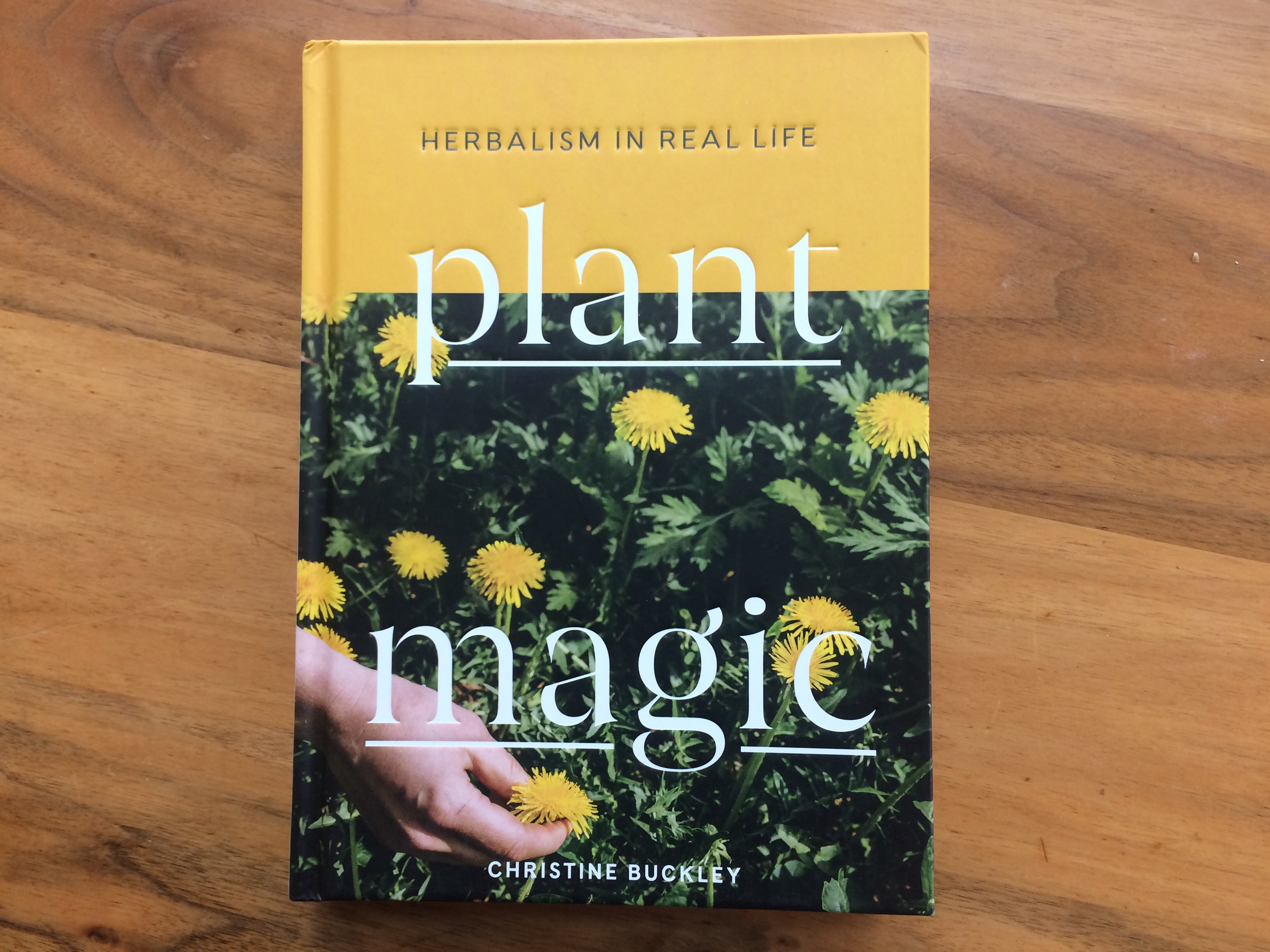
    Christine Buckley, in her new (and highly recommended) book Plant Magic includes dandelion in her herbal arsenal – she makes vodka tincture with the flowers and takes that jar of liquid sunshine as deep winter medicine, confessing it is her favourite plant for being “scrappy, fierce, life giving and cheery.”

    Buckley recommends to use the roots for sluggish digestion – dandelion will not just kick your digestive system into high gear, it also improves bile production in the liver, so you can digest fats and eliminate toxins from your body with more ease.  This will reduce inflammation in the body, make your skin look better, help your metabolism and allow the liver to cleanse the blood.

    It’s high in mineral content and inulin, a type of fibre, which is an excellent prebiotic.

    Are you sold yet?

    The leaves are great spring salads – waking up our systems. It’s a tonic, so that means you can take it, every day, and little by little, you will improve.

    “It is the ultimate preventative medicine,” says Buckley. And high in potassium, too.

    So long as the leaves are green, they’re edible. They become progressively bitter, so start with tender spring leaves. It also is packed with vitamins A, E, K, b6, B1 and C. Temper the bitterness with other ingredients (like plaintain leaves, garden herbs, seeds, nuts, shaved cheese, dried fruit.)

    So, with that data fomenting in my brain, my community of wild advisors offered tips on incorporating this super food into my diet.

    IMG_9128
    Christine Buckley’s must-have new book, Plant Magic

    Holly Joseph recommends: “The roots are nice and hot right now. Add to a stir fry, they taste so good! Brush them off under the hose. They are long and thin right now. And taste pretty peppery. I just cut it up right from the garden and put it right into my stir fry. Made it kind of spicy!”

    Asta Kovanen’s advice: “My tip is to cut wild greens in slowly. Add them in small percentages to your regular veg and then your palate can adjust without major assault.”

    Leala Selina Martin said: “I often will juice them as the larger they are the more bitter. They are so good for you though!”

    Sarinda Hoilett advised: “It’s all in the balance of flavours. Macadamia nuts (although gift from heaven) are expensive and hard to find…you can substitute cashews or even avocado and try for a creamy citrus blend to balance the bitter 🍃, And mix them with other greens or drop a few in a sweet smoothie.”

    Dandelion Cream Salad

    20 dandelion leaves, finely chopped, main stem rmoved

    1/2 cup macadamia nuts

    1/4 cup diced red bell pepper

    1/4 cup coconut water

    93617264_547637935955773_8913051030801154986_n3 tbs lemon juice

    1 tsp Celtic salt

    Massage chopped dandelion leaves well with salt to break down the fibre. Let sit for at least 5 minutes. Blend nuts with coconut water and lemon to cream. Mix well to coat dandelions with cream  and add red bell pepper. This salad is a wonderful way to get the great nutrition of dandelion with a reduction of the bitterness.


    EOJO8586

    After great success with Natalie’s dandelion cordial, making Christine Buckley’s winter rescue tincture (as I call it the “dandy brandy”) is next on my list.

    1 ½ cups dandelion flower blossoms

    1 cup honey

    1 cup brandy

    Put the flowers in a glass pint jar. Dissolve the honey in the brandy by stirring or whisking vigorously together. Pour the brandy and honey over the flowers, label and store in a cool dark place for 6 weeks. Bottle your tincture but don’t hide it away so well that you forget about it by winter.

    3321C13A-9284-428D-88D8-4AF3F8561DEE_1_105_c

    Pemberton-based clinical herbalist, Evelyn Coggins,advised, after reading this post: “I love to hear this topic of wild medicine/wild food being shared as miraculous, magical news… because it is all that. A weed is just a plant that hasn’t learned to grow in rows. The bitter principal of dandelion is tricky. We like sweet, salty and to some degree sour but bitter rarely. Maybe we are cautious because the toxic constituents in plants are most often present as alkaloids and alkaloids are bitter. It must have been a real learning curve to distinguish between toxic and beneficial bitters. The beneficial bitters aid digestion and many traditional aperitifs employ plant based bitters. Gin and tonic is a good example. Gin is prepared from juniper berries and they are bitter. Bitters act on the bitter receptors on the tongue and start a chain reaction that leads to the increased flow of bile into the digestive tract and all the nutritional value that ensues from there. It is not surprising that the liver leaps into action with bitters since poisons must be metabolized and hopefully rendered harmless by this organ. I agree that one must start slowly when turning to bitter plants but the journey is so worth it.”

    I’ve been a client of Evelyn’s and can’t recommend her highly enough.

    Now, more than ever, is a time to treat nature as an ally, not a servant/slave, and to behave with honour, humility, curiousity and gratitude.

    Just because you use the derisive word weed doesn’t mean this plant has no value.

    Finally, leave some for the pollinators. They matter in this lovely web, perhaps more than anyone. Not to mention, the roots reach deep into the soil to bring up nutrients, so they’re working healing magic on the Earth, not just our bodies.

    Thanks to Tanina Williams, who first introduced me to the idea of making dandelion jelly, for sharing this video:


  • Soil Matters

    Soil Matters

    Soil matters: Climate activists in our midst The regenerative agriculture movement is alive and well in Pemberton and beyond - LISA RICHARDSON

    “EVERY FARM HAS ITS OWN PERSONALITY,” says Amy Norgaard, a soil science student at the University of British Columbia, and former farmhand and market manager with Ice Cap Organics.

    Her two-year-long Master’s thesis, which she will defend in late spring, required her to travel between 18 different organic farms across southwest B.C., the Pemberton Valley, the Fraser Valley and Vancouver Island’s Comox Valley, to collate data about nutrients and soil amendments.

    At first, she thought this was going to give her the golden key to running the Ur-Farm, the perfect organic system, as she compiled tips and best practices from all the farms she was visiting and researching.

    But what she discovered is, there is no homogeny in small-scale, mixed-vegetable organic farming. And the idiosyncracies, in contrast to Big Ag’s monotony, work. “I’m working with this very niche group and yet none of these farms look the same!” she exclaims.

    Norgaard is an endearing combination of exuberance and intensity when she’s talking about her passions, of which snowboarding, soil and the tastiness of Pemberton-grown vegetables rank high. Now 27, she grew up in Merritt, hunting with her dad, and ripping around the mountain at Apex. She loved animals, worked at the local vet clinic, kept chickens as part of her 4H club program and captained every sports team she played on. She studied kinesiology for a while and hated it, took a season off to live in Whistler and snowboard every day and spent summers firefighting. Then, she stumbled into a soil science course. It was life-changing.

    She started learning about farming systems and their complexity and beauty and “the complete mess we’ve made with food production.” Two years later, she interned for eight months at Pemberton’s Ice Cap Organics to get her final six credits and dissolve what seemed to her to be a romantic idea about farming. It didn’t work: She loved it.

    Norgaard is still enchanted by the mystery of soil, and how, as much as we might have learned in the last 50 years, we’re realizing how little we understand of the infinite complexity of this system. “Soil is the basis of life,” she says. “This thin layer of topsoil we have on Earth is the medium for everything we depend on. Literally. For food and forests, for carbon cycles, for everything else it does like filter and hold water, and cycle nutrients. Literally, without soil we wouldn’t have a medium for decomposition.” And it’s one-metre thin—akin to a single cellular layer of skin on our bodies. And like our skin, it’s holding everything together. “Civilizations rise and fall with their soil management. It’s considered a finite resource in relation to our human lifespan.”

    The goal is not to measure soil quality, but orient towards soil health. Health is an important reframe, because soil is living. “It’s super offensive to a soil scientist to call it dirt, because dirt is inert. There’s no life in dirt. But soil is life.”

    And as much as a farm is a product of its landscape and its soil health, it’s also a reflection of the personality of its farmers, and the values and intentions they pour into it, liquidized as sweat.

    PHOTO BY GARRETT GROVE

    ‘FARMING WAS A WAY TO ALIGN WITH OUR VALUES’

    When I first met Delaney and Alisha Zayac, they had one season under their belt running Ice Cap Organics, their mixed-vegetable organic farm. They’d just bought an old house on two hectares in the Pemberton Valley between the Lillooet and Miller Rivers, and had a baby. Having tree-planted and run tree-planting crews for the last decade, they knew how to work hard. They’d read Vandana Shiva, the legendary food security activist, and Shiva’s writing prompted Alisha to transfer out of marine biology and into agroecology. An internship with Helmers Organic Farmhad put Pemberton on her radar. But at the beginning, it all seemed like a high-stakes gamble. Their five-year goal was ambitious, and yet not: they wanted to still be farming, and to work out how to have one day off a week.

    Fast forward to 2020. Would they tell their younger selves to change course, and try an easier life?

    “Definitely not!” says Delaney.

    “No!” echoes Alisha. “The other way around. It’s amazing.”

    It took some time to find the balance, between pouring everything into getting the farm going, and making time for themselves, for family. Ten years in, it’s manageable. But it’s still exciting, because the only constant is not-knowing. “You’re constantly making decisions,” says Delaney. “What amendments you’re using, what you plant where, how you’ll harvest different things, what tillage equipment you’re going to use. You’re doing it so constantly, and every decision has such weight in terms of outcomes, that you really feel you are part of the process. You’re connected to the ground. If I go out there and it’s time to start planting, and I till up a bunch of land too early and make it all crumbly and into little balls of mud, by making that one wrong decision I’m going to totally affect the fertility of that soil, and I’ve done that and seen what happens.” The farm becomes a literal manifestation of their intentions, decisions, and actions, for better and worse.

    One year, late in May, Delaney hiked up the ridge above Ice Cap Organics and looked down. He saw it suddenly, not as a manifestation of hundreds of decisions and learnings and missteps and logistics, but as a creative work, a personal expression of the two of them.

    It’s their version of marching for the climate.

    “Being an organic small-scale farmer, in some ways, is being a radical activist,” reflects Delaney. “It actually has more of a tangible impact on community and on ecosystem than protesting at the anti-world trade. I support that, too. I want to see change. I want to see big change in the world. We both do.”

    When they were in university, they realized that more than running around and talking about change, they wanted to be the change. They wanted to put their life’s work into something that manifested positive progress.

    “Farming was a way to align with our values,” says Alisha. “As soon as I started farming, I realized, this is actually enough.”

    But it’s not just a one-day march, after which you get to leave your signs in the gutter and go home. Small-scale organic farming is an all-in business—a complex one to operate at the level of intimacy that two hectares and a family operation demand. “Farming isn’t just a manufacturing business where you get 1,000 parts made in China and ship them over and sell them,” says Delaney. “You are actually producing. You’re managing the production on the farm, you’re managing sales, you’re managing all the systems—the irrigation system, soil-health system, greenhouse system, staff.”

    PHOTO BY GARRETT GROVE

    Ice Cap Organics plant, weed and harvest mostly everything by hand, pay fair wages and use farming practices that make the ecosystem healthier and more diverse. On their website, they explain the value their community-supported-agriculture (CSA) subscribers get when they sign up for a season (20 weeks) of harvest boxes. “It is cheaper to grow a head of lettuce on a 500-acre mono-crop lettuce farm in California with poorly paid migrant workers, massive capital infrastructure and harvesting equipment.” But, because buying direct from the farmer eliminates the middlemen in the supply chain, a consumer pays about the same.

    So the question is not just what are you having for dinner, tonight, but what system do you want to invest in? What world do you want to help manifest?

    Charles Massy, author of Call of the Reed Warbler, and a leading voice for regenerative organic agriculture—the use of farming to tend the soil and nurture living systems, rather than exploit, poison and deplete them as industrial monocropping tends to do—says regenerative agriculture is nearly two-and-a-half times better at burying carbon in the ground than anything else. “I see it as one of the very best solutions for global warming,” said Massy in a recent visit to Patagonia’s Ventura headquarters. “Since the Second World War, we humans have destabilized nearly all of the natural systems. We’re destabilizing things to the point where our own survival will become an issue. Yet because everything is integrated in a healthy system, with regenerative agriculture, there are all these positive knock-on effects—we store more water, we stop erosion, we encourage biodiversity. And it’s not just farmers that can get into this. The regenerative agriculture movement will only work when their products are supported by the urban community. It’s a two-way partnership and together we can really start addressing some of these major challenges tipping us towards [extinction].”

    The Zayacs can attest to how much more embedded in the climate and landscape they feel since starting their farm. “There’s something about just staying in one place and working the same land, for year upon year upon year,” reflects Delaney. “A big part of our being is invested in this ground here.”

    They’re also embedded in the community in a way they weren’t before.

    Explains Alisha: “Before the farm, we were part of lots of little bubbles, but here, you’re farming, harvesting your vegetables, putting your vegetables in the truck, taking them to people in Vancouver.” It’s an intimate, hand-to-hand transaction. She can easily imagine their customers cooking up dinner for friends later that night. Delaney says that, with a couple hundred people visiting them at market, he can mostly remember each face. It feels like mycelium, the exquisite interconnected branches of fungi that make soil healthy, through which plants communicate and share nutrients—a living network.

    It’s deeply meaningful. And yet, it’s constantly humbling. “Little things happen all the time to let you know you don’t have it all figured out,” says Delaney. “Farming is a lifelong learning process. And at the end of the day, we’re just growing some veggies.”

    ‘OUR SUCCESS IS ALSO EVERYONE ELSE’S SUCCESS’

    Rootdown Organics started the same year as Ice Cap—and both benefitted from mentorship and enthusiasm of the Helmers. The organic ecosystem of the Pemberton Valley has since expanded to include community-supported-agriculture (or harvest box) offerings from Laughing Crow, Plenty Wild, Blue House Organics, and Four Beat Farm. The Pemberton Farmers Market has been named the Farmers Market of the Year in the medium (21-to-60 vendor) category, organic flower farms are sprouting up, North Arm Farm is still a stalwart, and using the metric of residents per brewery, Pemberton was just voted the Best Beer Town in B.C. by The Growler, thanks to the Pemberton Brewing Company and the Miller family’s farm-to-tap offering, The Beer Farmers.

    As small, mixed-vegetable organic farms have sprung up in Pemberton, the growers have had to work out how to micro-target within the regional market—selling to restaurants versus Vancouver markets versus Squamish and Whistler markets—so they’re not competing directly with each other. “This farming gig is hard enough,” says Kerry McCann and Andrew Budgell, farming partners at Laughing Crow Organics,“without stepping on one another’s toes. We are in competition, even though all our businesses are slightly different. But our success is also everyone else’s success. If the other farms in the valley can’t thrive and be successful as humans and enterprises, that reflects on our ability to achieve success, too. Everyone is pretty good at finding their specialty and overlapping as little as possible.”

    Laughing Crow started eight years ago in a leased front field on Meadows Road on “a tight budget and a lot of hope.” They expanded each season, thanks to a Trojan work ethic and landowners Scott Lattimer and Lynne Menzel, who were willing to support their vision. It was exhausting, but the vision was strong: create a livelihood that would give back to the community, allow them to work for themselves, and not create a burden for the future generation to inherit. Last April, they moved their operation to 2.4 leased hectares at the Millers’ farm, which meant relocating and re-installing all their infrastructure—greenhouses, irrigation, washing and packing stations—from scratch, just as planting season was underway. On the plus side, it meant being able to tap into decades of farming know-how and the Millers’ intimate familiarity with the subtleties of the ground that Kerry and Andrew were now working. Not to mention, Bruce and Brenda Miller pioneered some of the first CSA mixed vegetable harvest box offerings in Pemberton almost 15 years ago.

    With the Millers’ newest farm experiment, the wildly successful Beer Farmers, having turned their new address into a destination, it made sense for Laughing Crow to try their hand at agritourism, so last season, they set up an honour stand, planted out a huge maze of sunflowers and grew what would become known as “The Grand Majestic Pumpkin Patch of Pemberton.” Of course, it was all an experiment.

    “We had a moment in July,” reflects McCann, “when we thought the sunflowers were going to bloom too early.” In their nightmares, the stunted maze would have suited only toddlers, but as it turned out, the sunflowers exploded into the most Instagrammed, beloved and feted event of the summer. “It turned out to be far more amazing than we anticipated. Neither of us had ever been in a field of flowers that big. The spectacle was really wonderful to be around and walk through. On top of the general beauty, the reaction from the community was really awesome. Everyone was so happy. It was infectious.”

    PHOTO BY GARRETT GROVE

    It felt like a win, to not only feed people through farming, but also be able to entertain and educate. “We know firsthand how thought-provoking it is to wander through the fields, to appreciate the plants and wonder about the food, the soil and the bugs,” says Budgell. Often their day will start or end with a walk around the fields, taking notes to create the next day’s to-do list.

    Inviting people onto the land itself—school groups, families, pumpkin hunters and sunflower lovers—was a way that Laughing Crow thought they could grow not just food, but activists and allies of the Earth and soil, as well.

    “We’d like to think that a visit to our farm and a wander through a field of sunflowers loaded with bees will crank up the urgency knob the next time someone is faced with the hard data on how we are endangering these very things,” says Budgell, “maybe in different a way than reading something on the internet or attending a climate march in Vancouver. Humans are always far more likely to protect what they feel connected to. Plus, what better way to build community than to meet up at a local farm brewery, on a local farm, chat with your local buddies and farmers and go home with some local food from the farm stand?”

    FEEDING THE SOIL, FEEDING THE WORLD

    Project Drawdown makes the case for taking up your knife and fork for the climate. “The world cannot be fed unless the soil is fed.” At least half of the carbon in the Earth’s soil has been released into the atmosphere over the past centuries. Putting it back, through regenerative agriculture, is one of the greatest opportunities to address human health, climate health and the financial well-being of farmers.

    One thing Amy Norgaard can say with certainty, having dug deep into soil health for the past two years, is that the Pemberton Valley hit paydirt when it came to soil. “You’re sitting on an amazing expanse of soils, which is a really valuable resource, not only for food production but for the ecosystem services that farmlands provide to society.” Don’t squander it, she urges. “It’s important for those soils to be managed well. That is often more expensive for the farmer, so as consumers, we need to be willing to pay for that land stewardship. We have to allow for the food to cost more. If farming isn’t a viable occupation, then those lands won’t be used for farming. Those beautiful meadows will become billionaires’ playgrounds and vacation homes.”

    When regenerative farming is economically viable, Norgaard concludes, farmers do the hard work of protecting and stewarding the resource. It’s probably the yummiest way of contributing to positive climate action.

    Earth activism needs fighters, warriors, protestors, policy makers, lobbyists, dreamers, repairers, regenerators. It needs us all. And as much, if not more, than anything else, it needs people to stand for the planet who know the smell of dirt under their nails, of sun on their skin and sweat on their brow, who know the joy of planting a seed and tending it, and harvesting it when it transforms into fecund and vibrant life. It needs us to sustain and nourish ourselves and each other, and to gather around tables of fresh healthy food, just plucked from the bed, still trailing the heat of the sun. It needs us to be attuned to the rhythms and cycles of the seasons. It needs us to know, with a deep cellular knowing, that even when you can’t see it, the life force is thrumming within, just waiting for the conditions to be right, just waiting for the right ally to come along.

    PHOTO BY GARRETT GROVE

    And that is how you can eat your planet whole again. The formula is simple: Soil is life. Support those who keep it healthy. And by way of return on your investment, they’ll keep you healthy too.

    This feature ran in the Pique on February 27 2020 and was a follow-up to a story I wrote for the Patagonia Journal. All photos by Garrett Grove.

    Follow the Pemby farm scene on instagram:

    @laughingcroworganics

    @icecaporganics

    @thebeerfarmers

    @amyyellen

    And photographer @GarrettGrove


  • Food Security in the Sea to Sky corridor is not just about farmland

    Food Security in the Sea to Sky corridor is not just about farmland

    Traced Elements contributor, change-agent and local gardening guru, Dawn Johnson spoke recently on food security in this podcast with host Kim Slater, for the Community Foundation of Whistler’s Vital Signs project.

    Listen to the conversation here.


    Global food security is not looking great, shared Dawn, so we need to look at building our resiliency, on a grassroots level, right now.

    Screen Shot 2020-03-05 at 11.54.31 AM

    Food security is a complex issue that touches the entire food system – it’s about a lot more than answering the question: “In our area do we have enough food to feed our people?” 

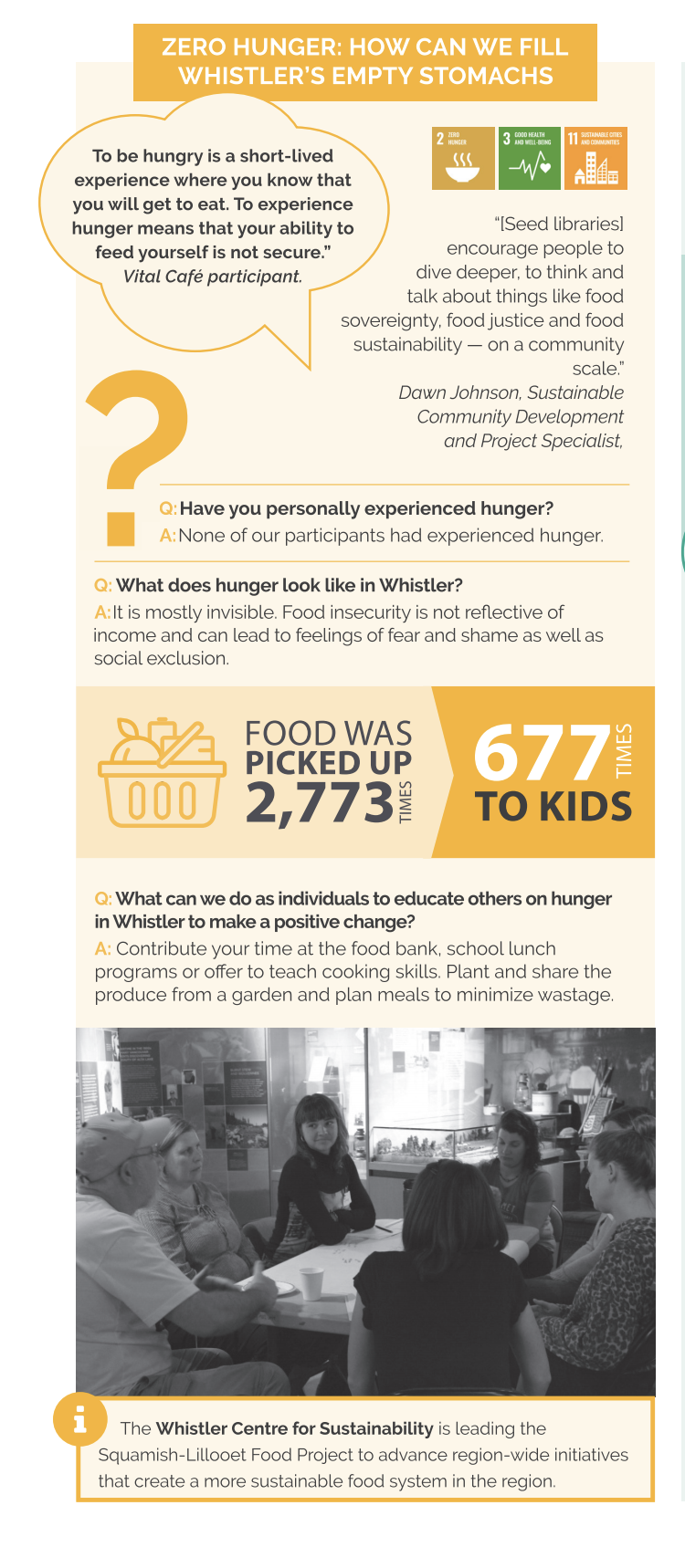
    It’s about people being able to access food, and in BC the biggest barrier for food security isn’t related to how much food we can grow here, or what the food cost is, but to how much income people have available to spend on food.

    Some great organizations are working on this through the corridor and that’s a strength – Helping Hands Society in Squamish, the Whistler Food Bank, the Pemberton Food Bank, Stewardship Pemberton Society. 

    1 in 6 children in BC belong to families who are concerned that they don’t feel they’re feeding them as weak as they could.

    Food production is getting more challenging for growers, with climate being more erratic.

    Food costs in BC have been increasing by 10% in the past 10 years, but over that time, our wages have only increased by 2.5%. People with lower incomes are spending so much more of their income on food. Someone on social assistance spends 44% of their income on food. There’s a clear correlation between income and food security. We need to support people to have better income in order to address food security.

    Screen Shot 2020-03-05 at 11.53.53 AM

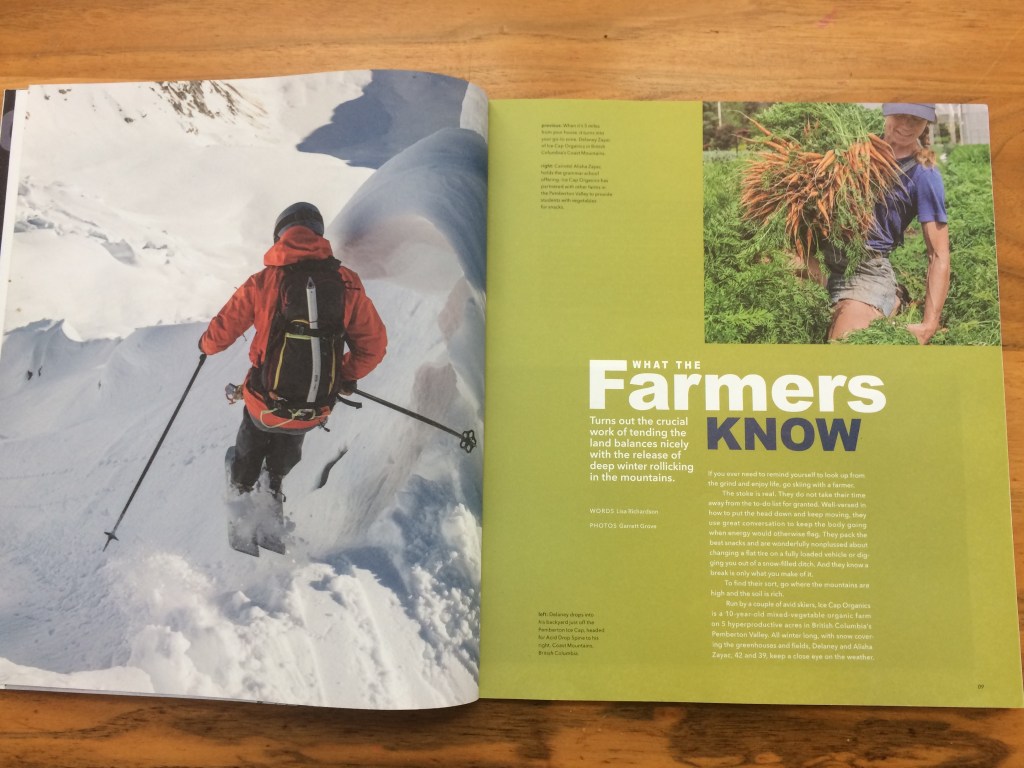
  • Pemberton farmers featured in Patagonia’s Winter 2020 catalogue: What the Farmers Know

    Pemberton farmers featured in Patagonia’s Winter 2020 catalogue: What the Farmers Know

    Turns out the crucial work of tending to the land balances nicely with the release of deep winter rollicking in the mountains.

    If you ever need to remind yourself to look up from the grind and enjoy life, go skiing with a farmer.

    The stoke is real. They do not take their time away from the to-do list for granted. Well-versed in how to put the head down and keep moving, they use great conversation to keep the body going when energy would otherwise flag. They pack the best snacks, and are wonderfully nonplussed about changing a flat tire on a fully-loaded vehicle or digging you out of a snow-filled ditch. And they know a break is only what you make of it.

    To find their sort, go where the mountains are high and soil is rich.


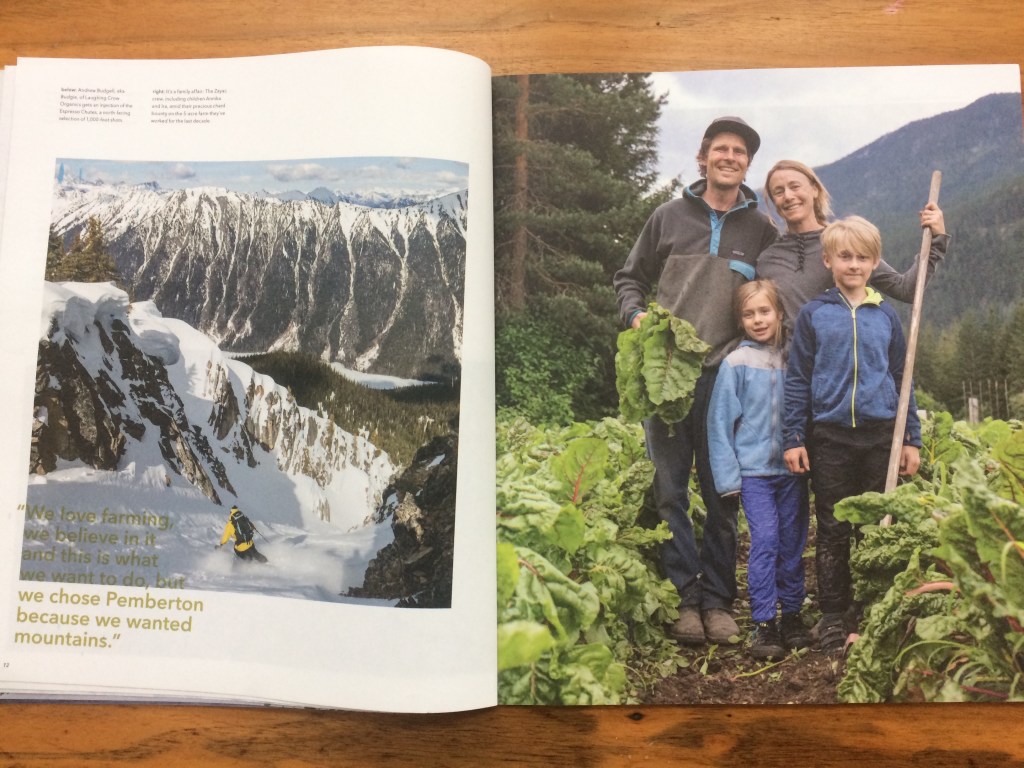
    Run by a couple of avid skiers, Ice Cap Organics is a ten-year-old mixed vegetable organic farm, on five hyper-productive acres in British Columbia’s Pemberton Valley. All winter long, with snow covering the greenhouses and fields, Delaney and Alisha Zayac, 42 and 39, keep a close eye on the weather. And whenever the conditions are right, Delaney, is up at 3 a.m., blazing out the door, skinning in the dark with headlamps to pursue objectives out on Miller Ridge or Duffey Lake Road with a small crew of friends. Alisha often opts to show their kids what’s to love about winter.  

    The volcanic-rich river-silt blessed soil of the Pemberton Valley has earned many farmers’ attention, but it’s the massive Coast Mountains that catch the farming-skiing type. And if the mountains bring folks in, it’s sometimes the farming that gets them to stay—loamy earth beneath 8,000-foot mountains, and living to the sound of glacier-fed rivers.

    “It’s why we’re here,” says Alisha. “Winters off is one of the things that drew us to farming,” explains the former tree-planter and agro-ecology scientist. “We love farming, we believe in it, and this is what we want to do, but we chose Pemberton, because we wanted mountains. We canvassed the world, to find places where you have mountains and farmland – Bella Coola, Pemberton, Chile, a couple of places in France.”

    Delaney reflects on their decision-making process—a couple of young nomads who were dividing their year into three seasons—university, tree-planting, travelling or skiing.  He’d spent his twenties and early thirties skiing over 100 days a year, bumming throughout the Canadian Rockies, Kootenays and Coast Range, and venturing farther afield to the Andes and the Alps. It was time to root down and think about having a family but Delaney knew that without big mountains there was no chance of his calling a place home. Pemberton was fertile, steep, proximate to a hungry market, and permanently set to stun—a place where there are no ugly views.

    Now their year breaks into two parts: farming season, and winter. As the farm sleeps, the pair take turns driving their vegetables down to winter markets in Vancouver, a city of 2.5 million people two hours to the south. They make plans, research the latest science and developments in farming, ski, and regenerate. “We work hard in the summer, and play hard in the winter.”  Every morning since completing the 10-day silent Vipassana retreat she’s wanted to do for decades, Alisha wakes up before dawn, before the kids, 6 and 8, have roused, to sit and meditate for an hour, watch her mind, and bank some equanimity for the day ahead. Delaney plans his last spring mission to the remote Waddington Range. Bad weather days, they tackle the farm chores, like sourcing an old upright freezer from a Chinese grocery store that they can upcycle into a germinator for their seed starts.

    Then, come growing season, they take up their mantle as activists.

    “That’s another reason we started farming,” says Alisha. “It was a way to align with our values, a positive way to be part of the community. I wanted to fight the good fight for agriculture and as soon as I started farming, I realized this is actually enough.” It’s a quiet, radical activism.

    After he’s been at the markets in the city for the weekend, the first thing Delaney does is park the truck, grab the kids and walk around in the fields together, see how things are looking, noting the growth and changes that have unfurled in the last three days. The Lillooet River runs past the end of the narrow, pot-holed street, flowing down out of the ice-cap and past the sulfurous thermal sleeping volcano that still vents steam out its fumeroles. The Lil’wat Nation, whose traditional territory this is, says the wild land upstream of Ice Cap’s farm has a power that comes from deep in the earth. It’s so big and powerful that when he skis back there, it gives him goosebumps. He treads the soil of the farm to shake off the city, touch down, ground down, and tap quickly back into that energy.

    Winter gives it the time to seep in.

    “Every farm has its own personality,” says Amy Norgaard, who’s worked at many farms in the Pemberton Valley, including Ice Cap Organics.

    Amy, 26, grew up in western Canada, in the 7,000-person ranching and logging town of Merritt, British Columbia, skiing and snowboarding obsessively from the age of two. When her mom got breast cancer, Amy, then in high-school, discovered that vegetables are potent and delicious medicine. Later, she floundered through university courses until discovering the faculty of Land and Food systems—that’s when Amy found her people.

    “I took my first soil science course in 2013 and it literally changed my life. I started learning about farming systems and their complexity and beauty and the complete mess we’ve made with food production.” Two years later, to acquire her final six credits and prove to herself that her romantic idea of farming probably wouldn’t withstand reality, she interned as a farmhand for eight months at Ice Cap. All the pieces fell into place – her love of the mountains and her understanding that being stressed is completely different from working hard. She farmed so hard that years of brain-spinning insomnia disappeared, allowing her to fall asleep exhausted and satisfied.

    Of course, the skiing helped.

    For the last eight years that he has lived in Pemberton, Andrew Budgell rented a poorly insulated cabin near his farm fields, tucked off the narrow road in a giant grove of cedars. Winter is the only time he’s not covered in dirt, but the price he pays is in “cold.” Some days, it was so freezing, he’d blast hot air in his face with a hair dryer to bring himself back to life.

    “He calls it the comfort gun,” says his soft-spoken farming partner, Kerry McCann.

    Andrew, 44, and Kerry, 36, met in Pemberton eight years ago, when Andrew, a ski-bumming boot-fitter in Whistler and refugee from the suburbs of Ottawa, decided to experiment with growing salad greens as a side hustle. He knew nothing about farming, except that he wasn’t afraid of hard work, loved learning, and wanted to attune more deeply to the rhythms of the earth.

    McCann, a beekeeper, yoga teacher and cranio-sacral therapist, had been working as the “hands” of an arthritic physiotherapist in the economically depressed community in Ontario where she’d grown up, home-schooled, on a self-sufficient homestead run by her back-to-the-lander parents. Changes in the health insurance legislation meant her work was drying up, so she ventured west, and stopped in the first place she found that had seven pages of help wanted ads in the newspaper – the Whistler-Pemberton corridor. She convinced her landlord to let her install garden beds alongside the field where Andrew was growing his greens. As her seasonal job as a park host wound down, Kerry began to ponder her next move when Andrew proposed next-leveling his salad bar. “Maybe we should start a farm? I can’t do this alone. We’ll get bees!”

    Kerry is an instinctive grower. Where Andrew acquires knowledge through his brain, poring over books and websites, and studying dewpoint and freezing level and weather models, Kerry’s insight into the natural world flows through her actual pores – she will walk outside, sniff the air and announce, “Frost is on its way. We should cover the vegetables.” These approaches define their skiing styles, too: Andrew studies maps and trip reports; Kerry rests on instinct.

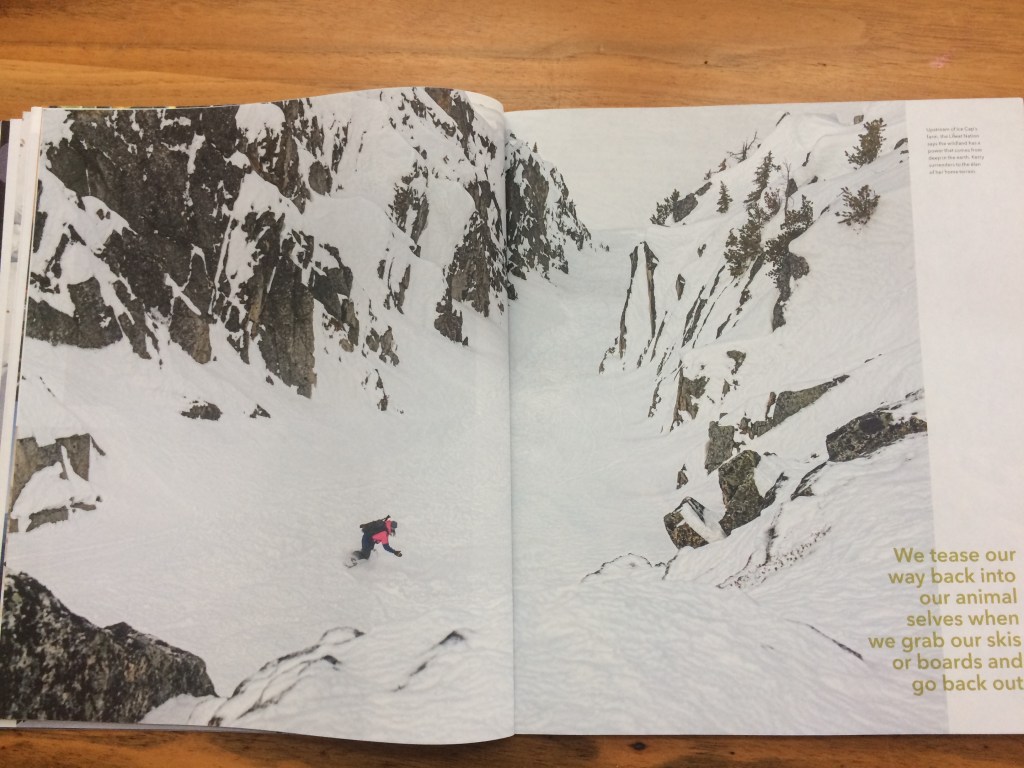
    Pemberton farmers are featured as radical activists, balancing work with winter play, in Patagonia's latest journal.

    Seven years into operating Laughing Crow Organics – their certified organic mixed vegetable farm – they’ve doubled income and veggie production almost every year. But Andrew says, “The reality is, we’re both very challenged in pulling this off. We are living and breathing this farm dawn until dusk.” Farming, just like hiking and skiing your ass around the mountains in temps that turn any exposed hair into icecicles, is not an easy endeavour. 

    But they always eat well, and when winter arrives, they forget their 30-item daily to-do list and head for the hills.

    Kerry spent years meditating and practicing yoga; skiing is her winter practice, exploring the backroads and drainages and skin laps around Pemberton. “I used to spend a lot of time looking for enlightenment. But when you’re skiing powder, it’s a kind of samadhi,” she says, referring to the yogic word for oneness, or meditative absorption, the goal of all her sitting. It’s a kind of short-cut.

    Increasingly, Amy is part of Laughing Crow Organic’s winter crew too.  After several seasons with Ice Cap, she went to graduate school to study soil science. She skis every chance she gets. “Part of the connection you gain from farming comes from being so exposed to the elements. There’s a lot of vulnerability. You don’t know what the day is going to look like, and you’re vulnerable to what Mother Nature wants to do to you.” She thinks about this when she’s out skiing, too—the natural synergy between mountain people and growers, and how they understand the thrill and sense of vitality that come from being immersed in the elements. The honest exhaustion at the end of the day’s effort. The risk, the reward of getting out among it.

    Most of the modern developed world is a set of systems and habits and structures designed to limit our exposure to nature and keep us safe from variability, from discomfort or physical labor, and help us not even break a sweat. We tease our way back into our animal selves when we grab our skis and go back out. But the illusion of separation remains, constantly reinforced every time we jump into a vehicle, order a coffee to-go, stock up at the grocery store where an invisible, complex, global supply chain presents us with the illusion of a constant steady supply of fuel, of food, insulating us from our true vulnerability on this delicate earth.

    It’s good to sit with that: what the skiing-farmers know.

    This story was featured in Patagonia’s Winter 2020 Journal. All images captured by Garrett Grove.

    Follow IceCap Organics on instagram at www.instagram.com/icecaporganics/

    and Laughing Crow Organics at www.instagram.com/laughingcroworganics/

  • Vegan eggnog recipe courtesy Pemberton’s wizard cocktail concocters

    Vegan eggnog recipe courtesy Pemberton’s wizard cocktail concocters

    Not only are  Tyler and Lorien at Pemberton Distillery absolute wizards (and trailblazing legends) in the organic craft spirits industry, their ten year old distillery provides a creative outlet for their growing and making tendencies – motivating picking and planting missions (they grow their organic hops, most of the herbs and botanicals used in their Absinthe and many for their Gin and they are slowly expanding the raspberry, strawberry and rhubarb crops to eventually be self-sufficient) and cocktail concoctions.

    Here’s a festive offering that Lorien made for the bar at the Refresh holiday market a few weeks ago, and shares with us! pemberton distillery

    This Mylk Nog is a nice and simple alternative to traditional eggnog – the cashew and coconut milks make it nice and creamy still, but it is not at all syrupy. The Nocino is a green walnut liqueur (this year, the green walnuts were all harvested here in Pemberton!) which is slightly bitter and spicy, almost like an Amaro, and adds a really interesting character to the nog!

    food_epicurious1

    Mylk Nog (serves a gathering!)

    1L cashew milk (make your own or buy at grocery store)

    500ml full fat coconut milk 

    125ml simple syrup (1:1 cane sugar to water)

    200ml Pemberton Organic Kartoffelschnaps 

    100ml Pemberton Nocino Green Walnut Liqueur

    Nutmeg

    Combine all ingredients in blender to combine. Taste and adjust sweetness as desired. Chill overnight. Stir and serve in small glasses. Garnish with a dust of nutmeg. Will last in the fridge for a few days.

  • Unearthed: why mushrooms are the perfect symbol for the Dark Season, and why it’s totally okay for you to do LESS this Christmas

    Unearthed: why mushrooms are the perfect symbol for the Dark Season, and why it’s totally okay for you to do LESS this Christmas

    Sometimes when I tell myself to breathe, it triggers panic – as if by drawing attention to this innate, unconscious, automatic action, breathing in and out suddenly becomes improbably difficult. Meditation, swimming laps, yoga… all these experiences often contain a few extremely panicked moments when I gasp, unable to catch a breath that has suddenly awakened to itself, like an animal realizing it is trapped and throwing itself at the bars of the cage.

    It’s weird. “Here, notice this amazing thing you do. Breathing. Doesn’t it calm you down?”

    “OMFG. I can’t get enough air. I’m going to die!”

    I feel a little bit the same about this time of year: Mild fluttery panic somewhere beneath the rib cage.

    Up until now, you may have known this feeling as par for the course, as the essence of Shoulder Season, these days of Waiting for the Snow to Seriously Fly. The panic flutter channels as a kind of scarcity fear that ripples onwards and onwards, as the days shorten, darken, flip over, tumbling towards the bottom of the year: will there be enough snow? Will I get enough work? Will I ski enough days to pay off my pass? HOW many days left before Christmas? Have I got something for everyone? Will there be enough food to make it a feast? Will I manage to get through all the social occasions without melting down? Do I have enough of a tribe that I won’t be lonely?

    This year, thanks to Pemberton-based teacher Natalie Rousseau and her online programs, 13 Moons and The Witches’ Year, I have gleaned a slightly broader perspective on this time of year. I see that these questions arise from a deeper and older one: Will the light return? Every season that saw pre-industrial people store their harvests away and duck into shelters to weather the winter and live alongside the literal fruits of their labours, the consequences of their actions over the course of the preceding year, was a time of reckoning and resolution. It was a season of living with the question, what have I done with my time? Was it good enough?

    Rousseau calls this time of year, a 52 day period that runs from Samhain or Halloween to Yule or Winter Solstice, The Dark Season.

    I’ve come to think of it as a time of Unearthing. Of things not wanting to stay in their boxes, getting untidy, becoming pushed forth. Stories. Emotions. Stuff we’ve tried to bury, all heaving up, surfacing in strange ways, asking to be noticed, remedied, attended to.

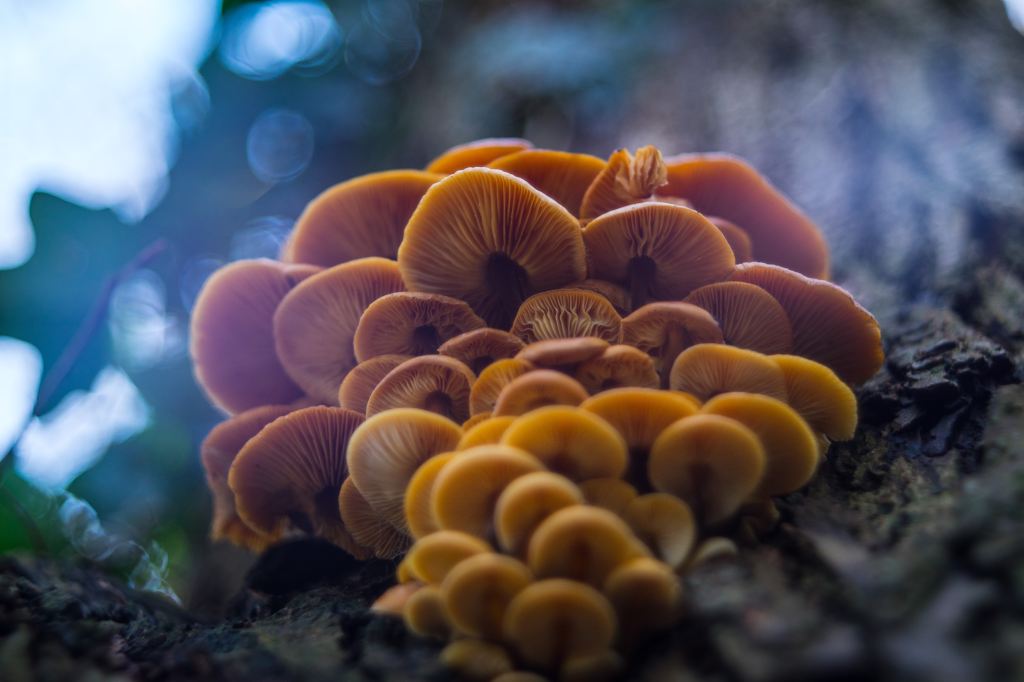
    For weeks, as I’ve learned of friends’ relationships breaking down and buried frictions waking up, tidied up the receipts of the year, seen stories I wrote months ago land in print, or stood in front of my pantry, outside the mushrooms were pushing themselves up with quiet force. Surfacing. Unearthing themselves. What did it all mean? Paul Stamets, the author of Mycelium Running, calls mushrooms “mycomagicians.” They are not afraid of endings, of decay. They are, in fact, “the grand recyclers of our planet, disassembling large organic molecules into simpler forms, which in turn nourish other members of the ecological community. Fungi are the interface organisms between life and death.”

    Kind of the perfect symbol for the Dark Season. Beneath our feet, beneath this surface of frosty soil that will soon be buried even deeper by metres of snow, (may it be so), vast intelligent complex fungal networks underscore and entangle everything. This is the season in which we glean a tiny window into that, as the fruit of all that complexity pops up. The question was never, “have I done enough?” But: Have We? Collectively, not just as little tribes, but in concert with the life force surging invisibly beneath our feet, all around us.

    Much is being unearthed, heaving to the surface, in these days, of unraveling climate systems. Much of our collective behaviour is nestling in for the winter, and demanding a reckoning. Sure makes you want to run for the nearest all-inclusive beach resort. Or beg the gods for the happy oblivion of a powder day.

    But before the flight, or fight – before the adrenalized response – the Wheel of the Year, the cycles of history, have built in this beautiful terrifying moment, this awful awe-full moment, a chance to be still and consider: have we done enough? Where have we fallen short? If we are gifted a new breath and a new day and another season together, what shall we plant in this beautiful living Earth? What shall we bequeath the future?

    “For most of our human evolution on this planet this was a season of rest,” says Rousseau. “And our souls still crave it. Important work happens in the catacombs and secret chambers of our soul during this season, even if our culture doesn’t recognize it.”

    Her prescription is generous, if not counter-intuitive to what we tend to expect of ourselves at this time of year: slow down. And notice.

    The year breathes its long sigh, and here, at the bottom of the breath, there is a pause. It’s okay if it makes you panic, a little. Notice that too. (Eventually it settles, I swear.) The pause is the most beautiful gift of the year, the echo of the harvest, in which all possibility hovers, looking for a place, a body, a community in which to land, to come into being once the light returns.

    This post first ran as a column in Pique newsmagazine, Velocity Project: how to slow the f*&k down and still achieve optimum productivity and life happiness. 

  • A question of growth

    A question of growth

    I read somewhere that your garden is a reflection of your personality.

    My garden has gone off-script.

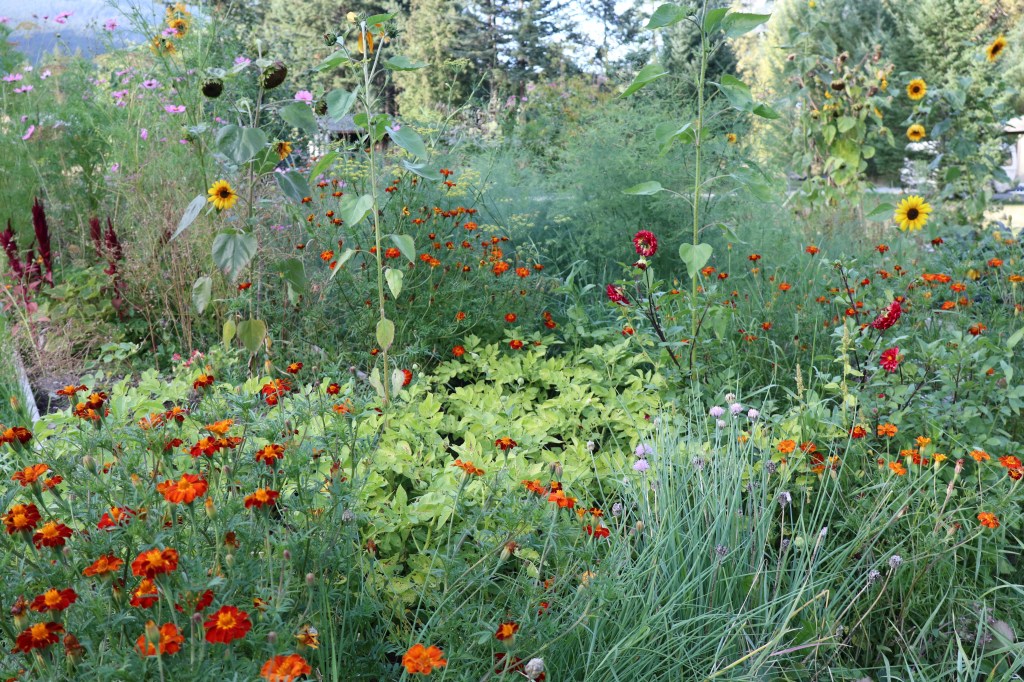
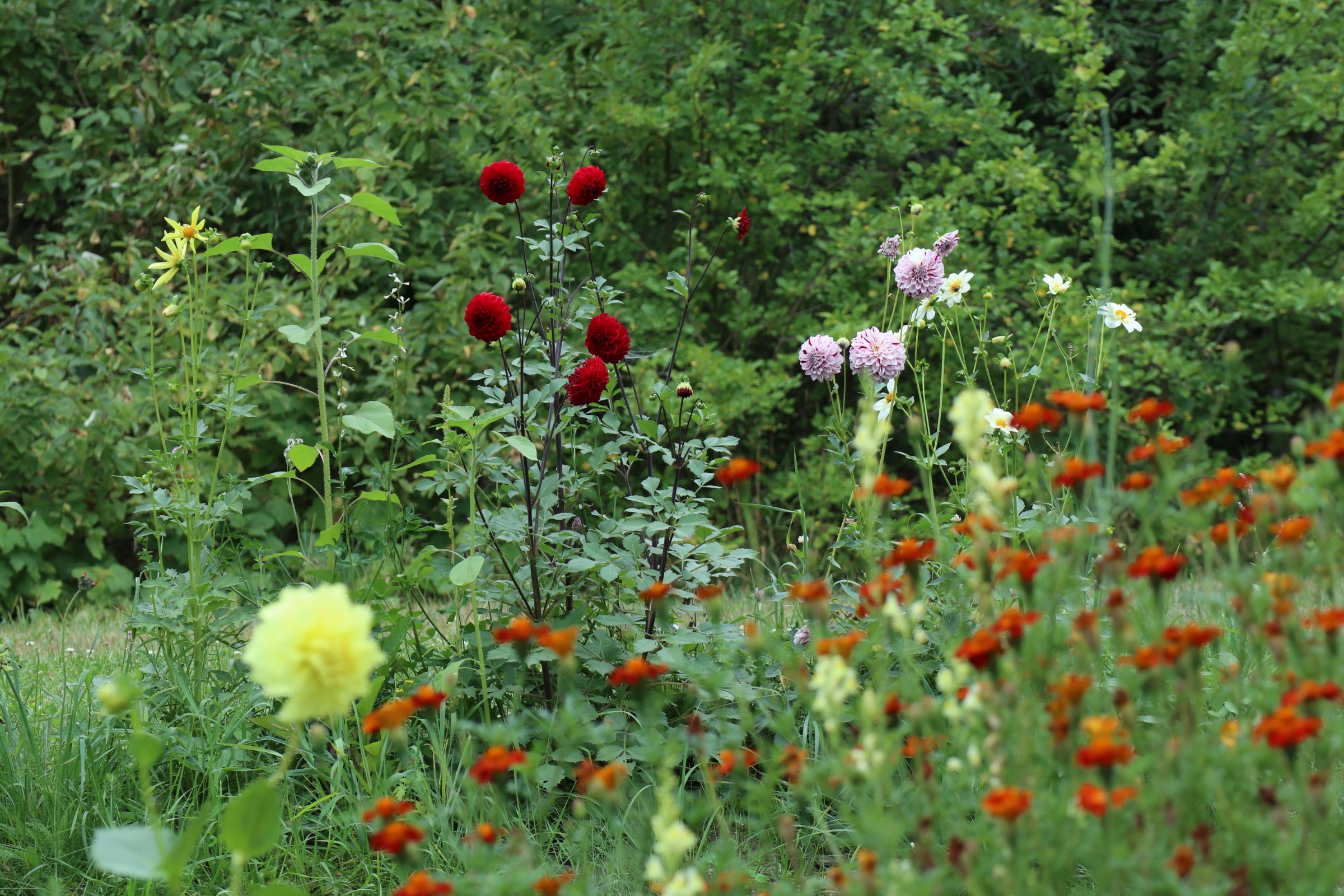
    It is wild, unkempt, rangy, not willing to commit to any one single thing beyond the belief that there are mysterious forces at play in the natural world to which I surrender control. It’s utterly prolific and not in any way linear or orderly. It’s an offering to pollinators.  On any given day there are so many different bees and wasps and butterflies and dragonflies that the air shimmers and vibrates. It’s been full of weeds since I discovered some of those weeds (hello purslane! hello plaintain!) are edible or medicinal, so opted to welcome them, taste them, invite their medicine in, instead of battling them. Battles are so rarely won.

    IMG_1536

    Last season, and all the seasons before in which I’ve engaged in this yearly experiment, all I could see were the flaws, the lack of order, the ample evidence that if a pioneer-era family were depending on my skills, we’d all be dead, that my late grandmother would shake her head at how few life skills I have.

    food_velocity1-1-8f860220b7694f98

    Today, with the cosmos, dill-weed, sunflowers towering over me, I am okay with this. I have realized that self-sufficiency isn’t as worth cultivating as community is. And each year in the garden, I have learned that I am part of a community of pollinators, of birds, of earthworms, of black bears that I shoo away, but who still win their fair share, of beet-green-nibbling deer (*shakes fist at air*), of rats (*insert unpublishable curses and shudders*), of friends who gift seedlings and starts and neighbours with abundant fruit trees and a willingness to share. This eco-system membership card comes with no assurances or written guarantees, and yet, I suspect I am more resilient in this club, than if I had invested my loosely focussed energy in a stockpile of canned goods, some guns, and a padlocked larder full of canned peaches.

    IMG_1608

    My garden is wildly prolific right now. And in a few months, everything will be dead.

    This is the way of the wheel of life. This is what is true, as much as I might like to push it away: every possibility grows out of an ending. And the endings keep coming around.

    The other night when racing-brain-syndrome pushed sleep away, I reached for a book of Mary Oliver poems. Turned on the light and read until my mind settled into the hammock of Oliver’s words, and I slipped back to sleep with these lines resting on my chest:

    “Every year we have been witness to it: how the world descends into a rich mash, in order that it may resume. And therefore who would cry out to the petals on the ground to stay, knowing as we must, how the vivacity of what was is married to the vitality of what will be? I don’t say it’s easy, but what else will do if the love one claims to have for the world be true?”

    Mary Oliver Lines Written in the Days of Growing Darkness

    Growth has been the mantra of this diseased era, the Anthropocene. Globalised growth detached from place or relationship. Growth, unrestrained by upper limit or sense of limitation or restraint. Growth without end.

    The folly.

    When Kate Raworth, the British economist and author of Doughnut Economics,  remodeled the way we look at the economy, she drew, instead of a pyramid, or a supply chain or a spreadsheet or the colonization of other planets, a doughnut.

    doughnut

    The first thing she did was draw a big circle around the outside of the economy and say: this is the limit, defined by the Earth’s life-supporting capacity. And here in the centre is a hole, and it represents everyone we’re failing. The challenge is to live within the doughnut – the space between the limits of social justice and planetary systems.

    When you trade growth-without-end for doughnuts and gardens and the wheel of the seasons, you have the courage to accept limits, to be still, to acknowledge endings and loss and the discomfort of never really nailing it. You also give yourself permission to start over, again and again, to risk it on relationships, to know the wealth of a table loaded with good food and air vibrating with bees, the difference between a larder and a hoard.

    IMG_1524
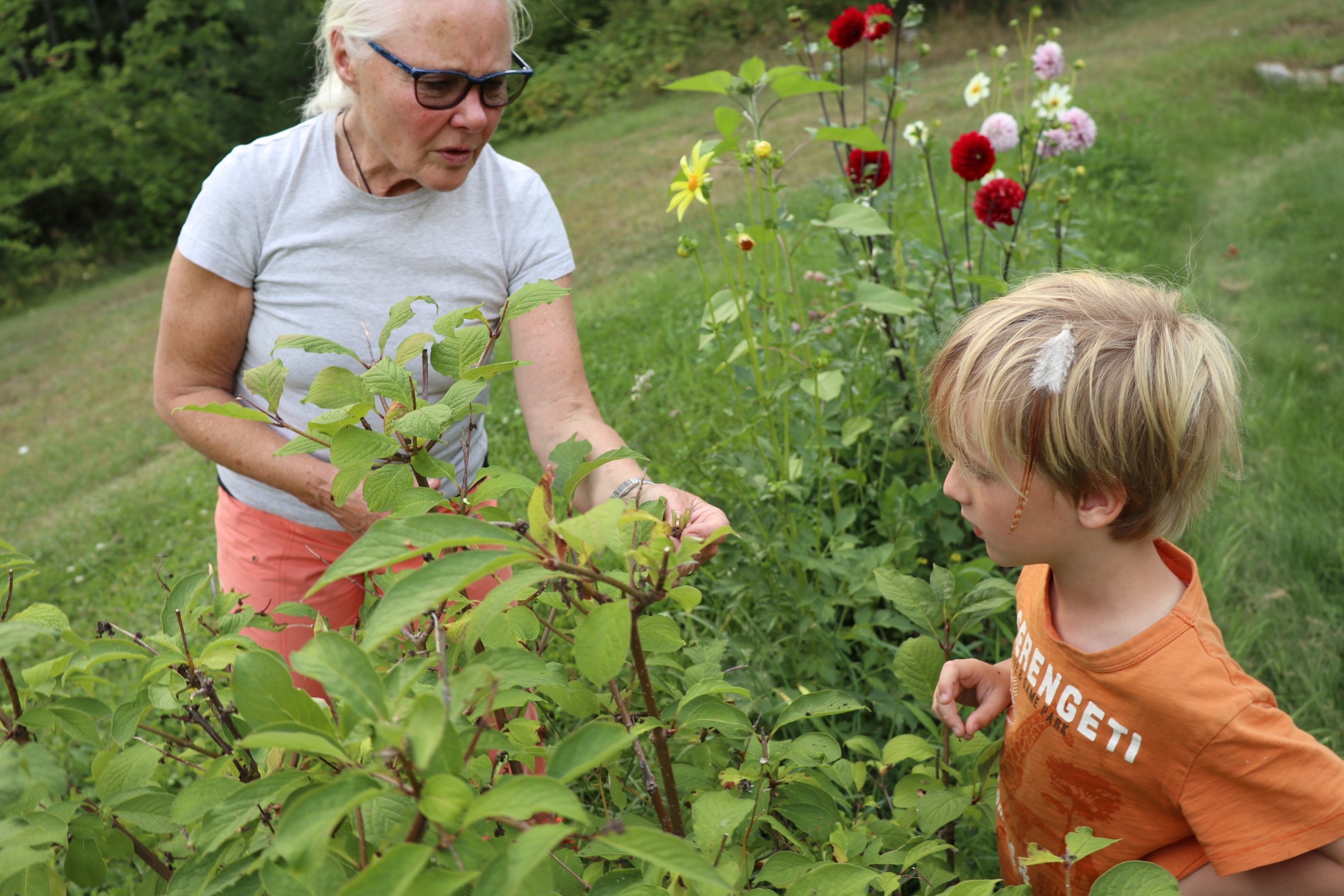
    my gardening guru, whose garden is most definitely not a shit-show, sharing her cuttings, dahlias and wisdom with the next gen

    I pile clippings and weeds and garden detritus onto a bed, and prep another for next year’s garlic, and steadfastly ignore those that are gone past the point of no return. I offer the birds free-rein at the sunflowers. I collect coriander seeds that dried on the stalk when I let the cilantro go to flower, and the surfaces and corners of the house fill up with brown paper bags full of drying seed pods and flower heads – reminders that this will all come around again, and this full lush vivacious moment is a good time to think about what to offer to ensure the vitality of what will be.


  • It’s time to Slow Food as if the future of food depended on it. Sunday August 18!

    It’s time to Slow Food as if the future of food depended on it. Sunday August 18!

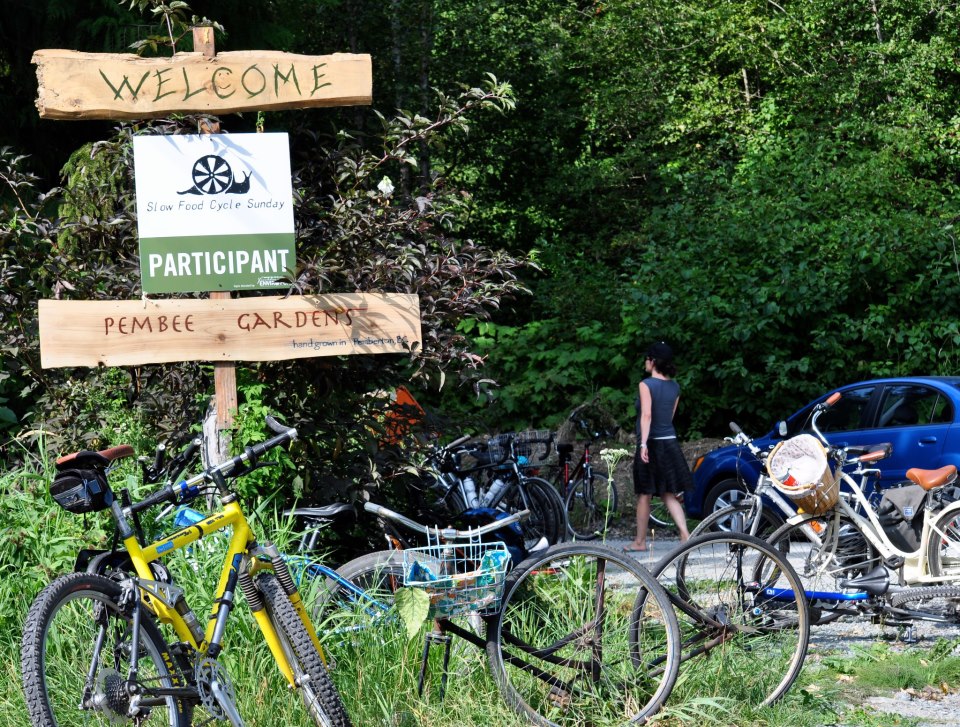
    Thanks to Carlee Cindric, the tireless event producer with Tourism Pemberton, behind Slow Food Cycle Sunday, for taking time out from organizing, to share this reminder of what Pemberton’s signature home-grown festival is all about. Connecting consumers with their food and the farmers responsible for it, seems more and more vital, as the UN releases its report forecasting the human population on Earth will go to 10 billion by 2050, and the way we eat and grow will have one of the most profound impacts on our planet, its habitability and climate stability, of almost any other thing we do. The headlines might read “world food security at risk” and “agricultural practices add to climate threat”, but what’s important to grasp (i.e. hook your soul’s momentum onto) here is that the way we grow our food (and our beer! and our booze! and our flowers!) offers one of the very best and most powerful ways we have of stabilizing the climate. It’s not a foregone conclusion. Don’t give in to despair! Get on your bike. And go meet some growers, who are practicing regenerative techniques and nurturing the soil that feeds us.

    by Carlee Cindric for Tourism Pemberton

    Do you Slow Food? It’s the 15th year of the annual Slow Food Cycle Sunday presented by the Pemberton Valley Supermarket! That’s quite an achievement given the modest beginnings of this favourite community event.

    60302107_2756632497686353_1835345366459875328_n
    Most compatible road-mates: tractor and bicycle. Photo by Dave Steers

    Founded in 2005 by two locals with a shared vision of the importance of farmland and connecting consumers with farmers/producers, the Slow Food Cycle Sunday has grown into a larger cycling festival complete with live music, food, drinks, art, crafts, treats and more – all with a local, grassroots vibe.

    67498225_1941028872663332_1332770906484768768_n
    Visit The BeerFarmers, one of Slow Food Cycle’s founding farms, and learn how long it really takes to grow and brew a beer. We’re talking field to tap.

    Pemberton’s Slow Food Cycle Sunday is an important event for Pemberton because it brings together consumers and producers in a unique ‘green’ agri-tourism experience, drawing participants from the Sea-to-Sky Corridor, Vancouver and worldwide. The event shines a spot light on the slow food movement – food that is produced or prepared in accordance with local culinary traditions, typically using high-quality locally sourced ingredients – and the importance of farm land, eating locally and supporting local food producers.

    484455_459547660752749_856749037_n

    The event invites participants to choose their own cycling adventure using an interpretive map highlighting the various participating farms and venues along Pemberton Meadows Road. Participants can set their own pace and decide which farms along the 25 kilometer roud-trip route to visit. Along the way, participating farms open their ‘doors’ for the day and host a variety of vendors selling and sampling everything Pemberton has to offer from baking and honey to coffee, Pemberton potato fries, hamburgers and of course Pemberton fresh fruit and veggies.

    67808141_10157218241065631_1610355901250666496_n
    Laughing Crow Organics have been “setting up” a sunflower maze for your pleasure at Slow Food Cycle, growing sunflower babies from seed for a field of sunny dreams experience.

    We’ve got a few new farms/venues and vendors joining us for year 15 which helps to keep the event new and exciting for those participants who return year after year.

    The Slow Food Cycle Sunday will take place on August 18. We encourage folks to register online before the event at slowfoodcyclesunday.com. Don’t forget to bring your helmet and water and remember to follow the rules of the road.  

    67718143_2909841565698778_5704900850485297152_n

    We look forward to hosting you during this celebration of Food, Farmers and the Joys of Biking! For more information, visit slowfoodcyclesunday.com


    67645071_2914099698606298_4618611159270948864_n


    Website: www.slowfoodcyclesunday.com
    Facebook: facebook.com/slowfoodcyclesunday
    Instagram: www.instagram.com/slowfoodcyclesunday

    #SFCS2019
    #SFCS
    #slowfoodcyclesunday

    The amazing thing about Slow Food Cycle is that, just by showing up, you are being part of the event. But if you want to further inject your energy into the day, you can sign up for a 2 hour volunteer shift at the registration table.

    68522701_2913573848658883_4964114043846524928_n


  • Why the Farmers Market is more than just a shopping experience

    Why the Farmers Market is more than just a shopping experience

    In the spring, I sprinkled a small mason jar of biodynamic preparation 500 under my fruit trees and around my garden beds, just as Anna Helmer had shown me. There didn’t seem to be a very specific science to it, although I videoed her doing it and watched it over several times to make sure I had the insouciant wrist flick just right.

    It seemed kind of random and messy, which should suit my style to a tee, but I felt weirdly anxious that I would screw it up by flinging the droplets around too wildly, causing the cosmic magic that had been channeled into this precious jar of “water” to elude my little patch of earth.

    When Helmer’s Farm hosted an open house in late April, I was there, dragging the kid and his best friend, who amused themselves for hours, eating potatoes cooked over a fire, gently terrorizing the ducks, and eventually holing up in the sandpit.


    They also took a turn stirring the great vat of biodynamic preparation, which I suspect was part of the Helmers’ agenda for hosting an open house – to crowdsource some sweat equity from the farm visitors.

    IMG_2950

    I took my turn with the stirring stick, thinking I was really helping things along until Doug Helmer took over and showed me how it was really done, the vigorous stirring that must take place for several hours, creating vortexes, then disrupting them by swirling the water the opposite direction, channeling a winter-buried cow horn full of celestial magic into a kind of homeopathic preparation for the soil.

    IMG_2952

    Once again, as I yielded the stick and accepted a small jar of preparation, it became apparent that I was benefitting a lot more than I was contributing. But as my farmer friends keep reminding me: if there isn’t a willing consumer at the other side of the field, their work is for naught. It might feel imbalanced, when I see how hard they work, but supporting that work makes you an important partner.

    Charles Massy is a 60-something year old Australian pastoralist, self-professed shit-disturber and the author of Call of the Reed Warbler, who has become a growing voice for regenerative agriculture. He contends that, given agriculture influences several major earth systems, adopting a more regenerative approach offers the biggest potential to save the planet from the climate crisis. Regenerative farming is “nearly two and a half times better at burying carbon in the ground than anything else” in large part because of its commitment to nurturing soil health and rebuilding soil organic matter.

    He came to these views from the near-decimation of his family farm, and its slow recovery into a commercially thriving business, through the trial and adoption of many regenerative practices. A PhD in his 50s helped provide a framework for his ideas.

    Massy sees regenerative agriculture’s success as being dependent on farmers who shift their practices to become part of this solution. But equally, it’s on consumers. The movement will only work if the farmers’ products are supported by the urban community. “It’s a two-way partnership.”

    Anna Helmer and her family have been growing for Farmers’ Markets for 20 years. She acknowledges that it’s easy for consumers to hit the weather-insulated grocery store or order up home delivery from SPUD, but contends that farmers’ markets offer one key advantage – something she has come to think of as ‘mutual appreciation.’ She writes, “This is an energy generated at the point of contact between primary producer and end consumer at market,  notably at the transaction stage. I take your money, you take my potatoes. We are both appreciative of the other. The feeling builds each week, from season to season and year to year and really can’t be re-created in other retail environments.”

    It’s the spark of contact that makes magic. Direct, human to human, contact. Built into that transfer of energy – my money, your product, eye contact, appreciation – is the recognition that we are interdependent, that through this simple interaction, we are defending the life force, and creating a more beautiful planet together.

    Every Friday, from June until October, the Pemberton Farmers Market offers the opportunity for these kinds of sparks to fly. Helmer’s Farm is there, as well as Four Beat Farm, Devine Gardens, Willowcraft Farm, Blackwater Creek Orchard, Spray Creek Ranch and Rainshadow & Seed to Culture. The Square Root Food Truck is back, alongside Whistler Elixir, Nidhi’s Cuisine, Rosalind Young’s gypsy wagon  the RomniBolta (Rosalind Young), Birken House Bakery, and new this year, Lori Ternes. You can also pick up From the Garden Shed’s lavender, herbal remedies from Evelyn Coggins, enjoy a massage from Inner Space Massage, or browse PawWow Pet Products, Rock the Feather, Gallup Pottery, Oh Suzana’s glassware, Betty Mercer’s repurposed silver and Aenahka Creations’ leatherwear.


    But it’s not just about shopping. With community groups setting up, live musicians playing each week, and a host of special events, from Bard in the Barn, to the Zucchini Derby, Slow Bike Race and Stone Soup celebration, the magic of the Market is really in the gathering.

    20181012_152022

    “Our vendors work together almost like a family and the overall community spirit makes it a welcoming event,” says Market Manager Molli Reynolds. “The barn is such a lovely structure that eliminates the need for individual tents and that brings us all together ‘under one roof’.”

    That community vibe was recognized last year when the Pemberton Farmers Market was awarded Farmer’s Market of the Year 2018, in the medium category, from the BC Association of Farmers Markets. Yes, our little community Farmers Market is the best of its size in BC.

    20181016_083818

    Because magic is a joint effort.  Creative sparks, like any kind of new life, require the DNA of more than one human to come together. Which is why Fridays under the Barn are one of my favourite kinds of gathering. The raw ingredients are all there – fresh produce, food and drinks and treats, live music, play zones, community organizations, great people. Just add yourself, and see what happens.


  • Frontier Thinking: Everything you do happens at the place where your ideas meet your idea of the world

    Frontier Thinking: Everything you do happens at the place where your ideas meet your idea of the world

    This is the time of year when the farm machines roll full-tilt out of winter hibernation.

    At least, that’s how Andrew Budgell speaks of it.

    Co-owner of Laughing Crow Organics, one of Pemberton’s small scale organic mixed vegetable farms, Budgell is six credits shy of an English degree, and seven years in to his transformation as a farmer. We sat down this winter to talk shop, mutually intrigued by each other’s craft.

    LGC-LaughingCrow-24©AudreyThizy.2019
    Andrew Budgell and Kerry McCann of Laughing Crow Organics. ©Audrey Thizy.2019. All rights reserved / audreythizy.mail@gmail.com / +1 778 266 3655 / http://www.audreythizy.com.

    “In the winter time, it’s like you’re assembling this really complicated machine,” Budgell explained. “And when the season starts, you pull it out in the field and start it up. It begins lumbering forward. And you start seeing, as the season goes on, that you’ve become a part of the machine, working, weeding, watching. But this has all been planned. Every now and again, the machine will trip because of something you didn’t think of. Then there’s this extra challenge of patching things up and putting out fires. But the machine rumbles onwards forever.”

    Once the snow is off the fields, and the Life Force is surging through everything, nothing is sleeping. And the farmers start moving to keep pace – a pace that will keep accelerating until they feel like they’re running. “I feel like if I don’t keep moving alongside it, the machine falls apart. You have one chance. It’s a really hard deadline, unless you can decode nature.”

    You make the machine, you become the machine. Phoyo by Laughing Crow organics

    Budgell is regaling me with images of his Frankensteinian creature, in part, because we’ve sat down to talk about the contrast between winter and summer. Winter is a time for planning and playing. Now that farming season is here, it’s time to get down and dirty with your creation – to fully engage in this mysterious interplay between your plans and ideas and the physical world.

    Farmer Andrew Budgell working on an early draft Laughing Crow Organics

    I returned to this interview after listening to poet David Whyte talk about “the conversational nature of reality.” Whyte suggests that “the only place where things are actually real is at this frontier between what you think is you, and what you think is not you; that whatever you desire of the world will not come to pass exactly as you like it. But the other mercy is that whatever the world desires of you will also not come to pass. And what actually occurs is this meeting, this frontier.”

    One day this winter, running alongside my own lumbering beast of deadlines and deliverables, I did something different. Instead of downing two espressos, I squandered 15 precious minutes in meditation. I sat, breathed out, and in, and out, and in, and offered a kind of prayer to the universe. This story means a lot to me, I admitted. I want to do the idea, and the people it represents, real service. And I have five and a half hours to do it. Anything or anyone out there that can help get this fully formed out onto the page right now is most welcome.

    I’d long been intrigued by Eat, Pray, Love author Elizabeth Gilbert’s theory of creativity, famously disseminated in her TED talk. Her insight is that there are Muses, a kind of “other” energy that works through us. A big part of doing creative work, maybe the biggest part, is consistently showing up so the forces know where to find you.

    She came to that story as a kind of medicine to her huge commercial success and the weight of creative pressure that followed. Excavating an ancient understanding of Muses was her way of letting the air out of the pressure cooker of her Next Big Project; saying, look it’s not all on me. If I just show up, some other magic will meet me there.

    It intrigued me, but it felt a bit passive, like she meant opening yourself up as a channel or a medium, letting something use you to flow through and onto the page. Writing hadn’t ever felt like productive sleep-walking to me. But when I sat in that moment of pause, inviting mysterious allies out of the cosmic woodwork, I suddenly saw it as a much more dynamic process – profoundly collaborative. Co-creation. Something might work through me, but it had to work with me, with my brain, my thought patterns and habits of language, and I would be shaped by the flow, just as I might allow it to help shape the work.

    It was a new frontier.

    It may be that some kind of meeting took place that day. But I began to let my fear and overwhelm subside at the responsibility of what I was tackling, trying to pull stories out of the ether, alone.

    LGC-LaughingCrow-12©AudreyThizy.2019
    Photo by Audrey Thizy

    Every spring, when the freshly plowed fields are full of scribbles and half-thoughts, Budgell feels the weight of the beautiful responsibility he has shouldered to feed hundreds of people. “We always freak out! We worry: is it going to grow this year? Is it going to happen? Are we going to have food? All through April and May and June. And then right around July, it’s like this crazy revelation. Oh my God! It worked again! Nature!”

    When the miraculous manifests photo by Laughing Crow Organics
    Photo courtesy Laughing Crow Organics

    “There is a chemistry to creative work that is about two parts miraculous to one part sheer effort,” reads a quote tacked above my desk.  The precise effort-to-miracle ratio may change, but both are indispensable. We keep fumbling back to this. It’s on you, but it’s not all on you. It can’t happen without you, so show up and do the very best you can but make space for the not-knowing, the magical, the forces that keep the plants growing and the words flowing, and whatever else needs human hands to manifest in the world, in this earthy gritty sweaty dimension, where revelation happens.

    Follow @laughingcroworganics on instagram for more revelations.