Blog

  • Picklepalooza: preserving high summer for my Future Self (and friends)

    Picklepalooza: preserving high summer for my Future Self (and friends)

    It’s not really cost-effective, this pickling and preserving business, I realize, as I empty another $20 bottle of Bragg’s apple cider vinegar into a pot. My husband keeps checking in, nervously asking “Are you having fun?” because these evenings are cutting into my Netflix/book-reading time, and I tend to be an angry-and resentful-if-you-aren’t-also-contributing house-cleaner.

    IMG_1630

    But there is the small stack of rainbow-hued jars starting to accumulate after a week of busy evenings,  glowing from within. There is the sound of the “pop” that makes my heart lift a little when the seal is made. (It worked! Not incubating botulism yet!) There is a sense of deep alignment with the seasons and the fleeting urgency of this specific moment (cucumbers! carrots! beans! Pickle them now, or forfeit the opportunity entirely for another year.)

    There is a small sense that I am resourcing myself for an uncertain future, by slow-growing these skills that all my ancestors knew but that somehow skipped a generation; that I’m building a little bit of resilience to depend slightly less on a volatile global supply chain. And there is the sense that I’m packing some of the sweetness of this moment, of this abundant sunshiney moment, into a glass container, as an offering to my Future Self. I imagine her, in the fall and winter, her step a little heavier getting out of bed in the dark, looking to a low-hung grey sky, missing the feeling of hair against bare shoulders and bare feet against lush clover-filled grass… and sending this gesture to her as a reminder: sweetness returns, love. Time might feel as if it’s lurching relentlessly forward, but it’s rolling over and over, cycling, spiralling, a wheel.

    Screen Shot 2020-06-18 at 10.45.46 AM copy

    Every year, for a while now, I’ve tried to make something to preserve or pickle in the summer – starting with strawberry jam in 2012 from bare bones instructions scribbled on the back of a cereal box by Tonette McEwan. I haven’t yet absorbed this process into muscle memory, and every summer, I enter the kitchen with a sense of dauntedness. How many ways can I mess this up? How does it work again?

    IMG_1526
    Step 1. Refer to bible. Read. Review. Read again.
    IMG_1531
    Step 2. Chop and stir. Revisit book several more times during process.
    IMG_1533
    Step 3. Ignore dishes for a moment and rejoice in moment of completion. (Then realize all the steps you forgot, like stirring to remove air bubbles, and wonder if that actually was half an inch of head room. Wish your grandma was here. Start dishes. Label. Schedule Moment of Truth for 6 weeks+ from now. Hope Future You bloody well appreciates this.)

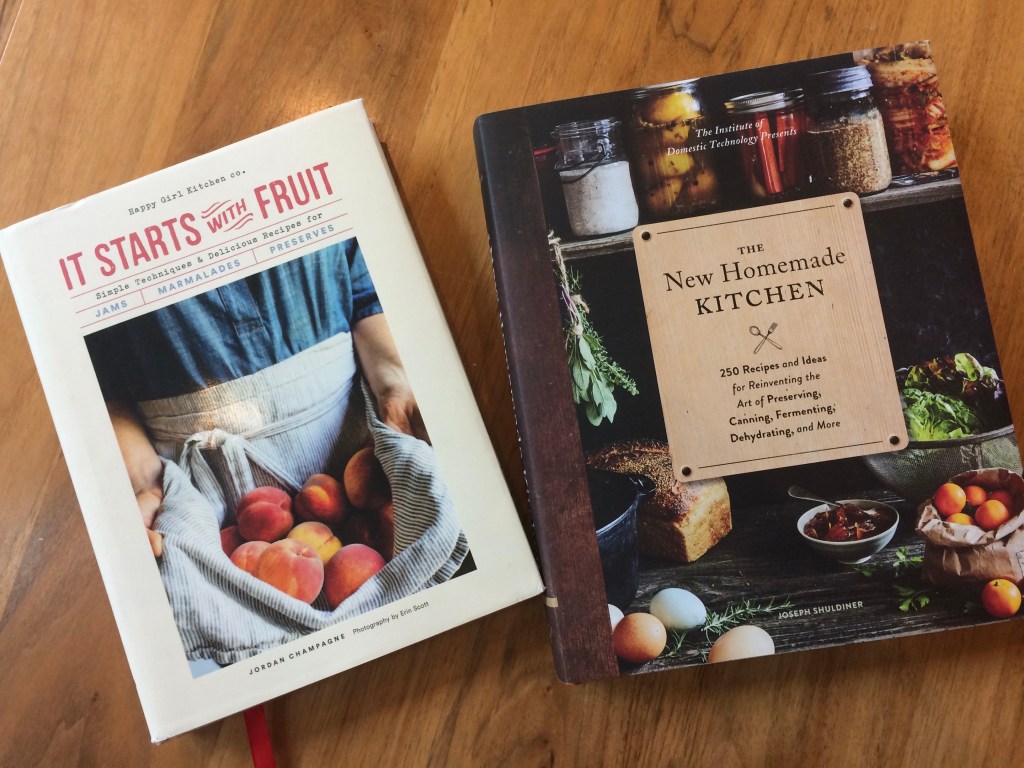
    I didn’t learn these things at the apron strings of a beloved elder or a practical mother. I learned them out of books, so the knowledge always feels a bit slippery, like it dumped out of my head last year the minute the pot was scrubbed (just like all the information crammed into my brain to pass an exam promptly vanished the minute we headed to the pub to celebrate the final test). I learned them at the bookshelf, and these new bibles (The New Homemade Kitchen  by Joseph Shuldiner and It Starts with Fruit by Jordan Champagne) are utterly lust-worthy and wonderful (and way better to have as a guide than a Google search.)

    And yet, each year, I have a growing sense of the rhythm of this work, the laying out of supplies, jars, tongs, the MacGyvering of a canning rack, the towels delineating where the ready jars and the full jars and the processed jars will await their turns. Each year, I find there’s a little something more I can grab from my garden, instead of at the store, to add to the mix – my own dill, my own coriander seeds.

    IMG_1535
    Enjoy August 7. Or discover they taste like a mouthful of salt and toss in compost. Vow not to try ‘winging it’ until you’re a bit more experienced.

    There are failures – like the unredeemable refrigerator pickles that I made with the leftover brine from the dill pickles and that tasted like an ocean vegetable –  a nice crunch and a mouthful of salt – to be deposited directly into the compost bin with a sigh. And there’s the worry that there are other, yet-to-be-discovered-screw-ups, that will be revealed when I eagerly open one of those jars of beets or beans or cukes or relish…

    But if I wanted guarantees, I’d go buy something industrially packed and commercially grown, from the store.

    I am realizing, deep in these days of uncertainty and strangeness, that I don’t trust those guarantees anymore.

    I want the intimacy of relationship, with my garden, my farmers, my neighbour’s generosity, my own hands conjuring a future snack or meal, with my family and friends when I lay out a small platter of cheeses and crackers and home-made relish, with the friends who shared recipes and whose names blazon the top of my barely-legible recipe cards.

    Perversely,  I’ve absorbed the idea that the latter is a much riskier prospect to depend upon. Probably because emotional vulnerability – failure, rejection, disappointment – always feels so live and lurking. But that terrain is the most rewarding. The faceless amorphous industrial food complex has seduced us with the idea of being reliable, invulnerable, of providing us whatever we want whenever we want it… but it’s fracturing right now as every faultline that has ever existed gapes under COVID19 pressure loads.

    Activate in the space you have influence

    I’m not pickling and preserving to save money, or to plant a flag for hope, or to stockpile my apocalypse arsenal. I’m doing what Kate Raworth, the renegade economist and founder of Doughnut Economics (which preaches the radical idea of building economic models that operate within the Earth’s carrying capacity and try to meet everyone’s needs), says: I’m activating in the space in which I have influence. In this small way, in the small space of my kitchen, I shape a small aspect of my future. Buying local, saving seeds, sharing abundance, observing the seasons, trading recipes with friends, falling into step with Nature… in these small ways, we all can.

    IMG_1527
    “A kitchen compendium, a handbook, a reference guide, and an inspiration, The New Homemade Kitchen includes step-by-step instructions, helpful tips, and delicious recipes that feature ingredients you just learned how to make yourself.” Amazing new book from Chronicle Books for rookies and veterans, covering all kinds of basics, as well as enticing experiments like making your own miso, cider or roasting your own coffee.


  • Laughing Crow’s farm monster is alive!

    Laughing Crow’s farm monster is alive!

    When I interviewed Kerry and Andrew last year, for a story about local farmers, Andrew shared his idea that the farm is a kind of mechanical beast that they build up every year, that eventually lurches to life. I loved seeing him unpack this idea in Laughing Crow Organics’ newsletter to harvest box subscribers last week, and got permission to share it here.

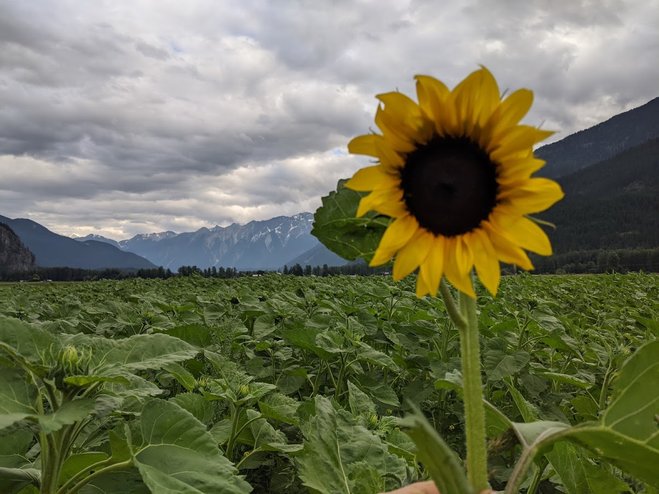
    In other news, the sunflower maze is ready and opening Friday August 14

    image-1

    Over to Andrew Budgell:

    The farm monster is a giant animated beast built from scratch every year, one miniature piece at a time placed by a few busy human hands.

    Slow incremental progress is the key.  In the early weeks it almost seems unlikely that it will take shape… 

    By June it starts to have form and begins to threaten action by spitting out peas, radishes, salad greens, lettuces and kales..

    More pieces are added…  the monster is fed and begins to belch out carrots and beets random flowers and zucchinis—–

    I’m not sure exactly what move creates the next shift but it’s like an all-of-a-sudden lurch when the monster begins to barf out all of the things… tomatoes, eggplants, beans, melons and onions. Squash starts to fatten up and beach ball pumpkins appear almost as if from nowhere… Brussels form, and armies of broccoli, cauliflower and cabbages line up for harvest.   

    It is exhilarating and exhausting all at once.  We are at this juncture now.  August…. we have built a veritable monster and are so very excited to share it with you over the second half the growing season.

    image-8

  • The Honour stands of Birken

    The Honour stands of Birken

    The Birken / D’Arcy corridor is unique to the Sea to Sky Region. Unhurried, non-commercial, safe, sparsely populated and relatively unchanged throughout the nearly 3 decades I’ve lived here. In fact, there is less here now than there was back then. Its downtown consists of an old resort at Gates Lake, open for a few months, and a telephone booth (there is no cell service). The Demographic is also interesting. It’s more affordable and out of the way and therefore attracts misfits, homesteaders, bohemians, red necks, hermits, draft dodgers, hippie relics, adventurers and commuters to Whistler. There are few, if any, employment opportunities, therefore those who stick it out have become resourceful, artistic and enterprising.

    The climate is more arid, being on the cusp of the interior and in the rain shadow of the Coast Mountains. Spring comes early.  We see more sunny days, warm days, and cool evenings. Its narrow valley is  protected by steep mountains. It is not a  conventional farming community like Pemberton with acres of flat tillable ground. It is however a great hobby gardening area. Its soils are well drained, mineral rich and ideally suited for fruits, berries, and garlic. Its waters are crisp and clean. I don’t believe a single person uses pesticides. It is sought after for bee keepers for this reason as well as its natural bio-diversity.

    PIC 5 plant sale

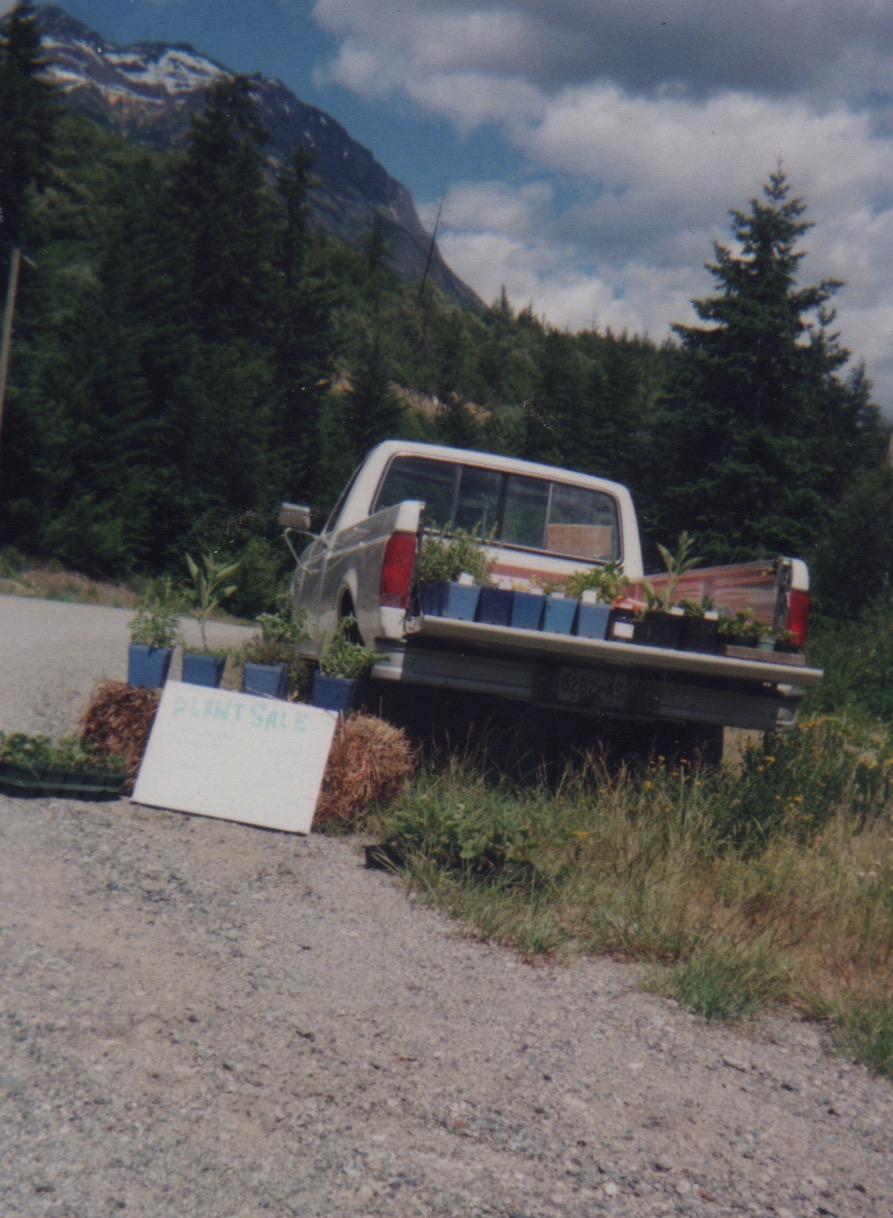
    I started putting plants and surplus veggies at the top of my driveway with a jar for cash many years ago, mostly for my neighbours. The above photo is circa 1995. I called it the Beer Stand back then. If I had enough for a case for the weekend it was a successful week. Over time it got consistently busier and we added more products. It became the Entertainment Stand where, in good weeks, we could go to a restaurant or even a concert. Our farm is now a registered business and after a good year we can take a vacation at the end of the season. Keeping it stocked is now a part-time job (farming, of course, is full-time), but I have to say it’s the best job I’ve ever had.  I joke when being leisurely that I’m currently working my job . The operating costs are extremely low so every sale is a bonus. Farming itself is extremely labour intensive with a low profit margin and high risk. We could never afford to pay someone to sit and serve customers. It’s really the only viable way of doing business in a rural area. If we bring perishables back from the market they quickly go up there in the fridge. We can offer an ever-changing wider selection of items than we would at the farmers market, can keep things fresh and pass our cost savings on to the customer. Win, win, win!
    Generally people are honest and since it’s the honour system, we accept e-transfers and IOU’s. Someone, who we caught pinching out of the change jar, returned years later with a letter of apology and a $50 bill. This restored our faith in humanity and the honour system. What comes around goes around.

    115823217_10157015108455755_4358984688747848677_o

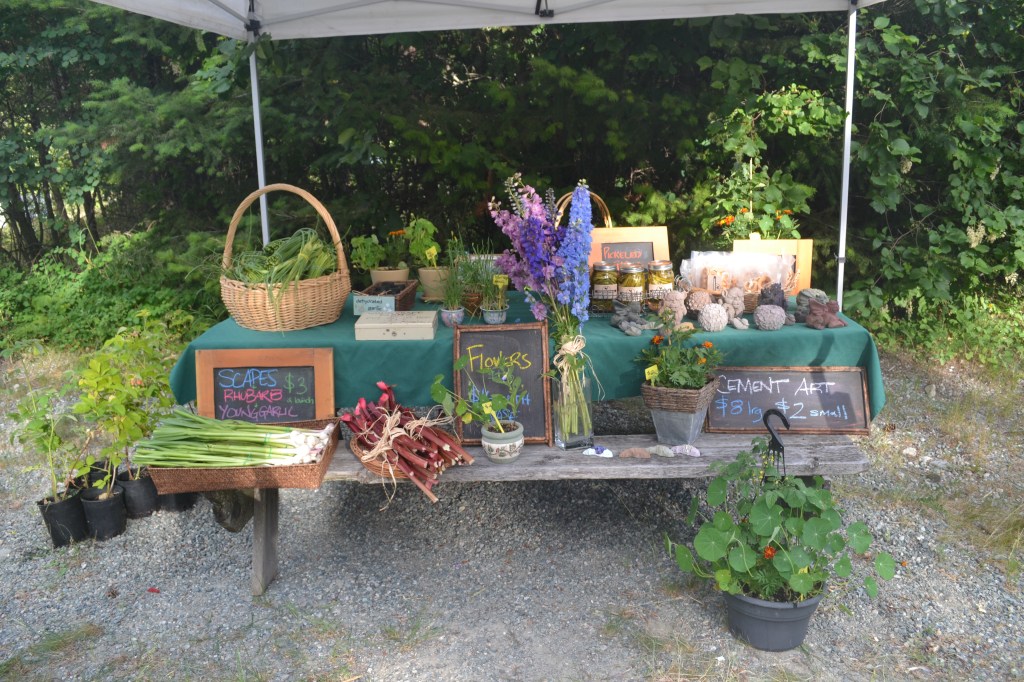
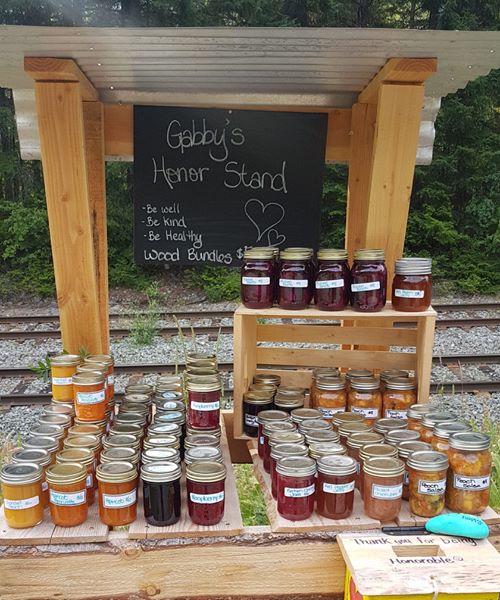
    Birken has now become a valley with many honour stands offering everything from jams to fresh pasta to firewood. It’s a place of cottage industries, where hobbies help many with spare cash. They range from tents, and  permanent shelters to coolers. Many interested in setting up their own stand have contacted us wondering if we would be offended by the competition. We look at it the opposite way. The more the merrier! It has started to become a destination place for a casual drive picking up things along the way.  Those coming up for a swim in our many lakes can grab some fruit to munch on. Campers and boaters can pick up a fresh bouquet and something to add to their dinners on the way home. We’ve had nothing but positive feedback. It reminds many of their country childhoods and a simpler time when everything was local and fresh and neighbours shared.


  • Chic’weed: A weed so chic you will love it like a flower.

    Chic’weed: A weed so chic you will love it like a flower.

    With the botanical name of ‘Myosoton aquaticum’ it becomes clear that there is more than meets the eye when acquainting oneself with the perennial weed known as ‘Chickweed’.

    These triumphant little wonders that grow in nitrogen rich soil pack a powerful punch of medicine. Chickweed is consumed for stomach and bowel problems, blood disorders, asthma, lung diseases, obesity, vitamin C deficiency (scurvy) and skin conditions such as psoriasis, rabies, itching, muscle and joint pain!

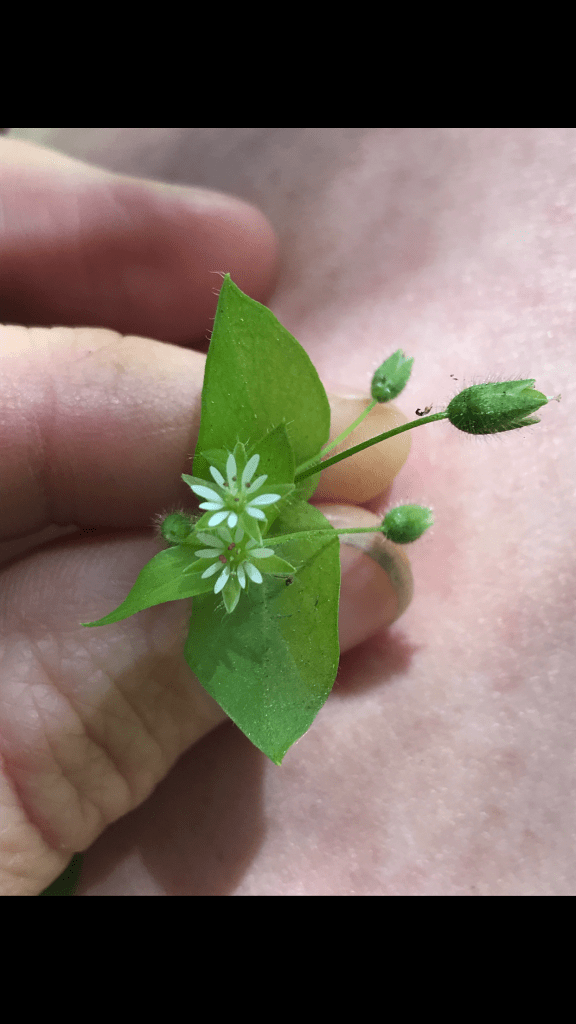
    Nestled among flocks of clover and dandelion allies there is great joy to be discovered upon first glance. Pristine symmetry of ten white fronds and with a closer look, noticing there are in fact five immaculate heart shaped petals split down the gentle center of her alluring, aromatic excellence.

    Building a relationship with this plant has been a joyful adventure and thankfully they grow wildly upon mountain tops, valleys and most lawns in the Pemberton Valley in every season sans snow. Chickweed is often overlooked as a weed, pulled up and out of the dirt without a chance to spread her delicate wings of love upon your dinner plates full of nourishing kindness and fresh flavor infusion. If you haven’t already I urge you to open your heart to this angelic wild edible and invite her into you culinary explorations!

    When wild harvesting as always only take what you need, in this case a pair of scissors, the top six inches of the plant and no more than 10% of the crop you see present. You can add her to fresh spring salads, summery mocktails and even fall soups and garnishes. My personal favorite way to integrate this wild beauty is my vegan, ‘Chic’week Pesto’. I add this into an ice cube tray and set it in the freezer for a heal(thy) does of delicious nourishment. It is especially useful on evenings when making dinner seems an unattainable feat! Many studies suggest integrating phytonutriens (an abundance of which are found in the complex immune systems of wild edible plants) into our daily diet will decrease disease, bringing us closer to our ancestors diet of grazing on a variety of nutrient dense wilderness edibles.

    Without further ado, here is the recipe!

    Chic’Weed Pesto Recipe:

    3 cups of Chickweed washed and drained

    1/4 cup of Nutritional Yeast

    1 cup raw nuts (cashews, pines, hazelnut, walnuts – pick your fave or mix)

    2-3 Raw garlic cloves

    1 tsp pink salt

    1/4 tsp black pepper

    1/2 cup olive oil

    1 tbsp fresh lemon juice

    Chop in a food processor until smooth, add to an ice cube tray and voila! Phytonutrient dense deliciousness at your fingertips!

    I can’t wait to see how you explore this wonderful plant!
    Until then you can find me on Instagram @theplayfulmooon making all vegan recipes to share with you through my recipe hashtag #eatrealrainbows🌈

    Much love!

    Leala

  • Nature’s Gifts

    Nature’s Gifts

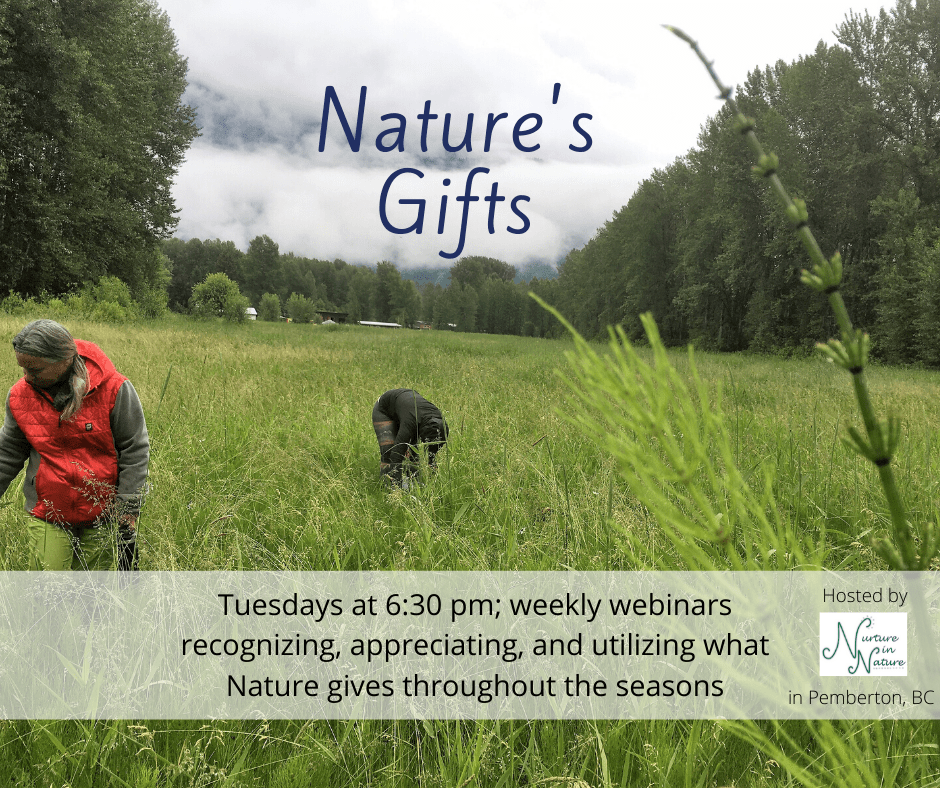
    What is this weed in my garden, or what is this plant on this trail?! Does it have any herbal, medicinal, or edible qualities? When and how could I make elderflower cordial? You can eat ferns!? How can I preserve thimbleberries? How can I save my salad greens for later in the season when I am no longer sick of salad? I hate to waste- what can I do with carrot tops?

    Nature gives us so much for free – if we know when and where to look for her gifts. They are often sporadic, and never last long! So every Tuesday we at Nurture in Nature are offering to take you on a little Zoom walk through our garden and forests to show off what is all around us that we so often forget to notice, and give some tips on how to recognize, appreciate, and utilize the never-ending gifts from Mother Nature. For example – chamomile is out right now!!

    For more information, visit our website-

    https://www.nurtureinnature.ca/blank-page-1

    feb88c_5df941c7e9b04a198f8519d911a654a5_mv2

    Our first session is free, to offer a taste at what we want to offer, and to practice of course! Tuesday June 30 at 6:30 pm, register online here;

    https://www.eventbrite.ca/e/natures-gifts-tickets-110216229710

    We hope that by demonstrating how we connect to the land around us, we can offer insight into how you can cultivate a deeper connection with the place and community wherever you are, be that Pemberton or elsewhere. So join us Tuesday to begin walking a path of connecting more deeply to your food system, community, and the environment, as we search for more sustainable and resilient lifestyles, together.

    Nurture your Nature

  • Chickenisms

    Chickenisms

    I know from the demand  following the pandemic, there are lots of new chicken raisers out there now. Many of them it seems are females (nurturers) trying to get their reluctant partners (practical) to get on board and help them set it up. The learning curve is steep and I’m sure there has been quite a few trials and tribulations. Raising chickens can be fun, frustrating and eye-opening, just like life in general. With this familiarity comes the realization that chickens offer a philosophical and social microcosm, especially within the English language. I believe there are more parallels attributed to chickens than any other farm animal. I am going to run you through just a small portion of sayings about chickens and how they relate to us.This is a short scenario about new Covid-inspired chicken farming couples.

    First of all many of you have been COOPED UP, with the lockdown as opposed to RUNNING AROUND WITH YOUR HEAD CUT OFF as per usual. So with no HEN PARTIES and a desire to be more self-sufficient you thought you would WING IT and and take some chicks UNDER YOUR WING.You wanted  to play MOTHER HEN  to someone other than your homeschooled children before they FLY THE COOP.  Your husband may have CHICKENED OUT but you PLAYED CHICKEN with him instead, stating not to PUT ALL YOUR EGGS IN ONE BASKET when it comes to food security. Being NO SPRING CHICKEN,  and knowing the PECKING ORDER, he was eventually HEN-PECKED to the point of having to build a coop. Doing the math, he realized that the cost would not be CHICKEN FEED. His calculations looked like CHICKEN SCRATCH on paper and the numbers didn’t add up. The CHICKEN AND EGG SITUATION is that raising chickens could actually cost money as you CAN’T COUNT YOUR CHICKENS BEFORE THEY HATCH!

  • Allies in Unlikely Places

    Allies in Unlikely Places

    For the past nine weeks I’d felt a low-level thrum of stress about the winter-mess of my garden. It would spike when I saw other people, in March, as the Prime Minster was giving his briefings in a snowstorm, who were pandemic-proofing their future by getting in loads of soil, going to physically-distanced plant sales, posting pics of their seedlings, their brand new beds. I was happy for them, of course. And happy for the idea that people would turn en masse to gardening.

    But I hated them too.

    That little frisson of envy and anxiety would perk up at the panic-buying of chickens and the video pleas from West Coast Seeds to please be patient, we’re experiencing unusual demand. I was working and parenting and re-orienting to life in isolation and trying to fit in the occasional mind-clearing walk in the woods. All my garden time in March and April was single-mindedly devoted to weeding the strawberry patch, an epic battle that left me hallucinating invasive wiry grass root systems whenever I closed my eyes. It was a race against time to excavate the plants before they began to flower, signaling May. It was a race against the 7 year old’s tolerance for solo-play. It was a battle compounded by the sense that now everyone else in the world was jumping ahead of me, scooping up all the seeds, all the soil, on top of all the yeast, flour and toilet paper they’d already stockpiled. Oh, hello scarcity mindset, my pandemic dance partner. The things that matter most (stretches of uninterrupted time, kids for my son to play with, seeds, clarity about the future) all seemed in desperately short supply.

    One afternoon trail-running, the sudden scent of cottonwood stopped me in my tracks. It was as if someone had spilled a jar of infused oil. I stopped and inhaled deeply, looking around to for the source. “What?” I wondered. “What is it?”

    It took a while for me to settle into listening mode, but when I did, the thought arose/the tree I could smell but couldn’t see, said: “When you work with us, you create the relationship that allows us to work with you.

    I had recognized the scent because I had worked with cottonwood – gleaning buds back in the spring of 2019, packing them into a jar and pouring olive oil over them, tucking it in the pantry and shaking it when I remembered. A year later, I strained out the plant matter and poured the sticky oil into an old tin can, warming it over a saucepan of water, into which I chucked the leftover ends of a beeswax candle, to make a salve for aching muscles.

    Had that quiet afternoon, working with my hands, my attention, and the invisible company of half a dozen women who had introduced me to this tree over the past few years, also been a gateway into a deeper relationship with the tree species itself? Could it be that a tree was now suggesting to me, that by doing that, I was opening up a portal of reciprocity, a way in which the plant could now work with me, too?

    As I finally declared the Victoria Day long weekend my time to plant, and cleared away mounds of last year’s garden debris from one bed, feeling that little surge of overwhelm, inadequacy, I thought back to my cottonwood-perfume-on-the-trail moment and wondered if maybe, I could just ask the garden nicely to be prolific this season to support my family, and even possibly, to allow me to support other families. After all, as I turned up self-seeded carrots and cilantro and a bounty of worms, it seemed bent on sprouting forth with life. Perhaps we could work together.

    What if the Law of Nature is as simple and generous and sensible as this: Work with what you have. It will work with you.

    Dr Robin Wall Kimmerer, botanist, professor and the author of Braiding Sweetgrass: Indigenous Wisdom, Scientific Knowledge and the Teaching of Plants, asks her nature-loving students if they believe nature loves them back. They’re always a bit insulted or shocked by the naivete of the question. They’re scientists, after all.

    Kimmerer writes, “How do I show my girls I love them on a morning in June? I pick them wild strawberries. We pick violets in May. How do we show our children our love? Each in our own way by a shower of gifts and a heavy rain of lessons. Maybe it was the smell of ripe tomatoes. It just came to me in a wash of happiness. I knew it with a certainty as warm and clear as September sunshine. The land loves us back. She loves us with beans and tomatoes. By a shower of gifts and a heavy rain of lessons. She provides for us and teaches us to provide for ourselves. That’s what good mothers do.

    I will always compare my garden to other people’s neater ones, the square angles, black soil, cute little labels, fancy trellises. Mine is chaotic and messy and imperfect. But it’s working with me. I felt the sudden lift of that, eased my trust into it. Some things will get eaten before I can harvest them, by deer or slugs or the kid. That’s part of it. We are impacted by other beings. It all flows. In this wild space, I dropped seeds and found a promise, and a reminder: it’s not all on my shoulders. All these beings and energies and life forms – the seeds, the wind, the rain, the worms – are working with me. Bringing me back, beckoning me back into relationship. Together, we might be okay. In fact, we might even flourish.


  • Healthy Rhubarb Sauce?!

    Healthy Rhubarb Sauce?!

    This post is a repost shared from https://www.nurtureinnature.ca. If you enjoy Kristina’s adventures in permaculture, which she has begun to share with us, be sure to follow her there.

    I wasn’t going to make rhubarb sauce this year- it needs a disgusting amount of sugar to make it taste good, and then it leaves that hairy feeling on my teeth. It’s not good for me, and it doesn’t feel good, so why spend the time?

    But, then I realized what was growing in a patch behind the farmhouse.

    Sweet Cicely has the natural chemical anethole that, when cooked, is twice as sweet as sucrose. It grows here in BC, and is a natural, unprocessed sugar. Now I don’t feel so bad about eating rhubarb sauce; it has half the amount of sugar in it, and I like eating it because it doesn’t leave that weird feeling in my mouth.


    Recipe:

    Note to all, my mom taught me to cook with measurements. But when I am out foraging, it is hard to get “2 cups of rhubarb”. Sometimes I end up with 3. Or 9. So I cook with proportions, and taste test to get it right. Good luck!

    1 part Rhubarb, cut into small pieces.

    With about 2 inches of water in the bottom of the pot so the rhubarb doesn’t burn, bring to a boil and let the rhubarb break down and become saucy and thick.

    Once it is about the desired texture, add 1/2 part diced sweet cicely.

    Add1/4 part of sugar, let it boil until you can no longer taste the liquorice flavour of the sweet cicely.

    You can add other fruits, like strawberries, and lessen the amount of sugar you need even more.

    Enjoy your rhubarb sauce on vanilla ice cream, in pies, or on yoghurt and granola for breakfast!

    I wouldn’t say it is healthy, per se.

    But at least it isn’t as unhealthy as it was, and it came mostly from my backyard!

    We deserve some sweet treats some times.

  • Pemberton Permaculture Community Garden

    Pemberton Permaculture Community Garden

    Community gardens – they allow for humans, plants, food, and wildlife to come together in symbiotic relationships. And now we have a new one in Pemberton!

    This slideshow requires JavaScript.

    Here at Nurture in Nature, we have 15 Pembertonians joining us on-site for two hours each week to maintain this communal permaculture garden. Everyone comes once a week to participate in the cycles of gardening, so the daily workload is shared amongst the group and we all get a weekly harvest. You can see in the above gallery we have come a long way so far this season! Thanks again to Sea To Sky Soils for helping so much with the initial setup!

    So far, we have harvested cotton buds, nettles, fiddleheads, dandelions, wild mint, spruce tips, and sweet cicely from the wild side of our garden. From our cultivated areas, we are already harvesting salad greens, heads of lettuce, kale and collard greens, and a plethora of herbs such as mints, lemon balm, oregano, summer savory, parsley and thyme. I have seen some pretty creative food ideas coming from the garden as we as a team learn how to create and share a yield as a community, but also how to appreciate what Nature is already offering without any work on our end. Cotton bud tinctures, nettle pesto, dandelion honey, peppermint brownies, herb butters and teas have all been made by our gardeners. Many of us joined this garden because we just didn’t have the space at home to grow our own food, so we can already see dramatic change towards resiliency for those of us currently involved!

    My favourite aspect of permaculture gardening that I have been able to share so far this year is succession planting. Check out these pictures, as we are now harvesting our biggest lettuce heads, we are freeing the carrot and beet babies that are hidden underneath – can you see them? How about the parsnips coming up under the peas, and the little lettuces that will replace the bigger ones when we pull them?

    The web that this garden is creating is already visible and tangible, and it is only a month old. We have new friends, weekly connections with people and our environment, and a deeper understanding of our food sources as well as gratitude for fresh nutrition. And the colours are only just beginning to blossom. What else will this new community garden bring?!


  • Fine & Dandy Syrup

    Fine & Dandy Syrup

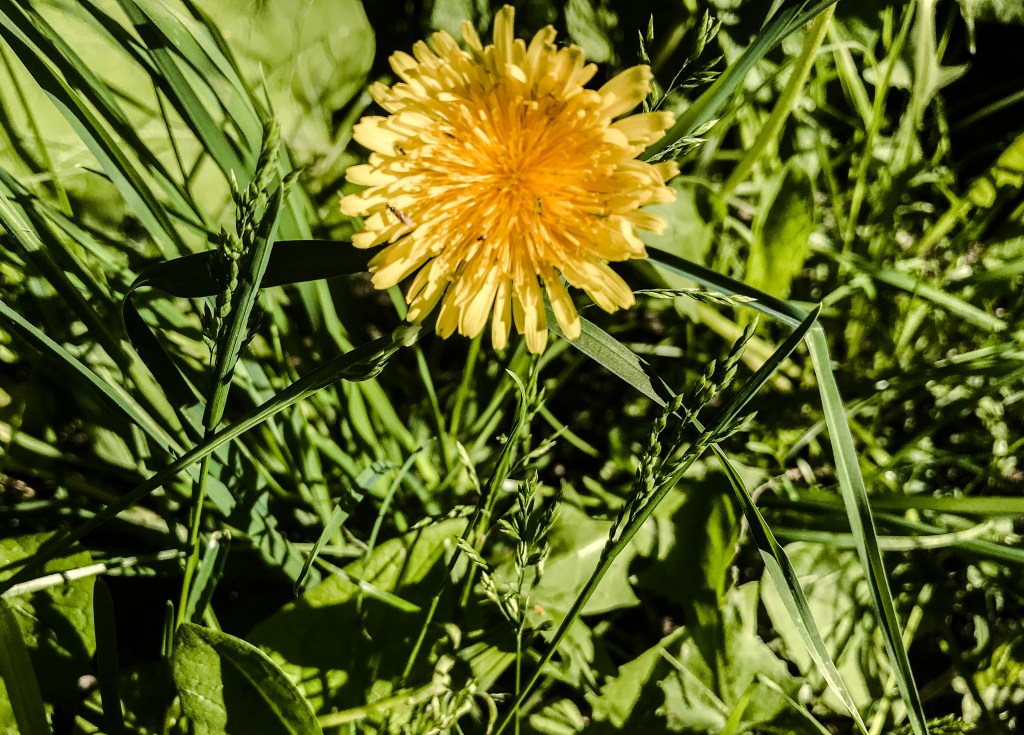
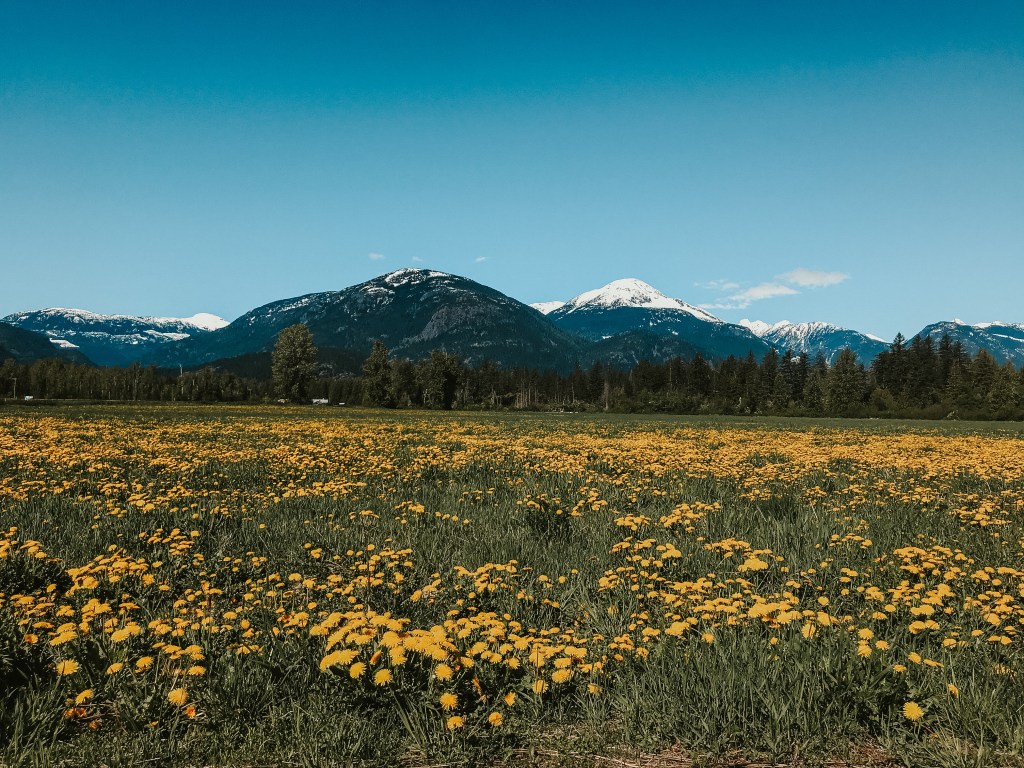
    This spring I have been truly taken with (or perhaps a better way of saying it would be: OBSESSED) with dandelions! Yes the weeds everyone attempts to terminate that spread easily upon crisp green lawns!

    These past few years I decided to make a pact with myself, to get in touch with some of my ancestral roots and learn more deeply their simple ways of existence and so, I have been exploring a deep pull within: the vast knowledge of wild edibles!

    As a young girl I always told the world that my favourite ‘flower’ was a dandelion. This remark was often met with scoffing or a simply worded statement “Dandelions are not flowers, they are weeds.” I didn’t know the difference, all I knew was that they looked like small puffs of sunshine that occasionally would turn into a fun toy that you could tell the time with. As an adult it has been many years since my dandelion days and I’m thoroughly proud to say they are back!

    As a vegan, a vegan cook and a self proclaimed kitchen witch, I have delved deep into the succulent yellow petals of our local friends and from root to tip I have explored all of the wonder this plant provides. Before I move onto the incredible recipe that features this wild edible, the health warrior in me wishes to share some fun facts about these bountiful beauties:

    • Dandelions contain fibre, vitamins A, C , K,  E, folate, small amounts of B vitamins and minerals including iron, calcium, magnesium and potassium.
    • You can consume the roots, the flower and the leaves!
    • Dandelion has been used for thousands of years in both Ayurvedic and Chinese medicine.
    • Dandelion is most commonly used as a liver remedy, diuretic and cholekinetic (increases stomach bile)
    • Dandelions are also used as a digestive aid for diseases of the mammary glands, abscesses, ulcerations and swollen lymph glands.

    They also can taste incredible! As a general rule the younger greens are less bitter and are great in salads or blanched as a side. The root can be roasted and drank with hot water as a coffee substitute. The heads can be added to salads, dressings, dips or even tempura them and add to a stir fry or salad. I have also added the yellow flowers to breads, baked goods, pancakes, coconut yogurt…you name it! Yet my favourite way to use these high mineral powerhouses is to make traditional Scandinavian dandelion honey! This is very simple, delicious and a great way to add a little sweetness to your desserts, morning pancakes and beverages.

    Recipe:

    • 2 cups of dandelion heads (presoaked in water, 1 tbsp vinegar for 10min and strained)
    • 2 tsp vanilla extract
    • 1/2 lemon
    • Organic sugar of choice
    • Water

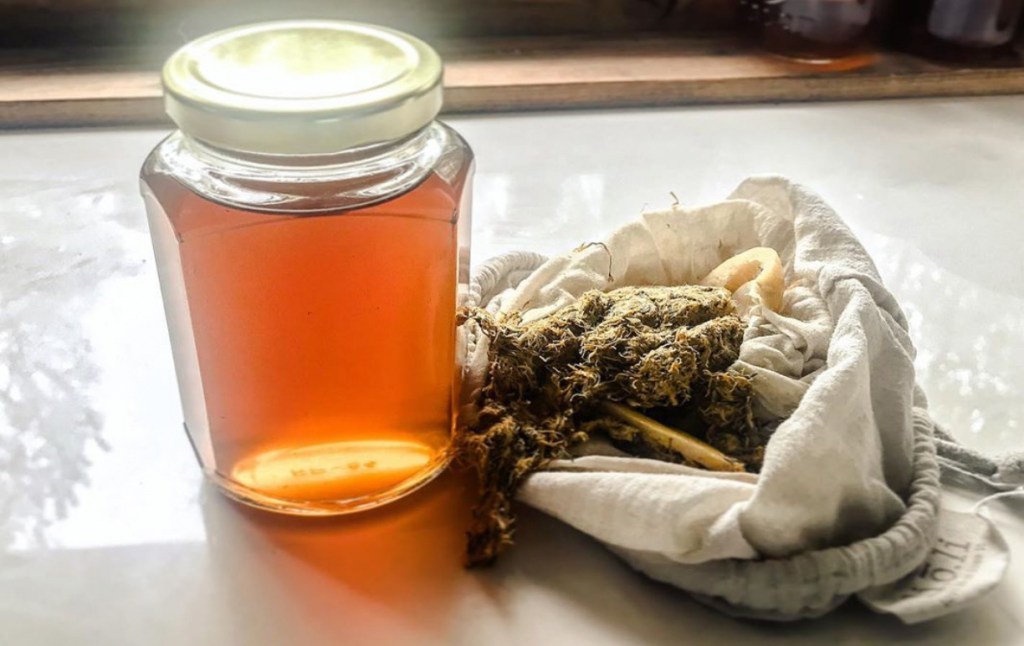
    In a medium sized pot cover the lemon, vanilla and 2 cups of dandelion heads with water. Bring to a boil and simmer for 15min, allow to cool and place in an airtight container in the fridge overnight to infuse. Next day strain out the solids using a nut milk bag or strainer. Measure the liquid you have in a jug, typically it should be around 1.5 – 2 cups. Match the same ratio with your organic sugar of choice. Bring the dandy liquid and sugar to a boil. Keep a close eye on it until it gets thicker and turns a deeper colour (around 15min.) Once finished add to a clean jar, you can store this in the refrigerator for about 1 month and enjoy in any way you please!

    It tastes remarkably like honey, is a sweeter rich in vitamins and minerals and just might be the best thing you have ever tried on pancakes!

    Enjoy your fine and dandy syrup !

    by Leala Selina

    Instagram: @theplayfulmoon Hashtag: #eatrealrainbows🌈