Author: Lisa Richardson

  • Plant medicine: wildcrafting Balm of Gilead

    Plant medicine: wildcrafting Balm of Gilead

    IMG_2019

    “What’s this?” asked my clutter-resistant husband, observing the giant mason jar of oily plant matter on the counter.

    “Ohh, it’s medicine! It’s called Balm of Gilead,” I explained.

    “Oh. But what is it?”

    “Cottonwood tips in oil.”

    “Hmm. And what’s it good for treating?” he asked, in an impressively neutral manner, eyes scanning to the brand new bottle of olive oil next to the stove that was now suddenly, dramatically, near-empty.

    IMG_2023

    I reamed off a list of benefits from Balm of Gilead, the old herbal remedy – that I’d just copied out carefully into my new Plant Allies notebook – using information I gleaned from Natalie Rousseau’s blog. The resinous buds are rich in salicin which your body converts to salicylic acid, the active ingredient in aspirin. Good for sore muscles, rheumatic conditions, simple wound healing, as an expectorant chest rub to treat a boggy spring chest cold. Bees also use the resin to protect their hives.

    “Plus,” I enthused, “it’s helping me be more in tune with this place, with the seasons, and what’s outside our door.” He’s knows that “tuning in to the deeper rhythms” is kind of my jam right now, so, even though I could see his brain calculating the cost per millilitre of this little experiment, as compared to the cost per unit of a bottle of generic aspirin tablets, as weighed against the likelihood of me ever 1. completing this project and 2. treating anything with it, he nodded quietly, and put the jar back on the counter.

    Since moving to Pemberton from the land of eucalypts and snow gums, I had acquired the habit of thinking that black cottonwood (Populus balsamifera ssp.) are kind of junk trees – the wood is too wet to burn well, the snowfall of the seeds in May wreak havoc on friends’ allergies, and the branches crash to the ground, making them kind of hazardous to live directly under under. Even though wonderful plant mentors like Evelyn Coggins, Dawn Johnson and Connie Sobchak have offered me other ways of thinking about cottonwood, thanks to their contributions to The Wellness Almanac – great bird habitat! good for erosion prevention! great shade in a sweltering Pemberton summer! a beautiful scent! a medicine! – those attributes felt like supplementary prizes, making up for basic deficiencies in character.

    Then, in February, I joined Kera Willis and Guliz Unlu for an all-day workshop, offered through Mountain Horse School,Lightning Seeds: Opening the Gateway of What’s Possible.” The hook had been set, when Kera asked:

    What happens when we invite natural rhythms, cycles and energies to help us create the changes we wish to see, in both ourselves and the wider world?

    What if we could get out of our own way?

    What if we could remember ourselves into a state of embedded belonging within the natural world?

    “In the same way a lightning strike may ignite an instant blaze or slow burn that smoulders for months, these awarenesses and experiences may take root eagerly within us, or they may take months (or even years!) to percolate down through our soil,” wrote Kera.

    Befriending my tree neighbours has been an outcome with a long slow germination. First there was ignorance, curiosity, longing, admiration of those with more knowing. Years of that.

    IMG_0934
    Lightning Seeds beneath a  big old cottonwood. Photo courtesy Kera Willis/Guliz Unlu.
    IMG_0948
    Besa. Photo courtesy Kera Willis/Guliz Unlu

    Then, facilitated by Kera and Guliz, a group of us were invited to stand in the crunching snow in the shelter of a cottonwood and consider: what is the smell of lighting? what is the sensation of green? what secret desire might we share with a horse, a tree, a non-verbal witness? How might be hold ourselves if we courted wonder, if we invited animals to approach us, instead of steam-rolling our way into the thick of things, without waiting, without listening, without receiving?

    We ended our explorations at the mixing table, hands-on, pouring melted beeswax and cottonwood oil into containers, inhaling the aroma. Connecting with our senses. Relating.

    IMG_0960
    Photo courtesy Kera Willis/Guliz Unlu
    IMG_0964
    Photo courtesy Kera Willis/Guliz Unlu

    Percolate.

    A month later, on the first day of spring break, I found myself at the base of a massive cottonwood that grows beside the creek behind my house. I wouldn’t have known it was a cottonwood. But I was sniffing around the ground like a truffle pig, and when I found dropped branches with the tell-tale resinous buds (quick sniff for confirmation, month-old memory of sitting at Kera’s table still fresh), I gazed up, to locate the source. Oh. There she is. Wow. Your majesty. I couldn’t help but bow. Her crown was stunning. So different from the conical tops of the Douglas-fir and red cedar that have filled my winter days.

    IMG_1868

    I picked the buds from winter-fallen branches, taking in the scent, and I kind of chatted away to the tree. First, I acknowledged her presence. Big step. I’ve walked by plenty of times, head in my own thoughts, brushing by like strangers. So we began the dance of becoming friends. I accepted her, without assessing her worthiness, just as I do when I become friends with someone. And I offered myself as a potential friend, and complimented her on her lovely qualities – like the fact that the branches she drops in winter storms are rich with buds that are full of medicine for spring coughs, muscle aches and pains, wound healing. I accepted the offering.

    She’s a local here, (a coastal dweller, her kin are native to western North America) and the flood plain is her habitat – she can take root in pure sand or gravel along riverbanks, and absorbs water through her roots to help control flooding.

    black-cottonwood

    I’d brought the wee lad with me, beckoning him outside with the promise of a “creek patrol.” I had showed him Natalie’s blog post, with her step by step photo instructions of making a poplar salve, and explained what I was wanting to do. I pulled out my little jar of salve from February and we both inhaled it. He absorbed it all quietly, then ran to find a basket for me, and his raspberry picking container (yogurt container with string to hang around the neck) from the bottom drawer.

    IMG_1869

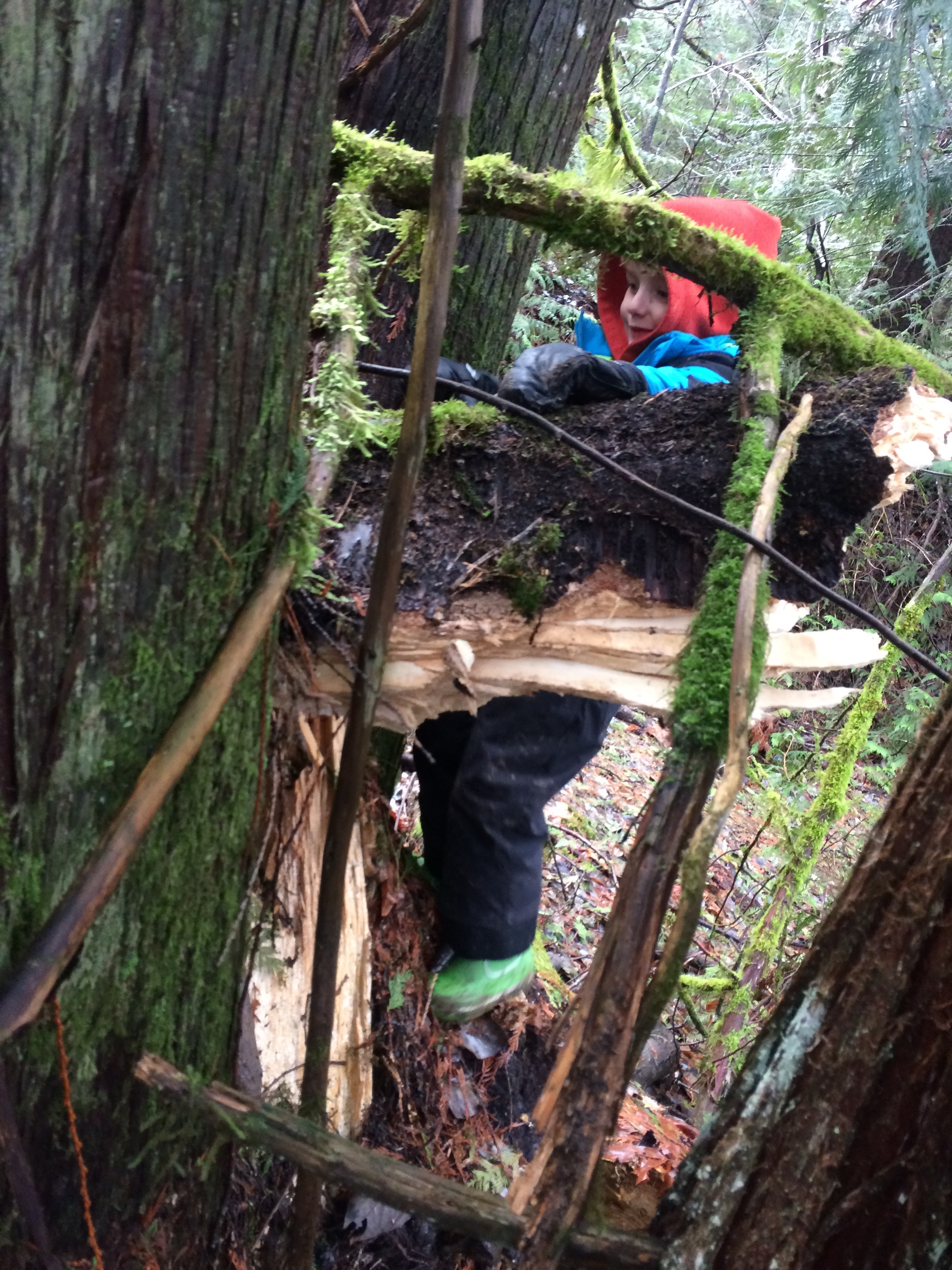
    As I plucked the buds from fallen branches he hustled back and forth between the creek and mother tree pouring water on it as “an offering.” Also leaving branches against its trunk in case it felt compelled to be a Fort anytime soon. It has been almost a year since we last talked about the idea of offering thanks to the trees and living things around us – and maybe we owe it to Wild Kratts, but he’s bought into that idea completely.

    (Cut to last night’s first fire, with deadfall we collected from the forest floor.

    Dad: “trees are so awesome because they give us firewood!”

    Boy: “No, trees are awesome because they give us oxygen. That’s more important than fire wood. If you don’t have oxygen, you can’t LIVE!”)

    IMG_1872
    Making offering. Moss, dirt, creek water.

    This is the seed I want to plant in his heart, I thought, as I was collecting buds from the forest floor : there is so much abundance here as long as we remember to acknowledge and give thanks and give something in return. This is the dawning that is, at last, awakening in me.

    The smell of cottonwood resin, which I found kind of medicinal and stenchy in February, is now something I inhale with intention and gladness. (Especially given that my hands are covered with it, right now, after I opened the lid of my brewing jar to see how things were looking. Word to the wise: when they say, “only fill your jar 3/4 full, because the buds will swell”, they mean it. Oh grasshopper. So much to learn.)

    Now that I have begun to enter into relationship with that great tree, I see her – from my window, out in the yard, walking the creek – all the time, and it doesn’t make sense to not nod in greeting. After all, we’re friends. Even if I never use the oil, medicinally, some “medicine” has been gained, in this, small glimpse at the significance of the phrase I have heard my Lil’wat neighbours use: all my relations.

    IMG_2020
    As explosions go, things could have been worse.


    IMG_2022
    Add to grocery list: olive oil.

    Balm of Gilead

    Local clinical herbalist, Evelyn Coggins says you can make Balm of Gilead as follows:

    Using a ratio of one part buds to 3 parts vegetable oil (I use olive oil), soak the buds for at least three weeks, stirring gently once a day to expose all bud surface areas to the solvent.

    I use 500 ml canning jars and cover the tops with paper towel secured with canning rings. This prevents stuff from falling into your oil but also allows the moisture from the buds to escape. Keep the oil in a warm place (in the oven with the oven light on) to help gently dissolve the resins into the oil.

    When your soaking is complete, allow the jars to sit at room temperature overnight then strain out the buds. Let the oil sit covered with a clean tea towel for another 24 hours at room temperature and then decant it into jars, cover tightly, label and store in a dark place.

    You can apply it to sore spots as is or mix it with other infused oils and essential oils, add some melted beeswax and presto: an absolutely fabulous homemade version of “Tiger Balm”.


  • Sprout away the winter blues: the marvel of microgreens

    Sprout away the winter blues: the marvel of microgreens

    Molly Costello, a wonderful artist I just discovered (thank you instagram), asked her community this week: how do you get through winter?

    More specifically, she asked, “how do you find joy in winter?” which is a very constructive re-frame.

    It’s a beautiful and productive thread, and prompted me to this place: SPROUT!

    Well, I was nudged as much by Molly’s question as by the $5 price tag on a head of wilted lettuce, and the price tag on a bunch of kale, which my garden no longer yields (most of it was nibbled down to stem by the deer, and anything that remained is now buried under a foot of snow) and which inevitably cooks down to a single mouthful, although any dirt I didn’t wash from it manages to expand in size in some perverse inverse leaf-to-dirt amplification equation). Plus, I was motivated by this instinct that when I make something from scratch, or see something grow, I feel stupidly happy; my kid engages more deeply in the real world, and we’re already in that constant tussle of real world versus seductive screen; also, a desire to have some greenery in the diet in the depths of winter. I already had a sprouting jar, so I pulled it out of the cupboard and carefully measured out my tablespoon of alfalfa seeds, rinsed them, soaked them in water overnight, and then begin the daily ritual of rinse, swirl, drain, sit back upside in the jar on the plate on the corner of the counter.

    deviyahya-1052792-unsplash
    Photo by Deviyahya on Unsplash

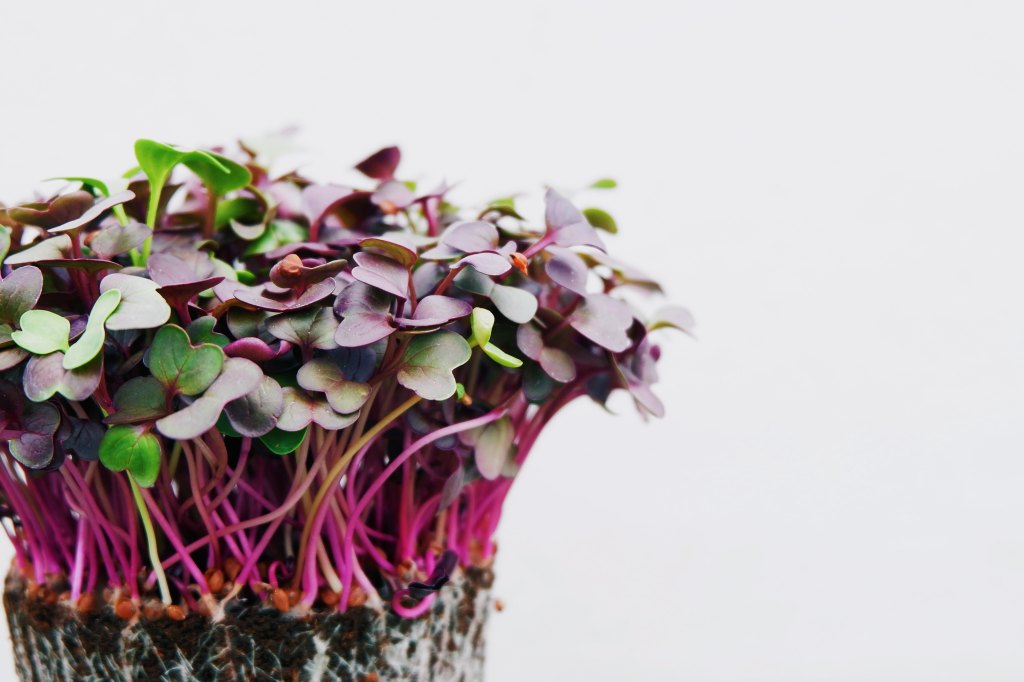
    Then, thanks to a combination of internet-smarts, sunflower seeds and encouragement from Stay Wild (apparently, Leah’s countertop at home is covered in sprouts and micro greens), and a great book from the library, I became a micro green grower.

    deviyahya-801405-unsplash
    Photo by Deviyahya on Unsplash

    Farmer and micro green guru, Elizabeth Millard offers a lot of great advice, but it’s her tone that I appreciate the most:

    “Winter in Minnesota is notorious for wearing optimists down to a brittle nub, but the more experimentation we did with micro greens, pea shoots, radishes and other tasty vegetables, the more we felt like we were extending summer into our house… There’s a certain thrill that comes with seeing seeds begin to pop into three first leaves, and if you’re wearing your pyjamas at the time, that excitement can feel doubled.”

    4b8cb2f8-92ef-4878-a1cd-53d643f28b4b--16795820412_4f4d4cfce6_b
    Microgreen guru Elizabeth Millard (left) and her partner Karla Pankrow of Bossy Acres farm in Minnesota

    As a person who works from home, being able to do things in one’s pyjamas is Mission Critical for me. It’s a flashing neon sign that says, “Lisa, this might even work for you.”

    And so, following the various bits of advice I’d gleaned from above-mentioned resources, I began, with one plastic salad box rescued from the recycling bin, some potting mix excavated from underneath the cobwebs in the garage, and my little packet of sunflower seeds acquired from Stay Wild.

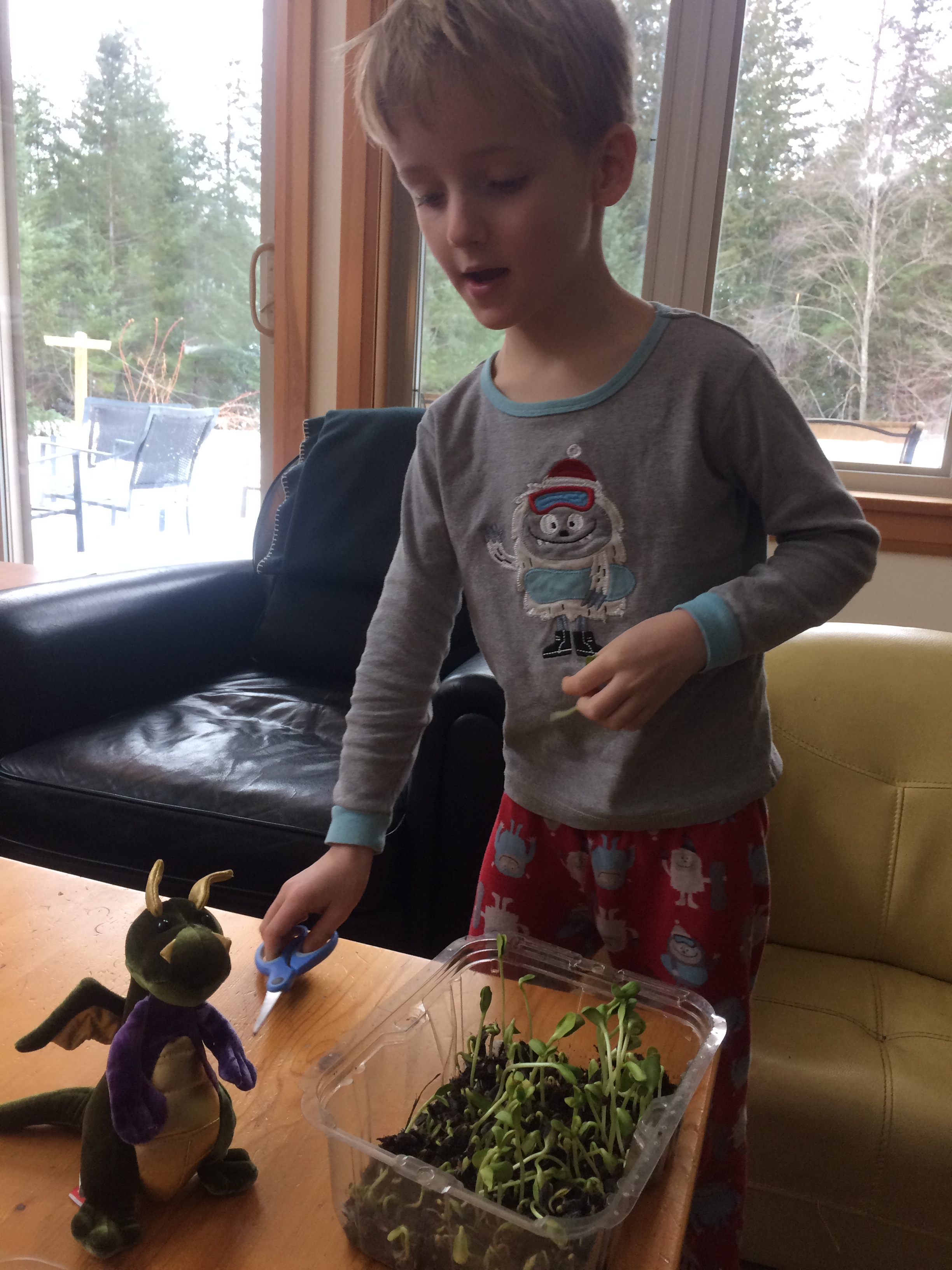
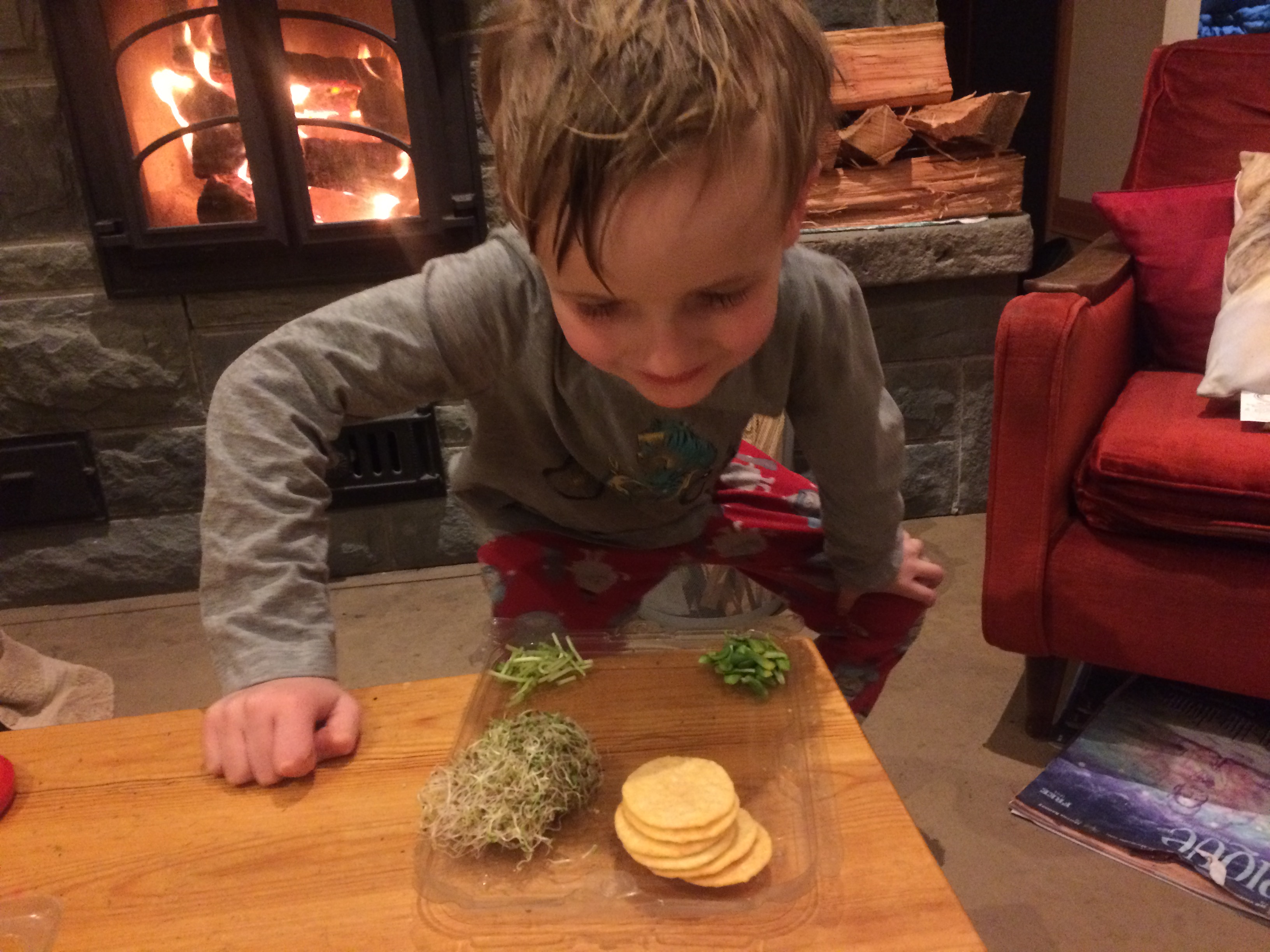
    A few days later, my 5 year old put himself in charge of the harvest, and Mr Just-Ichiban-Noodles-for-Me, snipped and plucked and made merry with the nutrient-dense cotyledons (the initial two leaves of a seedling, that give way to the plant’s “true leaves”). He made cracker-sandwiches for us, from the micro greens, and ate his way through much of the first harvest. Hooray!

    e19ef333-b272-4407-aea3-e48d7d0f1a87

    Some wins just feel too easy… I spent $3, used garbage, and my kid fed himself greens (and also introduced his meat-eating dragon to the joy of omnivorism.)

    img_0313
    Look, Sparky! Micro greens. Feel free to toast them, if you like. Bu they’re just as good raw, for those who don’t have the ability to breathe fire.


    img_0373
    Raw food chef-in-training preps the basic ingredients for a nutrient-dense snack for all the family.


    Added bonus, the micro greens made my dinner look more like the picture in the recipe book, which never happens! Wizardry. And joy.

    img_0402

    Millard said, in her book: “Sometime around the middle of February, it always seems to hit: the weariness of filling my shopping basket with fresh vegetables from California, Chile, Mexico, and even Peru or New Zealand. No offence to the hardworking farmers, because I truly appreciate the opportunity to eat oranges during a snowstorm. But these products require, by necessity, lengthy shipping times that sap them of flavour and nutrition to some degree. Still, it’s not easy to eat local when you live in a place that requires budgeting 20 minutes every morning for scraping the ice off your windshield.”

    How do you find joy in winter is a wonderful prompt, as I discovered when I read through the responses to Molly Costello’s post: cross-country skiing, running, sleepovers and dinners with friends, landscape planning and reading seed catalogues, being okay with not being totally okay, soup-making, sauna, drinking warm juice, extra gratitude practice, crafting, making art and cooking for friends, burning candles, forest walks, cold water swimming, making broth, hot baths, taking a cup of coffee outside cloaked in a huge coat, writing letters to long-distance friends and taking extra good care of the houseplants.

    If you want to get more specific, you could ask: where do you find joy in winter? And happily, I can now answer: on my kitchen counter.


  • L is for Lefse: a guest post by Connie Sobchak

    L is for Lefse: a guest post by Connie Sobchak

    Lefse by Connie SobchakAs Christmas neared, I thought about ways to make the season a little more special for my dad, who is in residential care in Squamish. Home baking is always a treat for him but I knew one item in particular would be most welcome: lefse. A Norwegian flatbread made with several variations, lefse was something Mom used to make for Christmas using Grandma’s recipe, which called for mashed potatoes, flour, milk, butter and a little salt. In the old cabin, she baked it on top of the wood stove after rolling it into tortilla sized rounds. Once one side cooked she flipped the lefse using an old yard stick, then made a stack of ten to twelve which were rolled up inside a tea towel. It was a sticky, floury, messy procedure but worth it when the butter and Roger’s Golden syrup came out; Dad would spread the syrup and butter over the lefse then roll it jelly roll style, holding both ends up to eat it so the syrup didn’t run out.

    Well, my attempts at recreating lefse have not been very successful – my potatoes were too wet or I didn’t add enough flour or I was too reluctant to commit to the messiness of it all. Dad ate it but I suspect he was being kind – thank goodness for the syrup. So this year, after a cousin reminded me that one could actually purchase lefse in the Lower Mainland, I phoned around to try to buy some; alas, the sources were too far away or just not feasible. Then I had a brainwave – I would post an ad on the local Buy and Sell sites: ISO someone willing to sell some lefse.  Help make an old Norwegian’s Christmas a little brighter.

    It took an hour till my inbox pinged and there was a message from a man in Squamish who was willing to trade me some lefse for Pemberton carrots and potatoes. We arranged a time and date and then I started fretting about finding the Roger’s golden syrup which has some substitutes but none that are quite as tasty, apparently. Before I could take my post down, another person responded, saying, this is the best post, ever!”  We chatted and she assured me that if I couldn’t find the Roger’s Golden Syrup, her folks had lots and she would meet me somewhere in Squamish and give me some.  People were committed to a successful completion of my mission.

    Tuesday rolled around and I texted my supplier that we were on the way and plugged the address into the GPS. They were in full production mode when I arrived; here was a couple who did not hesitate to embrace the lefse mess. He had made a round metal plate to place on top of the electric burner of the stove and they had ordered a proper ridged rolling pin and a thin flipping stick for easier manipulation of the rounds. It was his job to flip and tend the lefse while his wife prepared the dough and rolled it into the proper shape. 

    L is for Lefse

    Here, have a seat and taste it, they encouraged me, spreading one piece generously with butter.  Now, I have never really been a fan of this treat (some people say lefse tastes and feels like burnt newspaper with flour on it) but theirs was spectacular – soft and not too floury – perfectly cooked. We talked about how often they made the flatbread and what traditions they associated with it, discovering mutual friends and sharing Christmas stories. I left with twelve pieces wrapped in a napkin.  Don’t worry about the napkin, she said, I buy them at the thrift stores for nickels and dimes, then send them off full of baking.

    When I got to Hilltop House, Dad was participating in a word game wherein the participants had to offer words beginning with particular letters of the alphabet for a variety of prompts in under a minute. They were already at S Somewhere hotSedonaSomething yummySmoothiesSomething you eat at Christmas-Stollen.  I was not surprised to hear that Dad had said lefse earlier in the game for that particular prompt and the other residents were pleased to get a first hand glimpse of this item they had not heard of.  

    Mr Hellevang making lefse by Connie sobchak

    Dad and I went back to his room and I set up our little feast of lefse, butter and Roger’s Golden Syrup (which I found at Save-on.) While Dad rolled up his first piece, I relayed the story of how I’d procured it and he got a good chuckle in between bites.  Christmas season did indeed get a lot brighter because of that home baked treat.


  • Ask not what the Earth can do for you, but what you can do for the Earth

    Ask not what the Earth can do for you, but what you can do for the Earth

    When my kindergartener began concocting a little dirt-pile offering for the tree, to say thanks for the fallen branch he had harvested to be a sword, I wondered if maybe I’ve gone a bit far with my semi-pagan ramblings.

    IMG_4186

    I had relayed the rules of the honourable harvest to my little forest sprite, as I had just absorbed them from a 15 minute online video by Dr Robin Wall Kimmerer, botanist, author, professor of environmental biology and member of the Citizen Potawatomi Nation.

    I pronounced, in a conspiratorial whisper, that we should ask permission of the trees and thank them and offer something back for everything they give us, including the air we breathe.

    IMG_4232

    I delivered this mystical proclamation earnestly, reveling in the captive audience that is one’s own pre-school aged progeny and the prayerful way he stage-whispered “may I” into the old cedar’s rough bark, despite the fact that I have I completely failed to live up to this pact of reciprocity in my every day life… I mean, when was the last time I gave thanks to the earth? When was the last time I remembered my reusable shopping bags? When was the last time I made a gesture of offering?

    But out in the forest behind our house, where I mark the seasons by observing the shifting flows of the creek, “the earth” is not an abstract entity, it is right there, exhaling and shimmering around me, and talking to the trees seems as normal as any plot point in the fairy tales I read to the boy.

    The Honorable Harvest is a set of ethics that were taught to Dr Kimmerer by her teachers to guide her when she would go out to pick berries or medicines, and they landed somewhere in my son’s small body, and there he was, weeks later, offering a gift of humus, a hand-packed dirt pie, to the cedar tree.

    Is this how we grow a generation of honourable men? Or is it just a way to prolong his belief in magic a little longer? I wish I knew.

     The first rule for foragers, shared Dr Kimmerer, is you never take the first one – berry, mushroom, plant – because it might be the last. You restrain yourself, until you’ve checked the health of the population, asked permission of the plant, and listened for the answer. If you’re given permission, explains Dr Kimmerer, you take only what you need. You take in the way that does the least harm. You use everything you take. Then you give thanks, and share what you glean.

    The last and most important tenet is to reciprocate the gift.

    “If you take from the earth, in order for balance to occur, you have to give back. We have forgotten this. Even our definitions of sustainability are all about trying to find a formula by which we can keep on taking.”

    To heal our relationship with the land, says Dr Kimmerer, we have to reclaim our role as givers.

    “I don’t think what we need today is more data, more studies, new technology, or more money,” says Dr Kimmerer, “but an ethical shift. A change in the story that we tell ourselves about our relationship to the living world. We need acts of restoration, not only for polluted waters and degraded lands — we need a restoration of honor. This is where our efforts at de-extinction can go. To the regeneration of the ethics of reciprocity. It’s not the land that is broken, but the relationship between us and the land. We can heal the relationship, by asking, what will I give in return for the gifts of the earth, in return for the gifts of birds and berries, in return for the privilege of breath.”

    IMG_4198

    Small hands in the dirt. That’s where my answer, and a new story, begins. Will it be enough? I don’t know. But begin we must.

  • Literary Locavores: when Pembertonians head to the Whistler Writers Festival in 2018, talk turns (obviously) to food

    Literary Locavores: when Pembertonians head to the Whistler Writers Festival in 2018, talk turns (obviously) to food

    Screen Shot 2018-08-26 at 1.22.34 PM

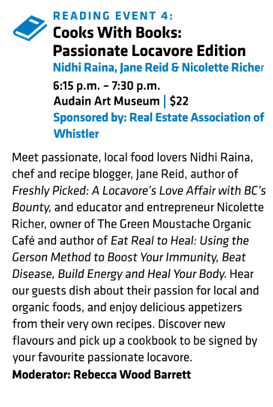
    Two Pembertonians will take to the stage at the 2018 Whistler Writers Festival on Friday, October 12, from 6:15pm, for the reading event Cooks with Books: Passionate Locavore Edition.

    Traced Elements contributor Nidhi Raina’s samosas and chutney have become famous at the Pemberton Farmers Market. And new Pembertonian Nicolette Richer is the creator of the Green Moustache Organic Café and the author of Eat Real to Heal: Using the Gerson Method to Boost Your Immunity, Beat Disease, Build Energy and Heal Your Body.

    They will appear alongside another local Jane Reid, who secured a publishing contract for her book after pitching at last year’s festival. Jane’s new book is Freshly Picked; A Locavore’s Love Affair with BC’s Bounty.

    40100039_10156706471735238_8306097769823600640_n

    Also, once your appetite is whet, save the date for a reading with Jane at the Pemberton Library, on Wednesday November 21, at 7pm.

    Tickets for the Whistler Writers Festival events are on sale now at https://whistlerwritersfest.ticketleap.com

    Download the program for the full weekend’s line-up here.


  • Tory Pearson explains where Pemberton’s first “community supported homestead” experiment began

    Tory Pearson explains where Pemberton’s first “community supported homestead” experiment began

    This is a story about the founding of the Wamhily CSH (Community Supported Homestead). What that is and why, is held in the story below. I hope this tale speaks to you and reminds you, as Field of Dreams profoundly taught us all: “If you build it, they will come.”

    I bought my acreage in a very tumultuous and vulnerable time. I’d been working in social and environmental justice organizations my entire career and had just transitioned into a role in Vancouver’s tech scene. It was what I felt I needed to do, but left me with a void inside and some major guilt for having transitioned to a life “for profit”. For the first time, I was dedicating my daily toils to the system that I knew was broken and only compounding the things about this world that are hollowing us out from the inside.

    It took three years working in high-paced tech sales for me to hit my wall. I was anxious, I was demoralized and I was becoming more and more disillusioned by the day.

    And then I found Pemberton.

    38637483_10156721693349306_2296609585441538048_n

    It happened as a result of a panic attack. Something that was totally foreign to me. I found myself hyperventilating under my desk in my office, overlooking the ferry boats of Granville Island with its happy tourists going about their day in the sun in one of Vancouver’s most beautiful locations. Who has a panic attack in Vancouver’s happiest place?

    I fled the office, got in my truck and ‘drove’. I say ‘drove’ but if we’re being fully honest it wasn’t driving, it was running. I ran up the Sea-to-Sky, I ran past Squamish and past Whistler, further than I’d ever been in this direction. I ran, only to find Pemby.

    It wasn’t until I hit this quiet mountain town that the anxiety lifted and I was able to breathe again. I felt it deep inside and I knew. This is it.

    It took me a few months of weekend visits and some persistence from my realtor, but I found it. I found my acreage. I found my blissful slice of paradise. I found Wamhily – five wild acres in the mountains outside Pemby that lacked cell reception. Perfect.

    37266574_10156671310489306_3804017680407592960_n

    For those of you who get it, this won’t be news to you. But for me, it was a revelation — the peace, the strength and the levelling and grounding power of these mountains. Of the land between them. And of what they can evoke in even the most desperate and hollowed out of us. So much so, I quit my job, left the upward trajectory of a stellar career and never looked back.

    I named my acreage Wamhily. It’s a long story, too long for this piece, but the short story is that the calm steadfast mountains, our deep rich forests and the serene lakes that make up our magical home manifested. Wamhily, an acronym for With All My Heart I Love You. And I do.

    Having worked in the political and not for profit trenches with others who wear their passion on their sleeves and who have been able to withstand the heartbreak that this world throws at us, things crystalized. Wamhily was built to open its arms to those still doing that great work, as a respite, as an oasis, and as a hub for support and connection between those who are able to continue the fight. A quiet place away in nature, far from the social and environmental fights we wage on behalf of others and our collective selves. A safe place in nature that is always here for you.

    Unfortunately, real life creeps in, and reality is: no acreage is an island, as much as we wish it could be so. There are bills, taxes and the costs that come with participating in greater society. And after four years, Wamhily has been forced to evolved.

    To say Wamhily was a one way street providing for the community that needed it would be a lie. After four years on the acreage, building my mini homestead, the community it fed has showed up. It has built gardens with me, it has tended bees, it has mourned their loss to bears getting fat for winter, it has supported the dream and revelled in its escapism. Now, it has moved to helping further, with supporting me in my homestead dreams and making sure the bills get paid to keep this place afloat for us all.

    This brings me to the Wamhily CSH.

    What is a CSH (Community Supported Homestead)?

    To be honest, I’ve never heard of another one. The idea came from the intrepid farmers out there running CSAs (Community Supported Agriculture), making their way with the help of their neighbours, friends and those that believe in local farming. Participants pay a fee at the outset of the season and reap the benefit that harvest season holds.

    The inaugural Wamhily CSH is the first time a monetary value will be placed on the gift that Wamhily is to me and those that draw upon it. It feels weird to bring money into this beautiful ecosystem of love and support but it came at the behest of its community, now demanding to pay into the work I do and the dream it supports in us all.

    In spring, we harvest garlic scapes from the garden and make pesto. Summer brings:  beets, beans and cucumbers for pickling; tomatoes for drying and sauce; peppers and onions to add for salsa; berries for jam; cabbages for sauerkraut; herbs and kidney beans for drying; seeds for saving; and other garden delights that find their way into jars. Down time manifests vegan soaps made from scratch with exfoliants like lavender grown and dried here, and knitted dish rags so you can say goodbye to disposable j-clothes, among many other gifts.

    39979433_10156761712549306_4218753195821760512_n

    Before the costs and toils of the season are upon me, I know I have the support of my community. Not just in spirit, but in the currency of our culture, dollar dollar bills y’all. Those who believe in what I’m doing buy in at the outset and set me up to be able to manifest the season’s bounty into what we need to get by throughout the year. A jar of raspberry jam, still smacking of the sunshine it was harvested in, shining through in the bleak grey of February.

    In short, a CSH is a community supporting an alternative “back to our roots” lifestyle, supporting a person and supporting a belief that together we can grow, make and provide for ourselves. I’m not just preserving food or making my own cheese — we’re preserving a way of living that our existing consumerist and capitalist system have thrown to the wayside and devalued.

    Wamhily’s CSH is more than just the monetary support to be able to provide healthy and love-filled food and household items. It’s the understanding between us that there is value in where we’ve come from and the knowledge passed from generation to generation. There is innate and deep importance in hands covered in dirt, arms torn up by blackberry brambles, wax from my hives dipped into tapers.

    The Wamhily CSH is the manifestation of love into action. A divergence from the corporatized and prescribed path to a more connected and nurturing one. Of my community saving me and I hope, in a small way, me saving them.

    It comes not from a place of judgment of what we’ve inherited and is easy, but of what we can do when we set our minds to it and believe that we are capable. Capable of a different narrative, capable of doing more with less and capable of knowing deep in ourselves that we don’t need the system handed to us.

    This season, with the support of my community, I go to bed each night knowing that Field of Dreams was right. When you build it, they will come. At least when you build it together.

  • How does the Pemberton Seed Library work

    How does the Pemberton Seed Library work

    marjorie-bertrand-122238-unsplash
    Photo by Marjorie Bertrand on Unsplash


    If Catherine Karpman’s post, from earlier last week, got you excited about seed-saving, here is what the Pemberton Seed Library is all about, in a nutshell. Why not try saving seed from your garden this year, and donating it to the Seed library, to help boost the collection?!?

    Challenge for 2018? Accepted.

    Seed-Library.png

    If you do it, document it!! We’d love to share.

  • Nidhi Raina’s Collard Greens and Cottage Cheese

    Nidhi Raina’s Collard Greens and Cottage Cheese

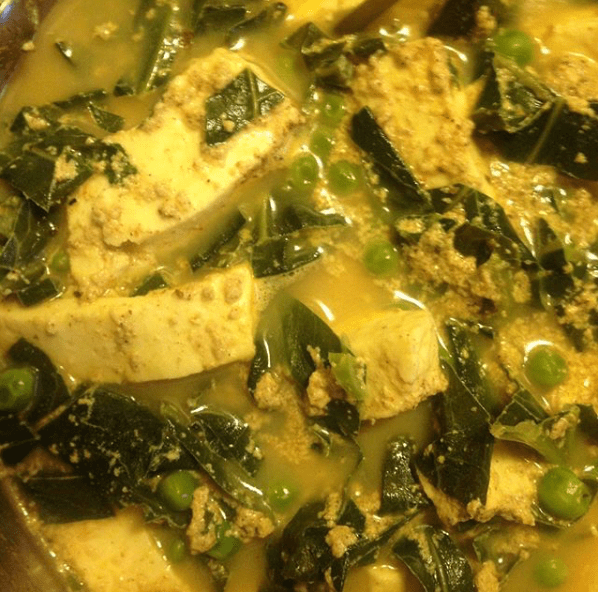
    Collard Greens and Cottage Cheese

    Collard Greens and Cottage Cheese
    Serves 4
    If you had a chance to try this at the Pemberton Farmers market this month, you will bookmark this page. Visit Nidhi under the Downtown Community Barn on Friday, between 3pm and 6:30pm, and see what she’s cooked up for Market-goers this week.

    Ingredients:
    Collard Greens 5 medium leaves
    Indian Cottage Cheese 100 grams
    Fresh green peas 50 grams
    Fennel powder 1 tsp
    Ginger powder 1 tsp
    Paprika 1/2 tsp
    Salt to taste
    Milk 1 cup
    Olive oil 1 tsp
    Non dairy coconut milk 1/2 cup

    Method
    1. Wash collard Greens, remove veins, stem julienne and set aside.
    2. Cube Cottage Cheese into bite size squares and set aside.
    3. Heat a medium size ceramic pan and warm the oil.
    4. Add all the spices and sauté for a minute.
    5. Add the milk or ccconut milk and bring to a boil. Simmer for 5 minutes on low heat to cook the spices.
    6. Add the Cottage Cheese and cook for a minute.  Add the peas and simmer another minute.
    7.Serve hot on rice!

  • How do you explain a seed to a three year old?

    How do you explain a seed to a three year old?

    “Tell me more about seeds,” asked my three year old, way back when. It was spring. We’d been mucking about in the dirt all morning, depositing tiny treasures in the warming earth.

    IMG_5422
    Now 5, even more helpful on the seed front.

    IMG_5434IMG_5438IMG_5439

    A seed is an inkling, I wanted to say. It is its own ambition and instruction book, all bundled into one. It is a packet of information. It is your heritage and your birthright, little man, even though you are inheriting a world in which the control of more than half of the world’s seed stock has fallen into the hands of a few mega-chemical companies. Some people call that bio-piracy. But I don’t want you to know about this yet. Because thinking too hard about these things makes me want to crawl into bed, pull the duvet over my head, and refuse to get up again.

    But you, Small, you make me want to sit on my haunches in the warming earth, with some trowels and forks and little packets full of seed. You make me want to cajole a beautiful harvest out of the little square of world I find myself inhabiting, and so, every spring, we start at it, with just a handful of seeds and a fistful of hope.

    IMG_3745

    And by this time of year, I look at the Life Force asserting itself in my garden, and feel it coursing through me, as I pick strawberries, admire the calendula, tug up a radish, measure the height of the sunflowers just by standing next to it and gazing up… Hope. Hope. Hope.

    (And weeds. Of course. Let’s not get too precious.)


    “Every young person should recognize that working with their hands is not a degradation. It’s the highest evolution of our species. Start a garden. Create a playground in the way you grow food. Save seeds. Cook. Create community. We are not atomized producers and consumers. We are part of the Earth family. We are part of the human family. We are part of a food community. Food connects us. Everything is food.” ~ Vandana Shiva

    Thank you to Evelyn Coggins for sharing this video with me.

  • Cookbook Club to reconvene, after summer hiatus, on September 20, with a freestyle celebration of your own garden

    Cookbook Club to reconvene, after summer hiatus, on September 20, with a freestyle celebration of your own garden

    Cookbook Club goes freestyle.

    Your mission, should you choose to accept it, is to grow your next dish for Cookbook Club’s next gathering, at Stay Wild Natural Health, on Thursday, September 20.

    No specific cookbook needed, when the real recipe for deliciousness is the terroir of this place right here.

    Potluck or preserves-tasting and trading session – let’s celebrate the end of summer, the harvest, and the potential we have in our own backyard to experiment with a zero mile diet.

    It’s a Cookbook Club with no featured cookbook.

    Find your own recipe. Bring copies, so everyone can build out their repertoire.

    Explore Traced Elements and try one of the recipes our contributors have shared.

    Screen Shot 2018-06-14 at 10.11.47 AM

    Pickle or preserve a little something extra, and put it away to share and show offf this September.

    Celebrate an ingredient.

    Enlist a farmer to help you.

    Let’s see what freestyle Cookbook Club dishes out.

    See you in September.