Tag: featured

  • A festival of weeds: eat more dandelions

    A festival of weeds: eat more dandelions

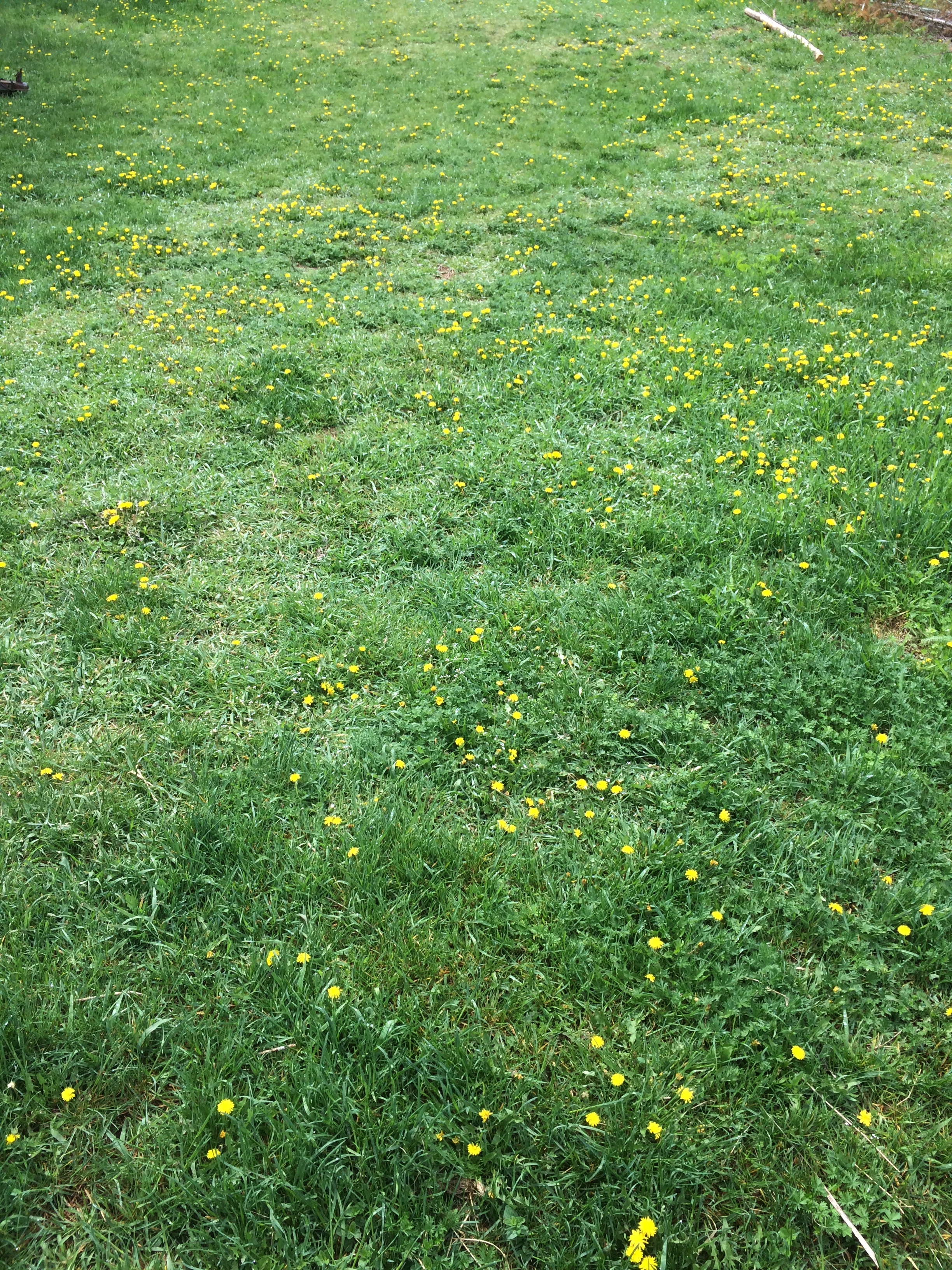
    Could a food chain that whispers of global vulnerability make me reconsider the value of my yard as part of my personal supply chain? I cultivate weeds better than anything. My yard is a festival of dandelions.
    IMG_9770

    There is nothing to be gained by declaring war on this. But everything to be gained by researching all the medicinal and nutritional benefits of dandelion and declaring it my most successful garden crop ever. So, with a nudge of encouragement from Natalie Rousseau, whose plant ally for early spring in her 13 Moons course was dandelion, I cooked up a dandelion saute, as the evening’s serve of greens.

    It tasted… so… weedy.

    The seven year old sniffed and said, “No.” Husband’s verdict: “not for the permanent recipe collection.”

    I went to instagram to announce this state of affairs.

    IMG_9074

    And was encouraged by friends not to give up.

    So I did some more research. They are SO GOOD FOR YOU. My coffee-to-wine IV line slash coping technique has short term effectiveness, (upping and downing me as required), but I’m not in love with the long term consequences (like looking haggard. I embrace witchiness but I’m not ready to be a hag just yet.) The promise of clear skin alone convinced me to keep trying – if not to disguise or balance the taste of dandelion, then to acquire.

    Two weeks into my experiments with dandelion (and with even more available in my yard, yay abundance!)  it’s some combination of all of the above.
    865964C7-5F3D-4BB3-A0DC-14A000007B20_1_105_c

    Susun Weed has taught that information in wild food is healing to our cells, it nourishes them with fewer glitches, it returns us to a state of health that aligns with an older Earth, because the receptor sites for minerals in our cells, are primed for the nutrients found in wild food.

    the optimum nutrition is the nutrition from the wild plants. ~ susun weed

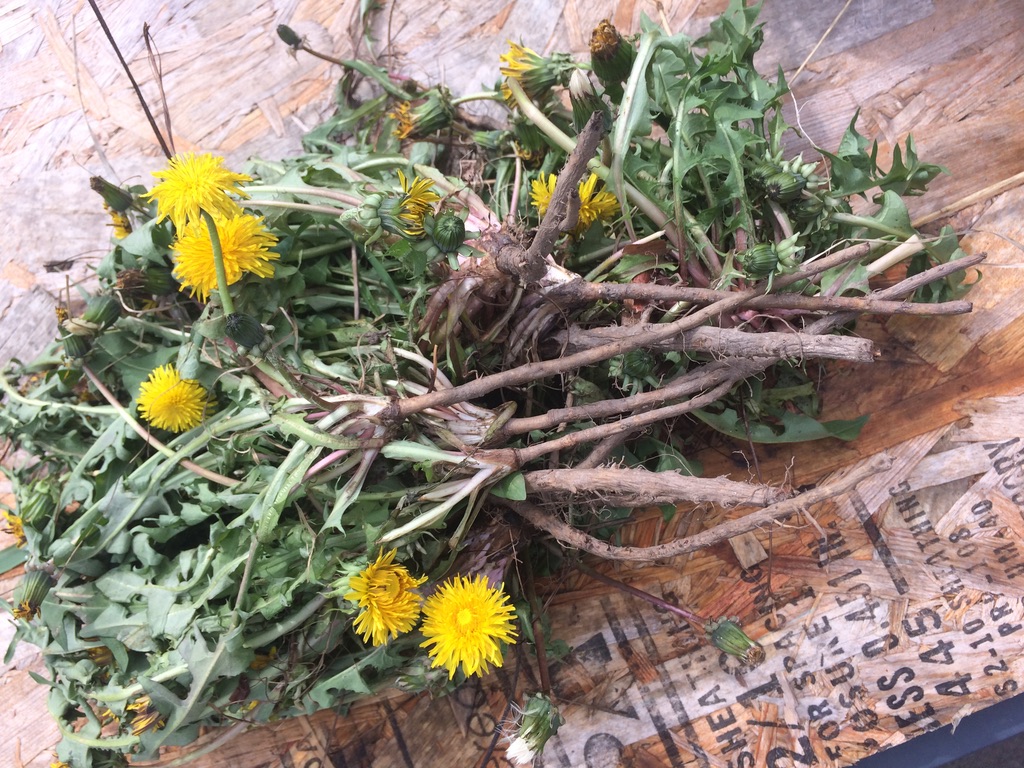
    Dandelion is a member of the Asteraceae (daisy) family, a spring tonic and blood purifier. Dandelion leaves and roots relieve chronic stagnation in the liver, while the flowers can relieve a stagnant depressed spirit.

    “It grows almost anywhere: wild in fields, lining trails, in suburban yards, breaking through cracks in city sidewalks. Its constant presence is a reminder of its persistence to live as long as it can under any condition.” ~ Christine Buckley, Plant Magic

    It was actually imported to North America as a spring green and boasts the scientific name Taraxacum officinale, meaning the official remedy. Like, for everything.

    Its strengths are as a tonic, diuretic, alterative, antirheumatic, bitter, cholagogic, hepatic, exhilarant, mild laxative and nutritive.

    Dandelion – Are tap-rooted biennial or perennial herbaceous plants, native to temperate areas of the world. Dandelions are thought to have evolved about thirty million years ago in Eurasia, they have been used by humans as food and herb for much of recorded history. Dandelions are one of the first plants to bloom in the spring and therefore are a very important source of nectar and pollen early in the season. Its tap-root will bring up nutrients for shallower-rooting plants, and add minerals and nitrogen to the soil. Dandelions are even said to emit ethylene gas which helps fruit ripen.
    IMG_9127

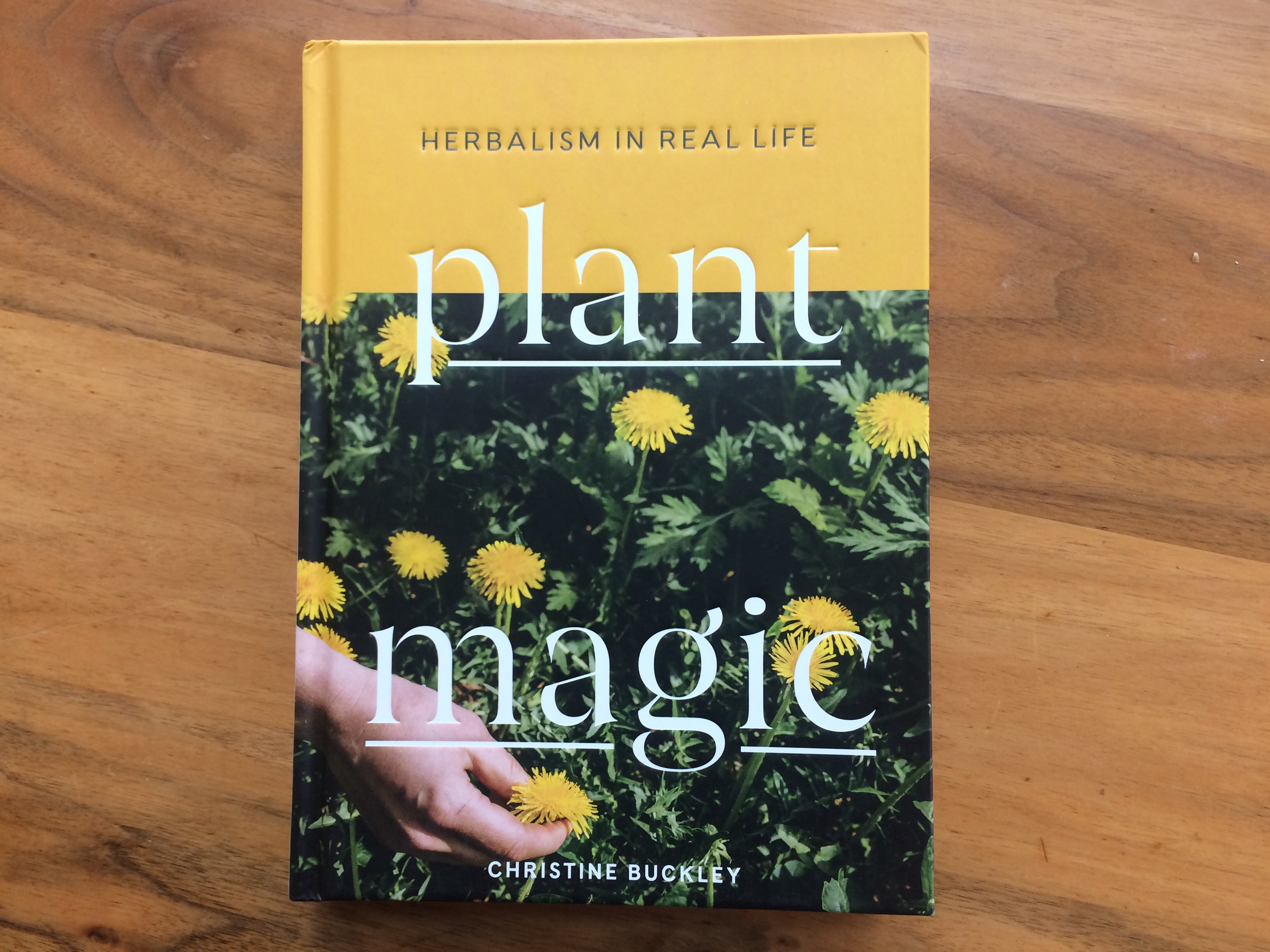
    Christine Buckley, in her new (and highly recommended) book Plant Magic includes dandelion in her herbal arsenal – she makes vodka tincture with the flowers and takes that jar of liquid sunshine as deep winter medicine, confessing it is her favourite plant for being “scrappy, fierce, life giving and cheery.”

    Buckley recommends to use the roots for sluggish digestion – dandelion will not just kick your digestive system into high gear, it also improves bile production in the liver, so you can digest fats and eliminate toxins from your body with more ease.  This will reduce inflammation in the body, make your skin look better, help your metabolism and allow the liver to cleanse the blood.

    It’s high in mineral content and inulin, a type of fibre, which is an excellent prebiotic.

    Are you sold yet?

    The leaves are great spring salads – waking up our systems. It’s a tonic, so that means you can take it, every day, and little by little, you will improve.

    “It is the ultimate preventative medicine,” says Buckley. And high in potassium, too.

    So long as the leaves are green, they’re edible. They become progressively bitter, so start with tender spring leaves. It also is packed with vitamins A, E, K, b6, B1 and C. Temper the bitterness with other ingredients (like plaintain leaves, garden herbs, seeds, nuts, shaved cheese, dried fruit.)

    So, with that data fomenting in my brain, my community of wild advisors offered tips on incorporating this super food into my diet.

    IMG_9128
    Christine Buckley’s must-have new book, Plant Magic

    Holly Joseph recommends: “The roots are nice and hot right now. Add to a stir fry, they taste so good! Brush them off under the hose. They are long and thin right now. And taste pretty peppery. I just cut it up right from the garden and put it right into my stir fry. Made it kind of spicy!”

    Asta Kovanen’s advice: “My tip is to cut wild greens in slowly. Add them in small percentages to your regular veg and then your palate can adjust without major assault.”

    Leala Selina Martin said: “I often will juice them as the larger they are the more bitter. They are so good for you though!”

    Sarinda Hoilett advised: “It’s all in the balance of flavours. Macadamia nuts (although gift from heaven) are expensive and hard to find…you can substitute cashews or even avocado and try for a creamy citrus blend to balance the bitter 🍃, And mix them with other greens or drop a few in a sweet smoothie.”

    Dandelion Cream Salad

    20 dandelion leaves, finely chopped, main stem rmoved

    1/2 cup macadamia nuts

    1/4 cup diced red bell pepper

    1/4 cup coconut water

    93617264_547637935955773_8913051030801154986_n3 tbs lemon juice

    1 tsp Celtic salt

    Massage chopped dandelion leaves well with salt to break down the fibre. Let sit for at least 5 minutes. Blend nuts with coconut water and lemon to cream. Mix well to coat dandelions with cream  and add red bell pepper. This salad is a wonderful way to get the great nutrition of dandelion with a reduction of the bitterness.


    EOJO8586

    After great success with Natalie’s dandelion cordial, making Christine Buckley’s winter rescue tincture (as I call it the “dandy brandy”) is next on my list.

    1 ½ cups dandelion flower blossoms

    1 cup honey

    1 cup brandy

    Put the flowers in a glass pint jar. Dissolve the honey in the brandy by stirring or whisking vigorously together. Pour the brandy and honey over the flowers, label and store in a cool dark place for 6 weeks. Bottle your tincture but don’t hide it away so well that you forget about it by winter.

    3321C13A-9284-428D-88D8-4AF3F8561DEE_1_105_c

    Pemberton-based clinical herbalist, Evelyn Coggins,advised, after reading this post: “I love to hear this topic of wild medicine/wild food being shared as miraculous, magical news… because it is all that. A weed is just a plant that hasn’t learned to grow in rows. The bitter principal of dandelion is tricky. We like sweet, salty and to some degree sour but bitter rarely. Maybe we are cautious because the toxic constituents in plants are most often present as alkaloids and alkaloids are bitter. It must have been a real learning curve to distinguish between toxic and beneficial bitters. The beneficial bitters aid digestion and many traditional aperitifs employ plant based bitters. Gin and tonic is a good example. Gin is prepared from juniper berries and they are bitter. Bitters act on the bitter receptors on the tongue and start a chain reaction that leads to the increased flow of bile into the digestive tract and all the nutritional value that ensues from there. It is not surprising that the liver leaps into action with bitters since poisons must be metabolized and hopefully rendered harmless by this organ. I agree that one must start slowly when turning to bitter plants but the journey is so worth it.”

    I’ve been a client of Evelyn’s and can’t recommend her highly enough.

    Now, more than ever, is a time to treat nature as an ally, not a servant/slave, and to behave with honour, humility, curiousity and gratitude.

    Just because you use the derisive word weed doesn’t mean this plant has no value.

    Finally, leave some for the pollinators. They matter in this lovely web, perhaps more than anyone. Not to mention, the roots reach deep into the soil to bring up nutrients, so they’re working healing magic on the Earth, not just our bodies.

    Thanks to Tanina Williams, who first introduced me to the idea of making dandelion jelly, for sharing this video:


  • Thank you to the Vegans

    Thank you to the Vegans

    As discussed in my last post I think we owe vegans in particular an enormous debt of gratitude. These deadly viruses originate with wild animals in captivity caged inhumanely alongside domesticated animals for human consumption in markets mainly in China, but also it has been reported Indonesia and Thailand. What will happen in future and how and if this will be monitored is another matter.

    Vegans are against the use of any animal product for consumption and their choices are truly admirable. We have so many ethical food producers here and ethical and sustainable hunting practices yet unfortunately there will always be people who abuse a shared trust. Also, whenever we purchase packaged meat in the grocery store and are not connected with the hunting of the meat ourselves or the raising of the meat ourselves or by people we know in our own community (shout out to those very important and hard-working people in Pemberton now and how grateful I am to you) then we honestly cannot say for sure that the meat was raised ethically.

    So if you find this all too much to process (pun not intended) then you can just go vegan. And if that is too much to process then you can at least go partially vegan. I find vegan eating particularly easy at breakfast and lunch. Oatmeal and oat milk (yay – oat milk has 4g of protein per cup!), toast with peanut butter, etc.

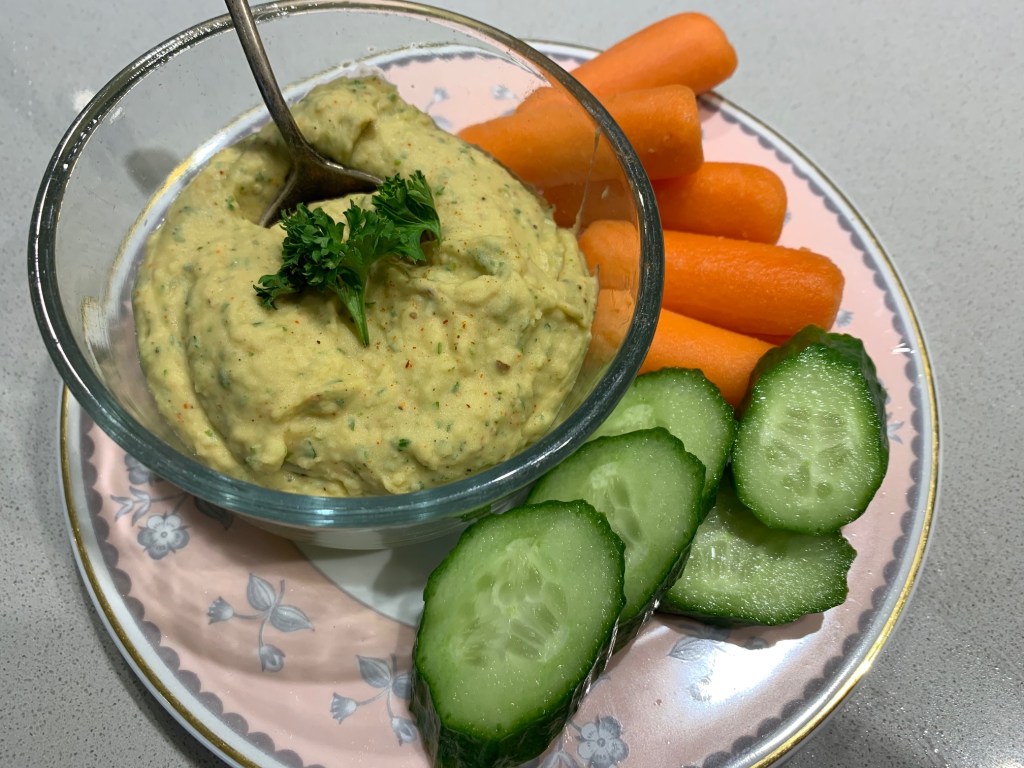
    For lunch I like to serve bean dips and veggies and even a light lentil soup. I just tweaked a bean dip I found online that in its original posted form was bland and blah. This one is zippy and fluffy and very delish. Please enjoy and thank you again to the vegan community.

    White Bean Dip with Pemberton Garlic and Parsley:

    Ingredients:

    15 grams of small white cannellini beans

    **Method for dried beans: Soak a bag or two of dried cannellini beans overnight. In the AM, drain water and put beans in slow cooker and add water until beans are covered by two inches. Cook on low 8 hours. When tender, put 15 gram portions of beans in containers and freeze for future use.

    2 cloves Pemberton garlic

    4 dashes hot sauce (I like the Cholula brand from Mexico)

    1/3-1/2 cup pure olive oil

    3 tbs fresh-squeezed lemon juice

    1/3 cup Pemberton-grown parsley

    1 tsp salt

    1 tsp pepper

    1 tsp paprika

    Method: Blend all ingredients together in Cuisinart. Adjust salt and pepper to taste. Serve with sliced cucumbers, celery, carrots or sweet peppers.

  • Perceptions of the Heart

    Perceptions of the Heart

    It is the heart that always sees, before the head can see.‘ – Thomas Carlyle

    The hawthorn trees are budding in the garden and will probably flower in May, well before we are able to safely move around our community once again. In its way, hawthorn is the perfect metaphor for our time.

    In the Celtic Tree Oracle, the hawthorn card advises restraint, waiting, keeping to oneself and focusing on mental rather than physical activity.

    Hawthorns will vigorously defend their space. Who hasn’t run afoul of one of these trees? If you push forward too quickly with reckless disregard for the fearsome spines lining the branches, some of which can be an inch long, they will pierce your skin to produce a deep, ragged tear before you can stop and extricate yourself. My entire family has lost flesh and blood to local hawthorn.

    Conversely hawthorns can also be generous with their gentle medicine. Across time, extracts of hawthorn have been used as medicine for the human heart. Just like every member of this community, hawthorn can be hard-hearted if its personal space has been invaded and soft-hearted if treated with respect.

    We are heartsick or broken-hearted these days. We wake expectantly to the possibilities of the day only to remember with sinking hearts that the enemy is still within our gates and our lives are irrevocably altered.

    The neuroendocrine and electromagnetic functions of the heart are well documented but only in literature and legend is the heart widely accepted as an organ of perception and communication.

    We evaluate everything emotionally as we perceive it. We think about it after.

    – Doc Childre

    Perceptions of the heart drive the tears, panic and anxiety that are never far from our waking hours and often stalk the vivid dreams of our nights as well.

    According to Chinese traditionalists, the heart stores the shen. The notion of shen is roughly equivalent to the spirit. If the heart is sick, the spirit becomes homeless to wander the body without focus. Its energy is scattered and every organ system is affected.

    Practitioners of Western medicine have long observed that depression can be symptomatic of heart problems. When the heart is made healthy again, the depression dissipates. In both philosophies then, medicine for the heart is medicine for the entire physical body and the spirit.

    I vividly recall one of my teachers saying years ago that everyone over the age of 50 years should be taking hawthorn. This one statement permanently etched in my brain the tonic and remedial properties of hawthorn tea.

    Medicine for our hearts can be easily made from hawthorn. Leaves, flowers and berries contain significant levels of oligomeric proanthocyanidins (OPC’s) – the good stuff in brightly colored fruits and vegetables that may protect the heart and cardiovascular system. Happily for our purposes, these small condensed tannins are readily soluble in hot water.

    If you are lucky enough to have access to a hawthorn tree, you can harvest the leaves and flowers in spring and the berries in late summer to extract those OPC’s either into a tea or a decoction that will help you to take heart in these trying times.

    When harvesting hawthorn, I learned early on to form a clear intention, approach the tree slowly and listen for permission. I have been taught since childhood to never take without asking and to ask only for what I can use.

    You can prepare a tea from fresh or dried plant matter. Simply chop or grind the leaves and/or flowers and soak in hot water that has just come off the boil. For dry herb try 1 teaspoon to 1 cup water and for fresh try 1 tablespoon to 1 cup water. Steep for at least 15 minutes with a towel over the teacup or pot to keep it hot.

    For berries make a decoction by bringing 3 tablespoon fresh or 1 tablespoon dried to a slow simmer in 3 cups water for 20-30 minutes. Bubbles should be barely breaking the surface in the pot.

    Strain your preparations into a cup and add any flavorings you want, such as honey, lemon or cinnamon. Teas should not be prepared and refrigerated for more than 36 hours as they may start to ferment.

    As for what you should be doing in this time, I suggest you set aside your thoughts and words to follow the perceptions of your heart for it knows the path that is right for you.


  • Appreciating the Neighbourhood Chicken Lady

    Appreciating the Neighbourhood Chicken Lady

    Hey folks!

    Let’s talk about the cost of a dozen eggs.  What I see in our area is that most farmers sell a dozen eggs for $5.  A few farmers sell for $6 or $7, not many.  In the grocery store prices range from $3 to $8.

    I have been selling eggs for $6 and most people feel comfortable paying that price.  Here’s the thing, I do not make any money off selling eggs.  I basically sell eggs for the People.  The People love farm, fresh eggs!  That’s why I do it.  I even try not to use eggs in my home so that I have more to sell.  It is not because I’m being greedy and want to make more money but because I need to sell them all to break even.  Yes. you heard that right!  If I sell the majority of the eggs I collect, I break even but only with the cost of feed.

    I have been using an app called “Count My Eggs” for the last 40 days.  I can input how many chickens I have, how many eggs I collect each day, my expenses, and my sales.  The app tells me that I have collected over 500 eggs (chicken and duck) and sold over 450 eggs.  It shows me that I have spent $2 more on feed in last 40 days than I’ve made in sales.  I lose money.  Having said this, I do have eggs in the incubator and if I had sold them I would have made a tiny bit more on egg sales.  Had I sold those 3 dozen eggs I would have made about $0.45/day of income.  Yep, raking in the big bucks!!

    Screenshot_20200402-152857_Instagram

    I have the same feed expenses all year but chickens don’t lay all year.  The math is about $6.64/day for about 40 laying hens and a few roosters all year round regardless of how many eggs they lay/day.  In the winter they hardly lay and I use a light the coop during the winter to try and encourage laying (so a bit of hydro).   The chickens take a lot of laying breaks throughout the year (if it’s too hot, or too cold, if they’re molting, if they’re stressed out, if there isn’t enough daylight, a hundred reasons!).  No eggs, no income…but they keep on eating.  There will be a bit of a flux in income for the next month or so selling day-old chicks but it won’t even begin to cover what I’ve spent feeding hens that aren’t laying.

    Keeping chickens takes a lot of time, every day. I am not compensated for the hours spent feeding and watering, cleaning coops and water jugs, collecting and washing eggs, or building fences.  Also anything extra, like sawdust or wood pellets for the floor and nesting boxes, replacment feeders, or the cost of fencing materials when needed is money out of my pocket.

    Raising chickens is not a money maker, it is a passion project (like most farming is).  I love being able to provide folks with eggs from happy, healthy, free-range chickens but I do so at a great cost to my bank account.

    Please remember how hard I work every day, all year to provide people with eggs and please keep this article in mind when you are asked to pay a bit more for a dozen eggs.  I do it all for you!

    Dare I ask for $7.00/dozen?

    Screenshot_20200402-161843_Instagram

    Air hugs!

    -Meg

    Once a farm girl, always a farm girl.

    once_a_farm_girl_nametag

  • Earth-tending

    Earth-tending

    Tend: care for or look after; give one’s attention to.

    A few years ago I was in the habit of taking long walks — slow meanders along the Valley Trail in Whistler. 

    20190814_181914

    The pace gave me time to observe the emergence and dying back of the various plants that grew alongside the trail through the fluctuations of the seasons. I also noted growing piles of cigarette butts scattered along the route. I thought about how for some animals, guided to food sources by their highly-acute noses, these small but numerous objects were not only an inconvenience but a stinky hindrance. And since my silent berating of those tossing the litter wasn’t doing much good, I decided that cleaning up the cigarette butts would be a more tangible act of care to extend towards these little creatures. Thus, the practice of earth-tending entered my life.

    OLYMPUS DIGITAL CAMERA

    Sometimes it feels as though there’s not much I can do for the Earth. While glaciers are melting, tornados swirling and fires burning the Amazon rainforest, my rote environmental gestures of recycling and reducing meat intake seem pitiful. But somehow by making my gestures smaller, and more insignificant they became more personal too. It may not make a noticeable difference but I can choose to do these acts regardless, to microscopically tend to the earth as if each gesture is a show of respect for this living planet, our home.

    20190812_080517

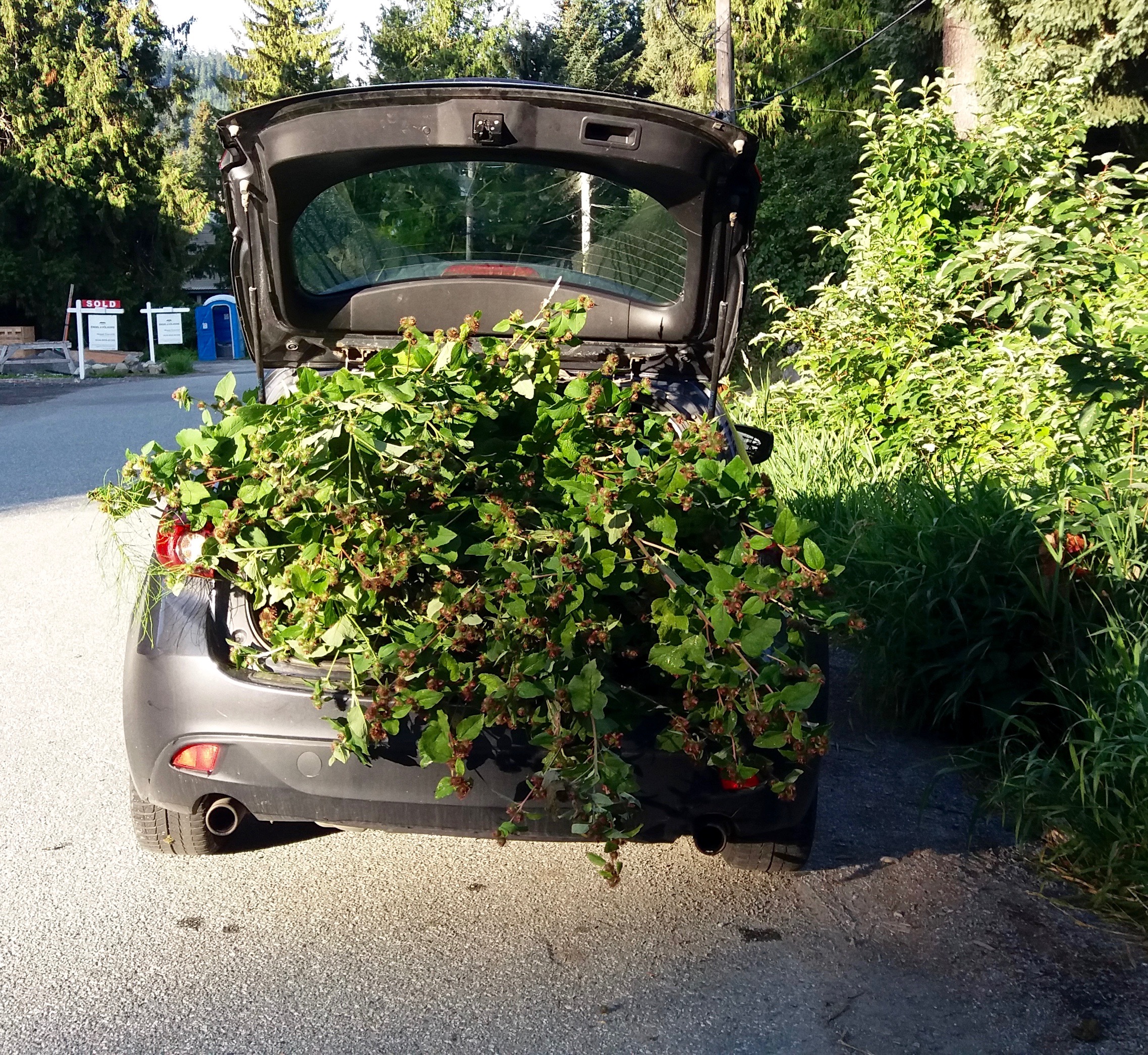
    This summer at my partner’s urging, we adopted a section of the Valley Trail to keep clear of the wildly tenacious burdock plant (as part of a Sea-to-Sky Invasive Species initiative). We would head out with clippers, gloves, a tarp and shovel and spend a few hours clearing a section. Before long my partner extended our range to the whole neighbourhood of Creekside and we removed seemingly tonnes of green matter.

    OLYMPUS DIGITAL CAMERA

    In his mind the project was an eradication of a pesky plant; in my mind it was a type of guerrilla gardening, another act of tending. Instead of planting anything we were creating space for native plants to return (hopefully). In a way we hoped to ameliorate the heavy human footprint in the neighbourhood as seeds (via burrs) are often moved by humans and their canine companions. In some places the burdock was growing dense, thick. Walls of clinging burrs can limit passage for berry-foraging bears and small winged animals such as birds and bats can become trapped and even die in the tangle.

    20190814_182001

    I had moments lamenting a summer spent in the ditches, thinking  “What on earth are we doing out here, getting clubbed in the head and tangled-in-burrs instead of bbq-ing or at the lake” but then I’d see the street or patch that we’d cleared.

    20190820_075158

    On some levels it felt never-ending but on other levels, it mattered. The caring mattered. And in the long run, it deepens my relationship with this place we call home. 

    OLYMPUS DIGITAL CAMERA

    I can’t pick up every piece of garbage I see, nor do I want to, but as I sit here in an airport lobby a bird is stuck indoors—flying around, trying to find an exit. It perched on the seat across from me and swivelled its head, looking for the way. I don’t always know how to work through my grief about the current state of the planet or the plight of creatures we share it with,  but I do know that small acts of tending, of caring, seem to be a window out. 

  • Tips and tricks for starting seeds

    Tips and tricks for starting seeds

    With the promise of spring just around the corner, starting seeds initiates the growing season. Nothing conveys more optimism and hope for the future for a gardener.  Seeds are amazing, wonderful little specks of embryonic life.They are relatively easy to start, but these few guidelines can increase success.

    1- Store seeds properly in a cool dark place. It sounds detrimental but apparently the deep-freeze is best. That’s how the seed banks preserve them.

    2- Read the package for info, or better yet Google it. This will tell you timing, depth and whether they need light (sprinkle on top) or darkness (cover with newspaper). Some seeds have special requirements such as pre-soaking.

    3- Check the date packaged and find out how long they are viable for. If you’re not sure you can pre-germinate them in wet paper towel.

    4- Make sure you have the appropriate-sized container with drainage holes. Generally bigger plants and seeds will need bigger containers.

    5- If you are recycling containers, always wash and disinfect them with diluted bleach or hydrogen peroxide to kill moulds, bacteria, diseases, critters and their eggs.

    6- Always use a fine sterilized potting mix (peat moss, perlite and vermiculite) or peat pucks. Never use dirt from outside or recycled mix. All it takes is a few eggs or spores to create an infestation indoors. If you do encounter bugs, isolate immediately, discard or treat with insecticidal soap.

    7- Use a tray without drainage holes to capture excess water and to encourage roots to go down to get it.

    8- Line the bottom of the tray with perlite to provide aeration and somewhere for the roots to thrive should they outgrow their container. This is especially useful when using peat pellets.

    9-Grow more than you will require, there will usually be casualties and you can always trade or gift them. A staggered seeding schedule can increases your odds and provide a varied harvest in the future.

    10- Cover with washed sand to fill in the nooks and crannies. Newly sprouted seeds will easily push through this layer. When the sand dries on the surface they need water. Never overfill the container as the water will run off instead of soaking in.

    11- Label and date them. It’s easy to forget what you started if you have many trays going. Be patient. Some seeds take weeks to sprout but most are 5-7 days.

    12- Place somewhere with bottom heat until germinated. A heat mat or on top of the fridge works great.

    13- Cover with a dome or plastic film to retain humidity and heat.

    14- Use a spray bottle to keep starts misted and let water percolate to the bottom of the tray. A watering can will probably be too much for the sprouts.  The larger the plant and container the more water it will need.Never let the soil dry out, but also don’t over water.

    15- Place in a bright spot but out of direct sunlight. Place a fluorescent light a few inches above. This prevents stretching. A timer on 18hrs will promote more growth and give them a few hours to rest.

    16- The starts will eventually need ventilation, opening a window is good but an oscillating fan on low will help stiffen the stalks and prevent mould and damping off (a condition where the plants rot and fall over at the base from cold, damp soil and stagnant air).

    17- Tall plants may need staking – wooden skewers and tape work great. Pinching the tops can also promote a shorter bushy habit.

    17- Up-pot or transplant as soon as they outgrow their containers.Make sure there is no risk of frost before putting outside.

    18- Acclimatize them by slowly increasing light and decreasing temperature.
    Harden them off before planting by putting them out in the day (weather permitting) a week before slowly increasing duration.


    19- Feed them every second or third watering. Liquid seaweed is great – it has all the micro and macro nutrients they need at first. Start with 1/4 strength and slowly increase dosage. Remember, potting soil has zero nutrients.They can only survive so long on their own stored energy.

    20- Treat them like helpless, fragile babies, after all thats exactly what they are.

    Good luck and happy gardening!

  • Taking My Own Medicine

    Taking My Own Medicine

    Every October I sort of lose my mind. I could choose to call it seasonal affective disorder, depression, pieces of shadow I have not eaten. But I am careful not to put it into any of these neat little boxes, because then I would stop extending my most compassionate curiosity toward this strange seasonal storm. I want it to remain a wild thing, an unknown tempest of fury and flying sticks, because every time it shows up it serves a purpose. I’d even go so far as calling it sacred, because each time I allow it to sweep my floor clean, something I have been praying for enters.

    There’s a pattern here. A seasonality. Every October, I used to migrate like a swan. As soon as the last of September’s warmth sank over the horizon, I blew up my life, put the pieces in a backpack, and left. Later, when I stopped traveling to far-off countries and instead moved in a series of lunges across the North American continent, October became the month I put everything I owned into my car (or my truck, or a suitcase in the underbelly of a Greyhound bus) and drove until I hit a coast and had to stop.

    Now that I’ve rooted myself in the kind of life that contains four horses, one sheep, one pig, one dog, twelve ducks and two roosters, the ferocious energy of THE MIGRATION THAT SHOULD BE HAPPENING no longer blows me across the continent. Instead, it bowls me over. This year, I looked out over the crazy abundance of harvest season, my belly full of squash and roast duck (all the incredible generosity of the natural world!) and was so irrevocably angry that nothing made sense anymore. The anger burnt until there was nothing left but nothingness. While all around me trees dropped their leaves in an incredible display of letting go, I was furious at them for making it look so easy. This is insane, no?

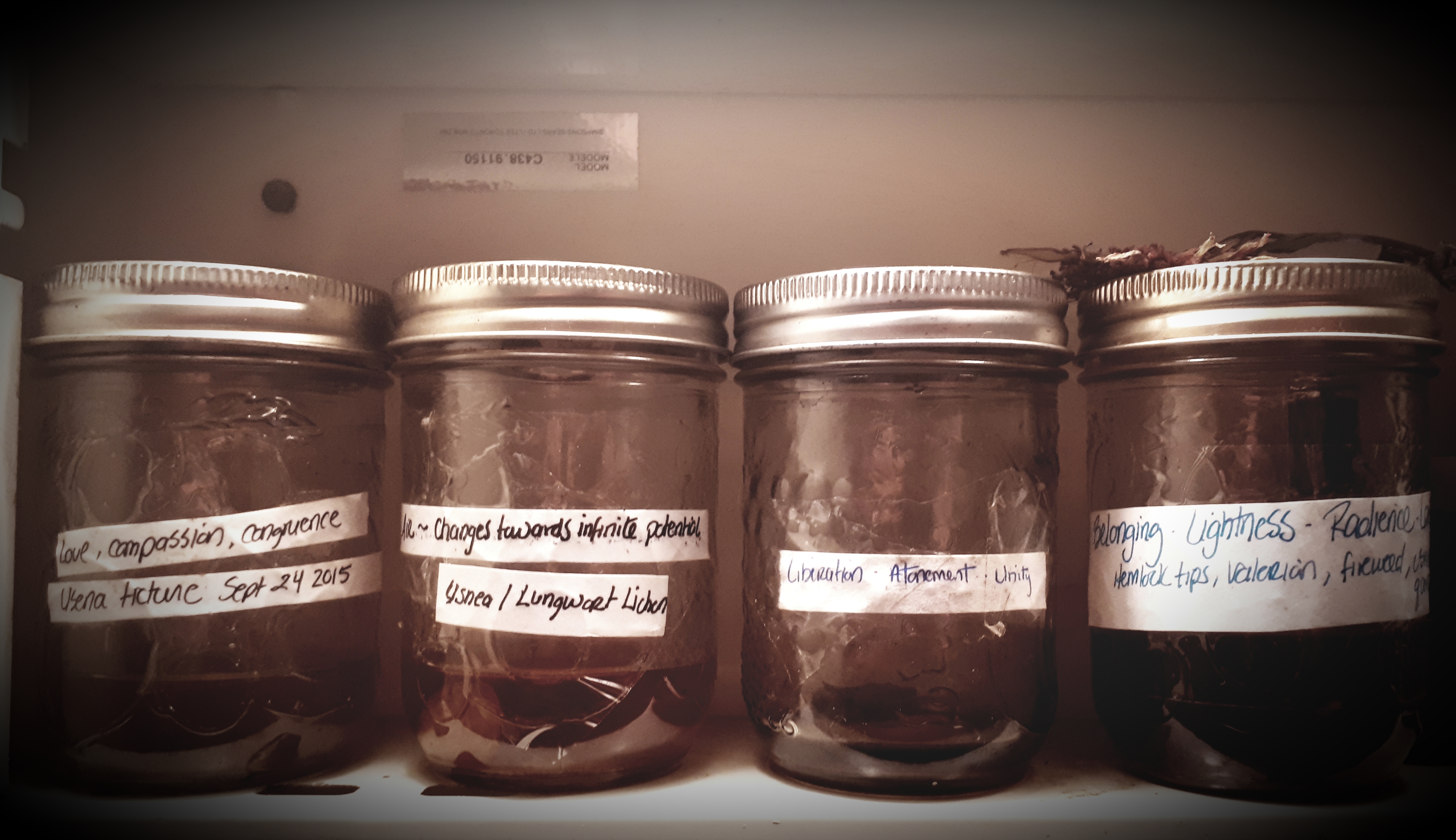
    How does this connect to Pemberton food culture, you ask? Well, it doesn’t. But it does. Because a couple of days ago, before this year’s particular loss of mind levelled out and let me think with something akin to clarity, I opened my medicine cabinet and saw this:

    medicine cabinet

    “This” is the library of wild-foraged tinctures I’ve created over the past 4 years. (Their labels are double-sided, so the essence of the words can seep into the medicine.) As I read their labels, I realized something: I created each of these medicines in October. Each was created as a support for weathering that particular year’s energetic storm. As I felt into their contents, I realized that looking at the interior of my medicine chest was like looking at the growth rings of my own evolution, as well as my connection to this wild part of the world I call home.

    2015: Love, Compassion, Congruence. Usnea longissima: the long, delicate single strands of lichen that hangs from trees like the animate glowing trees in Avatar. Potent antiviral and immune support, grows only where the air is pure and the forests contain old growth.

    2016: Changes toward Infinite Potential. Again Usnea longissima, this time with Lungwort Lichen (Lobaria pulmonaria.) I was still working with air beings, still striving for lightness. This one recognized the animus of the invisible transmission of air as connector between the animal and plant realms and between all beings. (If I breathe in air a tree exhaled and then YOU then take in the air I breathed-)

    2017: Liberation. Atonement. Unity. This was a graduation ceremony from air to earth, something I created specifically when I moved from Squamish Valley to Pemberton. Devil’s club root and bark (adaptogen), willow bark (for deep pain and calling in receptivity and remediation).

    2018: Belonging, Lightness, Radiance, Love. This one I made in secret after hiking up to Tenquille Lake with Pemby herbalist Evelyn Coggins this summer. We were not supposed to take any plants. (Evelyn, I am sorry I am so terrible at obeying rules.) There’s a chance a few flower heads of Valerian and River Fireweed (along with a few hemlock tips, a piece of old man’s beard (another Usnea!), and a piece of quartz may have made their way into my pocket on this hike. (Barely a handful of plant matter, I swear…) Covered in 100 proof vodka and shaken every day for 20 days, this one is light and floral but POTENT. Holy $^%&. The first time I tried it I almost fell asleep in the library. It’s for taking before bed, to encourage new neural connections to form through dreams…

    Then I had a conversation with myself that I’m embarrassed to disclose. But I will anyway, because I think we all have these sorts of conversations from time to time. It’s just not something we talk about.

    “Well Kera, you should try to remember to take some of these. That was the point of making them.”

    “Humph.”

    “??”

    “Oh, right. Okay, okay.”

    “And you know that St John’s Wort tincture you have in a mason jar under the kitchen sink? You should take that too. Because you made it SPECIFICALLY for coping with Octobers. Remember?”

    “Um, yeah. Yeah I did.”

    I did. I do. I am. Taking them. Ten drops in the morning of Liberation/Atonement/Unity and 6 drops of Belonging/Lightness/Radiance/Love before bed. Could the prescription be anymore poetic?

    Pharmaceutical companies, take note. You could do better.


  • How do you explain a seed to a three year old?

    How do you explain a seed to a three year old?

    “Tell me more about seeds,” asked my three year old, way back when. It was spring. We’d been mucking about in the dirt all morning, depositing tiny treasures in the warming earth.

    IMG_5422
    Now 5, even more helpful on the seed front.

    IMG_5434IMG_5438IMG_5439

    A seed is an inkling, I wanted to say. It is its own ambition and instruction book, all bundled into one. It is a packet of information. It is your heritage and your birthright, little man, even though you are inheriting a world in which the control of more than half of the world’s seed stock has fallen into the hands of a few mega-chemical companies. Some people call that bio-piracy. But I don’t want you to know about this yet. Because thinking too hard about these things makes me want to crawl into bed, pull the duvet over my head, and refuse to get up again.

    But you, Small, you make me want to sit on my haunches in the warming earth, with some trowels and forks and little packets full of seed. You make me want to cajole a beautiful harvest out of the little square of world I find myself inhabiting, and so, every spring, we start at it, with just a handful of seeds and a fistful of hope.

    IMG_3745

    And by this time of year, I look at the Life Force asserting itself in my garden, and feel it coursing through me, as I pick strawberries, admire the calendula, tug up a radish, measure the height of the sunflowers just by standing next to it and gazing up… Hope. Hope. Hope.

    (And weeds. Of course. Let’s not get too precious.)


    “Every young person should recognize that working with their hands is not a degradation. It’s the highest evolution of our species. Start a garden. Create a playground in the way you grow food. Save seeds. Cook. Create community. We are not atomized producers and consumers. We are part of the Earth family. We are part of the human family. We are part of a food community. Food connects us. Everything is food.” ~ Vandana Shiva

    Thank you to Evelyn Coggins for sharing this video with me.