One of the few businesses that has and will continue to thrive throughout the Covid crisis is the garden and small farming sector. The sudden interest in our food security, sustainability and living off the land is at a level I have never seen before. This is great. It is something that anyone involved in small farming has been advocating and working towards for a long time. I have seen the progression from the early farmers market days, trying to convince consumers what organic meant and that local was best, to the vibrant markets we have now. It’s been a slow and steady growth, business-wise. Something is different now – maybe self-isolation has give folks time to think about what’s really important in the game of life, how vulnerable and dependent on the system we are.
I would never discourage anyone to garden. Even a few patio planters, home landscaping or a herb garden can bring anyone joy. Warning, it can be addictive. There’s always more to learn. It’s grounding and healthy for body and mind. Do it.
What I’m seeing as the result of the pandemic, is a mad rush to become self sufficient in a very short period of time. People are “panic buying” chickens, livestock, incubators, fencing, potting soil, seeds and any garden supplies as if it were toilet paper. As a side hobby, gardening is awesome, but the reality is you will most likely spend more on retail supplies and work hard for a small harvest. You will have successes and even more failures. You will enjoy the fruits of your labour so much it will seem worth it. Unfortunately, it won’t make you self-sufficient right away. Sorry.
I’m not quite there yet, myself and that’s after 27 years of homesteading, with 5 years of schooling and lots of related work and business experience. My first veggie garden was in 1994. It was a lot of work. I had mediocre results. There was no Google. I winged it. I decided I would try to live off what I grew. I lost 50 lbs, before I gave in to groceries and meat. Not advisable as a weight loss diet.
I don’t like bursting people’s bubbles, because I have always said I live in one myself. I have learned mostly through trial and error, and it pains me to see others about to make the same mistakes I made through naivete and inexperience. I have the need to explain to those new to this way of life that it’s just not a short term process that can be accomplished in a season. For most small business plans, they say you shouldn’t see a return on your investment for 2 -3 yrs. For small farms change that to decades. Available land, infrastructure, supplies, labour and overhead will eat into any profits. If you plant a fruit tree you might not see a reasonable harvest for 8-10 years. Soil needs to be built up over several years. You need a rough plan, expect slow incremental growth and lots of long term commitment.
It’s all possible with patience, capital, sweat equity and a good team.
Study it as much as you want, it’s endless. The reality is you will inevitably learn from your mistakes and Mother Nature will always throw you a curveball or two.
My advice is to start small with realistic goals and low expectations. Think about by whom and how everything will be maintained, especially if you plan to return to your regular work in the future. Don’t “put the cart before the horse” by buying livestock before you have fencing and shelters or plants before your beds are prepped. Be patient. Timing is everything. Ask questions. Don’t overspend on fancy tools and gadgets from Lee Valley, exotic plants, and pricey greenhouses. Do a few things well instead of trying everything. Be efficient. Think about how you can work with nature in the simplest ways. Don’t bite off more than you can chew. Enjoy, it’s a long ride.
‘It is the heart that always sees, before the head can see.‘ – Thomas Carlyle
The hawthorn trees are budding in the garden and will probably flower in May, well before we are able to safely move around our community once again. In its way, hawthorn is the perfect metaphor for our time.
In the Celtic Tree Oracle, the hawthorn card advises restraint, waiting, keeping to oneself and focusing on mental rather than physical activity.
Hawthorns will vigorously defend their space. Who hasn’t run afoul of one of these trees? If you push forward too quickly with reckless disregard for the fearsome spines lining the branches, some of which can be an inch long, they will pierce your skin to produce a deep, ragged tear before you can stop and extricate yourself. My entire family has lost flesh and blood to local hawthorn.
Conversely hawthorns can also be generous with their gentle medicine. Across time, extracts of hawthorn have been used as medicine for the human heart. Just like every member of this community, hawthorn can be hard-hearted if its personal space has been invaded and soft-hearted if treated with respect.
We are heartsick or broken-hearted these days. We wake expectantly to the possibilities of the day only to remember with sinking hearts that the enemy is still within our gates and our lives are irrevocably altered.
The neuroendocrine and electromagnetic functions of the heart are well documented but only in literature and legend is the heart widely accepted as an organ of perception and communication.
“We evaluate everything emotionally as we perceive it. We think about it after. “
– Doc Childre
Perceptions of the heart drive the tears, panic and anxiety that are never far from our waking hours and often stalk the vivid dreams of our nights as well.
According to Chinese traditionalists, the heart stores the shen. The notion of shen is roughly equivalent to the spirit. If the heart is sick, the spirit becomes homeless to wander the body without focus. Its energy is scattered and every organ system is affected.
Practitioners of Western medicine have long observed that depression can be symptomatic of heart problems. When the heart is made healthy again, the depression dissipates. In both philosophies then, medicine for the heart is medicine for the entire physical body and the spirit.
I vividly recall one of my teachers saying years ago that everyone over the age of 50 years should be taking hawthorn. This one statement permanently etched in my brain the tonic and remedial properties of hawthorn tea.
Medicine for our hearts can be easily made from hawthorn. Leaves, flowers and berries contain significant levels of oligomeric proanthocyanidins (OPC’s) – the good stuff in brightly colored fruits and vegetables that may protect the heart and cardiovascular system. Happily for our purposes, these small condensed tannins are readily soluble in hot water.
If you are lucky enough to have access to a hawthorn tree, you can harvest the leaves and flowers in spring and the berries in late summer to extract those OPC’s either into a tea or a decoction that will help you to take heart in these trying times.
When harvesting hawthorn, I learned early on to form a clear intention, approach the tree slowly and listen for permission. I have been taught since childhood to never take without asking and to ask only for what I can use.
You can prepare a tea from fresh or dried plant matter. Simply chop or grind the leaves and/or flowers and soak in hot water that has just come off the boil. For dry herb try 1 teaspoon to 1 cup water and for fresh try 1 tablespoon to 1 cup water. Steep for at least 15 minutes with a towel over the teacup or pot to keep it hot.
For berries make a decoction by bringing 3 tablespoon fresh or 1 tablespoon dried to a slow simmer in 3 cups water for 20-30 minutes. Bubbles should be barely breaking the surface in the pot.
Strain your preparations into a cup and add any flavorings you want, such as honey, lemon or cinnamon. Teas should not be prepared and refrigerated for more than 36 hours as they may start to ferment.
As for what you should be doing in this time, I suggest you set aside your thoughts and words to follow the perceptions of your heart for it knows the path that is right for you.
Let’s talk about the cost of a dozen eggs. What I see in our area is that most farmers sell a dozen eggs for $5. A few farmers sell for $6 or $7, not many. In the grocery store prices range from $3 to $8.
I have been selling eggs for $6 and most people feel comfortable paying that price. Here’s the thing, I do not make any money off selling eggs. I basically sell eggs for the People. The People love farm, fresh eggs! That’s why I do it. I even try not to use eggs in my home so that I have more to sell. It is not because I’m being greedy and want to make more money but because I need to sell them all to break even. Yes. you heard that right! If I sell the majority of the eggs I collect, I break even but only with the cost of feed.
I have been using an app called “Count My Eggs” for the last 40 days. I can input how many chickens I have, how many eggs I collect each day, my expenses, and my sales. The app tells me that I have collected over 500 eggs (chicken and duck) and sold over 450 eggs. It shows me that I have spent $2 more on feed in last 40 days than I’ve made in sales. I lose money. Having said this, I do have eggs in the incubator and if I had sold them I would have made a tiny bit more on egg sales. Had I sold those 3 dozen eggs I would have made about $0.45/day of income. Yep, raking in the big bucks!!
I have the same feed expenses all year but chickens don’t lay all year. The math is about $6.64/day for about 40 laying hens and a few roosters all year round regardless of how many eggs they lay/day. In the winter they hardly lay and I use a light the coop during the winter to try and encourage laying (so a bit of hydro). The chickens take a lot of laying breaks throughout the year (if it’s too hot, or too cold, if they’re molting, if they’re stressed out, if there isn’t enough daylight, a hundred reasons!). No eggs, no income…but they keep on eating. There will be a bit of a flux in income for the next month or so selling day-old chicks but it won’t even begin to cover what I’ve spent feeding hens that aren’t laying.
Keeping chickens takes a lot of time, every day. I am not compensated for the hours spent feeding and watering, cleaning coops and water jugs, collecting and washing eggs, or building fences. Also anything extra, like sawdust or wood pellets for the floor and nesting boxes, replacment feeders, or the cost of fencing materials when needed is money out of my pocket.
Raising chickens is not a money maker, it is a passion project (like most farming is). I love being able to provide folks with eggs from happy, healthy, free-range chickens but I do so at a great cost to my bank account.
Please remember how hard I work every day, all year to provide people with eggs and please keep this article in mind when you are asked to pay a bit more for a dozen eggs. I do it all for you!
In these strange times I have been waiting (impatiently) for the frogs to start croaking. First come the pussy willows, next comes the frogs. And tonight I heard them – over on Urdal Road. They will slowly migrate west to Collins Road and Pemberton Meadows Road soon but for now you have to tilt your ears to the east. I always am excited to hear the first frogs, but this year I have been really anxious for them – a sign that outside of the human species, life goes on as normal.
Thank you to our farmers. This pandemic and crisis has re-alerted me to the importance of food security. When I first moved to Pemberton 16 years ago Anna Helmer explained all this to me. I hadn’t a clue, being raised in Vancouver and buying my groceries at Safeway. I didn’t know what the ALR was. “Pave paradise, put up a parking lot”, sang Joni Mitchell in Big Yellow Taxi. More recently, she wrote in her song Shine: “Shine on fertile farmland buried under subdivisions”.
We need farmers. We need farmland. This cannot be outsourced. Farmland must be protected. We are learning this now during this crisis. The hard way.
When the Hellevangs recently announced that they were selling big 50 lb bags of Yukon Gold potatoes I jumped on it. And for the last 2 weeks we have been eating a lot of baked potatoes. I visited the UK for the first time nearly 30 years ago, and my Mum and I stayed with her friends who had a very young and “highly-spirited” (bratty in our view) child. She would only settle down with the promise of a “jacket potato”. At a village tea room or at their home these jacket potatoes seemed to have magical powers.
Not sure why it’s taken me so long to embrace the simple but sublime jacket potato – but if you have some chili on hand (my recipe for deer chili is posted on this blog), plus sour cream, chopped green onions, butter and crumbled bacon, and of course some beautiful Pemberton Yukon Gold or Russet potatoes, you have such an easy and delicious meal.
Frogs, farmers, potatoes. Pemberton we will get through this!
Pemberton Baked Potatoes: (serves 4)
4 large Russet or Yukon Gold Pemberton-grown potatoes, scrubbed well.
Method: Using the tines of a fork, poke the potatoes in 5 or 6 places.
Bake 1 to 1.5 hours at 350F. (Time depends on size of your potatoes.)
Serve with butter, sour cream, green onions, bacon bits, or chili.
The past few weeks, with the arrival of COVID-19 to our piece of the world, has caused me, as a normally un-anxious person, to become riddled with anxiety and a sense of foreboding, as I know is the case with many of my friends, colleagues and neighbours.
Working in the hospitality industry in Whistler, with hotels temporarily ceasing operations and restaurants and bars closed to guests, means that is time to pull up the boot straps and find a way to both save money and release some of that tension.
My go-to is baking and I do happen to have a banana bread in the oven as I type. But, as the hotel restaurant where I work had to close suddenly, there was a lot of food that was potentially going to go to waste and was instead given away to the staff, primarily to those who were just about to receive a temporary lay-off notice. 😦 I did, however, manage to get my hands on some yogurts and this recipe for Maple Granola is one that I have been meaning to make for a while. So now my daily breakfast consists of yogurt parfait with half a banana and, if I really needed a snack, the granola would work for that too.
FYI I didn’t actually have any sunflower seeds in the cupboard but did have some linseeds so added those in instead. However, I’m pretty much sure you could add in whatever seeds, nuts and dried fruit you prefer and it would still taste delicious!
Ingredients
(Makes 8 cups)
3 cups large-flake rolled oats
1 1/3 cup natural almonds or pecans , chopped
3/4 cups pepitas (pumpkin seeds)
3/4 cups sunflower seeds
1/3 cup sesame seeds
1 teaspoon cinnamon
3/4 teaspoons kosher salt or sea salt
1/2 teaspoon ground ginger
2/3 cups maple syrup
3 tablespoons canola oil or melted coconut oil
1/2 cup coconut chips (optional)1
/3 cup dried cranberries
1/3 cup raisins
Directions
Preheat oven to 300°F.
In large bowl, stir together oats, almonds, pepitas, sunflower seeds, sesame seeds, cinnamon, salt and ginger. Add maple syrup and oil, stirring to coat; spread evenly on baking sheet. Bake until golden brown, stirring every 15 minutes and rotating pan halfway through, about 40 minutes. Let cool completely in pan.
Sprinkle with coconut chips (if using), cranberries and raisins.
I don’t intend to downplay the seriousness of the present situation nor am I arrogant nor ignorant enough to suggest this will not affect everyone, including ourselves. My partner and I have been laid off over 2 months early and we rely on this income to get us through the lean planting and prepping season where were busy working and buying supplies with little income. We will have to adapt – something we are familiar with. “We will get by, we will survive”: an anthem and lyric from my favourite band.
Rural dwellers, being more isolated, have an advantage right now and farmers are optimists – they have to be, as every year poses new and unforeseen challenges. Different hits and misses, but things always seem to work out in the long run. Just planting seeds, building soil or incubating eggs is a sign you believe in the positivity for the future. Theres no short term gain. It’s all for a benefit sometime down the road.
Homesteading, by definition, is literally staying and working from home, something all others are being asked to do, many out of their comfort zone. Many of the practises the general public are being asked to do are commonplace for us. Farmers can’t be germaphobes, they are constantly exposed to bacteria, both good and bad. They also understand that such exposure builds up their immune system, same goes for plants and livestock. At the same time most understand the importance of disinfecting propagation rooms, equipment, and keeping stables and coops clean to prevent an outbreak of pests and diseases, which can get out of hand quickly. Once a problem is identified, it’s important to act quickly as the situation increases exponentially. Organic farmers will resist the temptation to completely nuke everything with chemicals – the idea is to regain a sense of balance, so nature can do the rest. You never get it all, just slow down and manage the overwhelming progression. Patience and persistence are the key. Sound familiar?
Quarantine is another age-old practice. It’s always a good idea to separate sick plants and animals for the greater good of the rest. The difficult decision to cull is something we all have to deal with. As Darwin observed long ago, it’s the survival of the fittest that lets the strongest genetics evolve. Sometimes you you have to let something special go, so others can live.
Organic farmers know that Mother Nature has a tendency to spank those who challenge her natural balance. The worst outbreaks occur in monocultures and factory farming. Mad cow disease, avian flus, E coli, listeria and now Covid 19 (apparently originating a dirty Asian market) are all examples of problems from an overcrowded, unsanitary, misguided system and unnatural methods.
Stocking up, preserving and being prepared are the cornerstones of homesteading. Pantries and freezers are like safety deposit boxes. It’s a currency that rarely devalues and becomes more valuable when times are tough. It’s something that is an ongoing process, not something you rush and do over a weekend. Toilet paper however, is not a survival item. Any naturalist knows water, newspaper, moss or leaves will do in a pinch, pardon the pun.
I’ve sometimes questioned my decision to live off the land, knowing if I did the math it would be much more economical to use my skillset and work as a landscape designer or operate heavy machinery, and buy food with a regular salary from regular sources. These options however didn’t offer to feed my soul. Working outside with nature is my happy place. In times like these, I have no regrets.
So it’s business as usual on the farm, with the always-lots-to-do list to keep busy. We will easily and naturally do our civic duty to self isolate, keep our social (media) distance, practice hygiene, stay active outdoors, and offer and accept help from the community. I just cleaned the chicken coop, I washed my hands thoroughly.
I was originally going to call this post “A Recipe for Ordinary Wonder.” I’ve already written about wonder here, and while I think it’s essential, it remains a little ephemeral. It slips beyond the edges of our understanding. I feel the medicine of this particular moment needs to be earthy, grounded, real. Needs to be practical enough to lift us out of our fear and isolation. It needs to come in bite sized pieces, like good dark chocolate.
I’m a horse and nature based teacher. Or rather I was, until the recommendations for social distancing led me to decide to cancel my spring break camps and enter self imposed quarantine as I’ve taught students from all over the Sea to Sky corridor (and the world, via Whistler) over the last two weeks. Yesterday while picking out the paddocks, I asked myself this question: if I’m not able to teach in person– to create the kind of meaning filled and deeply felt transformative encounters between horses, humans and land I feel we so badly need right now– what can I offer through other means that can give people the skills to create experiences for themselves?
There’s a lot of writing swirling around about reconnecting and seeking stillness right now. What I think we’re being invited to do is to expand our consciousness past our own perspective. To broaden it past the narrow road of our individual lives and the lives of our families; to open to the collective whose voices move close against the boundaries we’ve made around ourselves. As I write this, an image comes into my mind of a dog shaking its head: one of those proper shakes where their ears flap up against the sides of their skull, and you can almost hear their brain rattling around in there, rearranging their neural pathways.
These times we’re in are like that. We’re being shaken out of our patterns. We can choose to steel ourselves against what’s happening and create more rigidity in response to change (which we know we’re going to see a lot more of in this lifetime…) or we can get curious and explore it as an adjustment in our perspective, an ear shake that opens us to something wider than what we were.
I want to give you a set of tools, something real and grounded and simple, that you can play with. Play with these with your kids. Pull one out each day and see where it takes you. You don’t need anything special. Just your body and the body of the world. Some of them might seem a little silly. That’s on purpose. They’re meant to enliven the younger parts of ourselves. That’s often where our biggest perspective shifts lie and where the more authentic parts of ourselves are buried. They’re also meant to give us the kind of connection we crave right now, an empathetic, felt sense of being known by an other. It’s just that, in this case, “the other” isn’t human. Even better! Nature is endlessly forgiving of our bumbling attempts to re-mind ourselves of our relationship with her. There’s no judgement here. Think of these exercises as lighthearted games, little valentines we can exchange with the more-than-human-world that surrounds us.
If you try these, I’d love to hear about your experiences in the comments. Share your valentines with me. (I promise I won’t judge you either. ❤ )
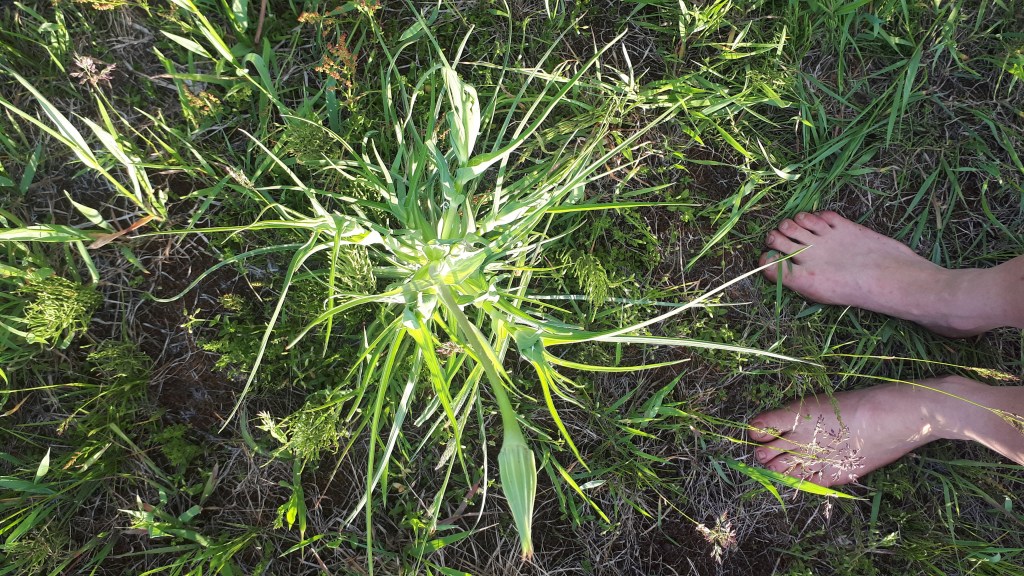
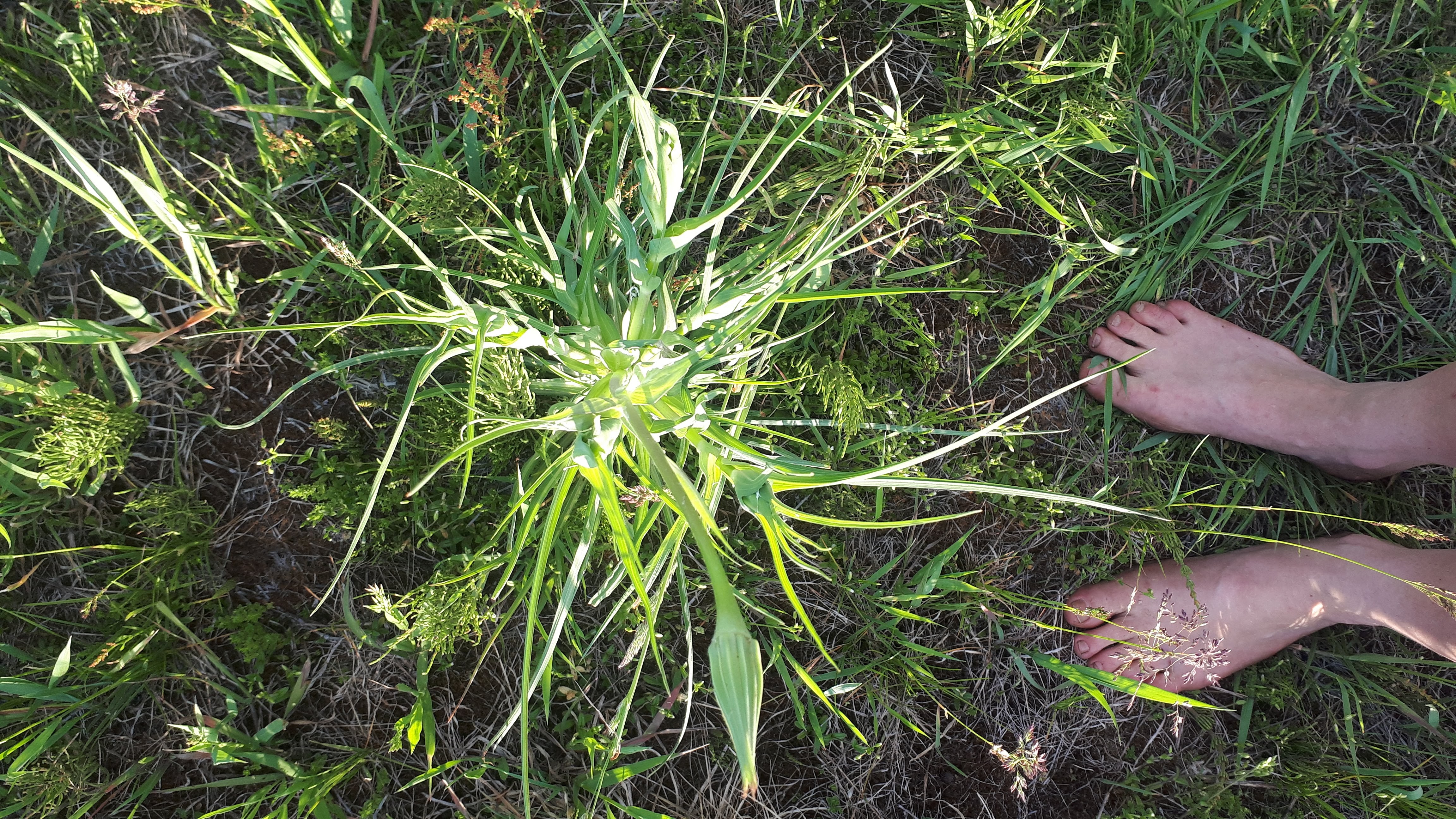
Take off your shoes. And your socks. Find a patch of ground that looks warm and safe and inviting and stand on it. If you want more, go for a little walk. If you’ve tried a warm and inviting patch of ground already, try standing on snow. Try pavement. Try mud. Try exploring a liminal zone by walking from a shadow to sunlight, and track the differences in temperature with the bottom of your feet. Want to level up? Watch my video, “Place Based Walking,” for some ideas. Or walk on some gravel for a free acupressure session. (Top tip: touching the earth barefoot grounds and stabilizes the electromagnetic systems in the body. It literally rewires us to attune to the larger electromagnetic field of the earth, which helps us to come closer to a state of heart and brain coherence. Think of this as your antidote to all the wireless technology we’re saturated with, and the true savasana with which to end your online yoga class.)
Let yourself be touched. The next time you’re out on a trail– or in your backyard, for that matter– notice the shrubs and trees that lean close to the edge of the path. It may be an errant twig that brushes across your cheek, or a cottonwood limb that’s come down across the over the course of winter. Or perhaps a low hanging cedar branch that brushes the top of your head and releases its scent. Just before you move out of the way, stop. Let yourself come into contact with this tree. You are nature touching nature. See how many different trees, bushes and branches you can let make contact with. Try not to do it on purpose. What happens if you turn off the path and into thick brush? Is it easier to find the gentlest way through? Is there something in your walking that becomes a kind of dance? An intimate exchange with the life forms we’ve believed to be inanimate all around us? What thoughts do we dance with in our psychic space in this same way? What reaches always toward us, yet remains unnoticed? What do we cut through in order to continue to travel in the direction we want to go? What does it take for us to be touched by a different part of nature in this way? A rock? A lake? How would we have to move our bodies to make contact?
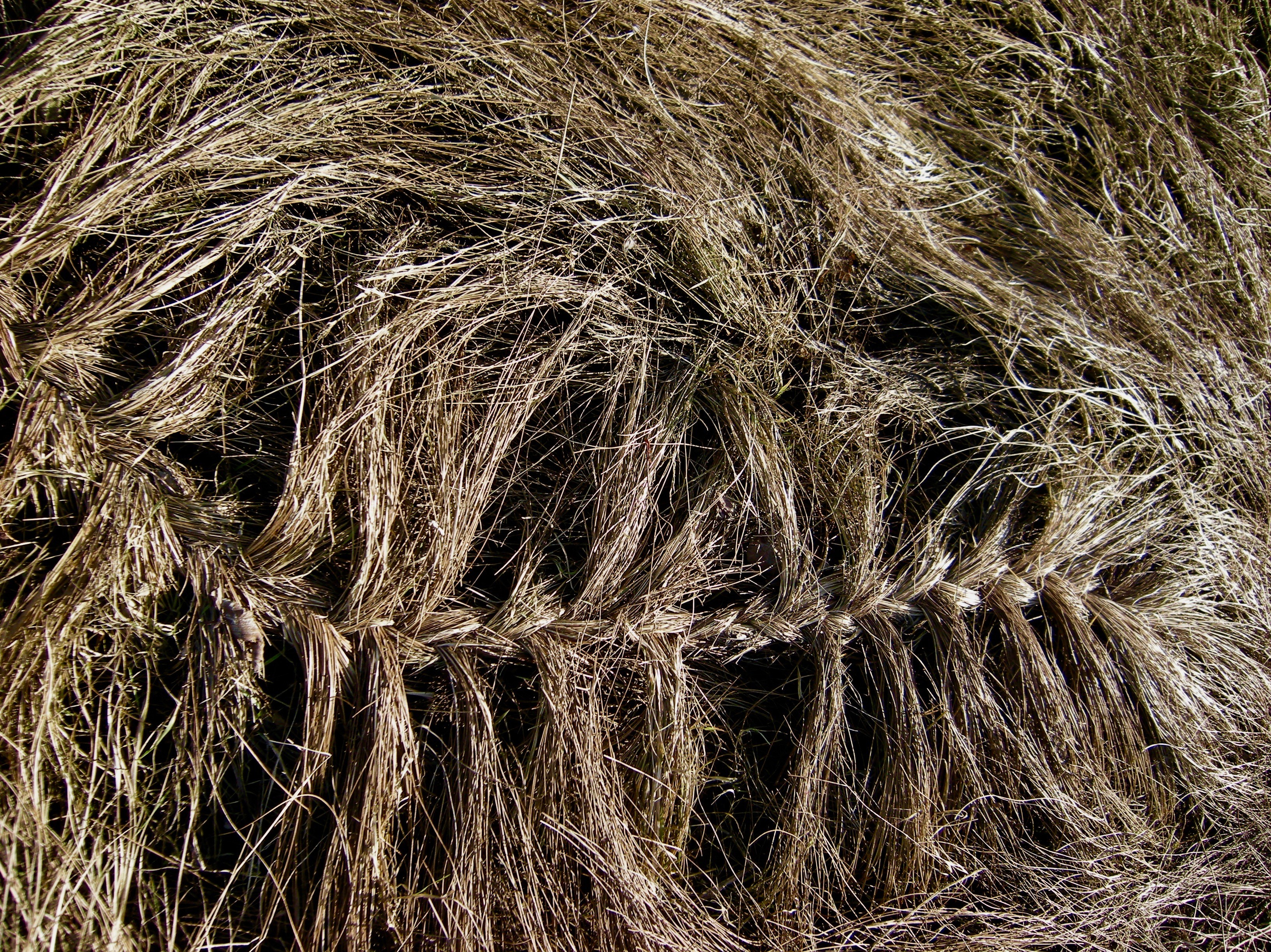
Fall in love with something small. Go outside. You can go to your favourite patch of woods or rock or field, or give yourself a challenge and start on a sidewalk or in the middle of your street. Your goal now is to wander. To meander with no destination in mind until something tiny calls your attention and makes you stop. Look down in the direction of your feet and keep your eyes soft. Look at the trunks of the trees. Look at everything without really looking at it. Keep your attention soft, like a photograph that’s not quite in focus. Wander until something, of its own accord, pulls your attention toward itself. It might be a bright green wolf lichen, or a pattern the compression of the snow has left in last summer’s dried grass. It might even be a chocolate bar wrapper with half of its colour worn away, held to the ground by a fallen stick. Once something tiny calls you awake, then give yourself to it entirely. Bend down and get close. Learn everything you can about it without causing harm. Then stand up, zoom out again, let your attention go soft, and start wandering again until something else calls to you. If you’re with your family or a friend for this, tell each other something you love about the tiny thing you discovered without giving away its identity. See if they can guess what it was. (Top tip: if you can cultivate this kind of “falling in love outside of yourself”, this sense of your attention being called to something of its own accord, it’s the best state of consciousness for finding mushrooms and other medicinal plants, and a profound way to activate our intuition. This form of listening to the being-ness of the world has been essential to the survival and evolution of human beings up until the last hundred years or so, when we started to place our emphasis on the rational, linear parts of our cognition.)
Look up. Go to where there is nothing a human has made between you and the sky and look up. Bring a blanket and lie on a rock and look up. Let the sun heat your eyes behind your closed lids. Sit with your back against a tree and trace the line its trunk makes on the way to the sky with your gaze. Follow that line out into the crown of the tree, as if you were drawing the lines of each branch into the sky with your mind. Or look at clouds and then trace them in your mind’s eye in this same way. At night, look up at the stars. Imagine you are sailing on a ship a thousand years ago and this is the only map you have to guide you into the unknown. Learn a few constellations, or trace lines between the stars and make up your own patterns and give them names. Learn a star or a constellation as a family and know that every time you go outside and look up at it, you are connected. Look up. We need to remember the world is bigger than us again. (PS: I have a secret theory I have only anecdotal evidence to prove, but I’m still going to share it with you anyways: I think looking up in this way– actively tracing and engaging the muscles of our eyes in unfamiliar patterns of movement, specifically looking up into the worlds that exist above the plane human live on– causes our vagus nerve (and our autonomic nervous system, which governs our heart rate, breathing, digestion, hormone levels, AND THEREFORE OUR STRESS RESPONSE) to shift from fight/flight/freeze back to social engagement.)
Leave a gift. Make something beautiful out of some bits of nature you find around you. (Three year olds are great at this, as they haven’t yet been trained out of this kind of reciprocity with their environment. ) Arrange a line of pinecones that marches across your street and makes someone else wonder. Create a spiral made out of pine needles for the wind to blow away. Line up twenty sticks from longest to shortest. Write “I love you” in pebbles across the valley trail. It doesn’t have to be profound, and it doesn’t have to be ‘Art’. Making and creativity are part of the basic tenants of humanity. Nature is always taking chaos and creating something more complex and more beautiful. How can we invite some of this elemental and playful creativity into our lives? How do we share our energy with others in ways that add to the glorious mystery of the natural world? Be inspired by the ephemeral earthworks created by Andy Goldsworthy or the morning altars offered by Day Schildkret, but don’t get trapped by the idea that your gift has to be a grand gesture. Gratitude, giving, and making are ancient parts of our being. Make something now, in this field where we’re standing, with just the materials of the field itself, for nature herself to wonder about.
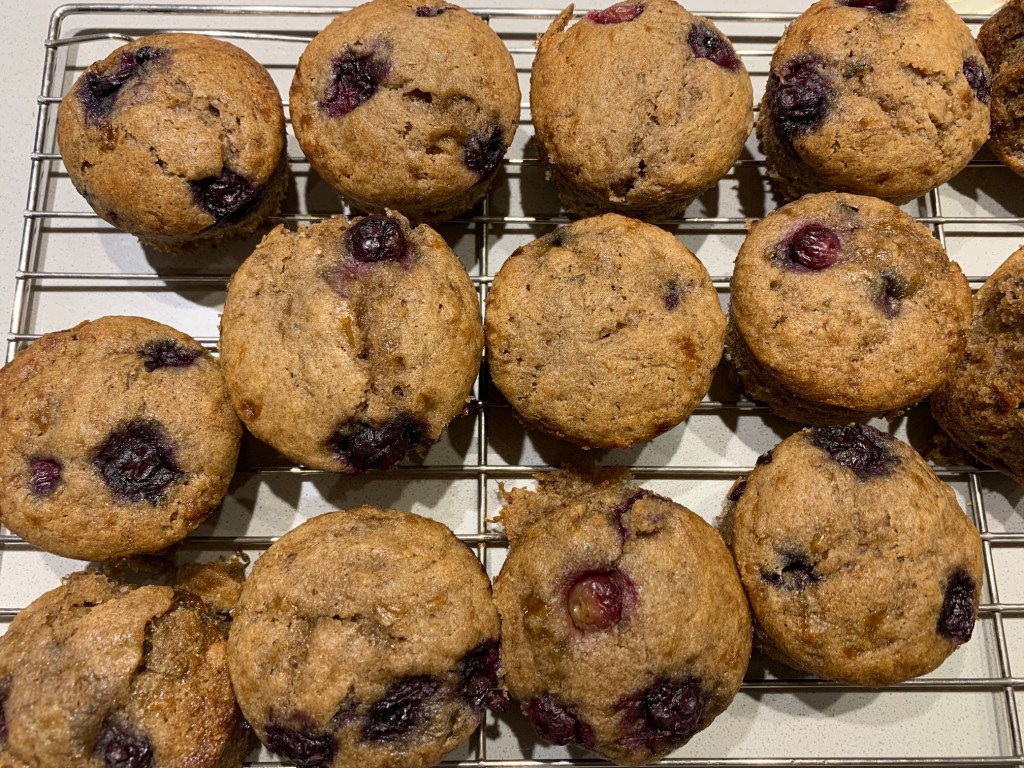
These muffins are a great staple to have on hand at any time of year. And they make good use of “all the Pemberton blueberries you froze last summer”. You did that of course.
Lisa has asked me to explain why I substitute spelt for wheat flour on every occasion. Well, a number of years ago my mother warned me that wheat is inflammatory and can cause arthritis-like symptoms in people after the age of 40. And like clockwork, after I hit 40, sure enough, my hands got stiff after I ate wheat. Didn’t matter if it was crackers or bread: after I ate wheat my hands were stiff the next day.
So it was a no-brainer to switch to spelt. If you can get to Costco, some locations sell Anita’s Sprouted spelt flour which I really like. Some brands don’t work well. I tried the Everland brand from Amazon and my muffins did not hold together at all.
Thank you Mum for this invaluable advice. I hope others will give it a go. Stiff hands and fingers are no fun at all, and it really is an easy switch to transition to spelt. I have no time for white flour anyway. No nutrition content and I prefer the nutty, complex taste of whole grains in most of my baking – with the exception of brownies and birthday cakes!
Pemberton Blueberry Banana Muffins (yield: 15-18 muffins depending on size)
Ingredients:
1 cup plus 2 tbs whole grain spelt flour
2 tbs corn meal
1 tsp baking soda
2 eggs
½ cup grapeseed oil
½ cup white sugar
2 large very ripe bananas, mashed
3/4 cup blueberries
1 tsp cinnamon
1/4 tsp sea salt
Method:
Place mashed bananas, oil, eggs, sugar, cinnamon and baking soda in stand mixer and beat well until combined. Add flour and cornmeal and mix until just combined.
Preheat oven to 350F.
Use a 3 tbs spring-loaded cookie/muffin scoop (I like the OXO brand) to place scoops of batter into buttered muffin pans. (I like silicone muffin pans as they clean easily in the dishwasher.)
Press 3-4 blueberries into top each muffin. (I prefer adding my blueberries this way as then they look nicer but you can always add during mixing process.)
Bake 20 minutes and check for doneness. May need another 5 minutes. Oven temperatures vary so baking times are not set in stone. Enjoy!
** Coming Soon: another cookbook review – thanks to Lisa. I tried one recipe from a very recently-published Japanese cuisine cookbook, but the result was ho-hum so it needs some more time and patience!
The ones that are cold, wet and miserable and you walk the dog only to feel chilled to the bones. Or it’s snowing so hard you just want to curl up in front of the fire with a good book and a huge mug of coffee. The ones when all you want to do is eat comfort food, but with the least amount of effort to make it.
Well I found it in this recipe for Creamy Chicken with Biscuits. 🙂 Place all the ingredients (except the biscuits) in the slow cooker and leave it to do it’s thing for 3 to 6 hours, depending on the temperature setting you choose! Isn’t the slow cooker magic?
And what makes this recipe even better are those biscuits. You could go the extra easy [ie lazy] route and buy some store-bought ready-made biscuits OR you could make up the simple recipe that’s included for Easy Drop Biscuits. Just put all the ingredients in a food processor and mix together. I ended up bringing mine together on the counter so I really felt that I had put the effort in, and because all I really have is a hand blender chopper thing so it doesn’t work quite as well! 😉
Anyway, boy were they worth it! They made the dish even better and merited the 10 minutes it took to make them. Flaky, buttery and oh so yummy.
Ingredients
2 cups all-purpose flour, spooned and leveled
1/2 cup (1 stick) cold unsalted butter, cut into small pieces
1 tablespoon baking powder
1 teaspoon kosher salt
1 cup whole milk
Directions
Heat oven to 400° F.
In a food processor, combine the flour, butter, baking powder, and salt; pulse until pea-size clumps form.
Add the milk and pulse just until moistened.
Drop 6 large mounds of the dough (about ½ cup each) onto a baking sheet.
Bake until golden, 18 to 20 minutes.
Now you know what to throw in the slow cooker on the next cold, wet, miserable day. You’re welcome!
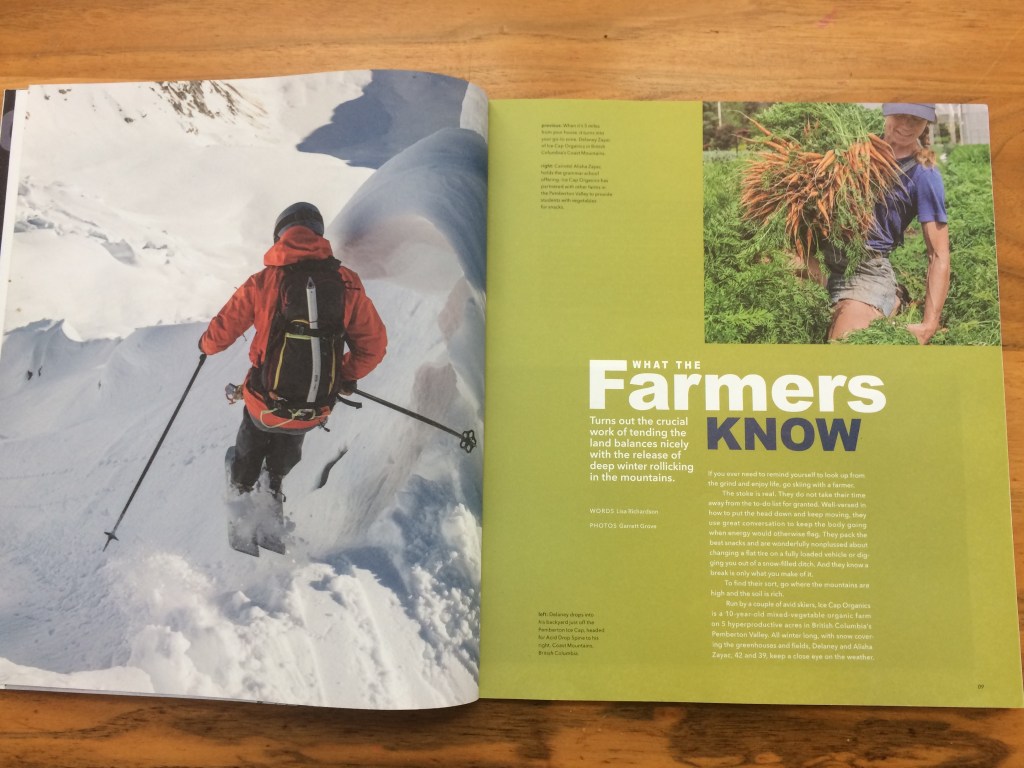
Turns out the crucial work of tending to the land balances nicely with the release of deep winter rollicking in the mountains.
If you ever need to remind yourself to look up from the grind and enjoy life, go skiing with a farmer.
The stoke is real. They do not take their time away from the to-do list for granted. Well-versed in how to put the head down and keep moving, they use great conversation to keep the body going when energy would otherwise flag. They pack the best snacks, and are wonderfully nonplussed about changing a flat tire on a fully-loaded vehicle or digging you out of a snow-filled ditch. And they know a break is only what you make of it.
To find their sort, go where the mountains are high and soil is rich.
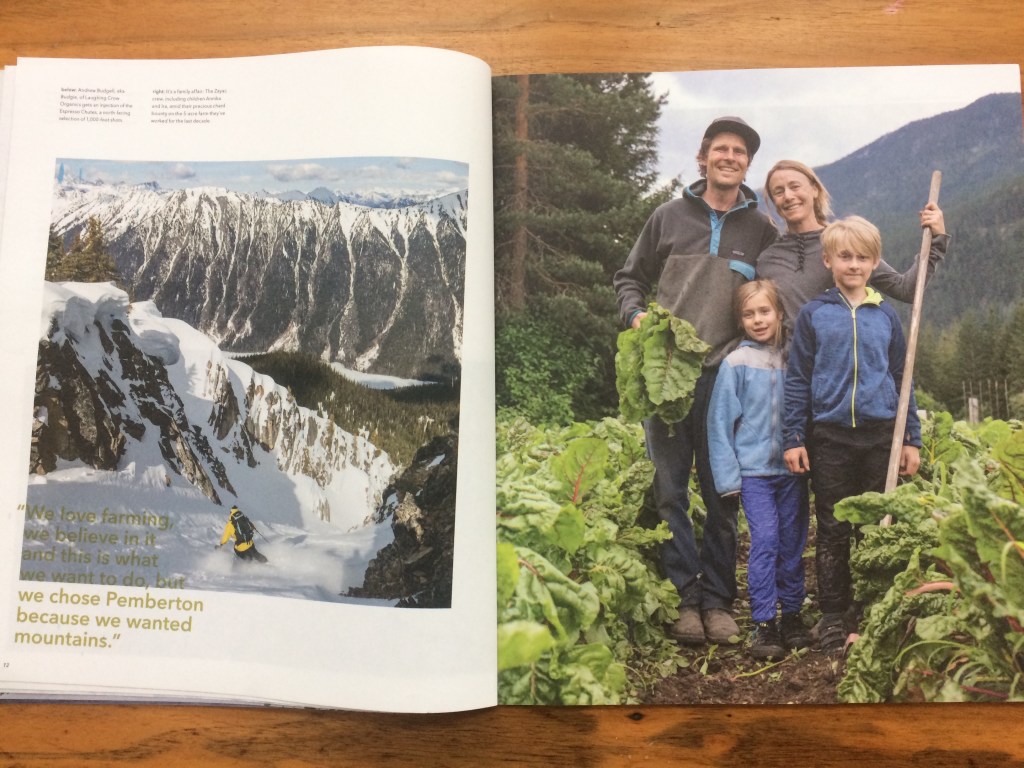
Run by a couple of avid skiers, Ice Cap Organics is a ten-year-old mixed vegetable organic farm, on five hyper-productive acres in British Columbia’s Pemberton Valley. All winter long, with snow covering the greenhouses and fields, Delaney and Alisha Zayac, 42 and 39, keep a close eye on the weather. And whenever the conditions are right, Delaney, is up at 3 a.m., blazing out the door, skinning in the dark with headlamps to pursue objectives out on Miller Ridge or Duffey Lake Road with a small crew of friends. Alisha often opts to show their kids what’s to love about winter.
The volcanic-rich river-silt blessed soil of the Pemberton Valley has earned many farmers’ attention, but it’s the massive Coast Mountains that catch the farming-skiing type. And if the mountains bring folks in, it’s sometimes the farming that gets them to stay—loamy earth beneath 8,000-foot mountains, and living to the sound of glacier-fed rivers.
“It’s why we’re here,” says Alisha. “Winters off is one of the things that drew us to farming,” explains the former tree-planter and agro-ecology scientist. “We love farming, we believe in it, and this is what we want to do, but we chose Pemberton, because we wanted mountains. We canvassed the world, to find places where you have mountains and farmland – Bella Coola, Pemberton, Chile, a couple of places in France.”
Delaney reflects on their decision-making process—a couple of young nomads who were dividing their year into three seasons—university, tree-planting, travelling or skiing. He’d spent his twenties and early thirties skiing over 100 days a year, bumming throughout the Canadian Rockies, Kootenays and Coast Range, and venturing farther afield to the Andes and the Alps. It was time to root down and think about having a family but Delaney knew that without big mountains there was no chance of his calling a place home. Pemberton was fertile, steep, proximate to a hungry market, and permanently set to stun—a place where there are no ugly views.
Now their year breaks into two parts: farming season, and winter. As the farm sleeps, the pair take turns driving their vegetables down to winter markets in Vancouver, a city of 2.5 million people two hours to the south. They make plans, research the latest science and developments in farming, ski, and regenerate. “We work hard in the summer, and play hard in the winter.” Every morning since completing the 10-day silent Vipassana retreat she’s wanted to do for decades, Alisha wakes up before dawn, before the kids, 6 and 8, have roused, to sit and meditate for an hour, watch her mind, and bank some equanimity for the day ahead. Delaney plans his last spring mission to the remote Waddington Range. Bad weather days, they tackle the farm chores, like sourcing an old upright freezer from a Chinese grocery store that they can upcycle into a germinator for their seed starts.
Then, come growing season, they take up their mantle as activists.
“That’s another reason we started farming,” says Alisha. “It was a way to align with our values, a positive way to be part of the community. I wanted to fight the good fight for agriculture and as soon as I started farming, I realized this is actually enough.” It’s a quiet, radical activism.
After he’s been at the markets in the city for the weekend, the first thing Delaney does is park the truck, grab the kids and walk around in the fields together, see how things are looking, noting the growth and changes that have unfurled in the last three days. The Lillooet River runs past the end of the narrow, pot-holed street, flowing down out of the ice-cap and past the sulfurous thermal sleeping volcano that still vents steam out its fumeroles. The Lil’wat Nation, whose traditional territory this is, says the wild land upstream of Ice Cap’s farm has a power that comes from deep in the earth. It’s so big and powerful that when he skis back there, it gives him goosebumps. He treads the soil of the farm to shake off the city, touch down, ground down, and tap quickly back into that energy.
Winter gives it the time to seep in.
“Every farm has its own personality,” says Amy Norgaard, who’s worked at many farms in the Pemberton Valley, including Ice Cap Organics.
Amy, 26, grew up in western Canada, in the 7,000-person ranching and logging town of Merritt, British Columbia, skiing and snowboarding obsessively from the age of two. When her mom got breast cancer, Amy, then in high-school, discovered that vegetables are potent and delicious medicine. Later, she floundered through university courses until discovering the faculty of Land and Food systems—that’s when Amy found her people.
“I took my first soil science course in 2013 and it literally changed my life. I started learning about farming systems and their complexity and beauty and the complete mess we’ve made with food production.” Two years later, to acquire her final six credits and prove to herself that her romantic idea of farming probably wouldn’t withstand reality, she interned as a farmhand for eight months at Ice Cap. All the pieces fell into place – her love of the mountains and her understanding that being stressed is completely different from working hard. She farmed so hard that years of brain-spinning insomnia disappeared, allowing her to fall asleep exhausted and satisfied.
Of course, the skiing helped.
For the last eight years that he has lived in Pemberton, Andrew Budgell rented a poorly insulated cabin near his farm fields, tucked off the narrow road in a giant grove of cedars. Winter is the only time he’s not covered in dirt, but the price he pays is in “cold.” Some days, it was so freezing, he’d blast hot air in his face with a hair dryer to bring himself back to life.
“He calls it the comfort gun,” says his soft-spoken farming partner, Kerry McCann.
Andrew, 44, and Kerry, 36, met in Pemberton eight years ago, when Andrew, a ski-bumming boot-fitter in Whistler and refugee from the suburbs of Ottawa, decided to experiment with growing salad greens as a side hustle. He knew nothing about farming, except that he wasn’t afraid of hard work, loved learning, and wanted to attune more deeply to the rhythms of the earth.
McCann, a beekeeper, yoga teacher and cranio-sacral therapist, had been working as the “hands” of an arthritic physiotherapist in the economically depressed community in Ontario where she’d grown up, home-schooled, on a self-sufficient homestead run by her back-to-the-lander parents. Changes in the health insurance legislation meant her work was drying up, so she ventured west, and stopped in the first place she found that had seven pages of help wanted ads in the newspaper – the Whistler-Pemberton corridor. She convinced her landlord to let her install garden beds alongside the field where Andrew was growing his greens. As her seasonal job as a park host wound down, Kerry began to ponder her next move when Andrew proposed next-leveling his salad bar. “Maybe we should start a farm? I can’t do this alone. We’ll get bees!”
Kerry is an instinctive grower. Where Andrew acquires knowledge through his brain, poring over books and websites, and studying dewpoint and freezing level and weather models, Kerry’s insight into the natural world flows through her actual pores – she will walk outside, sniff the air and announce, “Frost is on its way. We should cover the vegetables.” These approaches define their skiing styles, too: Andrew studies maps and trip reports; Kerry rests on instinct.
Seven years into operating Laughing Crow Organics – their certified organic mixed vegetable farm – they’ve doubled income and veggie production almost every year. But Andrew says, “The reality is, we’re both very challenged in pulling this off. We are living and breathing this farm dawn until dusk.” Farming, just like hiking and skiing your ass around the mountains in temps that turn any exposed hair into icecicles, is not an easy endeavour.
But they always eat well, and when winter arrives, they forget their 30-item daily to-do list and head for the hills.
Kerry spent years meditating and practicing yoga; skiing is her winter practice, exploring the backroads and drainages and skin laps around Pemberton. “I used to spend a lot of time looking for enlightenment. But when you’re skiing powder, it’s a kind of samadhi,” she says, referring to the yogic word for oneness, or meditative absorption, the goal of all her sitting. It’s a kind of short-cut.
Increasingly, Amy is part of Laughing Crow Organic’s winter crew too. After several seasons with Ice Cap, she went to graduate school to study soil science. She skis every chance she gets. “Part of the connection you gain from farming comes from being so exposed to the elements. There’s a lot of vulnerability. You don’t know what the day is going to look like, and you’re vulnerable to what Mother Nature wants to do to you.” She thinks about this when she’s out skiing, too—the natural synergy between mountain people and growers, and how they understand the thrill and sense of vitality that come from being immersed in the elements. The honest exhaustion at the end of the day’s effort. The risk, the reward of getting out among it.
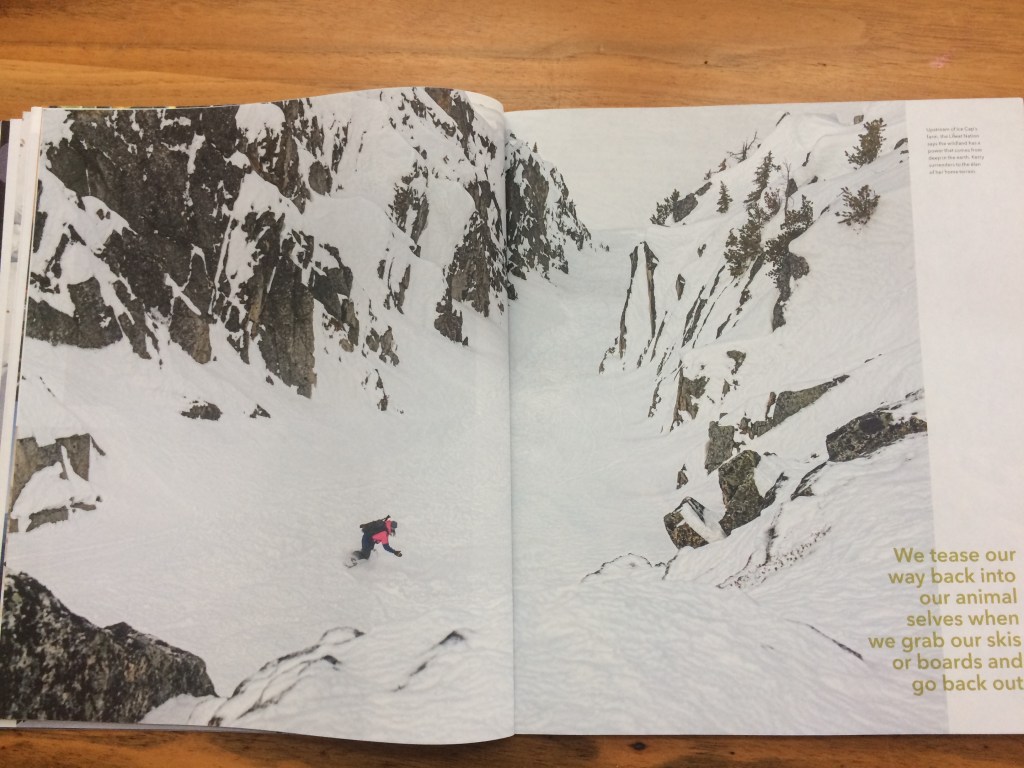
Most of the modern developed world is a set of systems and habits and structures designed to limit our exposure to nature and keep us safe from variability, from discomfort or physical labor, and help us not even break a sweat. We tease our way back into our animal selves when we grab our skis and go back out. But the illusion of separation remains, constantly reinforced every time we jump into a vehicle, order a coffee to-go, stock up at the grocery store where an invisible, complex, global supply chain presents us with the illusion of a constant steady supply of fuel, of food, insulating us from our true vulnerability on this delicate earth.
It’s good to sit with that: what the skiing-farmers know.
This story was featured in Patagonia’s Winter 2020 Journal. All images captured by Garrett Grove.

 One of the few businesses that has and will continue to thrive throughout the Covid crisis is the garden and small farming sector. The sudden interest in our food security, sustainability and living off the land is at a level I have never seen before. This is great. It is something that anyone involved in small farming has been advocating and working towards for a long time. I have seen the progression from the early farmers market days, trying to convince consumers what organic meant and that local was best, to the vibrant markets we have now. It’s been a slow and steady growth, business-wise. Something is different now – maybe self-isolation has give folks time to think about what’s really important in the game of life, how vulnerable and dependent on the system we are.





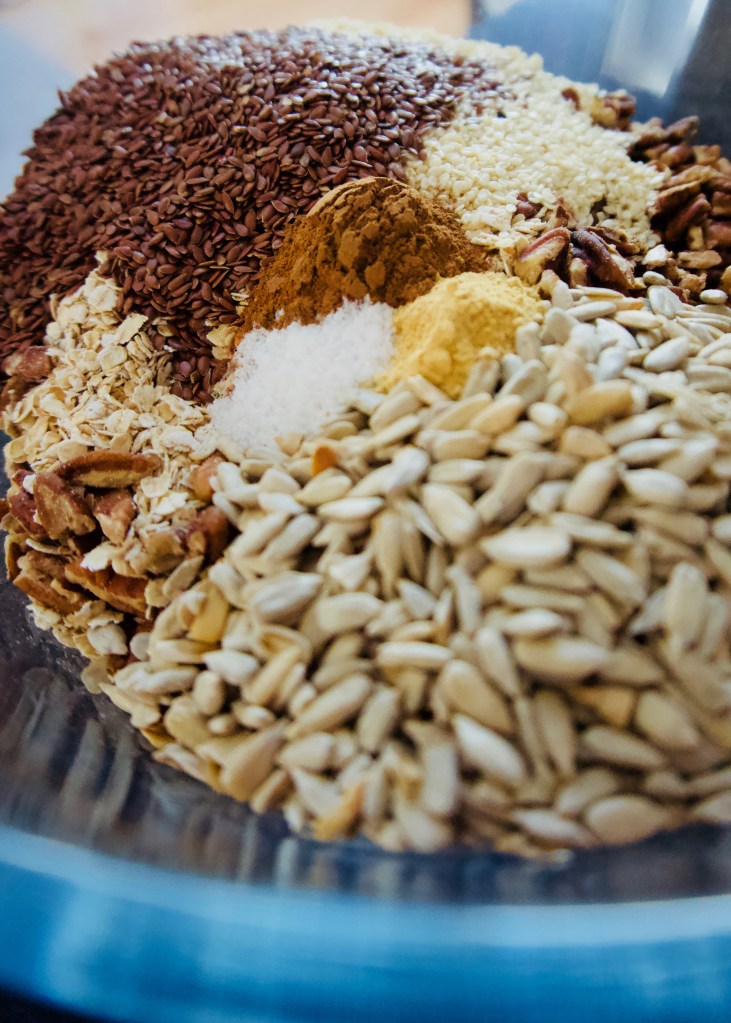 FYI I didn’t actually have any sunflower seeds in the cupboard but did have some linseeds so added those in instead. However, I’m pretty much sure you could add in whatever seeds, nuts and dried fruit you prefer and it would still taste delicious!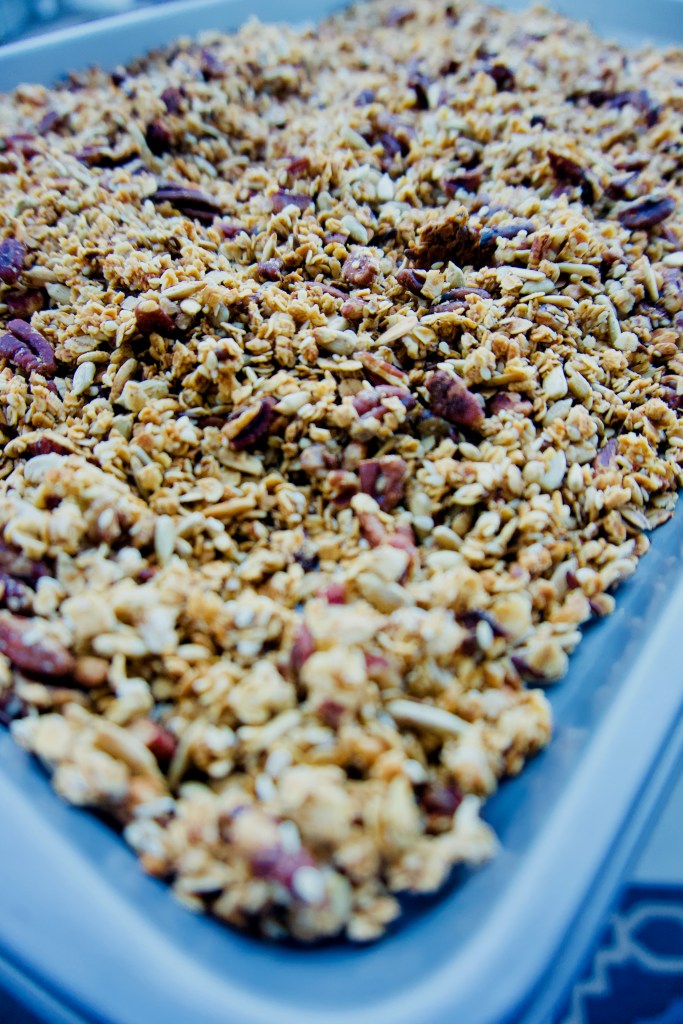






 Traced Elements