Category: food

  • Vegan eggnog recipe courtesy Pemberton’s wizard cocktail concocters

    Vegan eggnog recipe courtesy Pemberton’s wizard cocktail concocters

    Not only are  Tyler and Lorien at Pemberton Distillery absolute wizards (and trailblazing legends) in the organic craft spirits industry, their ten year old distillery provides a creative outlet for their growing and making tendencies – motivating picking and planting missions (they grow their organic hops, most of the herbs and botanicals used in their Absinthe and many for their Gin and they are slowly expanding the raspberry, strawberry and rhubarb crops to eventually be self-sufficient) and cocktail concoctions.

    Here’s a festive offering that Lorien made for the bar at the Refresh holiday market a few weeks ago, and shares with us! pemberton distillery

    This Mylk Nog is a nice and simple alternative to traditional eggnog – the cashew and coconut milks make it nice and creamy still, but it is not at all syrupy. The Nocino is a green walnut liqueur (this year, the green walnuts were all harvested here in Pemberton!) which is slightly bitter and spicy, almost like an Amaro, and adds a really interesting character to the nog!

    food_epicurious1

    Mylk Nog (serves a gathering!)

    1L cashew milk (make your own or buy at grocery store)

    500ml full fat coconut milk 

    125ml simple syrup (1:1 cane sugar to water)

    200ml Pemberton Organic Kartoffelschnaps 

    100ml Pemberton Nocino Green Walnut Liqueur

    Nutmeg

    Combine all ingredients in blender to combine. Taste and adjust sweetness as desired. Chill overnight. Stir and serve in small glasses. Garnish with a dust of nutmeg. Will last in the fridge for a few days.

  • Munchy Munchy Cookbook for kids: review

    Munchy Munchy Cookbook for kids: review

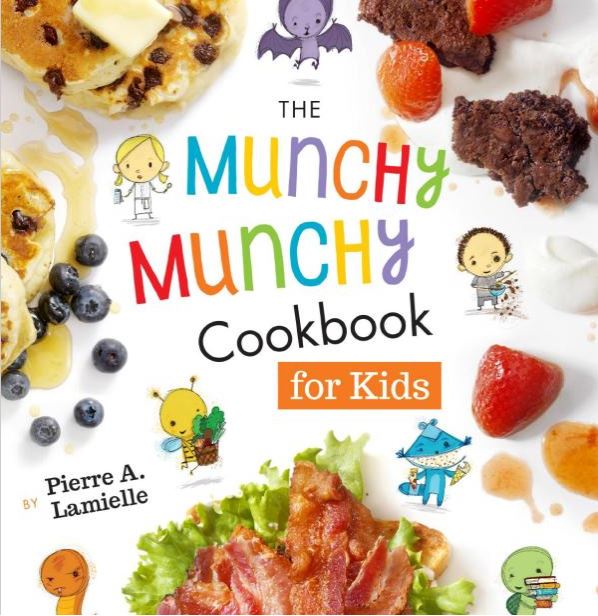
    My kids offered (er.. rather were bribed with a cookbook and kitchen privileges) to review the Munchy Munchy Cookbook for Kids by Pierre A. Lamielle. It looked and sounded like a lot of fun.

    Here’s our first shared book review featuring me (tonight, tired mom), Calian (10) and Kwaya (8). My additions are in italics.

    The book is pretty cool. It includes handy cooking instructions, a good variety of easy to make, but not dull recipes, safety tips and great illustrated characters.

    What did you like about the book?

    K: I thought it was a cool idea for the Munchy Munchy Bunch.

    There’s Sal, who has to follow a recipe; Pepper, who’s a hot mess; Ragu, who’s always hungry for anything and everything;  Ziti, who’s the absolute most picky eater of all time; Sage, who’s the ultimate food nerd; Rose, who knows how everything grows; and Bean, who’s here and there and everywhere.

    K: The very, very, very slow grilled cheese looked yummy. I did not get time to make it!

    C: I made the volcano eggs and pancakes. I wanted to make the brownies, too, but you wouldn’t let me.

    How did the recipes go?

    C: The volcano eggs didn’t turn out well. I didn’t follow the recipe that well. They were hard inside. I’d like to try making them again.

    Volcano eggs in progress

    C: The pancakes were the best pancakes I’ve ever made. And they even looked like the best pancakes.

    Good looking pancakes!

    I agree. C was home from school with a cold one day and made the pancakes. They tasted great, cooked easily, and would pack well for lunch.

    What else would you like to cook?

    C: I would like to cook the brownies. The Caesar salad looks good, but we don’t have the ingredients or any lettuce.

    What didn’t you like?

    K: The illustrations on the recipes were not my favourite. I couldn’t really tell what I was seeing.

    Who would you recommend this cookbook for?

    K: The book would be good for a person who has never cooked before: maybe someone who is 6 or 7.

    C: It would be good for someone like Gabriel in kindergarten to learn how to cook his first things. Older kids (like us) could use it without help. Younger kids could use it with parents in the kitchen.

    Anything else to add?

    K: Thanks for the book!

    I was impressed by the description of Familius, the global trade publishing company that published this book. They believe that the family is the fundamental unit of society and that happy families (of all types) are the foundation of a happy life. They publish beautiful books that help families live their 9 Habits of Happy Family Life: love together, play together, learn together, work together, talk together, heal together, read together, eat together, laugh together. What an inspiring mission!

    Update

    C made the brownies. They were delicious for one-bowl brownies with limited ingredients–chewy and crispy without being too chocolately. Another success!

  • The Vibrant Life: Cookbook review

    The Vibrant Life: Cookbook review

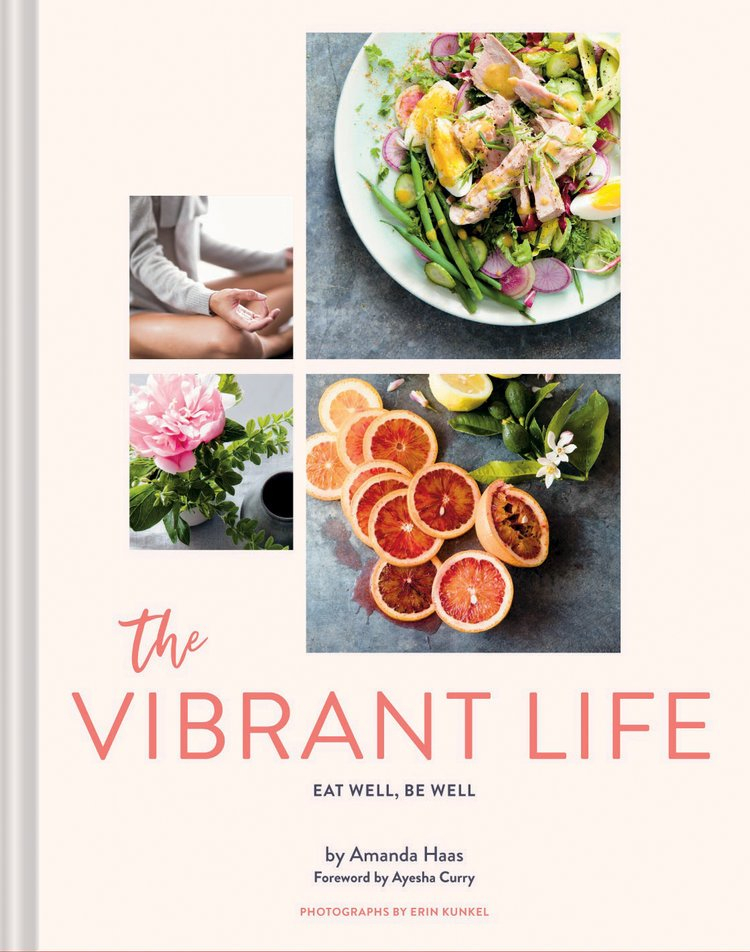
    I’ll admit that when I ordered The Vibrant Life cookbook by Amanda Haas, I thought I was ordering The Anti-Inflammation Cookbook which she also wrote. I was dealing with a neck injury and figured that learning some low inflammation recipes would expand my repertoire and help me heal.

    Haas’s introduction, though, won me over.

    Haas, the former culinary director for swoon-worthy cookware store Williams-Sonoma, talks about reaching the age of 45 and experiencing chronic fatigue along with other health complaints. She’s not advocating for turning back the clock – she says, “I love that age has provided me with a stronger sense of self, courage and compassion.” Instead, she talks about having people who showed up in her life and helped her redefine what aging looked like.

    The Vibrant Life is Haas’s answer to wanting to resolve her health issues to feel great. It’s a wellness cookbook that includes recipes and lifestyle recommendations ranging from yoga and strength-training to acupuncture, cryotherapy and meditation.

    I’m the same age as Haas and can relate to her call to live her best life.

    The ups

    The book is well designed and full of easy to follow, unfussy recipes and excellent photography. It’s moderate and balanced in terms of the diet presented. Although gluten-free, many of the recipes include meat, fish or dairy.

    The downs

    Because many of the ingredients for many recipes wouldn’t be found in a regular, well-stocked kitchen (e.g. tarragon, Marcona almonds, pistachios, sour cherries, fennel bulbs, adobo sauce, crème fraiche, King Trumpet mushrooms, golden raisins), this wouldn’t be my everyday go-to recipe book.

    Although recipes like the chocolate ganache tart with grand marnier, tequila old-fashioneds, and roasted Moroccan chicken with cauliflower “couscous” sound delicious, I was, frankly, expecting more wholesome plant-based dishes from a wellness cookbook. Instead, there seem to be a disproportionate number of recipes in the “Land and Sea” and “Sweets, Treats and Cocktails” chapters.

    granola-1

    Favourites

    I didn’t have some of the ingredients required on hand, so tried some of the simpler recipes, including:

    • The drinks like maple-turmeric golden milk and coconut almond matcha, both made with almond milk
    • Sophia’s toasted almond granola – a tasty recipe featuring dark chocolate, sour cherries, maples syrup and cardamom
    • Wild rice, butternut squash salad with pistachios, cherries and mint
    • Blistered curry cauliflower with mint, currants and toasted almonds

    CauliflowerKaleSoupThe shaved brussel sprout salad with roasted root vegetables and pomegranate seeds is next on my list.

    The final word

    I can see myself cooking some of the recipes for special occasions, but don’t imagine that this cookbook will make it into my regular rotation. For a wellness cookbook, too, I would have liked to be nudged further along with truly inspiring, downright healthy food.

    This book would make a great gift for an omnivore, who enjoys making colourful, tasty, fresh food to entertain friends.

    With Haas’s simple, but sincere wellness recommendations, it would also make sense for someone who has experienced some health challenges and is just starting out on a wellness path.

    And thanks

    Thanks to Raincoast Books for sharing this cookbook!

  • Rooting for a Rutabaga renaissance

    Rooting for a Rutabaga renaissance

    My brother says a stew is not a stew unless it contains rutabaga; I concur.  Surely that was my thinking when I roamed the patch in the recent fall drizzle, disheartened by the number of perfectly good vegetables going to waste because they were too big to be marketable.

    When I was a teen, I developed quite a resentment towards rutabaga (and most others that engendered chores.)  In the full heat of summer, the rows were never ending as we shuffled along with perfectly sharpened hoes, weeding out the lamb’s quarters and thistles which often had grown up again by the time we finished the plot.

    Later, once the first few frosts arrived, Dad would drive the tractor and wagon out into the field and we would get down on hands and knees to pull the rutabaga out, chop off the root, scrape off the side roots and mud then flip it around to lop off the top.  A sharp, heavy knife was essential.  Once we finished the cleaning, we lobbed the vegetables onto the wagon and shuffled forward.  

    Rainy weather caused mud to cling so that each globe gained a pound or so.  Eventually, the wagon would fill up and our knees would get a reprieve while we ambled back to the root house to bag the harvest that would have been washed during our walk break. Dad had jigged a small piece of plywood with the appropriate size for the rutabagas he would sell and we would measure some of the perfect looking ones only to find they were too big for commercial purposes-these went into other bags for customers who stopped by the farm for their fall vegetables.  Finally, we would empty the wagon and head back out to the field having bagged up about thirty fifty-pound bags for the root house.  Not much has changed about the process of harvesting.

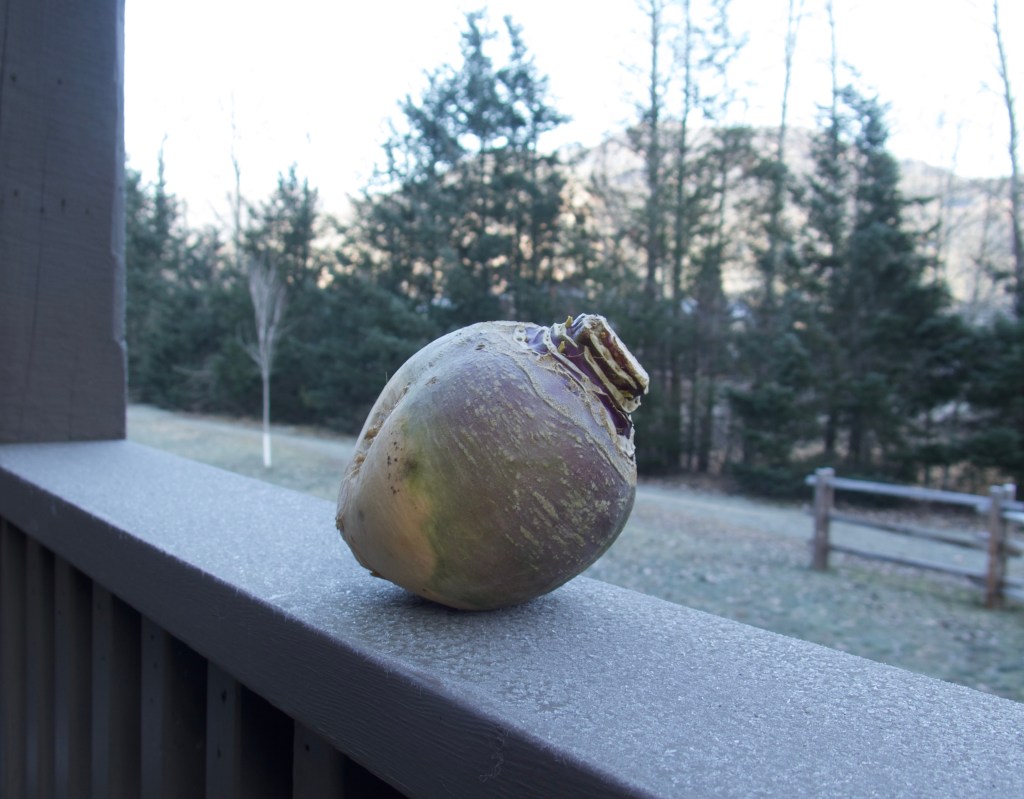
    Somehow, my resentment towards this month-long job never overpowered my taste for rutabaga – it was always a treat to slice one up and munch away on it while waiting for the wagon to get back.  I also liked it boiled then mashed up, served with a bit of butter and salt and pepper.  And, of course, I enjoyed it in stews, where it rounded out the flavours, adding a touch of sweetness along with the carrots.  It is not so surprising then,  that I should wander around in my brother’s field in the rain searching for those purple and yellow globes.  

    Back home, I explored new recipes to try and discovered many old ones, mostly from Europe.  This should not have surprised me – despite the growing interest in vegetables of all kinds, rutabaga consumption is not on the rise.  Yet, a half cup serving provides fifty three percent of daily vitamin C requirements, eight percent of needed calcium and a good quantity of vitamins  E , B6 and Thiamin – all with twelve percent fibre, five percent carbohydrate and sixty six calories.

    rutabaga

    A three pound rutabaga provided us with five meals over a two week period and half of the vegetable is still in the fridge waiting for my next inspiration.  

    Downstairs, in a dark cool corner, my twenty five pound bag could last well into February, though I’ve recently begun to process in bulk for convenience.  I boil the rutabaga with carrots-about two carrots to each rutabaga-then drain them and mash them, storing in freezer bags.  On a cold night, these can be thawed quickly and eaten as is or added to soups and stews to round out the flavour and add nutrients.

    Rutabagas are a cross between cabbage and turnip and they grow from seed, maturing in about ninety days. As a Brassica, these vegetables might be too bitter for some people, though they do sweeten up after a few frosts, so try leaving store bought ones outside overnight.  The greens can also be eaten, somewhat like swiss chard.  It’s a vegetable that deserves a renaissance:  try it with nutmeg, sautéed garlic, feta cheese, apple slices, maple syrup or maybe curry.  

    Inspired? Try Nidhi Raina’s Bad Boy Rutabaga and Turnip Curry.

  • Processing Vacation on Order for 2020

    Processing Vacation on Order for 2020

    I think we ran out of frozen peaches in April 2019. Corn even sooner.

    May was tough. That transition between enjoying the previous seasons’ harvest and the new harvest felt like eons. Even though, I do tend to allow myself asparagus from California and Mexico in the spring, it’s not the same as eating local fruits and vegetables grown by people you know and care about.

    By June, I had promised that I would work even harder to preserve 2019’s delectables and make it past May 2020 in good shape.

    I started by canning pickled garlic scapes. It was fast and easy, but I’m a canning chicken, so it was stressful to try a new recipe. A resulting complication of my chicken-ness was that I decided to eat all the scapes before they would have a chance to go off – it was likely a completely unnecessary panic and the reason we have none in storage.

    When late July arrived, I was certain I was ready for the pending influx of goods. But food started coming at me faster than ever — it was a very good growing season after all.

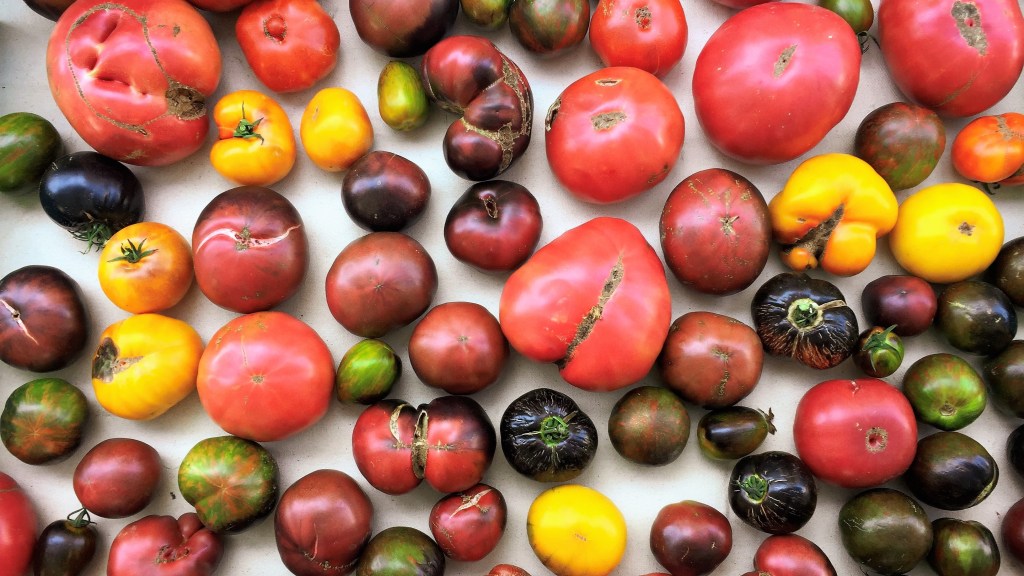
    Peaches, blueberries, green beans, corn and tomatoes.

    As we carried case after case through the door, I started to feel overwhelmed. Do work that pays the bills or process food became a dilemma that I just didn’t have an answer to.

    And, while I figure therocketnarcissist and I processed more than 300 pounds of food, all of it grown by people we know, I’m feeling like our freezer stockpile is dwindling. We’ve had a busy and mentally draining fall, so the freezer has been raided close to every day.

    Spaghetti sauce gone, tomato curries gone, corn stash cut by half.

    This year, I spent extra time looking for a good freezer salsa. I made about 60 cups mild or hot salsa – but the supply is shrinking – and fast. It’s just so damn good. And is incredibly useful as a base for a Mexican themed fried rice.

    All this makes me think that rather than take a biking vacation, an August 2020 processing vacation might be in order. I’m curious, have you ever taken a processing vacation?

    Of note, I can’t even begin to imagine what it would have been like to farm with such abundance coming our way this past summer. Kudos to all the farmers that worked hard to keep up and feed us the best fruits and vegetables that the Squamish-Lillooet region has to offer.

    In case tomatoes are a plenty next year too, here’s a link to the salsa recipe.

  • Wonder really is a survival skill

    Wonder really is a survival skill

    I read this quote as I skimmed The Curious Nature Guide: Explore the Natural Wonders All Around You, by Clare Walker Leslie and it stuck with me. It’s at the heart of what I hope my kids get out of school… and life, really. 

    But maybe it’s for just that reason–how busy we are and distracted and disconnected we are–that wonder really is a survival skill. It might be the thing that reminds of what really matters, and of the greater systems that our lives are completely dependent on. It might be the thing that helps us build an emotional connection–an intimacy–with our surroundings that, in turn, would make us want to do anything we can to protect them. ~ H. Emerson Blake in the foreword to Wonder and Other Survival Skills

    It’s wonder that helped me survive the last year, too.

    Exactly a year ago, I quit my decade-long secure government job, launched myself into self-employment and simultaneously became really ill. I left work and needed my first of many blood transfusions a few weeks later. I’d been struggling with severe anemia for years and my condition had eluded a definitive diagnosis.  

    By February I received a lymphoma diagnosis and in March I was receiving life-giving and equally barbaric chemo and antibody treatments. 

    I worked in bed for the winter–one of the luxuries of self-employment– and in the spring began a slower version of gardening. 

    My year was all about survival, but also wonder. Wonder at the drugs that saved me, and the plants they were originally derived from. Wonder at my family, who I would love to live with for a long time, and would grieve so much to leave. Wonder at how sick I had become, how I’d fallen between cracks in the medical system, how I looked “fine” and pale when I was barely floating through my days with dangerously low hemoglobin– the oxygen carrying component of blood.

    And there was wonder at how ridiculously great and high I felt the first time I received a blood transfusion. Wonder at how my fingers and lips turned pink–how I was reanimated with blood. Wonder that strangers literally gave me the gift of life. Wonder at the cost of my drugs–$10,000 for two days’ treatment every month. Wonder that our health care system paid for them. Wonder at how much care was missing in treatment, and also wonder at how much care was offered from lab techs, ER and chemo nurses, and angel friends.

    HomeGrown

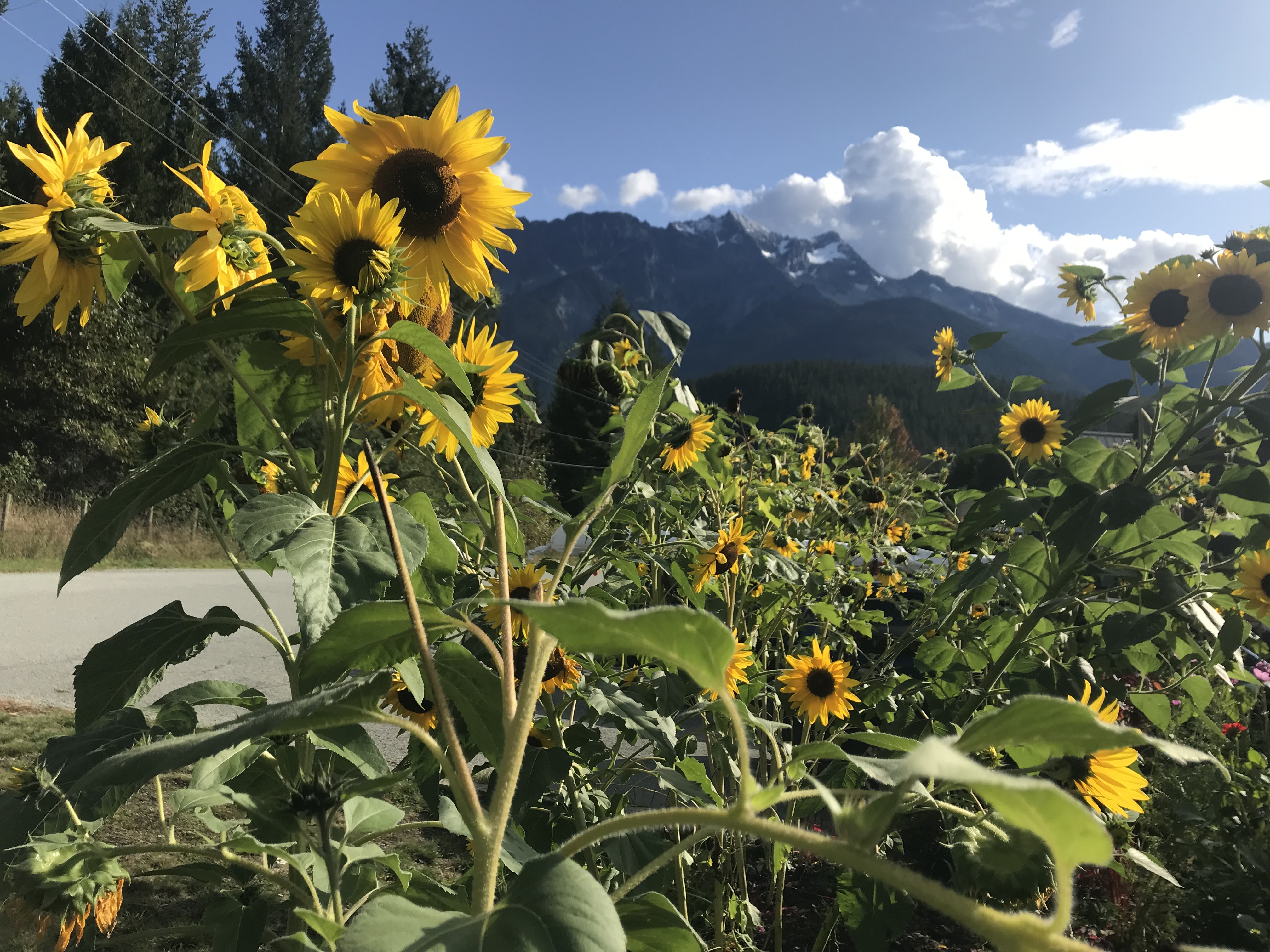
    And my wonder garden grew in spite of me, and continued to offer gifts: the wonder of harvesting garlic in between summer rain storms, celebrating epic and endless dahlia blooms, eating broccoli and peas for days, and enjoying such a bounty of tomatoes that the last batch sat ripening in egg cartons on my counter even last week. Wonder at the soil–lush, rich, buttery and black that I’ve been building in my garden for the last few years. Wonder at the sunflowers that provided so many blooms abuzz with bees and then food for weeks to so many different kinds of birds. 

    SunflowerJungle

    I also experienced confusion and wonder at the suffering of so many people I saw in treatment and in our community. I felt the sadness of illness and accidents and the losses of loved ones.  Wonder at the gaping holes and the ways we try to soothe and patch them.

    I had a few days after my second round of treatment when I entered a black pit of despair. Nothing made sense. I saw no reason for my suffering or anyone’s suffering and no reason for living or sickness or treatment for it. But then tulips bloomed and that made sense. It a crack of enchantment. A thread of wonder. A signal that something small was still right in the world. 

    It’s foggy and cold today. There are cracked chestnuts, a precarious pile of birch logs, a dull axe, a frosty table and a barbeque abandoned for the season on our deck. The leaves are still hanging onto the overhanging chestnut tree, now wilted and brown. I’ve been harvesting the last scrubby bits of kale, chard, parsley, chives and celery leaves sticking out of straw mulch, as I surrender to buying greens over the winter.

    Mel'sHappyPlace

    I survived the year, along with my garden, along with my kids, along with my partner, along with my dog, along with my work, thanks, in part, to the balm of wonder.

  • Best of Pemberton Fall Dinner: Pine mushrooms and deer burgers!

    Best of Pemberton Fall Dinner: Pine mushrooms and deer burgers!

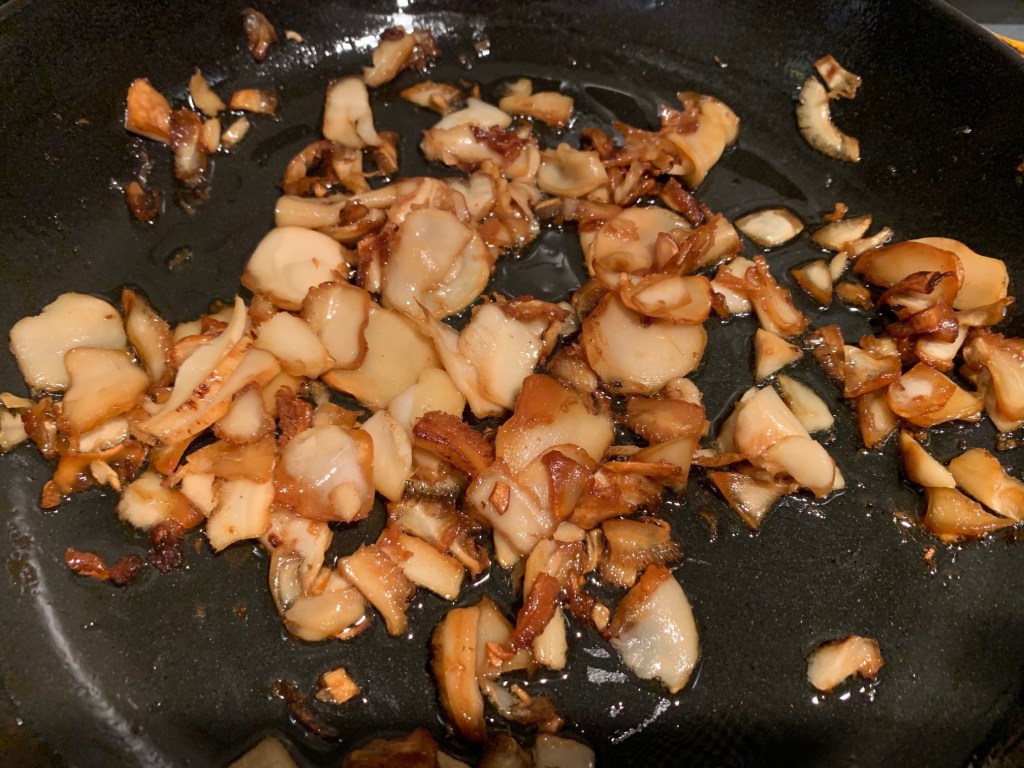
    This is a good time of year for eating well in Pemberton. Hopefully fresh deer meat, winter squash, mashed Sieglinde potatoes, and sautéed pine mushrooms! A healthier plate will also include sautéed chard – but I prefer to save my blanched chard to add to chilli and soup when it goes down so harmoniously with bold tomato flavour and spices. I used to dislike pine mushrooms but my tastes changed a few years ago when I ate them prepared very simply. Sautéed in olive oil, then drizzled with a tablespoon of fresh lemon juice and just a dash of gluten-free soy sauce…I can’t eat enough of them! Cheers to good fall meals using Pemberton’s finest local ingredients.

    Sautéed Pemberton Pine Mushrooms (serves 4 as a side dish, or 1 for a scrumptious snack)

    Ingredients:

    4 large pine mushrooms, well-scrubbed and clean

    2 tbs pure olive oil

    1 tbs fresh lemon juice

    ½ tsp gluten-free soy sauce

    Method:

    Scrub your pine mushrooms well.

    Slice VERY thinly into 2 mm slices. Thin slices are the key to flavourful and crispy pine mushrooms.

    Heat olive oil in a large cast iron skillet. Sauté mushrooms over medium heat until nicely browned and crisp. Turn off heat and add lemon juice and soy sauce. Enjoy!

    Pemberton Deer Burgers: (serves 4)

    Ingredients:

    1 lb ground deer meat

    2 tbs pure olive oil

    ½ medium yellow onion, fine dice

    1 tsp salt

    1 tsp pepper

    1 tsp prepared English mustard

    2 dashes hot sauce (optional)

    2 tbs chives, chopped.

    Method:

    Combine all ingredients. Form into patties. BBQ on high for about 10 minutes and flip burgers halfway through. Remove from heat when cooked through. Enjoy!

  • Pemberton Dairy-free Squash Pie

    Pemberton Dairy-free Squash Pie

    Even though Thanksgiving has passed, I still enjoy eating squash pie. I have tweaked a dairy-free version that I think is sublime!

    It can also made into tarts. Over the years I have developed a distaste for nutmeg and instead enjoy the taste of cardamom in my squash desserts. You can use pumpkin, acorn, butternut, or other types of squash in your pie filling. The key step is to strain your squash into a sieve to remove as much liquid as possible, for at least ½ hour. This will make a denser and richer pie filling.

    Pemberton Squash Pie:

    Ingredients:

    pastry for one 8-inch pie plate

    2 cups pureed Pemberton-grown winter squash

    1 cup brown sugar

    2 large eggs, plus 2 egg yolks

    1 tsp cardamom

    1/2 can full fat coconut milk

    1 tsp cinnamon

    ½ tsp ground ginger

    ¼ tsp ground cloves

    1/4 tsp salt

    Method:

    Make pastry and line an 8 inch diameter pie plate (I use a spelt pastry).

    Roast a large squash (your choice) in a 350F oven for 2 hours on a roasting pan filled with 2 inches of water.

    When squash is very soft, remove seeds and discard. Take flesh and puree in food processor. Put puree into a sieve and let strain over a bowl for ½ hour. Discard squash liquid, or use in another recipe, such as soup stock.

    In a stand mixer, add strained squash, sugar, eggs, spices and coconut milk. Blend well.

    Pour filling into pastry-lined pie plate.

    Bake 375F for 15 minutes, then 1 hour at 350F.

    Pie is done when the filling jiggles only slightly in the centre of the pie.

    Turn off oven and cool with oven door half open.

    Cool completely and serve with whip cream if desired.

  • A good pick-me-up soup for Fall:

    A good pick-me-up soup for Fall:

    There are germs flying around Pemberton these days. If and when a bug hits, this soup will offer some relief. The key is homemade chicken broth which I try to always have on hand. I have posted my recipe for chicken broth before but I will do it again as it is so important. Carton broth is not an option for me!

    Chicken, vegetable and barley soup:

     Ingredients:

    8 cups homemade chicken broth (recipe to follow)

    3 Pemberton-grown carrots, chopped

    1 cup Pemberton-grown parsley, chopped

    4 stalks celery chopped

    ½ cup cauliflower, very finely diced (optional)

    1 large yellow onion, diced

    2 tbs pure olive oil

    1/3 cup pearl barley

    2-3 cups diced cooked Pemberton-raised chicken

    2 tsp pepper

    2 tsp salt

    Method:

    Sauté all veggies and parsley in olive oil over medium heat until nicely caramelised and soft. Add salt and pepper. Add chicken broth, barley and diced chicken. Bring to boil. Then simmer 20-30 minutes. Enjoy!

    Chicken Broth:

    After roasting a whole Pemberton-raised chicken, remove meat or most of it.

    Place carcass and skin into a large stock pot. To this pot add about 4-6 cups of veggie trimmings.**

    Add ¼ cup of whole black peppercorns.

    Fill the stock pot with water.

    Bring to boil.

    Simmer 2-3 hours.

    Strain.

    Cool.

    Freeze in containers for later use.

    **I collect veggie trimmings each day and put them in a large Ziploc bag and store it in the freezer, adding to the bag each day. I usually add one full Ziploc bag of veggies to the stock pot. Veggie trimmings that commonly get thrown in the bag are: red pepper stems, carrot ends and peels, parsley and cilantro stalks, onion ends (not the brown peel), cauliflower stalks, fennel stalks, celery ends, acorn or butternut squash ends, wilted veggies, etc.) Do NOT add potato peelings or ginger root ends or peel – they will ruin your stock!

  • Pemberton Lunch Box Omelettes

    Pemberton Lunch Box Omelettes

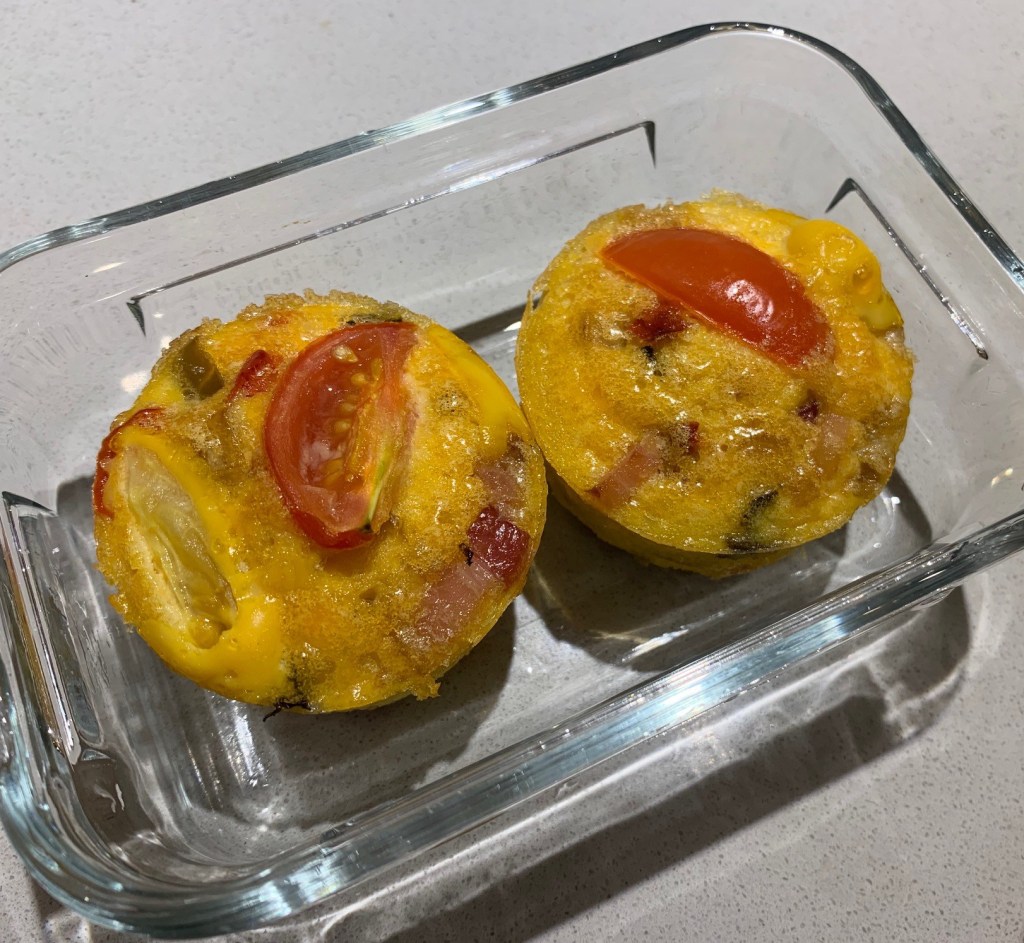
    This recipe is inspired by the portable egg bites that Starbucks sells. With all the produce available at the Farmer’s Market or in your garden these make a very good high protein lunch! And they are easy to make. This recipe makes 4 omelettes but you could easily double or triple the recipe.

    Ingredients:

    1 tbs pure olive oil

    4 Pemberton free-range large eggs

    4 slices high quality thick-cut bacon, diced

    1 Pemberton-grown red pepper, finely diced

    1/4 Pemberton-grown yellow or white onion, finely diced

    4 cherry tomatoes, sliced in half and then sliced lengthwise into thin slices

    2 tbs cilantro, finely chopped

    1/4 tsp salt

    1/4 tsp pepper

    Method:

    Sauté onion and red pepper in 1 tbs olive oil until soft and slightly caramelized. Add cilantro, salt and pepper.

    Fry bacon in separate fry pan until crisp but not crunchy.

    Add bacon to veggie mix.

    Blend eggs in blender on high for 10 seconds. Or beat well with whisk or fork.

    Place a silicone muffin pan into a large pyrex casserole dish.

    Boil a large kettle of water.

    Place 1.5 tbs veggie-bacon mix into each muffin cup. Then pour 1/4 egg mixture into each cup. Place 2 slices of cherry tomato atop each muffin.

    Pour boiling water into pyrex dish so it reaches halfway up the sides of the dish.

    Bake in oven at 350F for 30 minutes.

    Cool.

    Enjoy!