Category: farm story

  • Silly Gardening Mistakes

    Silly Gardening Mistakes

    Trial and error is a necessary and inevitable part of the learning curve for all gardeners.There are so many variables it’s impossible to always have 100% success, no matter the experience. Even when you think you have something figured out, you usually find you could have improved on your method, or Mother Nature throws your theory out the window.

    Luckily the internet with its blogs, scientific studies and You Tube provide a wealth of information. This can also get overwhelming and even provide misinformation, so read between the lines, keep it simple and my best advice: look to nature. Perhaps it’s unfortunate I didn’t have the luxury of the internet in my rookie years and even when things came online, we didn’t even get service for a couple decades. In the beginning I had one resource – “The Encyclopedia of Country Living”. A thick hippie homesteading bible from the 70’s, complete with anecdotes, recipes and preserving methods. Maybe it was a blessing as it forced me to experiment more, simplify, improvise and get my cues intuitively. One thing for sure is I made a lot of mistakes and learned from them. Improvements to techniques are constant, and mis-steps still occur. I try not to make the same blunders twice. I have compiled a list of common lessons I’ve learned, often the hard way.

    START SMALL.

    Biting off more than you can chew can end up being overwhelming. Planting seeds is the least labour intensive part, so it’s easy to get carried away. Don’t buy too many packages, there’s often hundreds of seeds in each. After all, it’s supposed to be fun even amid failures. If it’s no longer enjoyable, scale down or find another hobby.

    GROW WHAT YOU LIKE.

    If you don’t like Brussel sprouts, do you really want to tend them until Thanksgiving just to give them away and lie about how good they are? If you like something grow an abundance and learn how to perfect it and preserve it.

    PLANT FOR YOUR ZONE.

    Why bother growing something that will struggle and/or require extra protection. Ask your neighbours what does or doesn’t work, figure out your microclimate before you push the boundaries. If you notice that no one in your area grows a particular type of something its probably because someone else tried and failed or it’s just too difficult.

    SEEDING TOO EARLY.

    It’s easy to get excited and impatient in the late winter. There is an optimum sowing window and it varies depending on the plant. Problems can arise such as outgrowing their cell and needing up potting, weak leggy plants needing more light and nutrients, susceptibility to pests and diseases, over and under watering, and of course unnecessary labour. Sometimes you’re better off waiting and direct seeding. avoiding all those issues. Some seed packages will dictate what period to plant, listing the days before last frost or growing days required to harvest. This is still variable depending on your location, so again, ask your neighbours their schedule.

    PLANTING TOO LATE.

    Conversely getting things out late may result in a poor harvest. If you’ve “put the cart before the horse” by not having your beds prepared when your seedlings are at their prime for transplanting, this will affect the health and wellbeing of the plant’s whole cycle. There is also a transplant shock, and hot dry summer weather that can set things back to consider. Protecting your plants from various elements may be needed and change seasonally. Timing and knowing the growing season depending on the plant comes with experience. Expect some failures.

    ADJUST YOUR SCHEDULE FOR THE WEATHER.

    Planting in hot, sunny , dry or windy weather is not recommended. Nor is spreading soil in the rain, tilling mud or dust, mulching before it rains or pruning while flowering or when the sap is running. Some biodynamic farmers take things further and adjust for solar and moon cycles. Watching the weather is common sense for all gardeners.

    LIMIT WHAT YOU GROW.

    It’s best to do a few good things well than struggle with too many things going on. Plant what you can manage, and use efficiently. Succession planting can ensure a continuous crop of quick growing veggies such as greens or radishes as opposed to a huge patch of bolting lettuces and then nothing. Don’t forget the biggest and most common rookie mistake – planting too many Zucchinis!

    AVOID COMPROMISED PLANTS AND SEEDS.

    Plants have a life cycle and seeds have a shelf life. If a plant is sick and hasn’t been tended properly you will inherit all their problems and perhaps create more. If seeds are outdated or haven’t been stored properly you will be at a disadvantage from the get go. A good compassionate gardener can often nurse back a sick plant, but why take the risk and hassle as a beginner.

    BUILD YOUR SOIL.

    Everything your plants need, except for light, is in your soil. It is the foundation of every successful natural garden. Investigate nutrients, micro organisms, amendments, mulches and cultivation methods. It’s endless what you can learn and the more you do the better off your garden will be.

    RESIST UNNATURAL QUICK FIXES.

    By this I mean the use of pesticides and herbicides. Figure out the root causes, and find organic solutions. There are usually a multitude of natural alternatives. It often takes some time to regain a natural balance and eliminate the issue. Be patient.

    DON’T PROCRASTINATE.

    In gardening there is usually a short window to most optimally do a necessary task. The longer you wait the more difficult and time consuming most of the following steps become. If you have the opportunity, just do it right away.

    BE RESOURCEFUL.

    It’s easy to spend many times the value of your crop on exotic varieties, greenhouses, shiny tools and fancy gadgets. Your plants couldn’t care less. They just need the loving care of the gardener and that’s something you can’t buy. Buy used equipment, recycle and improvise. That’s what all the old timer gardeners do.

    BE CLEAN.

    Remember all it takes is a single spore or a mating couple of pests to exponentially turn into an infestation. Avoid bringing outdoor soil indoors, sterilize your growing area, disinfect your tools and wash all your recycled containers. It’s all extra work but well worth the prevention of potentially big problems.
  • Chickenisms

    Chickenisms

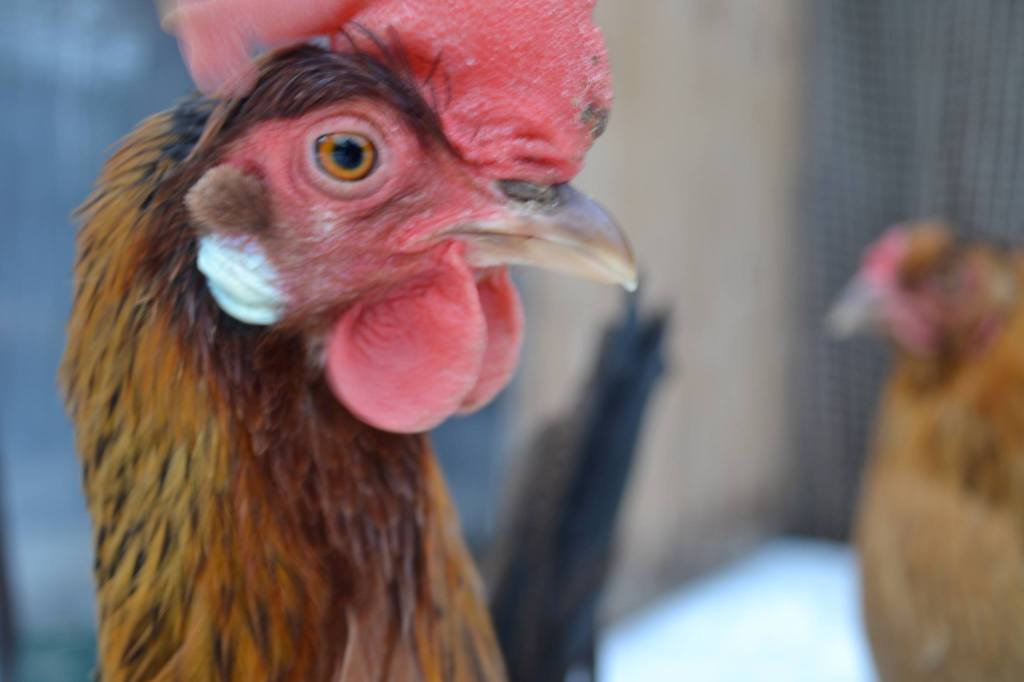
    I know from the demand  following the pandemic, there are lots of new chicken raisers out there now. Many of them it seems are females (nurturers) trying to get their reluctant partners (practical) to get on board and help them set it up. The learning curve is steep and I’m sure there has been quite a few trials and tribulations. Raising chickens can be fun, frustrating and eye-opening, just like life in general. With this familiarity comes the realization that chickens offer a philosophical and social microcosm, especially within the English language. I believe there are more parallels attributed to chickens than any other farm animal. I am going to run you through just a small portion of sayings about chickens and how they relate to us.This is a short scenario about new Covid-inspired chicken farming couples.

    First of all many of you have been COOPED UP, with the lockdown as opposed to RUNNING AROUND WITH YOUR HEAD CUT OFF as per usual. So with no HEN PARTIES and a desire to be more self-sufficient you thought you would WING IT and and take some chicks UNDER YOUR WING.You wanted  to play MOTHER HEN  to someone other than your homeschooled children before they FLY THE COOP.  Your husband may have CHICKENED OUT but you PLAYED CHICKEN with him instead, stating not to PUT ALL YOUR EGGS IN ONE BASKET when it comes to food security. Being NO SPRING CHICKEN,  and knowing the PECKING ORDER, he was eventually HEN-PECKED to the point of having to build a coop. Doing the math, he realized that the cost would not be CHICKEN FEED. His calculations looked like CHICKEN SCRATCH on paper and the numbers didn’t add up. The CHICKEN AND EGG SITUATION is that raising chickens could actually cost money as you CAN’T COUNT YOUR CHICKENS BEFORE THEY HATCH!

  • Appreciating the Neighbourhood Chicken Lady

    Appreciating the Neighbourhood Chicken Lady

    Hey folks!

    Let’s talk about the cost of a dozen eggs.  What I see in our area is that most farmers sell a dozen eggs for $5.  A few farmers sell for $6 or $7, not many.  In the grocery store prices range from $3 to $8.

    I have been selling eggs for $6 and most people feel comfortable paying that price.  Here’s the thing, I do not make any money off selling eggs.  I basically sell eggs for the People.  The People love farm, fresh eggs!  That’s why I do it.  I even try not to use eggs in my home so that I have more to sell.  It is not because I’m being greedy and want to make more money but because I need to sell them all to break even.  Yes. you heard that right!  If I sell the majority of the eggs I collect, I break even but only with the cost of feed.

    I have been using an app called “Count My Eggs” for the last 40 days.  I can input how many chickens I have, how many eggs I collect each day, my expenses, and my sales.  The app tells me that I have collected over 500 eggs (chicken and duck) and sold over 450 eggs.  It shows me that I have spent $2 more on feed in last 40 days than I’ve made in sales.  I lose money.  Having said this, I do have eggs in the incubator and if I had sold them I would have made a tiny bit more on egg sales.  Had I sold those 3 dozen eggs I would have made about $0.45/day of income.  Yep, raking in the big bucks!!

    Screenshot_20200402-152857_Instagram

    I have the same feed expenses all year but chickens don’t lay all year.  The math is about $6.64/day for about 40 laying hens and a few roosters all year round regardless of how many eggs they lay/day.  In the winter they hardly lay and I use a light the coop during the winter to try and encourage laying (so a bit of hydro).   The chickens take a lot of laying breaks throughout the year (if it’s too hot, or too cold, if they’re molting, if they’re stressed out, if there isn’t enough daylight, a hundred reasons!).  No eggs, no income…but they keep on eating.  There will be a bit of a flux in income for the next month or so selling day-old chicks but it won’t even begin to cover what I’ve spent feeding hens that aren’t laying.

    Keeping chickens takes a lot of time, every day. I am not compensated for the hours spent feeding and watering, cleaning coops and water jugs, collecting and washing eggs, or building fences.  Also anything extra, like sawdust or wood pellets for the floor and nesting boxes, replacment feeders, or the cost of fencing materials when needed is money out of my pocket.

    Raising chickens is not a money maker, it is a passion project (like most farming is).  I love being able to provide folks with eggs from happy, healthy, free-range chickens but I do so at a great cost to my bank account.

    Please remember how hard I work every day, all year to provide people with eggs and please keep this article in mind when you are asked to pay a bit more for a dozen eggs.  I do it all for you!

    Dare I ask for $7.00/dozen?

    Screenshot_20200402-161843_Instagram

    Air hugs!

    -Meg

    Once a farm girl, always a farm girl.

    once_a_farm_girl_nametag

  • Blissfully Homesteading through a Pandemic

    Blissfully Homesteading through a Pandemic

    I don’t intend to downplay the seriousness of the present situation nor am I arrogant nor ignorant enough to suggest this will not affect everyone, including ourselves. My partner and I have been laid off over 2 months early and we rely on this income to get us through the lean planting and prepping season where were busy working and buying supplies with little income. We will have to adapt – something we are familiar with. “We will get by, we will survive”: an anthem and lyric from my favourite band.

    Rural dwellers, being more isolated, have an advantage right now and farmers are optimists – they have to be, as every year poses new and unforeseen challenges. Different hits and misses, but things always seem to work out in the long run. Just planting seeds, building soil or incubating eggs is a sign you believe in the positivity for the future. Theres no short term gain. It’s all for a benefit sometime down the road.

    Homesteading, by definition, is literally staying and working from home, something all others are being asked to do, many out of their comfort zone. Many of the practises the general public are being asked to do are commonplace for us. Farmers can’t be germaphobes, they are constantly exposed to bacteria, both good and bad. They also understand that such exposure builds up their immune system, same goes for plants and livestock. At the same time most understand the importance of disinfecting propagation rooms, equipment, and keeping stables and coops clean to prevent an outbreak of pests and diseases, which can get out of hand quickly. Once a problem is identified, it’s important to act quickly as the situation increases exponentially. Organic farmers will resist the temptation to completely nuke everything with chemicals – the idea is to regain a sense of balance, so nature can do the rest. You never get it all, just slow down and manage the overwhelming progression. Patience and persistence are the key. Sound familiar?

    Quarantine is another age-old practice. It’s always a good idea to separate sick plants and animals for the greater good of the rest. The difficult decision to cull is something we all have to deal with.  As Darwin observed long ago, it’s the survival of the fittest that lets the strongest genetics evolve. Sometimes you you have to let something special go, so others can live.

    Organic farmers know that Mother Nature has a tendency to spank those who challenge her natural balance. The worst outbreaks occur in monocultures and factory farming. Mad cow disease, avian flus, E coli, listeria  and now Covid 19 (apparently originating a dirty Asian market) are all examples of problems from an overcrowded, unsanitary, misguided system and unnatural methods.

    Stocking up, preserving and being prepared are the cornerstones of homesteading. Pantries and freezers are like safety deposit boxes. It’s a currency that rarely devalues and becomes more valuable when times are tough. It’s something that is an ongoing process, not something you rush and do over a weekend. Toilet paper however, is not a survival item. Any naturalist knows water, newspaper, moss or leaves will do in a pinch, pardon the pun.

    I’ve sometimes questioned my decision to live off the land, knowing if I did the math it would be much more economical to use my skillset and work as a landscape designer or operate heavy machinery, and buy food with a regular salary from regular sources. These options however didn’t offer to feed my soul. Working outside with nature is my happy place. In times like these, I have no regrets.

    So it’s business as usual on the farm, with the always-lots-to-do list to keep busy. We will easily and naturally do our civic duty to self isolate, keep our social (media) distance, practice hygiene, stay active outdoors, and offer and accept help from the community.  I just cleaned the chicken coop, I washed my hands thoroughly.


  • Rooting for a Rutabaga renaissance

    Rooting for a Rutabaga renaissance

    My brother says a stew is not a stew unless it contains rutabaga; I concur.  Surely that was my thinking when I roamed the patch in the recent fall drizzle, disheartened by the number of perfectly good vegetables going to waste because they were too big to be marketable.

    When I was a teen, I developed quite a resentment towards rutabaga (and most others that engendered chores.)  In the full heat of summer, the rows were never ending as we shuffled along with perfectly sharpened hoes, weeding out the lamb’s quarters and thistles which often had grown up again by the time we finished the plot.

    Later, once the first few frosts arrived, Dad would drive the tractor and wagon out into the field and we would get down on hands and knees to pull the rutabaga out, chop off the root, scrape off the side roots and mud then flip it around to lop off the top.  A sharp, heavy knife was essential.  Once we finished the cleaning, we lobbed the vegetables onto the wagon and shuffled forward.  

    Rainy weather caused mud to cling so that each globe gained a pound or so.  Eventually, the wagon would fill up and our knees would get a reprieve while we ambled back to the root house to bag the harvest that would have been washed during our walk break. Dad had jigged a small piece of plywood with the appropriate size for the rutabagas he would sell and we would measure some of the perfect looking ones only to find they were too big for commercial purposes-these went into other bags for customers who stopped by the farm for their fall vegetables.  Finally, we would empty the wagon and head back out to the field having bagged up about thirty fifty-pound bags for the root house.  Not much has changed about the process of harvesting.

    Somehow, my resentment towards this month-long job never overpowered my taste for rutabaga – it was always a treat to slice one up and munch away on it while waiting for the wagon to get back.  I also liked it boiled then mashed up, served with a bit of butter and salt and pepper.  And, of course, I enjoyed it in stews, where it rounded out the flavours, adding a touch of sweetness along with the carrots.  It is not so surprising then,  that I should wander around in my brother’s field in the rain searching for those purple and yellow globes.  

    Back home, I explored new recipes to try and discovered many old ones, mostly from Europe.  This should not have surprised me – despite the growing interest in vegetables of all kinds, rutabaga consumption is not on the rise.  Yet, a half cup serving provides fifty three percent of daily vitamin C requirements, eight percent of needed calcium and a good quantity of vitamins  E , B6 and Thiamin – all with twelve percent fibre, five percent carbohydrate and sixty six calories.

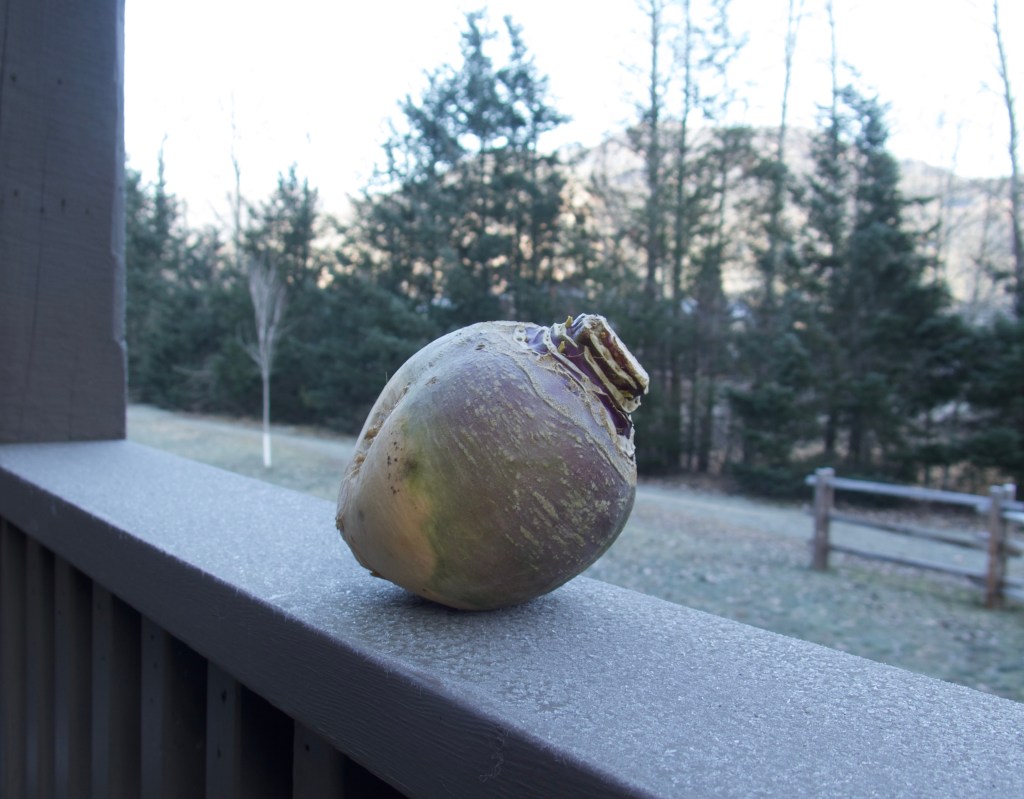
    rutabaga

    A three pound rutabaga provided us with five meals over a two week period and half of the vegetable is still in the fridge waiting for my next inspiration.  

    Downstairs, in a dark cool corner, my twenty five pound bag could last well into February, though I’ve recently begun to process in bulk for convenience.  I boil the rutabaga with carrots-about two carrots to each rutabaga-then drain them and mash them, storing in freezer bags.  On a cold night, these can be thawed quickly and eaten as is or added to soups and stews to round out the flavour and add nutrients.

    Rutabagas are a cross between cabbage and turnip and they grow from seed, maturing in about ninety days. As a Brassica, these vegetables might be too bitter for some people, though they do sweeten up after a few frosts, so try leaving store bought ones outside overnight.  The greens can also be eaten, somewhat like swiss chard.  It’s a vegetable that deserves a renaissance:  try it with nutmeg, sautéed garlic, feta cheese, apple slices, maple syrup or maybe curry.  

    Inspired? Try Nidhi Raina’s Bad Boy Rutabaga and Turnip Curry.

  • Top 10 Worst Attributes if you want to be a Farmer.

    Top 10 Worst Attributes if you want to be a Farmer.

    10. GREED. There are no get rich quick schemes. If you try to compensate by overcharging, being dishonest or biting off more than you can chew, it will eventually bite you right back. Avoid monocultures and what appear to be lucrative trends.  The market will usually bottom out. (Remember the ginseng craze of the 90’s?) You can fool some of the people some of the time, but not everyone all the time. Integrity is key.

    9. LAZINESS. If you prefer leisure over work, like to take naps and  shortcuts, you won’t last very long. Farming is long hours of hard work. It’s 24/7.  You will be getting up early for markets or need to get up in the middle of the night to check on livestock or cover your plants when there’s a frost warning. There is no easy way or everyone would be doing it.

    8. PROCRASTINATION. Putting stuff off will only lead to exponential work in the future.  A quick, easy weeding job one week can turn into an epic nightmare the next. You can never really be on top of everything, you can only keep trying. If you see something that needs doing, just do it.

    7. GERMOPHOBIA. You will literally be covered in dirt and shit most of the time. You will breath and ingest it and will not have clean hands for the whole season.  There will be bugs, slimy and smelly things. Get used to it – it builds up your immune system.

    6. OVERACHIEVING.  It’s so easy and tempting to go big, which could end up being unmanageable and stressful. It’s better to have a small productive garden than a big one you can’t handle. Do what you do best and leave the rest to others. At the same time don’t put all your eggs in one basket. Diversify.

    5. STUBBORNESS. Ask for help when you need it, delegate, and accept your failures and move on.  Be aware of your strengths and  weaknesses and hire someone who can do it for you if you’re not comfortable or able or have the right tool.

    ThinkstockPhotos-114457508

    4. COMPLACENCY. If you let your guard down, pests, weather, and safety issues could arise without warning.  There are many old farmers missing digits, limbs or suffering hearing loss. Be careful. Just because something worked once before doesn’t mean it will again. Be adaptable and keep learning.

    3. ARROGANCE. Don’t assume anything or think your invincible. Be modest and humble.  Don’t compare. Boasting and envy  are not productive. Be a positive  part of the farming community. Resist a competitive attitude. If the grass is greener on the other side of the fence… water your field!

    2. ATTENTION  DEFICIT. Farming is often long tedious hours of repetitive work. If you can’t focus on the same thing for hours, or even days, it will be a struggle. If you have to check your phone every few minutes, you’re doomed.

    1. PERFECTIONISM.  Things can never be perfect in such a dynamic environment, go with the flow and expect failures, and move on.  Learn from your mistakes.  Don’t over plan, let nature guide you. Enjoy.

  • Thoughts on plastic bag bans from an organic potato farmer

    Thoughts on plastic bag bans from an organic potato farmer

    Clamorous demands for a plastic bag ban at Vancouver farmers’ markets have resulted in… a (pending) plastic bag ban at market. The association that runs the markets at which we have been selling potatoes for over 25 years recently announced that starting with the 2020 season all single-use plastic bags will be banned. I have been privately fuming about it for ages, with no proper articulation. The formal announcement has forced me to publicly admit that I have issues with the new policy.

    First some groundwork. Let me lay this on you. I sell a lot of things in plastic. Potatoes mainly, but also carrots, beets, parsnips, and even on the odd occasion broccoli, beans and basil. Retailing with plastic is effective and efficient. It’s not completely brainless and some merchandizing skills are required. The tops should be tucked under the bags, for example, or the display can end up looking like a farmers’ market stand that sells plastic bags, as opposed to potatoes. The bags should be of good value with the price stickers visible. You should know when to use a twist tie for closure and when to use a knot, and what type of knot. The bag should contain no unsightly culls. There ought to be a bulk option right beside the ordered heap of pre-packaged product. Half the customers will choose one, half will choose the other.

    Things in plastic bags sell. Every retailer knows this. That’s why you see in the grocery store that everything is packaged, particularly in the produce department. If you want to sell more, put it in plastic. I think too, consumers have been convinced that things in plastic are more hygienic so that adds to the appeal and bolsters demand for plastic bagging. It’s entirely about boosting sales, however.

    So to continue with the summary of my current situation, plastic bags are a major part of our retailing plan at farmers’ market. I rely on them. If I want something to sell, I put it in a plastic bag. Boom. It sells. My farm depends on farmer’s market sales for almost 80% of our revenues and at least half those sales come from things in plastic: We make it convenient, attractive and of good value. We are managing to come up with lots of packaging alternatives, but none check all the boxes. The pending plastic bag ban is causing me to feel (and this is just for starters) highly irritated, somewhat stressed, and quite mis-understood.

    A mild yet persistent panic over-rides everything: how am I going to maintain sales at market if I can’t use plastic bags? I have known this was coming for a few years but now it is officially imminent, and I still don’t have a good replacement.


    My other feelings include indignation and not a little derision: how dare anyone who has never tried to sell potatoes in the rain demand a plastic bag ban. You can’t just put them in paper. A paper bag containing heavy potatoes is going to be very disappointing at some future possibly inconvenient and ruinous point, even in only slightly moist weather. The more fickle customer is going to pass on potatoes in soggy paper. There are a lot of that type of customer.

    This line of thought leads to a further point of indignation: why is it okay to impede my ability to compete in the retail environment? People need to understand that we feel ourselves slightly in competition with grocery stores who have a lot of very cheap potatoes, which they sell in plastic bags, because that’s how potatoes sell best. I have customers on the bubble to whom convenience and price almost outweigh taste and quality, and we will lose them. Resentment bubbles in my bosom…

    …followed by more derision: what exactly do you mean when you glibly say “single-use plastic bag ban”, which appears to be the go-to wording of this pending policy? It sounds a little jingo-y, to my ears, and it’s semantically weak.

    How about those produce roll-bags. They don’t have holes. They get used again. And again. Especially to carry potatoes and carrots in damp weather, and to store them at home. You know, it has been a long, long time since there was no plastic in the household. Before plastic bags, homes featured things like root-storage rooms, and somebody doing daily cooking and shopping. Freshly dug, delicate, oh-so-tasty nugget potatoes store well in a plastic bag in the bottom crisper drawer OR in a log-walled, dirt floor roothouse. Do people really know how to live without plastic? It’s kind of a big deal. Anyways, I am pretty sure those roll-bags are included in this ban.

    As another aside, because it is irresistible and the resentment has briefly bubbled over, are the same people also calling for a ban on plastic dog-poop bags? Oh? What’s that? You have a dog? And you think those dog poop bags aren’t rife with environmental issues and that your dog poop is pure? Bah. Pick it up with paper, why don’t you.

    I guess I think demands for plastic bag bans are thoughtless and not a little frenzied. Seems crazy to expect a little farmer like me to have to re-invent packaging, and that having done so, it will matter. I guess I don’t want to have to go through this with my 600 customers a week when the other 4 million people in the Lower Mainland are being offered, and are voluptuously consuming, singularly useless plastics galore at the grocery store.

    I don’t think anyone should feel like an environmental champion because they have been successful in their calls for a plastic bag ban at farmers’ market. This is, and you will forgive the expression, very small potatoes, and the price is being paid by a small, local organic family farm. Hardly heroic.

    Having said all that (and perhaps I have said too much), I am going to stop using the plastic bags with holes. I accept this. We have been thinking creatively for some time now, even before we heard the baying calls for a ban. It will cost us money, both in terms of lost sales and replacement packaging, but obviously I don’t think plastic bags with holes in them are useful beyond the single use for which they are so well designed. They are the junk food of packaging. We can do better. And I can even recognize that I might be wrong about the consequences.

    It would be super nice in return if people could check their calls for this ban. Farmers’ markets themselves are already on the cutting (and bleeding) edge of the quest for low environmental impact business operations. Environmental glory for all can certainly be found there. I am in awe of and deeply appreciative of the efforts that people will make to avail themselves of well-grown food at farmers’ markets. Speaking of plastic alone, a farmers’ market customer must barely use any compared to a grocery store shopper. Should we not be boasting about that? And enticing more of them over, rather than scaring them off?

    It is a simple exercise to find something environmentally devastating in someone else’s lifestyle. I try to resist (dog-poop bag rant an exception to the rule), because…well…sometimes it is none of my business.


    Anna Helmer farms with family and friends in the Pemberton Valley and dearly loves to pile it high and watch it fly.

  • The Biodynamic Farming Experience for the Celestially-Challenged, chapter 2

    The Biodynamic Farming Experience for the Celestially-Challenged, chapter 2

    Hello and welcome to Chapter 2 of The Biodynamic Farming Experience for the Celestially-Challenged. It is a partly-formed, poorly-articulated and over-hyphenated chronical of a particular journey, which is not quite the right word because it suggests the presence of a destination which is not at all guaranteed. Whatever it is, a woman-farmer-of-a-certain-age-and-experience (me) delves into the theory and more-importantly the practice of Biodynamic farming in search of fun (frankly) and future of farming (idealistically).

    Journey is clearly not the right word. Voyage of discovery? Too fancy. Is it a process? Nope. No fun. Compost heap. I think it might be a compost heap. Perfect. Piling up all kinds of ideas, layering them with experience, mixing up some theories, letting it sit. For absolute certain, something good is going to come of it, but it might take a while, depending on how raw the material is.

    The bottom layer in my compost pile of cosmic cognitive sentience (how about that!) is a cover-to-cover reading of the original Biodynamic lectures delivered by Dr. Rudolph Steiner. I am just about done. I remain perplexed most of the time, although I experience (sadly random and rare) flashes of triumph when I realize I have managed to grasp a concept or follow an argument- very quickly snuffed out, usually by the next paragraph. I persist, however, because I am hooked.

    In the last article I mentioned the Biodynamic Preparation 500, which we have been using for years. It is widely considered to be the most basic and simple preparation. It’s easy to make. You just stuff a cow horn full of fresh manure and bury it a foot or two down in the soil for the winter. In the spring, when dug up, the manure has transformed into a delightfully hummus-y loamy, dark, rich, almost powdery substance which is incorporated into water and sprinkled about the fields and gardens. Steiner manages to explain why the use of a cow horn is necessary, but I can’t. The point though, is to avail the farm to the powerful forces of the universe.

    Well the thing of it is, it also works on people. If you are not picking yourself up off the floor after collapsing in a dead faint of amazement, then I have not expressed myself well. Which is a problem with the writing, not with Biodynamics. You see, I myself have been made available to believe that the universe has an influence on the health of my farm because I have been using the Biodynamic Preparation 500.

    It’s taken close to twenty years of using the preparation for me to get to this stage. I hope it doesn’t take everyone else that long. Steiner seemed to think about 4 years should do it.

    To return to the point of this exercise: is Biodynamics fun? Is it the future of farming? I remain firm in my conviction that it might be. It is certainly more fun than the organic certification process, which I find has gotten a little dry. Necessary, if we are keen to relieve the Monsantos and DuPonts of the world their self-appointed mantle of agriculture way-finders. Obligatory, if you want to sell directly to people who don’t want to consume products from those companies. It is not, however, fun. Not that it needs to be, of course. That obviously does not come into it. It’s just that I find myself less and less satisfied with the result: a mere certificate.

    helmers_farm

    With Biodynamics, I seem to be ending up with a lot more than that. I have inspiration, wonder, amazement, incredulity, reality-checks, positive feedback from customers, tantalizing experiences of powerful forces. Lovely things to add to the compost heap of galactic oomph. I think I am going to be a better farmer because of it. Certainly, the farm is a better farm because of it.

    Returning to the question of looking into the future of farming. It does seem to me that farmers and consumers alike are aware that the organic certification program can only take us so far. There needs to be something that speaks to the fact that many farmers are going way beyond what is necessary to get the organic certificate. They are doing so because it becomes clear after a few years of organic farming, that the soil needs a little something more to gain health.

    While I think it is reasonable to look at Biodynamics to take it to the next level, there may be some snags. One of them has got to be that it can get a little bogged down in discussion, which I would like to flag as one of the biggest hinderances to productivity. A talking farmer is very often not a working farmer.

    Another issue is this insistence on involving the position of the sun and the moon in relation to the stars and planets. People like me are simply going to switch off when this topic arises. I believe that this aspect of Biodynamics is the stumbling block for most would-be practitioners. There is precious little science to back up the practices and very little apology is made for this.

    Cynically, I would also suggest the fact that Biodynamic farming does not require much in the way of support industries would really sink it as a viable farming method for the future. Apart from the odd tractor, a few implements and some cover-crop seed, Biodynamic farmers spend very little in the mainstream agricultural system. There is simply no need.

    So, as far as the future goes, Biodynamic farming is hazardously non-productive, off-putting, un-scientific and doesn’t contribute to the world’s largest companies. Doesn’t sound very promising does it.

    On the plus side, our yields are increasing, our customers are asking for it, and it is a fun way to farm. I think if we all just started throwing a little Biodynamic 500 around and carried on with our business, it would be a good start.

    Come visit the farm April 27, 2019 and we’ll mix some up for you.

    helmers biodynamic open house

  • The Atypical, Unfair Economics of Farming.

    The Atypical, Unfair Economics of Farming.

    Q : How do you make a million dollars farming? A: Start with 4 million!

    As far as business models go, none is as bizarre as farming. There are very few winning formulas. It’s either large scale corporate agribusiness (which has its fair share of hidden costs) or struggling small-scale mom-and-pop operations. There really is no middle ground. It’s feast or famine, so to speak.

    The reality is our food system is broken and has been heavily subsidized since it became a transportable industrialized commodity. The sticker price on food rarely reflects its true value. Farmers markets offer a more equitable price point, but the math still rarely adds up.

    Competition in most sectors is healthy to keep businesses up to date and prices in check. In farming, it’s devastating. Huge mechanized monocultures, using underpaid labour, utilizing relatively cheap petroleum for fertilizing, harvesting and transportation are no match for a local farmer growing the natural way. Throw in crop insurance, subsidies, GMO’s and shareholders and it’s a lose-lose for both sides. One model is unsustainable environmentally the other is economically unfeasible. It’s a David vs Goliath scenario. That’s why the local, organic and fair trade movement has developed to help level the playing field of this uphill battle. The disparity gap is massive.

    When I asked for something  pricey, my mother always said “Money doesn’t grow on trees.”  Eventually I proved her wrong, but she had a point. A fruit tree, for example, may not bear a sizeable crop for 8-10 yrs. During this time it will need annual maintenance and constant care. Same can be said for the fence that protects it, the irrigation system that waters it and the root cellar to store the fruit. Everything is a long term investment. It is said you plant “pears for your heirs.” I call my  fruit trees my RRSP’s.

    So why would anyone even attempt to become a farmer?

    Passion, sustainability, and the romantic notion of working with nature in the outdoors are all good reasons.

    Yes you can eke out a living like the pioneers did, but with today’s expenses, it’s hardly a get rich quick scheme. Most thriving farms either started out small and slowly grew within their means, such as in my case, or they were inherited complete with infrastructure. Other options are leasing land, buying into a co-op or renting out your land and hiring farm hands while you work your real paying job.

    The big dilemma surfaces eventually: Do you stay small, subsist and struggle, or do you invest large and go big, making it even more risky. Either way is tough and requires  hard work… Almost all will need winter employment and additional sources of income. When doing our books, I often get discouraged. My wife has to remind me sometimes we’ve chosen a lifestyle not a career.

    Can you imagine going to the bank and asking to borrow money for a farm start up in Pemberton with your list of capital projects and expenses? A couple million for the land and a couple more for housing, outbuildings, power, irrigation, equipment, supplies etc. That doesn’t even include the operating costs such as labour, permits, insurance, taxes, fuel, tools, amendments and general overhead.

    Now you have to explain that you’re going to sell your produce at a few dollars per pound, provided the weather and other environmental conditions co-operate. Our short growing season rarely offers a second chance. Over half the year brings in little or no income. Every concept is risky. Almost everything is perishable with a short shelf life. Now you have to market your goods. Do you get a fair price toiling away a couple days a week at farmers markets, drive all over delivering to restaurants, or do you succumb to the middle man and sell it at a discounted wholesale price? The middle man can make as much or more on the transaction alone. Any potential investors out there interested yet? I can picture the Dragons tearing a strip out of that business plan.

    So how on earth does one make a living farming? Hard work and determination is needed, but still won’t guarantee success alone. Diversifying, simplifying, creating a unique niche market, marketing, networking, packaging, bartering, preserving and value-adding your harvest into products is really the only way to justify small scale farming. Farmers should spend as much time in the kitchen, office and garage to be successful. Reinvesting, organization, maintenance and long term planning are essential.

    There is a relatively new category of farmer that seems to be proliferating: “Le Nouveaux Riche Fermier.” They are recognized by their huge mansions set in the middle of the field, a long tree lined paved driveway with a large elaborate locked gate. The obligatory white picket fence, brightly painted barn and shiny tractors. The owners are rarely seen outdoors and never with dirty fingernails. It’s often hard to see what they’re doing from the road. So what are they cultivating anyways? Tax breaks and the right to brag that they are trendy farmers at the country club, I suppose. If you assume all that bling was acquired through farming, you’re fooling yourself. It’s a false front.

    Just because you can afford to buy a farm doesn’t automatically make you a farmer. They are actually taking away usable land and degrading true farm culture.

    If you’re in it for the money, you’re literally wasting your time. There is not a single small-scale farmer that tracks their time and would ever attempt to calculate a wage. For them, their lifestyle is priceless. There is no point in tying to make sense of the economics. You work your ass off and hopefully reap something from what you sow.

    So the next time you wonder why that pineapple from the Philippines is cheaper that those local grapes at the farmers market, just remember your comparing apples and oranges.

  • A Farmer’s Ode to the Cabbage

    A Farmer’s Ode to the Cabbage

    IMG_3737
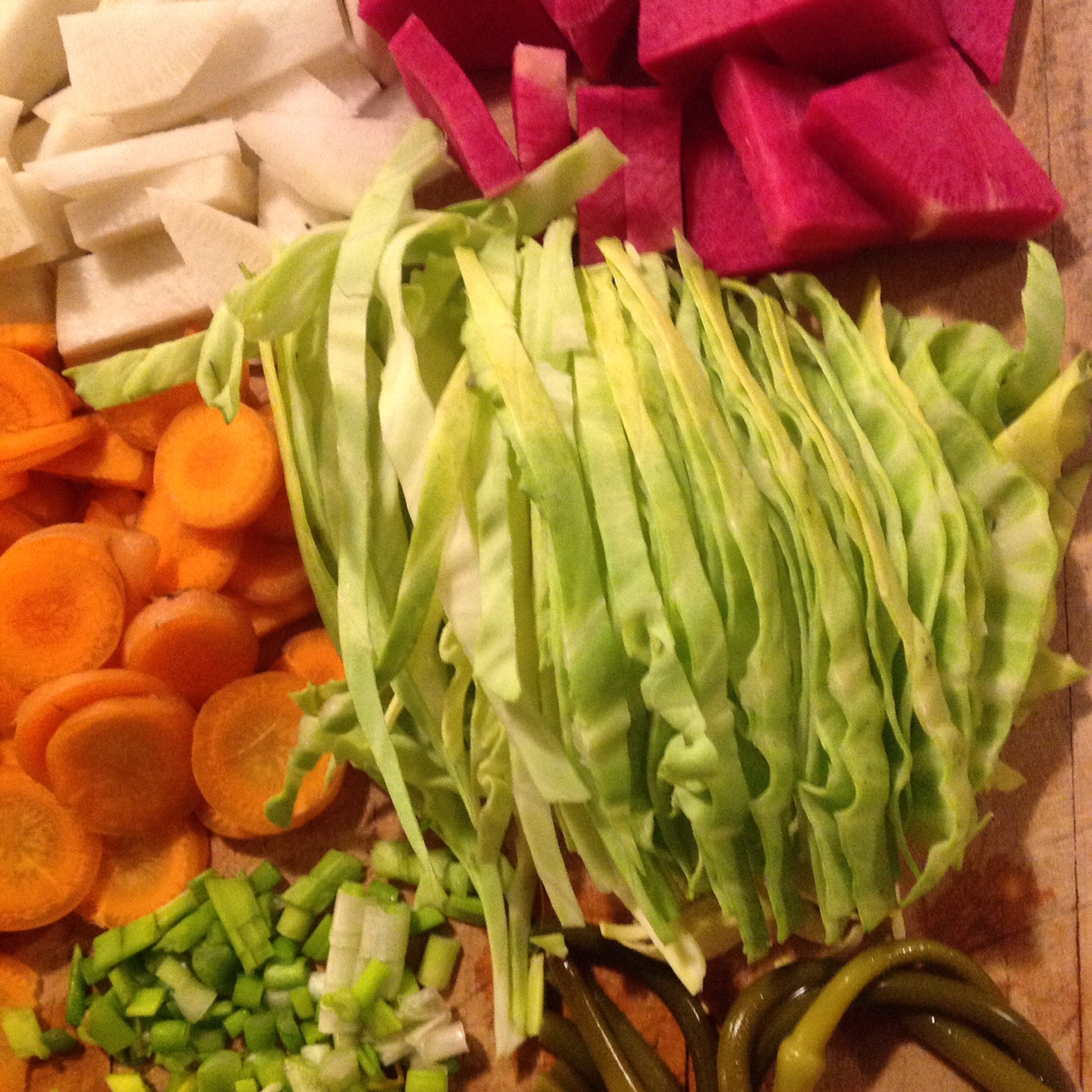
    Prepping dinner in late February.  Note “green onions”, carefully harvested from some storage onions that decided it was time to start sprouting.

    Note:  This post the product of a farmer itching for the snow to melt, of Lisa Richardson’s gentle encouragement to not be ashamed by my lack of posts since last May, and also a plug for a new page on our farm website that talks about VEGETABLES.

    It tries to answer questions like “What’s this?” or “How can I cook that?” or “Can I freeze these?” that I get asked from time to time as a CSA farmer.  I also admit to eating cabbage for breakfast on a regular basis.  Feel free to have a look if you’d like.  http://fourbeatfarm.ca/news/

    IMG_3723.JPG
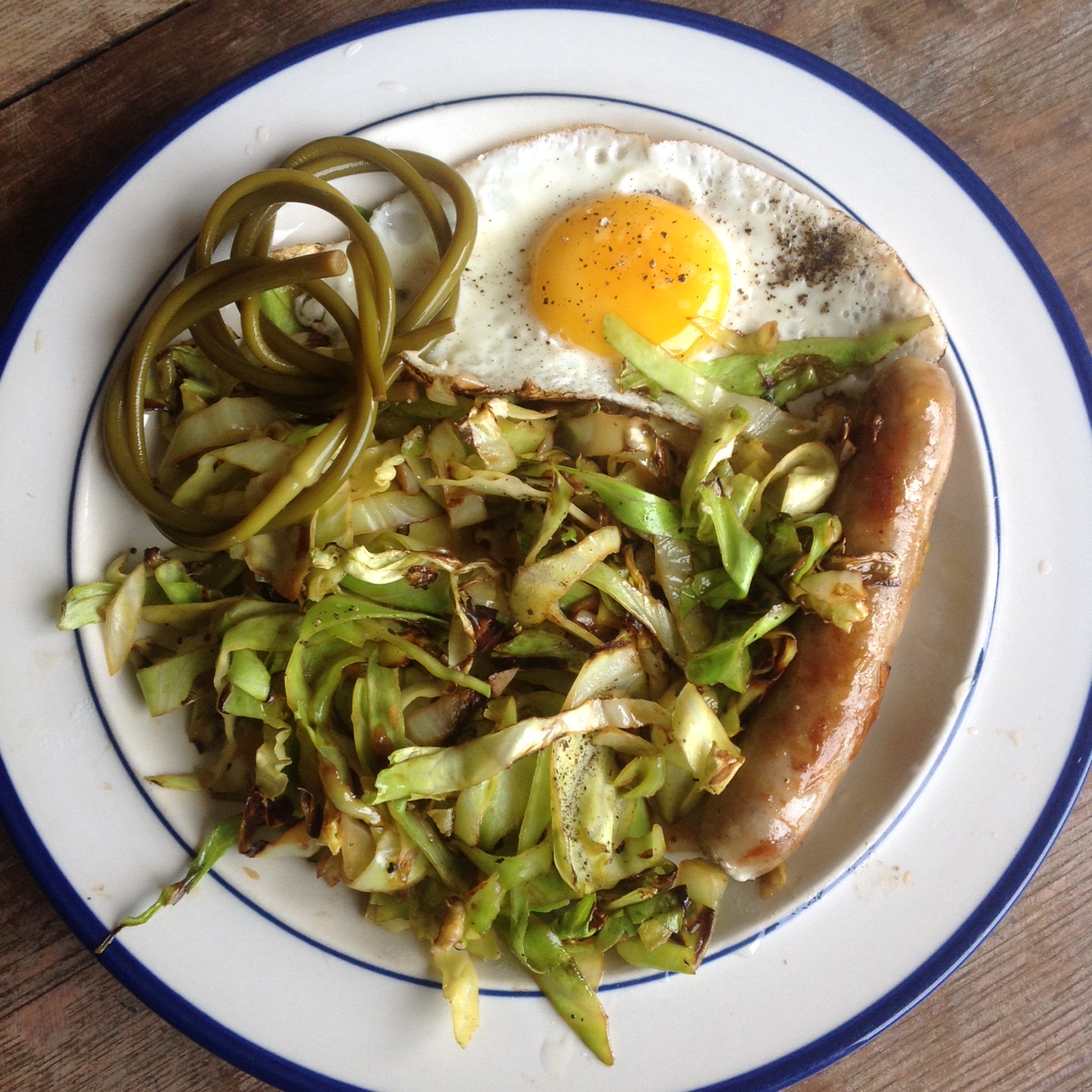
    A breakfast option for the Pemberton loca-vore.  Includes an average portion of cabbage, pickled garlic scapes from last summer, and some additions from friends at Spray Creek Ranch.

    Now, to ramble…

    Last week, the spare room where I store my personal supply of winter produce had its annual conversion into a spring “grow room” for this year’s seedlings.  Anyone else have ~8000 allium roommates right now?  No?  Oh well, just me then.  We will be co-habitating for a few weeks until the seedling greenhouse gets set-up and temperatures climb a bit.

    Because of this new roommate situation that I have come to believe is normal, I spent a few hours picking through the bins of winter storage vegetables.  Since I haven’t been to the produce section of the grocery store all winter, there wasn’t much left.  I salvaged the best to cram into the fridge and imminent meals, and that about took care of it.  Let me begin by saying that, despite my attention to detail when it comes to processing and storing vegetables in the main farming season (destined for CSA and farmers market shoppers), my winter set-up for personal use is…well…simple.  Or lacking.  Depends how you look at it. Let’s call it “rustic” to be nice.

    It’s a small room in the house.  It’s separated off and slightly insulated by a blanket over the doorway to avoid wasting woodstove heat from the hallway.  The window stays cracked open to let in cold air and keep the bins of veggies comfy.  When we get a cold snap, I make the crack smaller.  When we get a mid-winter thaw, I open the window a bit more.  If I remember.

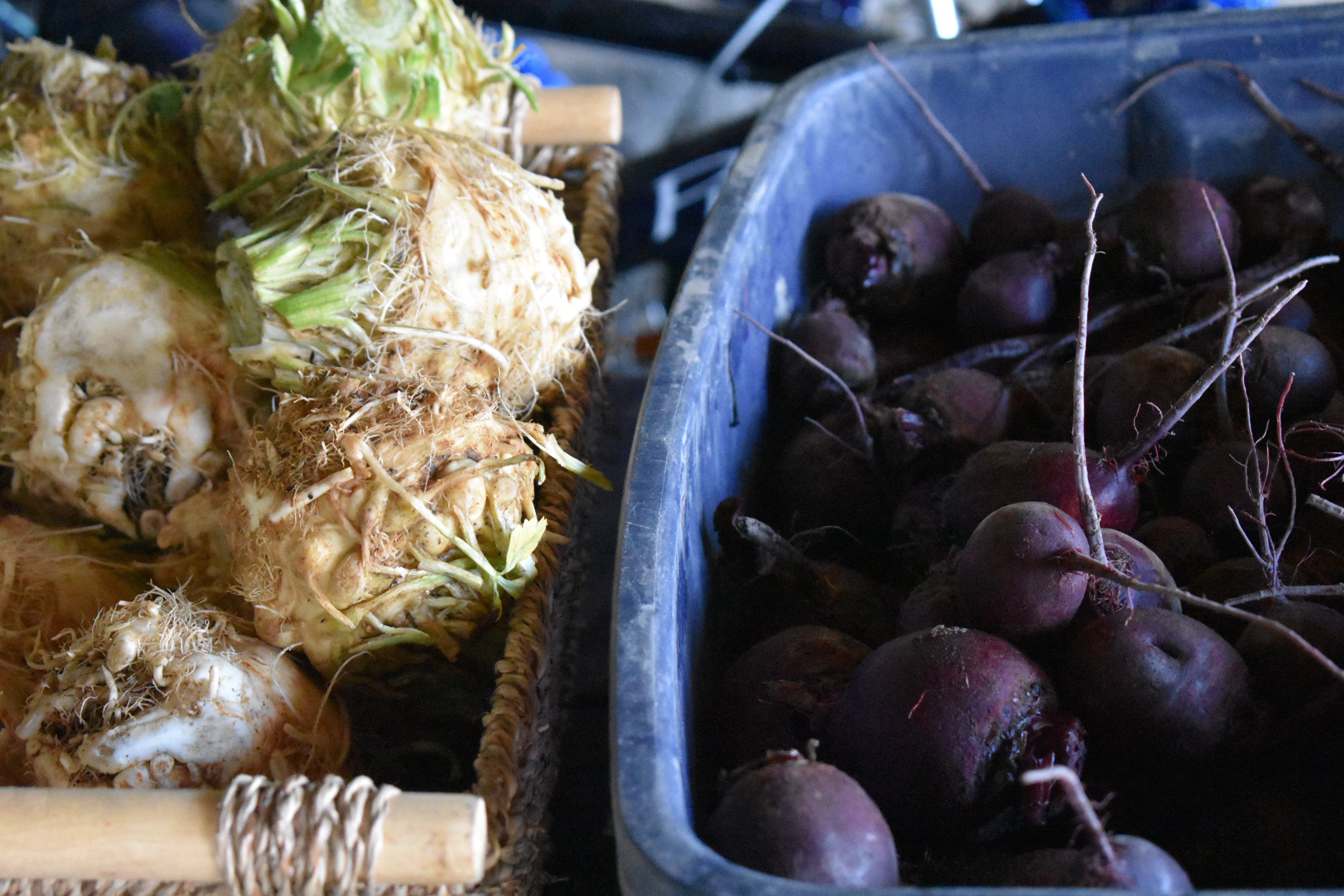
    This has successfully kept beets, carrots, turnips, watermelon radishes, cabbages, rutabaga, celery root, kohlrabi potatoes and onions in fine shape until at least early March.  There are some sprouty bits.  Occasionally one will turn to mush and cause a small amount of slime to touch those around it.  These now-slimey neighbours get rinsed off and put in soup or fed to the draft horses (onions exempt, they go direct to compost and bypass the horse trough).

    DSC_0529
    Winter storage veggies at their prime for fall CSA members.  Mine do not look like this now.

    By March, things kept in such un-fancy conditions tend to look a little tired.  Rutabagas are starting to sprout wild hairstyles.  Celery roots are looking a bit shrivelled.  But the cabbages?  Oh, the cabbages.  They’re like a breath of fresh air.  Dozens of them have been sitting in a Rubbermaid bin in the house for nearly four months and they are still crunchy, juicy, sweet, and willing to join in to up the freshness factor of just about any meal.

    If you’re looking for ideas about vegetables, recipes, or curious about how this particular farmer likes to eat her veggies year-round, I’d welcome you to check out a resource we are growing to help our friends and CSA members with the age-old question “What is this?”  (holds up a cabbage shaped like a cone, an alien-resembling kohlrabi, or a yellow beet).

    http://fourbeatfarm.ca/news/

    Seriously though, those cabbages.  They’re just what a farmer needs this time of year.

    IMG_3751
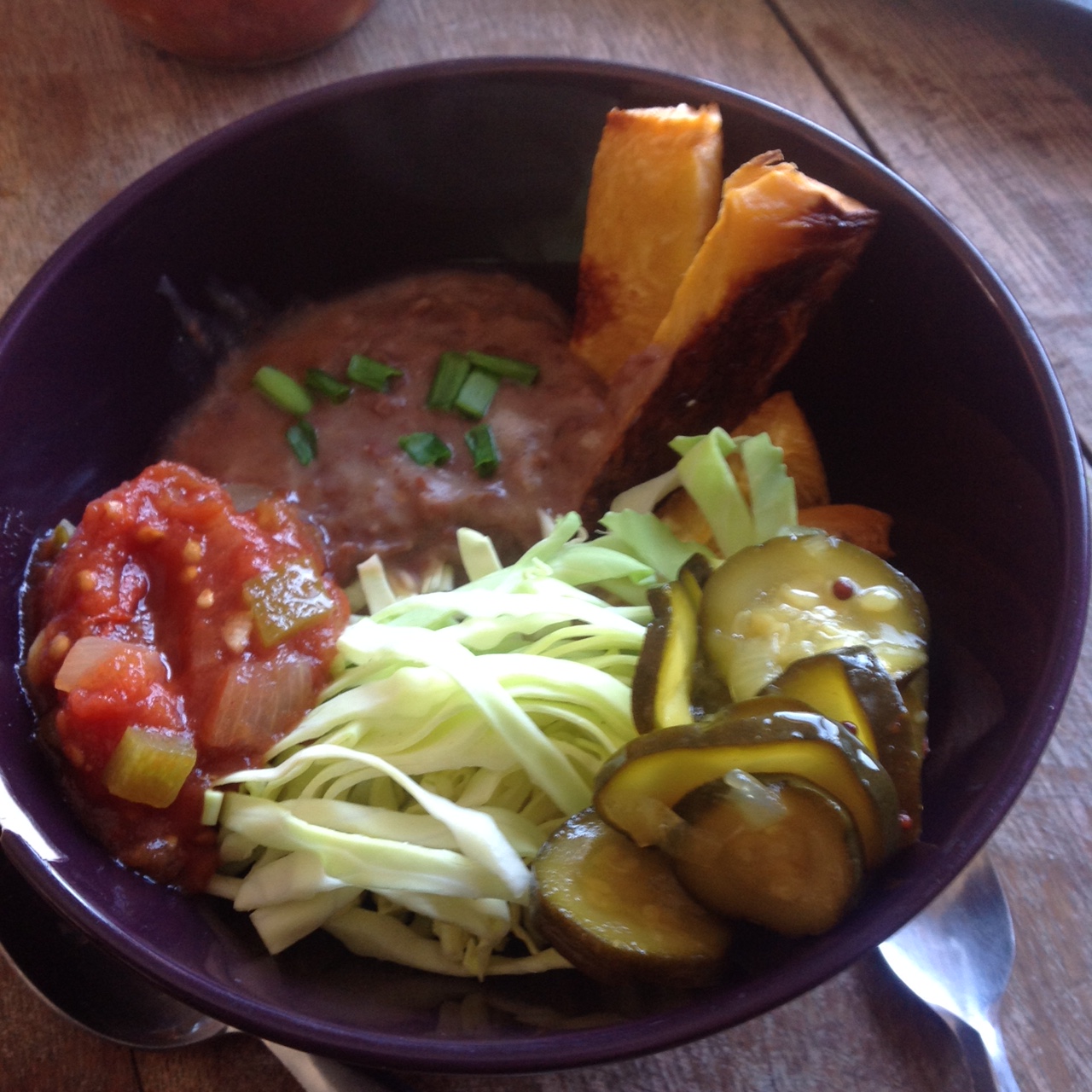
    A friend of mine called this a “Winter Glory Bowl”.  Not sure if she was joking or not, but we’ll take it.  Canned salsa from our summer tomatoes, refried beans from some shelling beans we grew and froze, sweet curry zucchini pickles, and roasted rutabaga.  I don’t know if they’ll be serving it at any restaurants anytime soon, but it was a perfect sweet & sour,  hearty & crunchy combination of food from the farm for a post-snowshoe lunch.