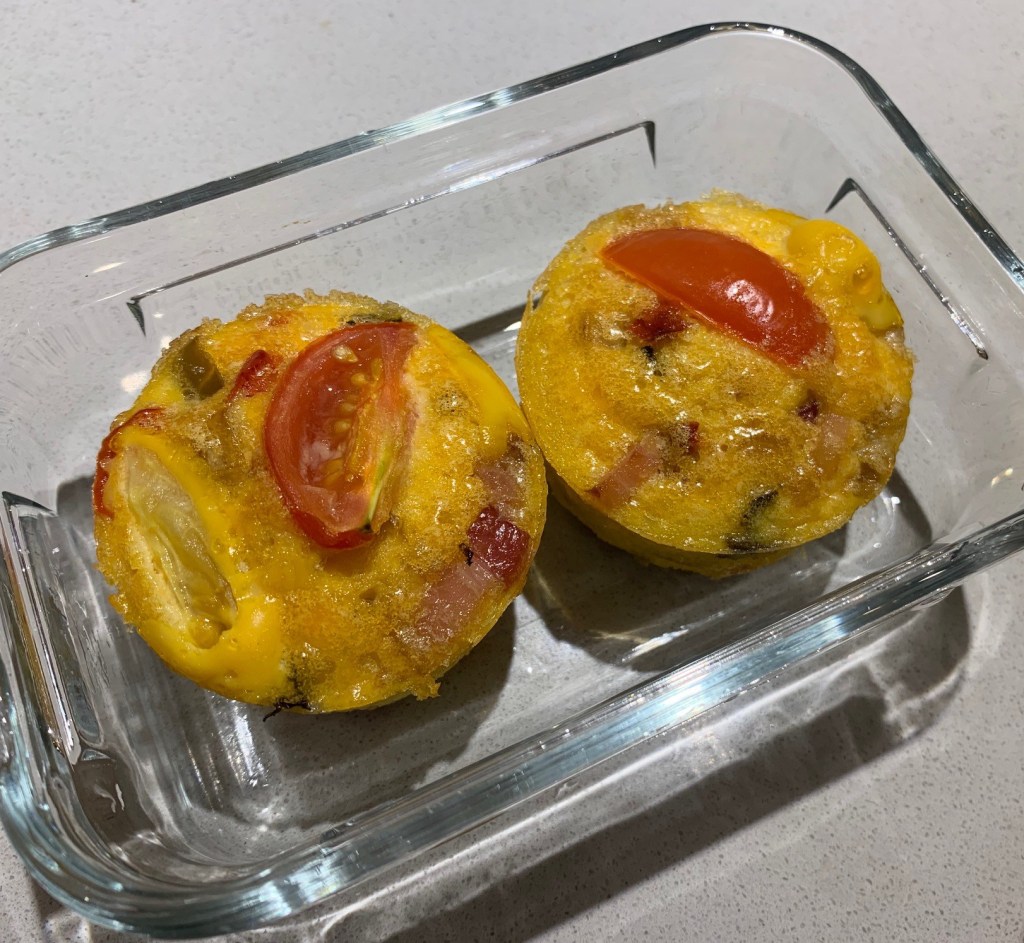
This recipe is inspired by the portable egg bites that Starbucks sells. With all the produce available at the Farmer’s Market or in your garden these make a very good high protein lunch! And they are easy to make. This recipe makes 4 omelettes but you could easily double or triple the recipe.
Ingredients:
1 tbs pure olive oil
4 Pemberton free-range large eggs
4 slices high quality thick-cut bacon, diced
1 Pemberton-grown red pepper, finely diced
1/4 Pemberton-grown yellow or white onion, finely diced
4 cherry tomatoes, sliced in half and then sliced lengthwise into thin slices
2 tbs cilantro, finely chopped
1/4 tsp salt
1/4 tsp pepper
Method:
Sauté onion and red pepper in 1 tbs olive oil until soft and slightly caramelized. Add cilantro, salt and pepper.
Fry bacon in separate fry pan until crisp but not crunchy.
Add bacon to veggie mix.
Blend eggs in blender on high for 10 seconds. Or beat well with whisk or fork.
Place a silicone muffin pan into a large pyrex casserole dish.
Boil a large kettle of water.
Place 1.5 tbs veggie-bacon mix into each muffin cup. Then pour 1/4 egg mixture into each cup. Place 2 slices of cherry tomato atop each muffin.
Pour boiling water into pyrex dish so it reaches halfway up the sides of the dish.
It’s a beautiful and productive thread, and prompted me to this place: SPROUT!
Well, I was nudged as much by Molly’s question as by the $5 price tag on a head of wilted lettuce, and the price tag on a bunch of kale, which my garden no longer yields (most of it was nibbled down to stem by the deer, and anything that remained is now buried under a foot of snow) and which inevitably cooks down to a single mouthful, although any dirt I didn’t wash from it manages to expand in size in some perverse inverse leaf-to-dirt amplification equation). Plus, I was motivated by this instinct that when I make something from scratch, or see something grow, I feel stupidly happy; my kid engages more deeply in the real world, and we’re already in that constant tussle of real world versus seductive screen; also, a desire to have some greenery in the diet in the depths of winter. I already had a sprouting jar, so I pulled it out of the cupboard and carefully measured out my tablespoon of alfalfa seeds, rinsed them, soaked them in water overnight, and then begin the daily ritual of rinse, swirl, drain, sit back upside in the jar on the plate on the corner of the counter.
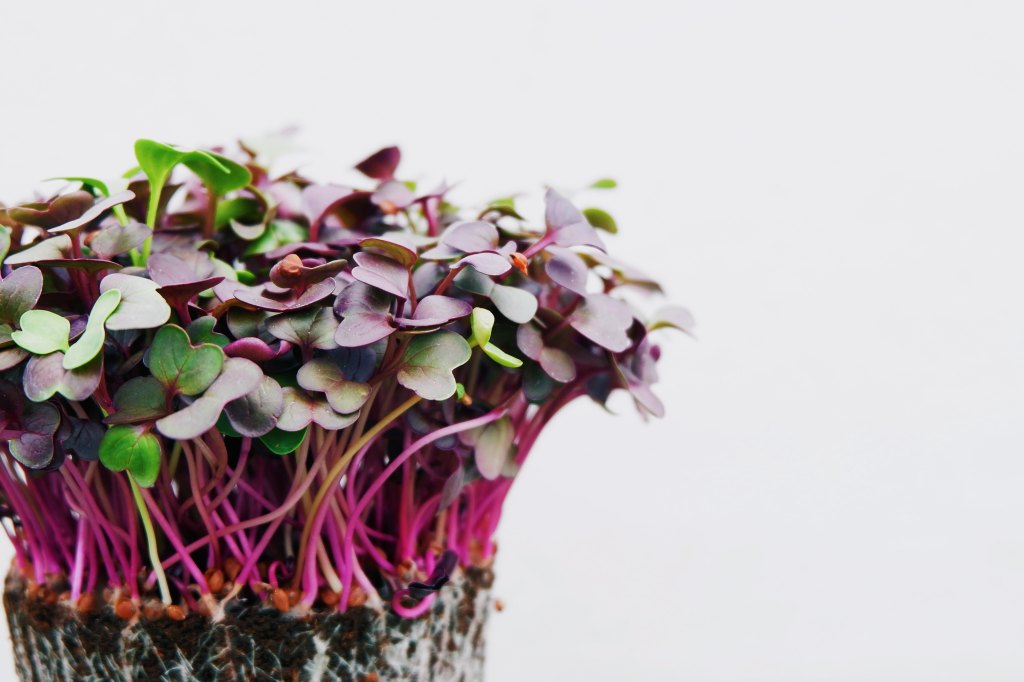
Then, thanks to a combination of internet-smarts, sunflower seeds and encouragement from Stay Wild (apparently, Leah’s countertop at home is covered in sprouts and micro greens), and a great book from the library, I became a micro green grower.
“Winter in Minnesota is notorious for wearing optimists down to a brittle nub, but the more experimentation we did with micro greens, pea shoots, radishes and other tasty vegetables, the more we felt like we were extending summer into our house… There’s a certain thrill that comes with seeing seeds begin to pop into three first leaves, and if you’re wearing your pyjamas at the time, that excitement can feel doubled.”
Microgreen guru Elizabeth Millard (left) and her partner Karla Pankrow of Bossy Acres farm in Minnesota
As a person who works from home, being able to do things in one’s pyjamas is Mission Critical for me. It’s a flashing neon sign that says, “Lisa, this might even work for you.”
And so, following the various bits of advice I’d gleaned from above-mentioned resources, I began, with one plastic salad box rescued from the recycling bin, some potting mix excavated from underneath the cobwebs in the garage, and my little packet of sunflower seeds acquired from Stay Wild.
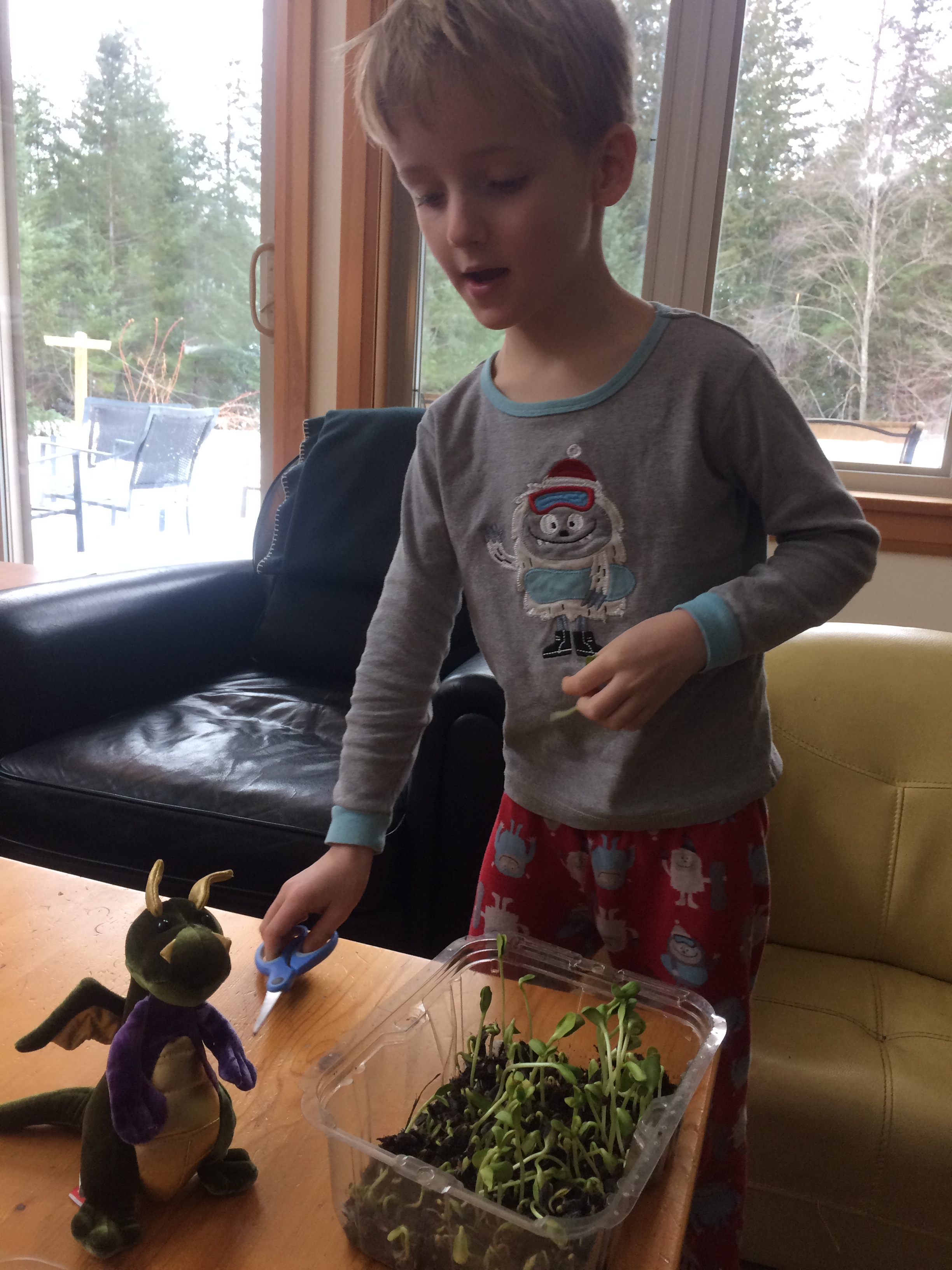
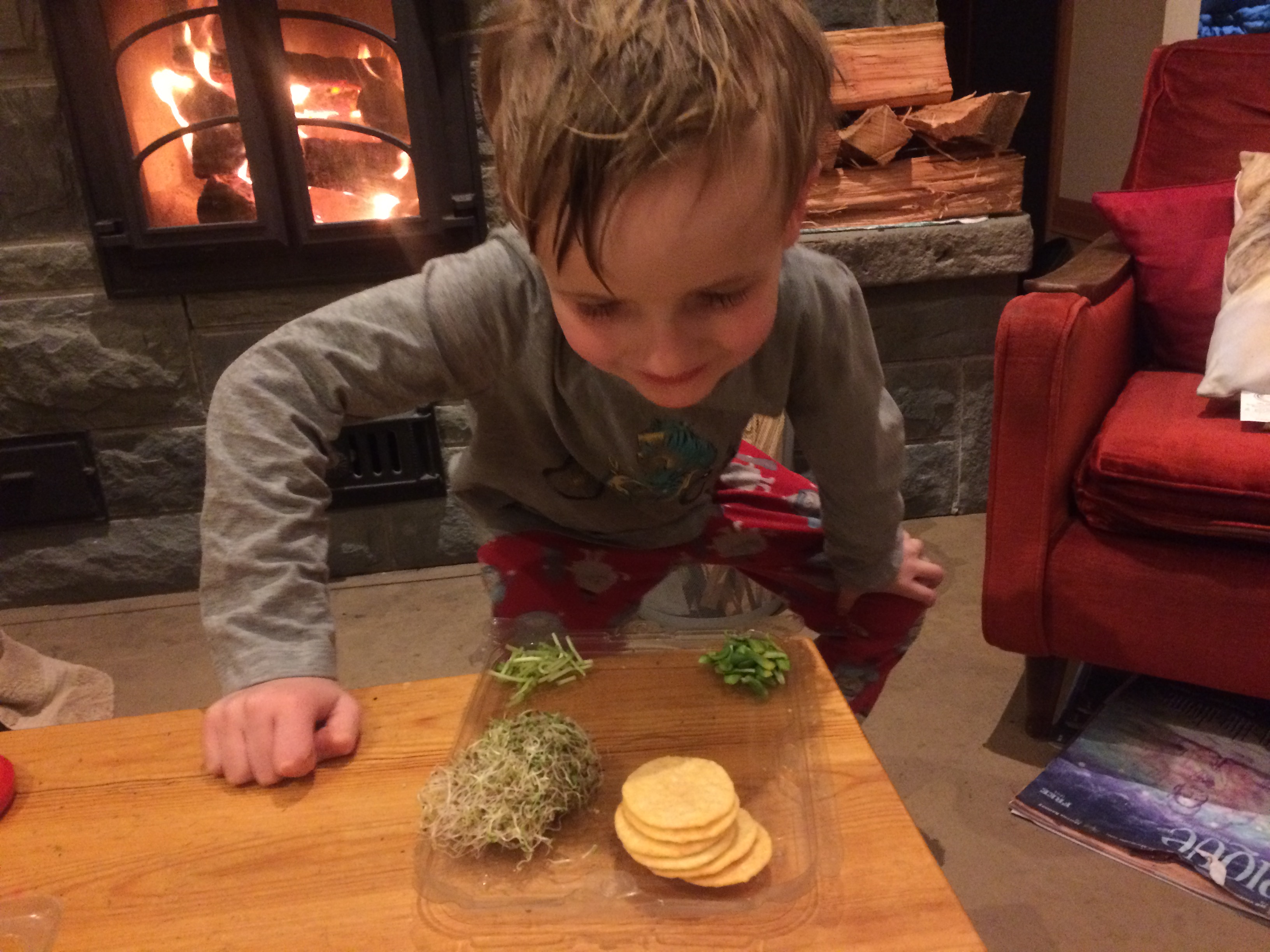
A few days later, my 5 year old put himself in charge of the harvest, and Mr Just-Ichiban-Noodles-for-Me, snipped and plucked and made merry with the nutrient-dense cotyledons (the initial two leaves of a seedling, that give way to the plant’s “true leaves”). He made cracker-sandwiches for us, from the micro greens, and ate his way through much of the first harvest. Hooray!
Some wins just feel too easy… I spent $3, used garbage, and my kid fed himself greens (and also introduced his meat-eating dragon to the joy of omnivorism.)
Look, Sparky! Micro greens. Feel free to toast them, if you like. Bu they’re just as good raw, for those who don’t have the ability to breathe fire.
Raw food chef-in-training preps the basic ingredients for a nutrient-dense snack for all the family.
Added bonus, the micro greens made my dinner look more like the picture in the recipe book, which never happens! Wizardry. And joy.
Millard said, in her book: “Sometime around the middle of February, it always seems to hit: the weariness of filling my shopping basket with fresh vegetables from California, Chile, Mexico, and even Peru or New Zealand. No offence to the hardworking farmers, because I truly appreciate the opportunity to eat oranges during a snowstorm. But these products require, by necessity, lengthy shipping times that sap them of flavour and nutrition to some degree. Still, it’s not easy to eat local when you live in a place that requires budgeting 20 minutes every morning for scraping the ice off your windshield.”
How do you find joy in winter is a wonderful prompt, as I discovered when I read through the responses to Molly Costello’s post: cross-country skiing, running, sleepovers and dinners with friends, landscape planning and reading seed catalogues, being okay with not being totally okay, soup-making, sauna, drinking warm juice, extra gratitude practice, crafting, making art and cooking for friends, burning candles, forest walks, cold water swimming, making broth, hot baths, taking a cup of coffee outside cloaked in a huge coat, writing letters to long-distance friends and taking extra good care of the houseplants.
If you want to get more specific, you could ask: where do you find joy in winter? And happily, I can now answer: on my kitchen counter.
Theres no doubt people in these parts are more and more concerned and conscious about what they ingest. After all, you are not only what you eat but also what your food ate. The organic food industry is a multi-billion dollar industry and continually growing. Making sense of labeling or the lack of it can be confusing. Organic regulations and labeling requirements differ from place to place and across different certifying bodies. Despite the popularity of farmers markets and kitchen gardens, here in BC most of our organic produce comes from California because they offer a consistent supply year-round. We are inevitably bound by their rules. Is it GMO, biodynamic, freerange, freerun wholesome, naturally grown? What does any of it mean? We just want good clean nourishment with the least harm to the environment. Right?
Is imported organic the best choice? It’s often overly packaged, travels hundreds of km’s, employs underpaid and often vulnerable illegal workers, and is heavily subsidized. Often farms are big unsustainable monocultures owned by big corporations. If they follow a few rules, there’s a certifying agency that will approve it. When there’s millions at stake and corporations involved, there is always a possibility of corruption. Produce also quickly loses its nutritional value within its shelf life, and tasteless varieties that keep best are preferred. Think California strawberries. Profits can come before your well-being. After all, it’s still capitalism.
So local is the best?
Yes of course! But, it’s limited in our climate.
And, no. For a number of reasons. Local organic out of season is either hothouse grown or warehouse stored using lots of energy and infrastructure. It’s not grown using soil and sunshine. The worst part of the “local” label is that here, as long as it was grown in BC, it can be called local. A Pemberton berry farmer here has no competitive advantage over the thousands of acres of commercial product flooding the market as local. Even a Fraser Valley potato can be sold here as local.
That’s wrong.
So what is a small scale farmer or even a gardener, who has unadulterated naturally grown surplus, to do?
Certifying is complicated, time-consuming and expensive. Saying that it’s organic is unlawful and disrespectful to those who have jumped through the hoops. What I see all the time is the “no spray” label: this is extremely deceptive because there are a myriad of organic sprays that all good growers use, such as: Bt, neem or horticultural oil, and insecticidal soap. So can you say it’s no spray and feed it tons of miracle grow? I guess, because no one is going to question or test it.
At our small farm we advertise ourselves as “Local and Sustainable” – which at fist glance sounds like a bunch of corporate bullshit, same as what we see from big companies globally. However we are truly local. We have been in corridor for 30 years and farming and homesteading for 25. We have only done business from Squamish to D’arcy. We have never bought, sold or repackaged anything from a middleman. We only do markets and farm-gate sales. We were once certified but found it costly and it wasn’t advantageous for our small scale. We have never deviated from the practices we learned that are acceptable. We are a mom and pop family business and feel our integrity is as important as a healthy environment. We welcome anyone to come and see how we do things.
So the message here is: get to know your farmers, pay them a visit and buy direct and fresh in season. Ask questions. There is no shortage of greenwash out there so buyer beware.
Save the date for 26 April’s Cook Book Club. We’re exploring Chef David Wolfman‘s award-winning new book, “Cooking with the Wolfman.”
Dubbed the “Godfather of Indigenous Cuisine”, Chef Wolfman is a classically trained Chef, Culinary Arts Professor at George Brown College and the executive producer and host of the 17 year strong television show (on APTN), Cooking with the Wolfman. Born in Toronto, Wolfman thinks of his mother’s territory in Xaxlip, just north of Lillooet, as “home” – he does homage to her, and indigenous cultures of the Americas, with this cook-book – a how-to, recipe book and collection of stories, all rolled into one.
There are some game options, fish options, and plenty of baked treats to try out.
Chef Wolfman says that if you are a fan of eating local, or eating sustainable, eating “indigenous” will be right up your alley.
“I always say local, sustainabie and indigenous is synonymous with each other. The direction I see us moving into – heirloom tomatoes, churning our own butters, making our own stocks, growing our own herbs, using all of the herb, using everything, so we’re not actually wasting food – it’s like we’re going back to what one elder told me are ‘the old ways’ – making sure we don’t take more from the earth and that we’re conscious of the earth.”
But whatever your food philosophy, or buzz words, or preferred cuisine, Wolfman’s belief aligns perfectly with what Cook Book Club is all about:
“The end goal is that we sit together and eat together and tell stories and love the company. That is all.”
So, make a plate, bring a date.
Cook Book Club is a PLUS ONE event, so if you’ve prepared a dish to share, bring a friend with you. Maybe you even want to prep your dish together, or share the cost of ingredients…
New for April’s Cook Book Club, we’ve adopted Signal Hill Elementary’s School Lunch Program as our charity of choice, and will have a donation dish at Cook Book Club for whatever cash-or-coin contribution you’d like to make.




 Traced Elements