Tag: biodynamic farming

  • Why the Farmers Market is more than just a shopping experience

    Why the Farmers Market is more than just a shopping experience

    In the spring, I sprinkled a small mason jar of biodynamic preparation 500 under my fruit trees and around my garden beds, just as Anna Helmer had shown me. There didn’t seem to be a very specific science to it, although I videoed her doing it and watched it over several times to make sure I had the insouciant wrist flick just right.

    It seemed kind of random and messy, which should suit my style to a tee, but I felt weirdly anxious that I would screw it up by flinging the droplets around too wildly, causing the cosmic magic that had been channeled into this precious jar of “water” to elude my little patch of earth.

    When Helmer’s Farm hosted an open house in late April, I was there, dragging the kid and his best friend, who amused themselves for hours, eating potatoes cooked over a fire, gently terrorizing the ducks, and eventually holing up in the sandpit.


    They also took a turn stirring the great vat of biodynamic preparation, which I suspect was part of the Helmers’ agenda for hosting an open house – to crowdsource some sweat equity from the farm visitors.

    IMG_2950

    I took my turn with the stirring stick, thinking I was really helping things along until Doug Helmer took over and showed me how it was really done, the vigorous stirring that must take place for several hours, creating vortexes, then disrupting them by swirling the water the opposite direction, channeling a winter-buried cow horn full of celestial magic into a kind of homeopathic preparation for the soil.

    IMG_2952

    Once again, as I yielded the stick and accepted a small jar of preparation, it became apparent that I was benefitting a lot more than I was contributing. But as my farmer friends keep reminding me: if there isn’t a willing consumer at the other side of the field, their work is for naught. It might feel imbalanced, when I see how hard they work, but supporting that work makes you an important partner.

    Charles Massy is a 60-something year old Australian pastoralist, self-professed shit-disturber and the author of Call of the Reed Warbler, who has become a growing voice for regenerative agriculture. He contends that, given agriculture influences several major earth systems, adopting a more regenerative approach offers the biggest potential to save the planet from the climate crisis. Regenerative farming is “nearly two and a half times better at burying carbon in the ground than anything else” in large part because of its commitment to nurturing soil health and rebuilding soil organic matter.

    He came to these views from the near-decimation of his family farm, and its slow recovery into a commercially thriving business, through the trial and adoption of many regenerative practices. A PhD in his 50s helped provide a framework for his ideas.

    Massy sees regenerative agriculture’s success as being dependent on farmers who shift their practices to become part of this solution. But equally, it’s on consumers. The movement will only work if the farmers’ products are supported by the urban community. “It’s a two-way partnership.”

    Anna Helmer and her family have been growing for Farmers’ Markets for 20 years. She acknowledges that it’s easy for consumers to hit the weather-insulated grocery store or order up home delivery from SPUD, but contends that farmers’ markets offer one key advantage – something she has come to think of as ‘mutual appreciation.’ She writes, “This is an energy generated at the point of contact between primary producer and end consumer at market,  notably at the transaction stage. I take your money, you take my potatoes. We are both appreciative of the other. The feeling builds each week, from season to season and year to year and really can’t be re-created in other retail environments.”

    It’s the spark of contact that makes magic. Direct, human to human, contact. Built into that transfer of energy – my money, your product, eye contact, appreciation – is the recognition that we are interdependent, that through this simple interaction, we are defending the life force, and creating a more beautiful planet together.

    Every Friday, from June until October, the Pemberton Farmers Market offers the opportunity for these kinds of sparks to fly. Helmer’s Farm is there, as well as Four Beat Farm, Devine Gardens, Willowcraft Farm, Blackwater Creek Orchard, Spray Creek Ranch and Rainshadow & Seed to Culture. The Square Root Food Truck is back, alongside Whistler Elixir, Nidhi’s Cuisine, Rosalind Young’s gypsy wagon  the RomniBolta (Rosalind Young), Birken House Bakery, and new this year, Lori Ternes. You can also pick up From the Garden Shed’s lavender, herbal remedies from Evelyn Coggins, enjoy a massage from Inner Space Massage, or browse PawWow Pet Products, Rock the Feather, Gallup Pottery, Oh Suzana’s glassware, Betty Mercer’s repurposed silver and Aenahka Creations’ leatherwear.


    But it’s not just about shopping. With community groups setting up, live musicians playing each week, and a host of special events, from Bard in the Barn, to the Zucchini Derby, Slow Bike Race and Stone Soup celebration, the magic of the Market is really in the gathering.

    20181012_152022

    “Our vendors work together almost like a family and the overall community spirit makes it a welcoming event,” says Market Manager Molli Reynolds. “The barn is such a lovely structure that eliminates the need for individual tents and that brings us all together ‘under one roof’.”

    That community vibe was recognized last year when the Pemberton Farmers Market was awarded Farmer’s Market of the Year 2018, in the medium category, from the BC Association of Farmers Markets. Yes, our little community Farmers Market is the best of its size in BC.

    20181016_083818

    Because magic is a joint effort.  Creative sparks, like any kind of new life, require the DNA of more than one human to come together. Which is why Fridays under the Barn are one of my favourite kinds of gathering. The raw ingredients are all there – fresh produce, food and drinks and treats, live music, play zones, community organizations, great people. Just add yourself, and see what happens.


  • The Biodynamic Farming Experience for the Celestially-Challenged, chapter 2

    The Biodynamic Farming Experience for the Celestially-Challenged, chapter 2

    Hello and welcome to Chapter 2 of The Biodynamic Farming Experience for the Celestially-Challenged. It is a partly-formed, poorly-articulated and over-hyphenated chronical of a particular journey, which is not quite the right word because it suggests the presence of a destination which is not at all guaranteed. Whatever it is, a woman-farmer-of-a-certain-age-and-experience (me) delves into the theory and more-importantly the practice of Biodynamic farming in search of fun (frankly) and future of farming (idealistically).

    Journey is clearly not the right word. Voyage of discovery? Too fancy. Is it a process? Nope. No fun. Compost heap. I think it might be a compost heap. Perfect. Piling up all kinds of ideas, layering them with experience, mixing up some theories, letting it sit. For absolute certain, something good is going to come of it, but it might take a while, depending on how raw the material is.

    The bottom layer in my compost pile of cosmic cognitive sentience (how about that!) is a cover-to-cover reading of the original Biodynamic lectures delivered by Dr. Rudolph Steiner. I am just about done. I remain perplexed most of the time, although I experience (sadly random and rare) flashes of triumph when I realize I have managed to grasp a concept or follow an argument- very quickly snuffed out, usually by the next paragraph. I persist, however, because I am hooked.

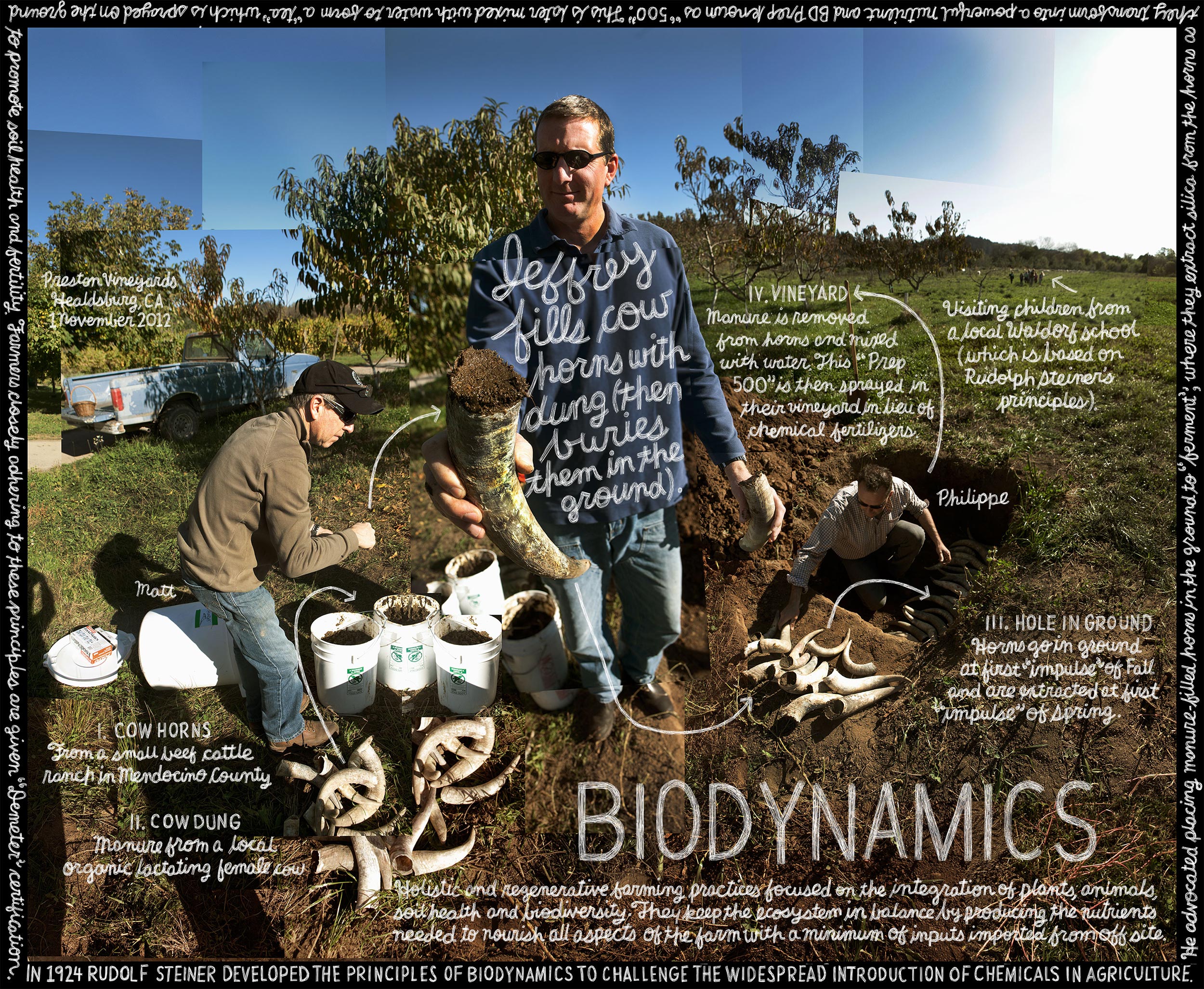
    In the last article I mentioned the Biodynamic Preparation 500, which we have been using for years. It is widely considered to be the most basic and simple preparation. It’s easy to make. You just stuff a cow horn full of fresh manure and bury it a foot or two down in the soil for the winter. In the spring, when dug up, the manure has transformed into a delightfully hummus-y loamy, dark, rich, almost powdery substance which is incorporated into water and sprinkled about the fields and gardens. Steiner manages to explain why the use of a cow horn is necessary, but I can’t. The point though, is to avail the farm to the powerful forces of the universe.

    Well the thing of it is, it also works on people. If you are not picking yourself up off the floor after collapsing in a dead faint of amazement, then I have not expressed myself well. Which is a problem with the writing, not with Biodynamics. You see, I myself have been made available to believe that the universe has an influence on the health of my farm because I have been using the Biodynamic Preparation 500.

    It’s taken close to twenty years of using the preparation for me to get to this stage. I hope it doesn’t take everyone else that long. Steiner seemed to think about 4 years should do it.

    To return to the point of this exercise: is Biodynamics fun? Is it the future of farming? I remain firm in my conviction that it might be. It is certainly more fun than the organic certification process, which I find has gotten a little dry. Necessary, if we are keen to relieve the Monsantos and DuPonts of the world their self-appointed mantle of agriculture way-finders. Obligatory, if you want to sell directly to people who don’t want to consume products from those companies. It is not, however, fun. Not that it needs to be, of course. That obviously does not come into it. It’s just that I find myself less and less satisfied with the result: a mere certificate.

    helmers_farm

    With Biodynamics, I seem to be ending up with a lot more than that. I have inspiration, wonder, amazement, incredulity, reality-checks, positive feedback from customers, tantalizing experiences of powerful forces. Lovely things to add to the compost heap of galactic oomph. I think I am going to be a better farmer because of it. Certainly, the farm is a better farm because of it.

    Returning to the question of looking into the future of farming. It does seem to me that farmers and consumers alike are aware that the organic certification program can only take us so far. There needs to be something that speaks to the fact that many farmers are going way beyond what is necessary to get the organic certificate. They are doing so because it becomes clear after a few years of organic farming, that the soil needs a little something more to gain health.

    While I think it is reasonable to look at Biodynamics to take it to the next level, there may be some snags. One of them has got to be that it can get a little bogged down in discussion, which I would like to flag as one of the biggest hinderances to productivity. A talking farmer is very often not a working farmer.

    Another issue is this insistence on involving the position of the sun and the moon in relation to the stars and planets. People like me are simply going to switch off when this topic arises. I believe that this aspect of Biodynamics is the stumbling block for most would-be practitioners. There is precious little science to back up the practices and very little apology is made for this.

    Cynically, I would also suggest the fact that Biodynamic farming does not require much in the way of support industries would really sink it as a viable farming method for the future. Apart from the odd tractor, a few implements and some cover-crop seed, Biodynamic farmers spend very little in the mainstream agricultural system. There is simply no need.

    So, as far as the future goes, Biodynamic farming is hazardously non-productive, off-putting, un-scientific and doesn’t contribute to the world’s largest companies. Doesn’t sound very promising does it.

    On the plus side, our yields are increasing, our customers are asking for it, and it is a fun way to farm. I think if we all just started throwing a little Biodynamic 500 around and carried on with our business, it would be a good start.

    Come visit the farm April 27, 2019 and we’ll mix some up for you.

    helmers biodynamic open house

  • Farm Story: The Biodynamic Ice-Break

    Farm Story: The Biodynamic Ice-Break

    Would you mind if we talked about Biodynamic farming?

    LEX158_Biodynamic_FINAL_FIXED-5715

    There. That’s how you keep your readership small. Those of you still with me have fought through eye-glaze and eye-roll and have resisted page turn. You will notice that even I am struggling a bit to stay on topic, and if only you could see the amount of squirming and fidgeting I am doing as I try to find the right way to write about one of the more under-simplified and over-complicated farming methods of our time.

    There is no way around this fact: Biodynamic farming methods involve focussing the power and influence of the entire universe on the health and productivity of the soil, plant, farmer and consumer. The sun, the planets, the galaxies beyond ours: they all matter. The position of the moon matters. It’s complicated. It’s off-putting.

    Screen Shot 2019-03-11 at 3.24.48 PM

    And yet, quite simply, it works whether you understand why or not. In fact, the less time sorting that out, the more time there will be for actual work and that is what really matters.

    We do need to talk about it, though. Biodynamics is an approach to farming that combines science, philosophy and common sense and it should not be avoided. Something like this could easily become the future of farming.

    You should know that it is a popular farming method in Germany, which has the highest concentration of scientific-minded farmers in the world, a fact I completely fabricated but which I believe could be used for emphasis without harm. I have (in actual fact) heard German farmers speak in excruciating scientific detail about soil science and crop management and then mention in a self-consciously off-hand manner that they also use Biodynamic preparations. Pressed further, they become extremely and remarkably vague about the details. I find this fascinating: farmers like that would not waste their time with something that wasn’t working.

    Our farm has been Biodynamic in practice and often certificate since the mid-nineties when my parents attended a conference on the subject and were impressed with the practical experience of the speakers. We have slowly incorporated some methods into our farming practices- and avoided talking about it as we really don’t understand it well enough to explain.

    slow food brochure (C) MC Bourgie 006
    Photo courtesy MC Bourgie

    To be honest, I really have not been paying much attention to the whole thing, content to let my parents and sister tell me what to do. It seemed more important to learn things like welding, mechanics and fertility-building cover-crop management. Although I have certainly not mastered any of that, I have gradually pushed Biodynamics up higher on the “things-to-learn-that-will-probably-be-helpful” list.

    Some Biodynamic practices have been incorporated thoroughly into our farm routine. Mom’s Biodynamic compost heaps, for example, could probably turn old cars into nice, rich, loamy soil. Tree branches certainly presented no difficulty. I follow her directions to build the heap, and I add the preparations (yarrow, chamomile, nettle, oak bark, dandelion, valerian) and marvel at the result a few months hence. It seems like magic, but really it isn’t.

    My sister annually buries cow horns stuffed with manure and that becomes the preparation we apply to the carrot field every year. It’s very simple: if we do it, we get great carrots. If we don’t, they are normal.

    My mom boils it all down quite nicely: it is a fun way to farm.

    Our Biodynamic practice does not extend far beyond this. It really should, or at least could. It is time to experiment with a few more methods, acquire some knowledge, become conversant. Most of all, I want to write about it in a way that can be easily understood. Is that possible? Can we keep it fun?

    slow food brochure (C) MC Bourgie 008
    Photo: MC Bourgie

    I am starting at a very, very basic level of celestial understanding. This point cannot be over-emphasized. I cannot even tell you for certain what my birth sign of the zodiac is. I just never found it important. In terms of blind faith however, I am on more solid ground. I can “witch” water wells, for example, and fully support the protection of random wild areas on our farm because grandma said there were a lot of fairies living there. I guess the fact that I now believe with absolute certainty that it is quite likely that plant health is influenced not only by the phases and position of the moon but the universe beyond isn’t such a stretch after-all. You commoners will have to struggle to keep up.

    My first self-assigned task has been to read the original lectures, delivered in 1924 at a German agricultural convention by Rudolph Steiner, a philosopher with a practical bent who is also known for starting the Waldorf school system. This I am doing until the snow melts and I don’t have time for reading anymore. Looks like I might be able to make it through the whole works.

    Contained in a book called Agriculture, the lectures were commissioned by a group of farmers who had recently begun to use chemical fertilizers. Although the yields of certain cash crops were reaching unheard-of levels, they noted a significant decline in the health of their soils, and the overall productivity of their farms. Alarmingly, they could no longer produce very much at all without the use of the new chemicals.

    So far, for about 95% of what I have read, I have not a clue what he is talking about. Every once in a while, however, he talks about potatoes, and I certainly know what they are. They are the hook that keeps me focussed. I keep reading, hoping he will mention them again.

    Another point of light is his reasoning for considering the universe in the first place. You can’t describe a person based on the last joint of their little finger, nor describe a farm using one plant in the far corner, but they are strongly related to the whole. If we allow for the possibility that we are the little joint of the little finger of the universe, if becomes obvious that there is a lot going on that matters to us.

    We are part of something much bigger.

    Stay tuned for the next exciting installment. I am going to be building compost heaps and seeding celeriac at a time suggested by the Biodynamic Calendar: the sun will be in Pisces and the moon in Virgo. I don’t know what this means but hopefully the plants can sort it out.

    Anna Helmer farms potatoes in the Pemberton Valley with her family and friends who know she can cook if she must.