I recently spoke, appropriately distanced and outdoors, with Anna Helmer.
Anna mentioned (with a teasing tone), that @Therocketnarcissist and I should share a recipe on The Farm Story Podcast. I don’t think she expected a “Yes!” with such enthusiasm.
Anyway, you’ll have to give it a listen. Right HERE.
Rustic Recipe Ahead
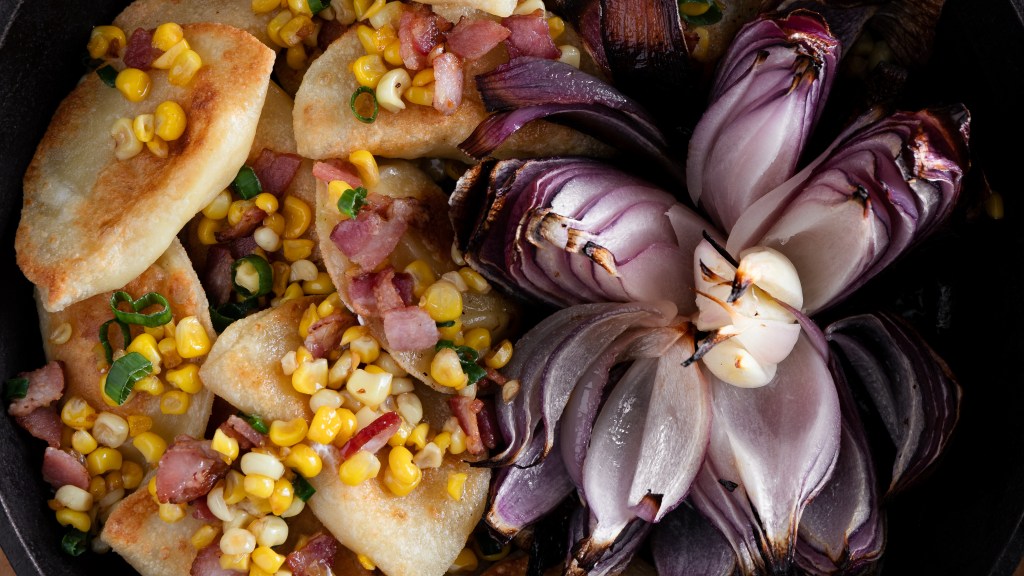
Here are the deets for the dough:
2 c. full fat plain yogurt
1 egg
1 tsp. salt
2 1/4 c. all-purpose flour
Extra flour for rolling out dough.
Beat wet ingredients together (with whisk, stand mixer or hand mixer).
Slowly add flour and salt to the wet ingredients, if using a stand mixer. Or if combining by hand, pile the flour, make a well and pour the liquid into the well and bring the flour to the middle until combined. Some needing is required to combine. It should be tacky, not sticky.
Wrap the dough and let rest in the fridge for 2 hours.
You can make your favourite filling now (listen to the podcast for suggestions or consult Chef Google).
Remove dough from fridge. Cut in half (or quarters if you have a small work surface). Roll out the dough to 1/8 of an inch.
Cut circles. Dumpling cutters are often 3″ circles. I used a wide mouth mason jar which is almost 2 3/8. I roll the dough even more after cutting as it tends to retract from the original roll out. I spin the piece around and work from the middle outward getting an even stretch. The finished piece should be 3″.
Add 1 tsp. of filling to each circle.
Fold the dough over the filling and pinch closed. If the dough has dried, try dipping your finger in water and running it around the edge of the circle before closing.
Place complete perogies on a floured surfaced until ready to cook (I use a cookie sheet as it can be moved to your pot of water).
Next, cook as desired. I like the boil then fry method. I often test one in boiling water to see how long it takes for the dough to cook. I occasionally do this before filling a bunch of perogies, so I can ensure my filling is appropriately seasoned.
If you still have questions after listening and reading this rustic recipe, let me know in the comments below.
Clamorous demands for a plastic bag ban at Vancouver farmers’ markets have resulted in… a (pending) plastic bag ban at market. The association that runs the markets at which we have been selling potatoes for over 25 years recently announced that starting with the 2020 season all single-use plastic bags will be banned. I have been privately fuming about it for ages, with no proper articulation. The formal announcement has forced me to publicly admit that I have issues with the new policy.
First some groundwork. Let me lay this on you. I sell a lot of things in plastic. Potatoes mainly, but also carrots, beets, parsnips, and even on the odd occasion broccoli, beans and basil. Retailing with plastic is effective and efficient. It’s not completely brainless and some merchandizing skills are required. The tops should be tucked under the bags, for example, or the display can end up looking like a farmers’ market stand that sells plastic bags, as opposed to potatoes. The bags should be of good value with the price stickers visible. You should know when to use a twist tie for closure and when to use a knot, and what type of knot. The bag should contain no unsightly culls. There ought to be a bulk option right beside the ordered heap of pre-packaged product. Half the customers will choose one, half will choose the other.
Things in plastic bags sell. Every retailer knows this. That’s why you see in the grocery store that everything is packaged, particularly in the produce department. If you want to sell more, put it in plastic. I think too, consumers have been convinced that things in plastic are more hygienic so that adds to the appeal and bolsters demand for plastic bagging. It’s entirely about boosting sales, however.
So to continue with the summary of my current situation, plastic bags are a major part of our retailing plan at farmers’ market. I rely on them. If I want something to sell, I put it in a plastic bag. Boom. It sells. My farm depends on farmer’s market sales for almost 80% of our revenues and at least half those sales come from things in plastic: We make it convenient, attractive and of good value. We are managing to come up with lots of packaging alternatives, but none check all the boxes. The pending plastic bag ban is causing me to feel (and this is just for starters) highly irritated, somewhat stressed, and quite mis-understood.
A mild yet persistent panic over-rides everything: how am I going to maintain sales at market if I can’t use plastic bags? I have known this was coming for a few years but now it is officially imminent, and I still don’t have a good replacement.
My other feelings include indignation and not a little derision: how dare anyone who has never tried to sell potatoes in the rain demand a plastic bag ban. You can’t just put them in paper. A paper bag containing heavy potatoes is going to be very disappointing at some future possibly inconvenient and ruinous point, even in only slightly moist weather. The more fickle customer is going to pass on potatoes in soggy paper. There are a lot of that type of customer.
This line of thought leads to a further point of indignation: why is it okay to impede my ability to compete in the retail environment? People need to understand that we feel ourselves slightly in competition with grocery stores who have a lot of very cheap potatoes, which they sell in plastic bags, because that’s how potatoes sell best. I have customers on the bubble to whom convenience and price almost outweigh taste and quality, and we will lose them. Resentment bubbles in my bosom…
…followed by more derision: what exactly do you mean when you glibly say “single-use plastic bag ban”, which appears to be the go-to wording of this pending policy? It sounds a little jingo-y, to my ears, and it’s semantically weak.
How about those produce roll-bags. They don’t have holes. They get used again. And again. Especially to carry potatoes and carrots in damp weather, and to store them at home. You know, it has been a long, long time since there was no plastic in the household. Before plastic bags, homes featured things like root-storage rooms, and somebody doing daily cooking and shopping. Freshly dug, delicate, oh-so-tasty nugget potatoes store well in a plastic bag in the bottom crisper drawer OR in a log-walled, dirt floor roothouse. Do people really know how to live without plastic? It’s kind of a big deal. Anyways, I am pretty sure those roll-bags are included in this ban.
As another aside, because it is irresistible and the resentment has briefly bubbled over, are the same people also calling for a ban on plastic dog-poop bags? Oh? What’s that? You have a dog? And you think those dog poop bags aren’t rife with environmental issues and that your dog poop is pure? Bah. Pick it up with paper, why don’t you.
I guess I think demands for plastic bag bans are thoughtless and not a little frenzied. Seems crazy to expect a little farmer like me to have to re-invent packaging, and that having done so, it will matter. I guess I don’t want to have to go through this with my 600 customers a week when the other 4 million people in the Lower Mainland are being offered, and are voluptuously consuming, singularly useless plastics galore at the grocery store.
I don’t think anyone should feel like an environmental champion because they have been successful in their calls for a plastic bag ban at farmers’ market. This is, and you will forgive the expression, very small potatoes, and the price is being paid by a small, local organic family farm. Hardly heroic.
Having said all that (and perhaps I have said too much), I am going to stop using the plastic bags with holes. I accept this. We have been thinking creatively for some time now, even before we heard the baying calls for a ban. It will cost us money, both in terms of lost sales and replacement packaging, but obviously I don’t think plastic bags with holes in them are useful beyond the single use for which they are so well designed. They are the junk food of packaging. We can do better. And I can even recognize that I might be wrong about the consequences.
It would be super nice in return if people could check their calls for this ban. Farmers’ markets themselves are already on the cutting (and bleeding) edge of the quest for low environmental impact business operations. Environmental glory for all can certainly be found there. I am in awe of and deeply appreciative of the efforts that people will make to avail themselves of well-grown food at farmers’ markets. Speaking of plastic alone, a farmers’ market customer must barely use any compared to a grocery store shopper. Should we not be boasting about that? And enticing more of them over, rather than scaring them off?
It is a simple exercise to find something environmentally devastating in someone else’s lifestyle. I try to resist (dog-poop bag rant an exception to the rule), because…well…sometimes it is none of my business.
Anna Helmer farms with family and friends in the Pemberton Valley and dearly loves to pile it high and watch it fly.
In the spring, I sprinkled a small mason jar of biodynamic preparation 500 under my fruit trees and around my garden beds, just as Anna Helmer had shown me. There didn’t seem to be a very specific science to it, although I videoed her doing it and watched it over several times to make sure I had the insouciant wrist flick just right.
It seemed kind of random and messy, which should suit my style to a tee, but I felt weirdly anxious that I would screw it up by flinging the droplets around too wildly, causing the cosmic magic that had been channeled into this precious jar of “water” to elude my little patch of earth.
When Helmer’s Farm hosted an open house in late April, I was there, dragging the kid and his best friend, who amused themselves for hours, eating potatoes cooked over a fire, gently terrorizing the ducks, and eventually holing up in the sandpit.
They also took a turn stirring the great vat of biodynamic preparation, which I suspect was part of the Helmers’ agenda for hosting an open house – to crowdsource some sweat equity from the farm visitors.
I took my turn with the stirring stick, thinking I was really helping things along until Doug Helmer took over and showed me how it was really done, the vigorous stirring that must take place for several hours, creating vortexes, then disrupting them by swirling the water the opposite direction, channeling a winter-buried cow horn full of celestial magic into a kind of homeopathic preparation for the soil.
Once again, as I yielded the stick and accepted a small jar of preparation, it became apparent that I was benefitting a lot more than I was contributing. But as my farmer friends keep reminding me: if there isn’t a willing consumer at the other side of the field, their work is for naught. It might feel imbalanced, when I see how hard they work, but supporting that work makes you an important partner.
Charles Massy is a 60-something year old Australian pastoralist, self-professed shit-disturber and the author of Call of the Reed Warbler, who has become a growing voice for regenerative agriculture. He contends that, given agriculture influences several major earth systems, adopting a more regenerative approach offers the biggest potential to save the planet from the climate crisis. Regenerative farming is “nearly two and a half times better at burying carbon in the ground than anything else” in large part because of its commitment to nurturing soil health and rebuilding soil organic matter.
He came to these views from the near-decimation of his family farm, and its slow recovery into a commercially thriving business, through the trial and adoption of many regenerative practices. A PhD in his 50s helped provide a framework for his ideas.
Massy sees regenerative agriculture’s success as being dependent on farmers who shift their practices to become part of this solution. But equally, it’s on consumers. The movement will only work if the farmers’ products are supported by the urban community. “It’s a two-way partnership.”
Anna Helmer and her family have been growing for Farmers’ Markets for 20 years. She acknowledges that it’s easy for consumers to hit the weather-insulated grocery store or order up home delivery from SPUD, but contends that farmers’ markets offer one key advantage – something she has come to think of as ‘mutual appreciation.’ She writes, “This is an energy generated at the point of contact between primary producer and end consumer at market, notably at the transaction stage. I take your money, you take my potatoes. We are both appreciative of the other. The feeling builds each week, from season to season and year to year and really can’t be re-created in other retail environments.”
It’s the spark of contact that makes magic. Direct, human to human, contact. Built into that transfer of energy – my money, your product, eye contact, appreciation – is the recognition that we are interdependent, that through this simple interaction, we are defending the life force, and creating a more beautiful planet together.
Every Friday, from June until October, the Pemberton Farmers Market offers the opportunity for these kinds of sparks to fly. Helmer’s Farm is there, as well as Four Beat Farm, Devine Gardens, Willowcraft Farm, Blackwater Creek Orchard, Spray Creek Ranch and Rainshadow & Seed to Culture. The Square Root Food Truck is back, alongside Whistler Elixir, Nidhi’s Cuisine, Rosalind Young’s gypsy wagon the RomniBolta (Rosalind Young), Birken House Bakery, and new this year, Lori Ternes. You can also pick up From the Garden Shed’s lavender, herbal remedies from Evelyn Coggins, enjoy a massage from Inner Space Massage, or browse PawWow Pet Products, Rock the Feather, Gallup Pottery, Oh Suzana’s glassware, Betty Mercer’s repurposed silver and Aenahka Creations’ leatherwear.
But it’s not just about shopping. With community groups setting up, live musicians playing each week, and a host of special events, from Bard in the Barn, to the Zucchini Derby, Slow Bike Race and Stone Soup celebration, the magic of the Market is really in the gathering.
“Our vendors work together almost like a family and the overall community spirit makes it a welcoming event,” says Market Manager Molli Reynolds. “The barn is such a lovely structure that eliminates the need for individual tents and that brings us all together ‘under one roof’.”
That community vibe was recognized last year when the Pemberton Farmers Market was awarded Farmer’s Market of the Year 2018, in the medium category, from the BC Association of Farmers Markets. Yes, our little community Farmers Market is the best of its size in BC.
Because magic is a joint effort. Creative sparks, like any kind of new life, require the DNA of more than one human to come together. Which is why Fridays under the Barn are one of my favourite kinds of gathering. The raw ingredients are all there – fresh produce, food and drinks and treats, live music, play zones, community organizations, great people. Just add yourself, and see what happens.
Hello and welcome to Chapter 2 of The Biodynamic Farming Experience for the Celestially-Challenged. It is a partly-formed, poorly-articulated and over-hyphenated chronical of a particular journey, which is not quite the right word because it suggests the presence of a destination which is not at all guaranteed. Whatever it is, a woman-farmer-of-a-certain-age-and-experience (me) delves into the theory and more-importantly the practice of Biodynamic farming in search of fun (frankly) and future of farming (idealistically).
Journey is clearly not the right word. Voyage of discovery? Too fancy. Is it a process? Nope. No fun. Compost heap. I think it might be a compost heap. Perfect. Piling up all kinds of ideas, layering them with experience, mixing up some theories, letting it sit. For absolute certain, something good is going to come of it, but it might take a while, depending on how raw the material is.
The bottom layer in my compost pile of cosmic cognitive sentience (how about that!) is a cover-to-cover reading of the original Biodynamic lectures delivered by Dr. Rudolph Steiner. I am just about done. I remain perplexed most of the time, although I experience (sadly random and rare) flashes of triumph when I realize I have managed to grasp a concept or follow an argument- very quickly snuffed out, usually by the next paragraph. I persist, however, because I am hooked.
In the last article I mentioned the Biodynamic Preparation 500, which we have been using for years. It is widely considered to be the most basic and simple preparation. It’s easy to make. You just stuff a cow horn full of fresh manure and bury it a foot or two down in the soil for the winter. In the spring, when dug up, the manure has transformed into a delightfully hummus-y loamy, dark, rich, almost powdery substance which is incorporated into water and sprinkled about the fields and gardens. Steiner manages to explain why the use of a cow horn is necessary, but I can’t. The point though, is to avail the farm to the powerful forces of the universe.
Well the thing of it is, it also works on people. If you are not picking yourself up off the floor after collapsing in a dead faint of amazement, then I have not expressed myself well. Which is a problem with the writing, not with Biodynamics. You see, I myself have been made available to believe that the universe has an influence on the health of my farm because I have been using the Biodynamic Preparation 500.
It’s taken close to twenty years of using the preparation for me to get to this stage. I hope it doesn’t take everyone else that long. Steiner seemed to think about 4 years should do it.
To return to the point of this exercise: is Biodynamics fun? Is it the future of farming? I remain firm in my conviction that it might be. It is certainly more fun than the organic certification process, which I find has gotten a little dry. Necessary, if we are keen to relieve the Monsantos and DuPonts of the world their self-appointed mantle of agriculture way-finders. Obligatory, if you want to sell directly to people who don’t want to consume products from those companies. It is not, however, fun. Not that it needs to be, of course. That obviously does not come into it. It’s just that I find myself less and less satisfied with the result: a mere certificate.
With Biodynamics, I seem to be ending up with a lot more than that. I have inspiration, wonder, amazement, incredulity, reality-checks, positive feedback from customers, tantalizing experiences of powerful forces. Lovely things to add to the compost heap of galactic oomph. I think I am going to be a better farmer because of it. Certainly, the farm is a better farm because of it.
Returning to the question of looking into the future of farming. It does seem to me that farmers and consumers alike are aware that the organic certification program can only take us so far. There needs to be something that speaks to the fact that many farmers are going way beyond what is necessary to get the organic certificate. They are doing so because it becomes clear after a few years of organic farming, that the soil needs a little something more to gain health.
While I think it is reasonable to look at Biodynamics to take it to the next level, there may be some snags. One of them has got to be that it can get a little bogged down in discussion, which I would like to flag as one of the biggest hinderances to productivity. A talking farmer is very often not a working farmer.
Another issue is this insistence on involving the position of the sun and the moon in relation to the stars and planets. People like me are simply going to switch off when this topic arises. I believe that this aspect of Biodynamics is the stumbling block for most would-be practitioners. There is precious little science to back up the practices and very little apology is made for this.
Cynically, I would also suggest the fact that Biodynamic farming does not require much in the way of support industries would really sink it as a viable farming method for the future. Apart from the odd tractor, a few implements and some cover-crop seed, Biodynamic farmers spend very little in the mainstream agricultural system. There is simply no need.
So, as far as the future goes, Biodynamic farming is hazardously non-productive, off-putting, un-scientific and doesn’t contribute to the world’s largest companies. Doesn’t sound very promising does it.
On the plus side, our yields are increasing, our customers are asking for it, and it is a fun way to farm. I think if we all just started throwing a little Biodynamic 500 around and carried on with our business, it would be a good start.
Come visit the farm April 27, 2019 and we’ll mix some up for you.
There. That’s how you keep your readership small. Those of you still with me have fought through eye-glaze and eye-roll and have resisted page turn. You will notice that even I am struggling a bit to stay on topic, and if only you could see the amount of squirming and fidgeting I am doing as I try to find the right way to write about one of the more under-simplified and over-complicated farming methods of our time.
There is no way around this fact: Biodynamic farming methods involve focussing the power and influence of the entire universe on the health and productivity of the soil, plant, farmer and consumer. The sun, the planets, the galaxies beyond ours: they all matter. The position of the moon matters. It’s complicated. It’s off-putting.
And yet, quite simply, it works whether you understand why or not. In fact, the less time sorting that out, the more time there will be for actual work and that is what really matters.
We do need to talk about it, though. Biodynamics is an approach to farming that combines science, philosophy and common sense and it should not be avoided. Something like this could easily become the future of farming.
You should know that it is a popular farming method in Germany, which has the highest concentration of scientific-minded farmers in the world, a fact I completely fabricated but which I believe could be used for emphasis without harm. I have (in actual fact) heard German farmers speak in excruciating scientific detail about soil science and crop management and then mention in a self-consciously off-hand manner that they also use Biodynamic preparations. Pressed further, they become extremely and remarkably vague about the details. I find this fascinating: farmers like that would not waste their time with something that wasn’t working.
Our farm has been Biodynamic in practice and often certificate since the mid-nineties when my parents attended a conference on the subject and were impressed with the practical experience of the speakers. We have slowly incorporated some methods into our farming practices- and avoided talking about it as we really don’t understand it well enough to explain.
Photo courtesy MC Bourgie
To be honest, I really have not been paying much attention to the whole thing, content to let my parents and sister tell me what to do. It seemed more important to learn things like welding, mechanics and fertility-building cover-crop management. Although I have certainly not mastered any of that, I have gradually pushed Biodynamics up higher on the “things-to-learn-that-will-probably-be-helpful” list.
Some Biodynamic practices have been incorporated thoroughly into our farm routine. Mom’s Biodynamic compost heaps, for example, could probably turn old cars into nice, rich, loamy soil. Tree branches certainly presented no difficulty. I follow her directions to build the heap, and I add the preparations (yarrow, chamomile, nettle, oak bark, dandelion, valerian) and marvel at the result a few months hence. It seems like magic, but really it isn’t.
My sister annually buries cow horns stuffed with manure and that becomes the preparation we apply to the carrot field every year. It’s very simple: if we do it, we get great carrots. If we don’t, they are normal.
My mom boils it all down quite nicely: it is a fun way to farm.
Our Biodynamic practice does not extend far beyond this. It really should, or at least could. It is time to experiment with a few more methods, acquire some knowledge, become conversant. Most of all, I want to write about it in a way that can be easily understood. Is that possible? Can we keep it fun?
Photo: MC Bourgie
I am starting at a very, very basic level of celestial understanding. This point cannot be over-emphasized. I cannot even tell you for certain what my birth sign of the zodiac is. I just never found it important. In terms of blind faith however, I am on more solid ground. I can “witch” water wells, for example, and fully support the protection of random wild areas on our farm because grandma said there were a lot of fairies living there. I guess the fact that I now believe with absolute certainty that it is quite likely that plant health is influenced not only by the phases and position of the moon but the universe beyond isn’t such a stretch after-all. You commoners will have to struggle to keep up.
My first self-assigned task has been to read the original lectures, delivered in 1924 at a German agricultural convention by Rudolph Steiner, a philosopher with a practical bent who is also known for starting the Waldorf school system. This I am doing until the snow melts and I don’t have time for reading anymore. Looks like I might be able to make it through the whole works.
Contained in a book called Agriculture, the lectures were commissioned by a group of farmers who had recently begun to use chemical fertilizers. Although the yields of certain cash crops were reaching unheard-of levels, they noted a significant decline in the health of their soils, and the overall productivity of their farms. Alarmingly, they could no longer produce very much at all without the use of the new chemicals.
So far, for about 95% of what I have read, I have not a clue what he is talking about. Every once in a while, however, he talks about potatoes, and I certainly know what they are. They are the hook that keeps me focussed. I keep reading, hoping he will mention them again.
Another point of light is his reasoning for considering the universe in the first place. You can’t describe a person based on the last joint of their little finger, nor describe a farm using one plant in the far corner, but they are strongly related to the whole. If we allow for the possibility that we are the little joint of the little finger of the universe, if becomes obvious that there is a lot going on that matters to us.
We are part of something much bigger.
Stay tuned for the next exciting installment. I am going to be building compost heaps and seeding celeriac at a time suggested by the Biodynamic Calendar: the sun will be in Pisces and the moon in Virgo. I don’t know what this means but hopefully the plants can sort it out.
Anna Helmer farms potatoes in the Pemberton Valley with her family and friends who know she can cook if she must.
The bell rings to start the market day. Relentless and demoralizing rain has been falling since the tents came out of the trailer and we began the set-up, two hours ago. The gutters now strung up between the tents are working well, emitting a steady stream of water into the growing pool along the back curb and the tent side walls keep us relatively rain-free inside the stall. The very air seems wet, however, and little can be done about that. Tough morning at market so far.
I’ve been selling my family farm’s produce at Vancouver farmers’ markets for 20 years, so I know how to sell potatoes in the rain. It’s just like how to do it in the sunshine, except it seems mentally harder. The difficulty lies in keeping the stall in a high state of readiness, even though it might be empty and you would prefer to be warm and dry elsewhere. Every sale matters- especially in the rain, if your farm depends on farmers’ market sales
I squeeze my way past the bins of backstock in the trailer where I have been changing out of sopping wet clothes. I have already traded a few hellos with the neighboring vendors, people I’ve seen every Saturday morning for years, but there’s been no time for more than that. I glance around to make sure all the signs are up and that the display is full: we’ve finished in time. It takes just as long to get set up in the rain as it does otherwise. Longer, of course, if you waste time regretting the situation.
The potatoes look good today, the red Chieftain and yellow Sieglinde sort of glowing in the dim light. My staff, who are making up $5 bags of potatoes and carrots, wisely refrain from discussing the weather. The vast, dripping, emptiness out in the market fairway which would normally be filled with customers eager to start shopping, lining up in advance of the opening bell, is obvious enough.
It is undeniably deserted, and despite the potatoes doing their best to provide sunshine, it feels disheartening. I give my head a shake because I think it’s too early to write this one off.
The first customer materializes- she’s a rain-or-shine regular who gave up on regular grocery stores quite a few years ago. She is followed by another I don’t recognize. A chef splashes his way in. I make sure his 20lb bag weighs at least 25. At the till, we’ll be rounding down more than usual. The customers might not notice but I don’t mind. I am feeling very benevolent towards anyone who turns up this morning.
Before I know it an hour has passed, and I realize that the potato display tables are hidden from view by the backs of customers filling bags. The stack of now empty bins in the back has risen to a level I hardly thought possible when the opening bell rang. It’s going to be a solid day, despite the rain, which might even be easing up a little.
One of my staff has been coming to market ever since she was a baby, and her mom worked for a farm vendor here before that. She’s on the first till, and I jump behind the second one, a line-up having formed of dripping wet customers who thank us for being here today when they get to the front.
It bears repeating: the rain-soaked customers are thanking us and giving us money for potatoes. In fact, now it’s so busy they are lining up to do so.
This, right here, is what makes farmers’ markets tick. People choose shopping in the rain over going to a grocery store. Farmers choose marketing in the rain over selling wholesale.
It’s what leads to the fact that farmers can make a living on an acreage that would otherwise be insufficient because they can get full retail for their produce.
The customers keep coming back for more because…well…I just don’t know. Is it the quality of the product? The contact with an actual farmer? The coffee and crepes? It might be magic. Whatever the cause, it provides me motivation to keep farming, and to keep customer service and marketing standards high. It seems like a practical way of showing the customers that I really appreciate their business.
I love being a part of this special relationship, but I worry that it won’t last. It’s so much work, there is so much to learn, and there is so much competition for customers- and surely, they won’t keep coming? I mean, sometimes they must quietly wonder if it is really all that great? The weather, the effort, the cost. All that cooking.
Customers. We need customers to make markets successful. We need to retain existing ones and win new ones who might also shop in the rain. The good news is that we are only tapping a tiny fraction of the people who buy food, so there are plenty more to be had. The bad news is that the competition out there is absolutely fierce, and nowhere else other than at farmers’ markets are customers asked to go out shopping in all sorts of weather, probably park far away, and spend perhaps a little more than they really meant to.
Farmers’ markets enjoy one major competitive advantage however, and that is something I have begun to call “mutual appreciation”. This is an energy generated at the point of contact between primary producer and end consumer at market, most notably at the transaction stage. I take your money, you take my potatoes. We are both appreciative of the other. The feeling builds each week, from season to season and year to year and really can’t be re-created in other retail environments.
The farmer can do much to cultivate the feeling of mutual appreciation in the stall. It’s about a lot more than saying “thank you”. Developing good customer service and merchandizing skills is of prime importance- pre-market preparation, and of course years of practice help too. In my opinion, it is important to put as much effort into selling the food as you spend growing it. These customers deserve that.
The farmer makes the magic that the people are coming back for. If you can also create this feeling of “mutual appreciation” in your stall, I think you’ll be able to have both tills busy, even in the rain.
Anna Helmer farms in the Pemberton Valley with her family: friends and relations. Her book is called: A Farmer’s Guide to Farmers’ Marketsand is available on amazon.com.
The time has come for a column on farm fashion. All the chick farm columnists eventually get around to a “what to wear” piece, don’t they? This one is all about what happens when fashion is slave to function and haute couture ain’t in it.
When choosing an outfit for the day, I consider the potential for getting dirty, wet, cold, greasy, dusty, sun-burned, heat-stroked, or photographed for Elle magazine.
The cows have very exacting standards. In forage. In fashion, they’re a bit more chill. Unless, of course, you’re wearing leather.
Evaluation complete, I don yesterday’s work pants, (hopefully, but unlikely) complete with small crescent wrench and pen-knife in the pockets, clean work shirt, work boots (rubber or leather), and make obvious weather-related adjustments. A seasonal ball cap or toque, with occasional forays into wide brimmed sun hats, offers warmth, shade, and hair control. I don’t bother with make-up.
There are two items in my functional farm-chic wardrobe to which a more detailed examination is due. They score particularly low on fashion but shoot the lights out on functionality; a by no means unusual description for just about everything I wear out there. Let us then consider coveralls, and the mosquito bag net.
Anna Helmer gets into her bee-suit, and someone takes a photo and puts it on Facebook.
Until I went to welding class in the city, where we were required to wear coveralls, I had decided against that look for myself. I tried wearing them a few years ago and felt about as alluring as an old hockey bag. Never having been what you might call an instinctively feminine dresser, I felt wearing coveralls would sever completely any connection to my embattled femininity. I had to draw the line.
In welding school I was not given any choice in the matter and I initially bemoaned my baggy figure. Eventually however, I noticed that my good jeans (worn mistakenly to class) stayed clean, protected by the Big Blues (pet name for my coveralls) which got sooty and smoky. Perhaps, I began to think, there was yet wine to be squeezed from this stone.
Sarah and Simone from Rootdown Organics demonstrate the key farm fashion accessories: soiled pants, rubber boots, cute baby who is actually in charge.
I have come to realize that the coveralls represent a new opportunity for me. I can stay a little cleaner on the farm, and not arrive home resembling a diesel spill in a dust bowl. Not only can I look presentable at the end of the day, but if Elle magazine does happen to show up for a photo shoot, I can be assured of a clean outfit underneath. They will still have to bring their own make-up person.
Alyssa and David from Plenty Wild Farms must have had enough time to shower before their photo shoot. Do farmers really ever look this clean when out in the fields?
Turning now to the mosquito bag net; my choice for most essential farm fashion accessory.
In my net I am bug-free; I blithely disregard the scornful sniggering of other slaves to fashion on the farm, slathered as they are in dodgy chemicals, and/or in a high state of denial over the level of torment they endure as bag-less labourers in mosquito country. There is no bigger slap in the face to high fashion than dropping a bag over your head, but neither can I countenance flies in my eyes.
Bruce Miller models the ultimate in Pemberton farm fashion, the Slow Food Cycle Sunday t-shirt.
To conclude, it would be nice to point to an item in my farm wardrobe that is more fashion than function, but I am at a loss. I suppose my pink John Deere ball cap tilts the balance slightly in favour of glam, but looses ground as its grubbiness increases with every passing day of summer. In an uncharacteristic eruption of reckless consumerism, I have purchased a brand new one for this summer.
Anna Helmer believes farmers are under-represented on the fashion run-way but sort of sympathizes.
Not being able to stage a photo shoot of Anna’s farm fashion moments during planting season, we’ve poached these illustrative photos of Pemberton’s organic farmers in their sartorial best, from BeyondYourEye.com photography, via the BC Organic Farmers.
Like most non-farmers, I used to assume that nothing really happens on a farm during the winter.
It took me around 5 years of working on one to realize that might not be true.
In my case, during the early years of adult farming, I was able to slide back into my city life with no farm obligations once markets ended and the crop was sold out in October. Mom and dad were doing whatever needed to be done. Feeding chickens? Reading about farming? No idea. I was off the payroll. November, December and January were excellent months to live in the city and have an inside job.
Spring in the city however, was depressing. It arrived early, starting with the first smell of dirt in February. While the farm itself was still safely covered in an un-farmable mixture of snow, mud and ice, each year my body felt the arrival of spring more strongly and it became more excruciating to have city obligations.
In March, the cherry blossoms, crocuses and daffodils lined my bike commute and I would arrive very distracted indeed. April came with the awareness that potato planting time was just around the corner and my work quality slipped even further. I quit, probably mere moments before I was fired, earlier and earlier every year.
I was unaware of the strength of spring. I wasn’t quite familiar enough with the process of farming to recognize how it was pulling my attention back to the farm.
Today, I get it. In fact, this very day I get it. And I got it powerfully one month ago, on March 1st standing in the farm yard, surrounded by snow and mud, with the sun gaining the upper hand on the clouds, and its warmth on my cheeks that was strong enough to reach my bones.
For that day, I felt spring, and with it, the inexorable pull to get to work.
It’s still quite easily ignored, as the list of jobs that can reasonably be done given the muddy, snowy, rainy freezing and puddling conditions of March will be very short for weeks yet. Nonetheless, the process has begun, and I now get to enter the flow gradually. The key at this time of year is to do all the tasks available, as the snow recedes and the mud dries up. They are not many, but if they are not done, they will be added to an ever-growing list and before long, they will drop off the bottom of it. That’s exactly how we develop stress on a farm.
I understand this now; I didn’t then. That doesn’t mean the compulsion to get to work wasn’t upon me. It was there alright, and it made me really cranky. While most people I knew in the city greeted spring with buoyant cheer, I became depressed, and couldn’t wait to get out.
By year four, with the February sun streaming in through the office windows, I knew I was not going to make it much longer. At that time, I was pretending to be an Administrative Assistant in the head office of the big natural food store in town. I sat at the front desk fielding phone calls and health care plan administrative details. It wasn’t absolutely terrible: I got to organize all kinds of things and had worked on a few interesting projects for my boss- the friend who always had to almost fire me.
Although still not able to articulate the effect of spring on my psyche, I was certainly no stranger to it by then, and I noted the arrival of spring with weary resignation. Instead of doing the work I was paid to be doing, I found myself planning another bike trip. By March I was well into it, in Australia, having a wonderful time. Bike touring noted as a very effective distraction.
The city charade was abandoned in year 5. I still needed something to do in January, however, so I babysat my uncle’s cattle ranch while he took a holiday. There was certainly no issue with spring depression symptom triggering because it was minus 40 most of the time. I learned a thing or two about isolation up there.
That February at the farm was glorious. Sunny every day, tiny little jobs to do here and there, and the freedom to move gently into the farming season. I still didn’t know very much about what I was doing, but at least I was doing something. And that’s half the battle.
Deep winter confessions of lavish plan-hatching and mild delusions, meet work in someone else’s root house. (Just don’t call it mindless.)
A farming luxury: to lavishly plan the work of the coming season when there is no chance of starting any of it for at least two months. Cue careless disregard for work. Sloppy accounting of work requirements. Expansive imaginings absent anything but the faintest work alarm bells, easily ignored.
The carrot crop proposal, for example. With a foot of snow on the ground and the clouds heavy with more, it seems totally reasonable to be planning to plant 2 acres of them this summer. The chefs are asking for more and the customers say they are the best at market. Ergo the ego demands, therefore the farmer plans, hence we can ignore the actual work involved. 2 acres. At least.
I am not totally unaware of how things will unfold in real life. There will certainly be a privately raised eyebrow when enthusiastic planning first encounters carrot reality and the 5-gallon pails of seed start showing up sometime next month. Second thoughts will come flooding in, assuming they haven’t already, when I find myself still seeding well into the evening come that day in June. Assuming (again) that I follow through with seeding the entire 2 acres, the subsequent weeding and irrigation requirements will cause heart palpitations in July and August, and the harvest will be frankly sobering, or perhaps borderline terrifying, because it will take for freakin’ ever to get them all out of the ground. And exactly one year from now, on a snowy day in mid-February, there will be tears because by now the unsold remaining crop will be sprouting hairs and getting soft in storage.
For now, however, it’s a really clever and enterprising idea, worth pursuing and budgeting for. It’s even spawning tangential plans: a cooler expansion. My optimism knows no limits. These days are golden.
To stay in farming shape, to maintain my farming bona fides now that markets are done for the season, and basically to keep it real, I am moonlighting as a forklift operator at a local seed potato farm, which is not as glamorous as it sounds.
More precisely, I am stationed at the end of a seed potato sorting conveyor line and every 15 minutes I get to hop on an electric forklift and pick up a 2200lb sack of Red La Soda seed potatoes. I take it to the scale. If it’s too heavy, I remove potatoes; too light and I add them. Weight confirmed, I check that I remembered to slip the tag into the attached tag-holder and I move the sack to the collection area. That done, I return the forklift to the ready position and help my work partner manage the next bag. Twenty-two sacks make a full load on an 18-wheeler. It takes about a day to get it done, if nothing breaks down. It is unusual for nothing to break down.
I like working on other people’s farms because I love considering a mechanical time-out to be an opportunity to get a walk in the sunshine. When they occur on my own farm, they can be expensive, disappointing and dreaded.
It really goes on and on, doing the same thing over and over, with one hour for lunch. In these circumstances, a good co-worker makes a very positive difference. I have just the guy. His good humour rarely falters – the one time it did, he had an orange and was completely restored. The other thing I liked was that he never stopped trying to do a good job. There are a lot of challenges to managing 2200lb of potatoes every 15 minutes, none the least of which is staying focused, and we worked as hard on the first bag as we did on the 22nd.
I am going to stop you right there before you call this mindless work. It is not. I think that phrase was floated by someone who could not handle the pressure of coming up with his/her own stuff to think about. (S)He panicked, quit, and branded it mindless.
It is not mindless. Once you have sorted out the physical aspects of what you are doing, your mind is free to be engaged. How do you think this article got written? Still and all, it can be nice when there are breakdowns to liven up the day.
So. Work. Thank goodness I have some to do or my theoretical planning for the summer might be absent a whiff of reality and I wouldn’t want that.






 Traced Elements