Blog

  • The Vibrant Life: Cookbook review

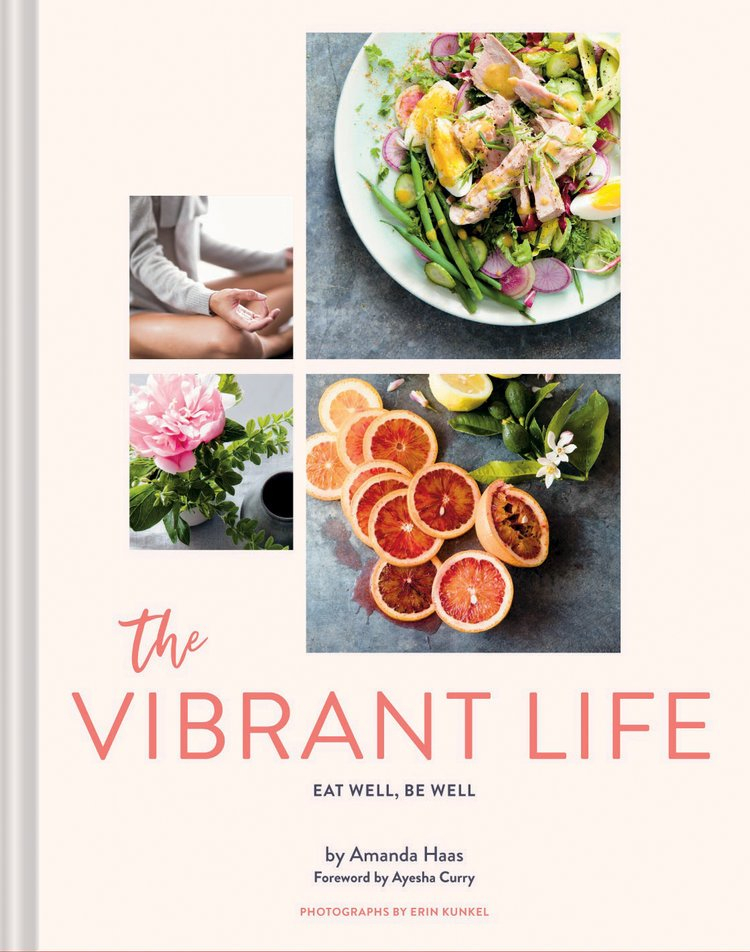
    The Vibrant Life: Cookbook review

    I’ll admit that when I ordered The Vibrant Life cookbook by Amanda Haas, I thought I was ordering The Anti-Inflammation Cookbook which she also wrote. I was dealing with a neck injury and figured that learning some low inflammation recipes would expand my repertoire and help me heal.

    Haas’s introduction, though, won me over.

    Haas, the former culinary director for swoon-worthy cookware store Williams-Sonoma, talks about reaching the age of 45 and experiencing chronic fatigue along with other health complaints. She’s not advocating for turning back the clock – she says, “I love that age has provided me with a stronger sense of self, courage and compassion.” Instead, she talks about having people who showed up in her life and helped her redefine what aging looked like.

    The Vibrant Life is Haas’s answer to wanting to resolve her health issues to feel great. It’s a wellness cookbook that includes recipes and lifestyle recommendations ranging from yoga and strength-training to acupuncture, cryotherapy and meditation.

    I’m the same age as Haas and can relate to her call to live her best life.

    The ups

    The book is well designed and full of easy to follow, unfussy recipes and excellent photography. It’s moderate and balanced in terms of the diet presented. Although gluten-free, many of the recipes include meat, fish or dairy.

    The downs

    Because many of the ingredients for many recipes wouldn’t be found in a regular, well-stocked kitchen (e.g. tarragon, Marcona almonds, pistachios, sour cherries, fennel bulbs, adobo sauce, crème fraiche, King Trumpet mushrooms, golden raisins), this wouldn’t be my everyday go-to recipe book.

    Although recipes like the chocolate ganache tart with grand marnier, tequila old-fashioneds, and roasted Moroccan chicken with cauliflower “couscous” sound delicious, I was, frankly, expecting more wholesome plant-based dishes from a wellness cookbook. Instead, there seem to be a disproportionate number of recipes in the “Land and Sea” and “Sweets, Treats and Cocktails” chapters.

    granola-1

    Favourites

    I didn’t have some of the ingredients required on hand, so tried some of the simpler recipes, including:

    • The drinks like maple-turmeric golden milk and coconut almond matcha, both made with almond milk
    • Sophia’s toasted almond granola – a tasty recipe featuring dark chocolate, sour cherries, maples syrup and cardamom
    • Wild rice, butternut squash salad with pistachios, cherries and mint
    • Blistered curry cauliflower with mint, currants and toasted almonds

    CauliflowerKaleSoupThe shaved brussel sprout salad with roasted root vegetables and pomegranate seeds is next on my list.

    The final word

    I can see myself cooking some of the recipes for special occasions, but don’t imagine that this cookbook will make it into my regular rotation. For a wellness cookbook, too, I would have liked to be nudged further along with truly inspiring, downright healthy food.

    This book would make a great gift for an omnivore, who enjoys making colourful, tasty, fresh food to entertain friends.

    With Haas’s simple, but sincere wellness recommendations, it would also make sense for someone who has experienced some health challenges and is just starting out on a wellness path.

    And thanks

    Thanks to Raincoast Books for sharing this cookbook!

  • Cookbook Club – Why Gathering is as Nourishing as Food

    Cookbook Club – Why Gathering is as Nourishing as Food

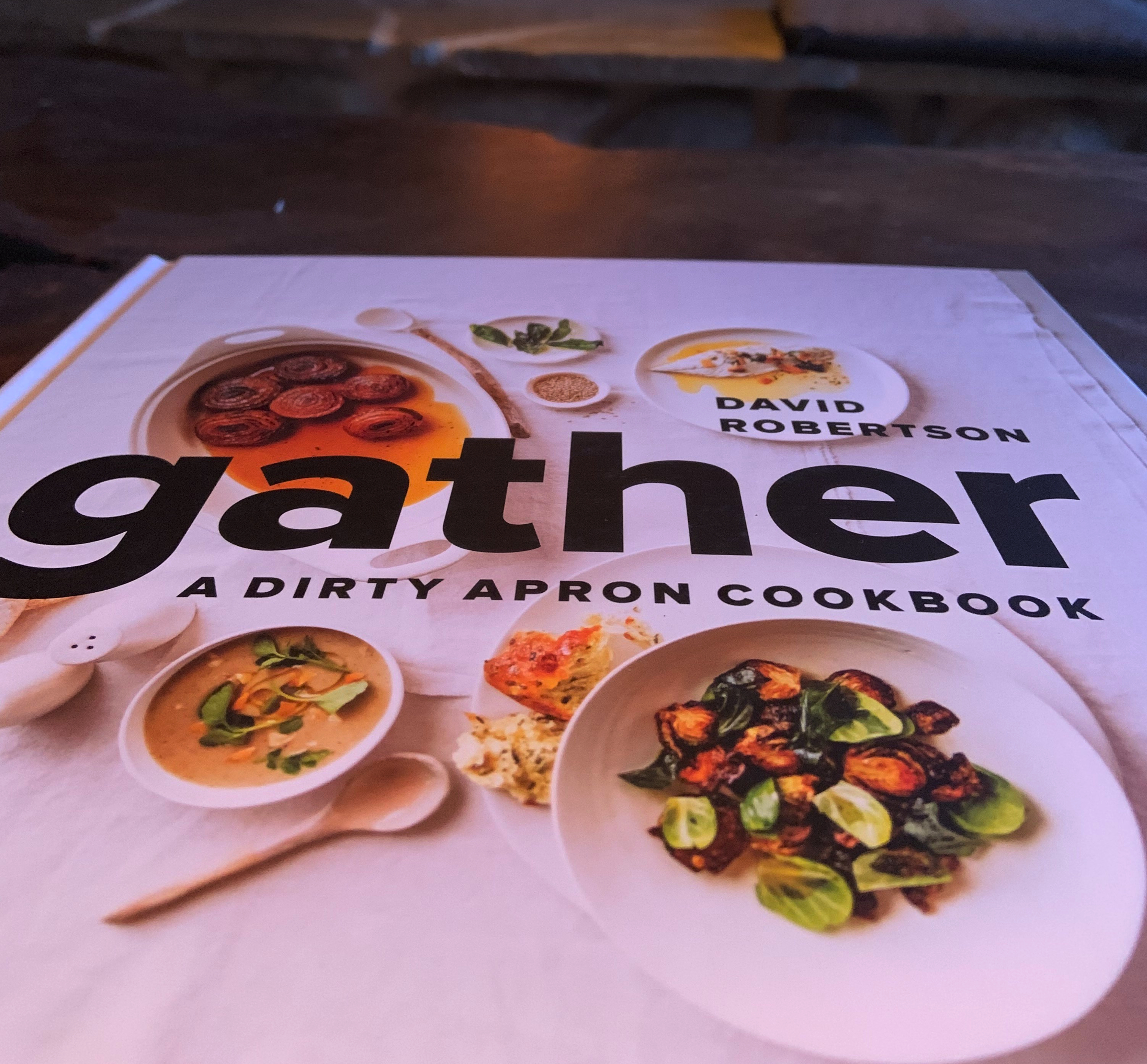
    Lisa gathered us to share recipes from the perfectly named cookbook Gather by David Robertson. David owns the Dirty Apron Cooking School in Vancouver. If you get the chance to take part in one of his interactive, social cooking classes, you will not be disappointed. When I did a short stint in Vancouver, a friend and I did one of his Italian classes and it was one of the most memorable experiences I have had. It is a learn-to-cook, meet-up, dinner date all wrapped in a delicious bow.  https://www.dirtyapron.com/cooking-school/

    img_4137-e1576086726292.jpg

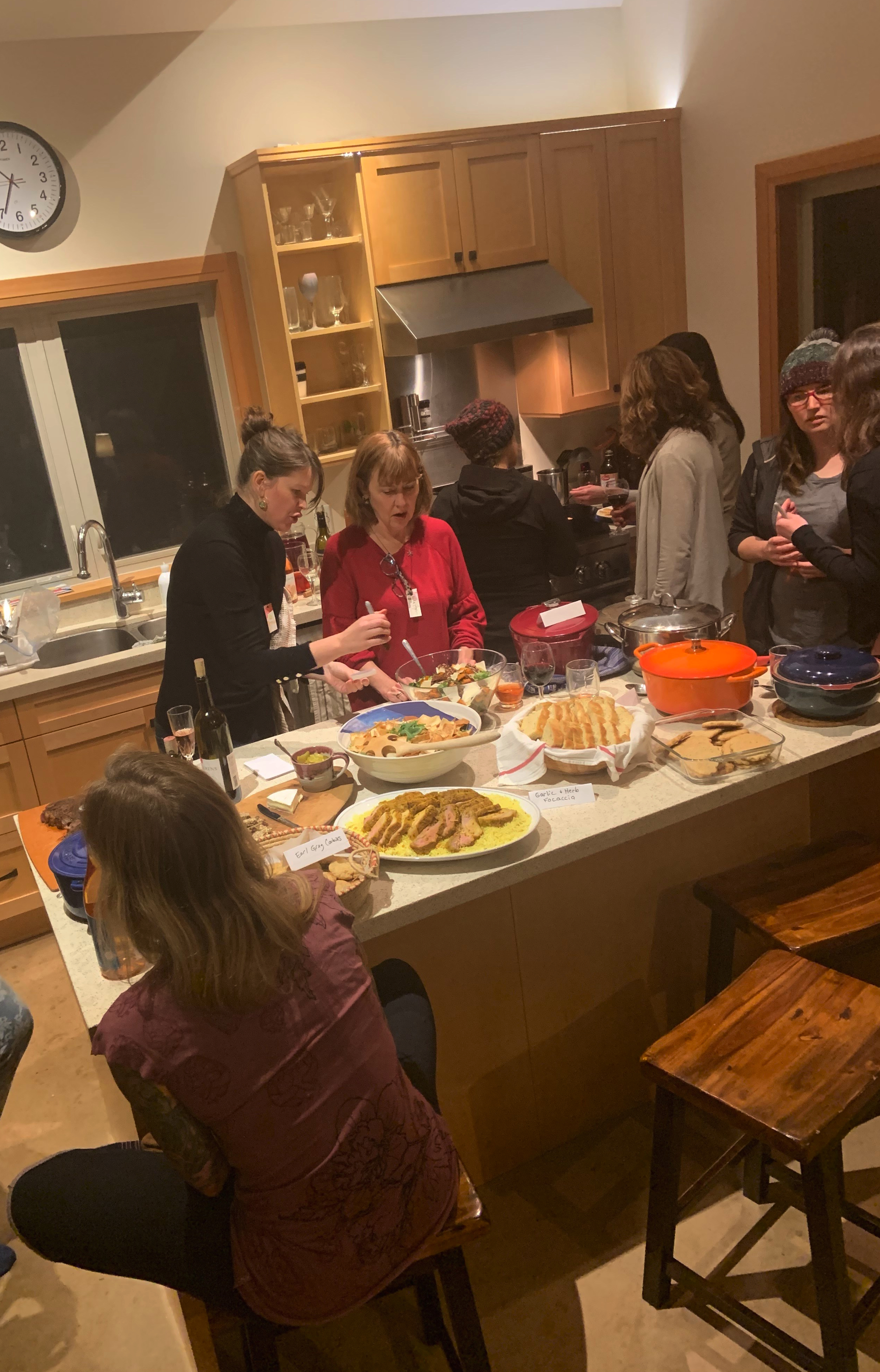
    On a cool December night in Pemberton, a group of sisters (figuratively, not literally, although I’d be cool if any of these dynamo women were actually my sisters) gathered to share food, share ideas, share music, share stories and to share love.

    IMG_4153

    Upon arriving to the warm glow of the farmhouse, there was a wonderful buzz, a positive energy in the excitement to unveil our nourishing dishes. Lisa kicked off the evening with a welcome. A welcome that set the tone to deepen our connections with each other, to be part of the sisterhood of this gathering. Lisa shared a story of “sistering” – a carpenter’s term to provide extra support to a weaker joist or strengthening a load-bearing beam. Our gathering is more than nourishing our bellies. It is also about nourishing our souls. It is about creating space to hold each other up, higher, stronger than when we all arrived – sistering.

    IMG_4147

    Eager to dive into the incredible dishes prepared with thoughtfulness, love and creativity, each person introduced themselves and the dishes they prepared. Stories started to emerge during the introductions and it was fascinating to hear how each person approached their dish. Living in a small town, several people agreed that there were challenges with certain dishes due to the shortage or absence of a key ingredient – a spice never heard of before or a hard-to-find-bean. Modifications became essential and there were some amazingly creative types in the group that approached their chosen recipe more as a rough guideline than a must-follow-rulebook. Full disclosure: cooking for guests is stressful, especially a brand new recipe and I needed to follow my recipe to its exact instructions, that way if the soup was a disaster, I could just blame the recipe.

    IMG_4146

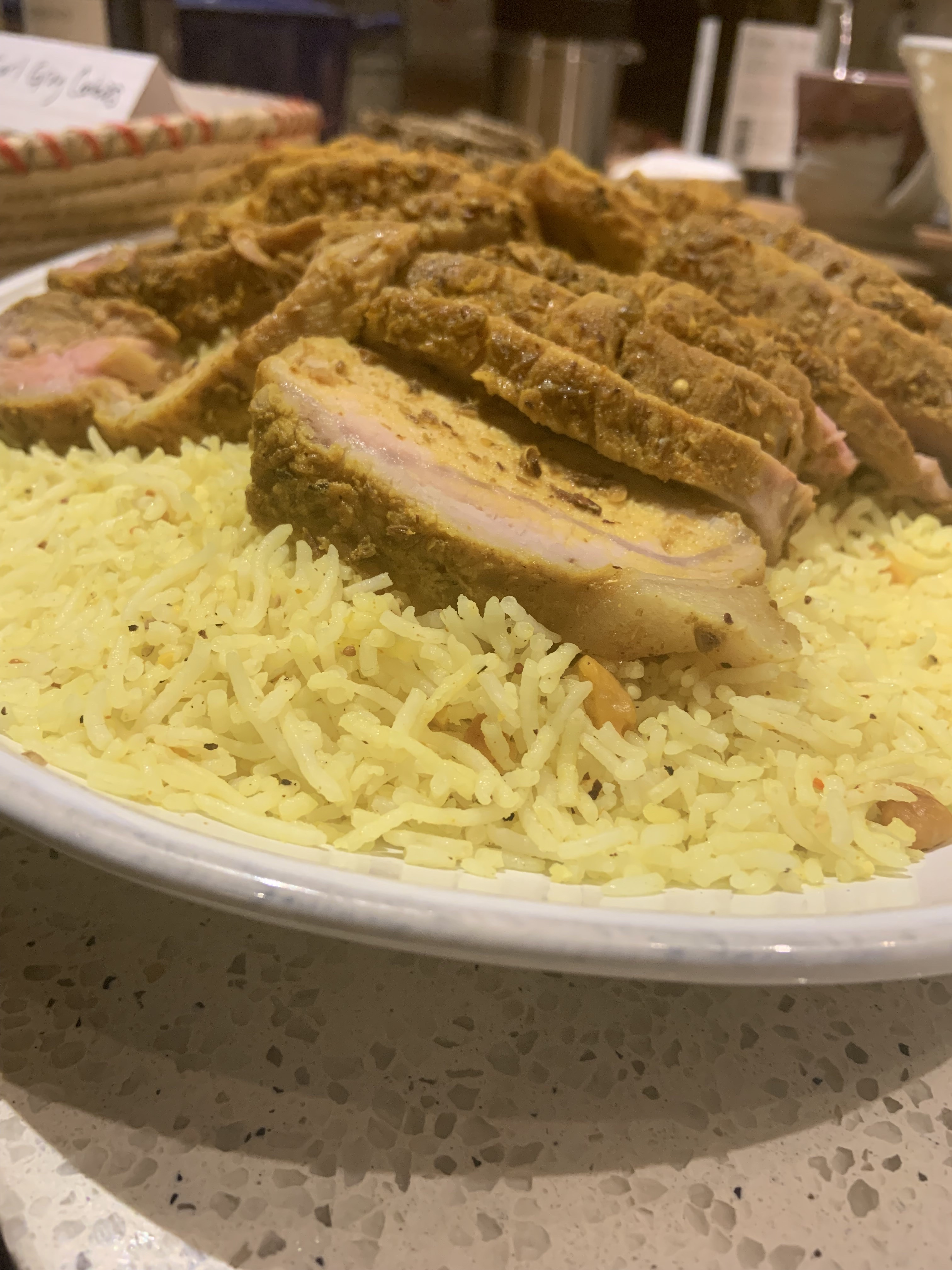
    Introductions completed, tummies growling, anticipation building, it was time to dive in. The Food. The food was unbelievable. The Flavours. The flavours were diverse, layered, complicated yet simple. The Options. The options were unlimited – there was something for everyone. The People. The people made the evening divine. Nothing to see here – just a bunch of warrior women meeting, quietly conquering the world, through food. The Conversation. If you paused for a moment while savouring a morsel of deliciousness, you could hear the hum of stories being told, recipe ideas being shared, connections being created.

    To Gather: the dry dictionary definition states “bring or come together”, “pick or collect as harvest”, “infer or deduce”.  After our evening gathering, here’s my definition. To Gather: “to come together to nourish each other through food, conversation, connection. To share a love for food, a love for life. To build a sisterhood.”

    img_4149.jpg

    It was the kind of evening that one does not want to end. And when it did, gracious thank yous were shared, heart-felt goodbyes were reluctantly made and each of us headed to our homes, bellies full, hearts filled. Upon arriving at home, my husband inquired as to which dish was my favorite. Cheeky guy – I’m not falling for that “who’s your favorite kid” trick question. I told him about the dishes, the immense flavours, the quality of company. I tried to explain sistering but quickly realized that this gathering was not something to be explained, rather, to be experienced. So, I summed the evening to him by saying “A gathering of amazing women, what could be better than that”?

    IMG_4148

  • Rooting for a Rutabaga renaissance

    Rooting for a Rutabaga renaissance

    My brother says a stew is not a stew unless it contains rutabaga; I concur.  Surely that was my thinking when I roamed the patch in the recent fall drizzle, disheartened by the number of perfectly good vegetables going to waste because they were too big to be marketable.

    When I was a teen, I developed quite a resentment towards rutabaga (and most others that engendered chores.)  In the full heat of summer, the rows were never ending as we shuffled along with perfectly sharpened hoes, weeding out the lamb’s quarters and thistles which often had grown up again by the time we finished the plot.

    Later, once the first few frosts arrived, Dad would drive the tractor and wagon out into the field and we would get down on hands and knees to pull the rutabaga out, chop off the root, scrape off the side roots and mud then flip it around to lop off the top.  A sharp, heavy knife was essential.  Once we finished the cleaning, we lobbed the vegetables onto the wagon and shuffled forward.  

    Rainy weather caused mud to cling so that each globe gained a pound or so.  Eventually, the wagon would fill up and our knees would get a reprieve while we ambled back to the root house to bag the harvest that would have been washed during our walk break. Dad had jigged a small piece of plywood with the appropriate size for the rutabagas he would sell and we would measure some of the perfect looking ones only to find they were too big for commercial purposes-these went into other bags for customers who stopped by the farm for their fall vegetables.  Finally, we would empty the wagon and head back out to the field having bagged up about thirty fifty-pound bags for the root house.  Not much has changed about the process of harvesting.

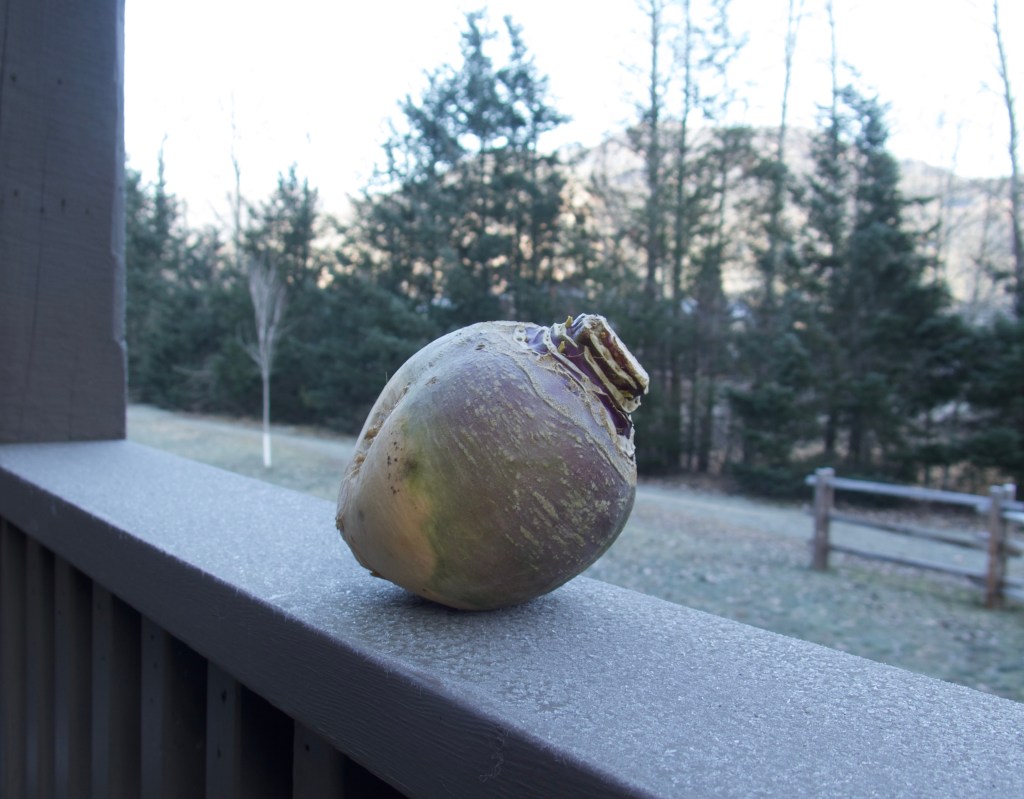
    Somehow, my resentment towards this month-long job never overpowered my taste for rutabaga – it was always a treat to slice one up and munch away on it while waiting for the wagon to get back.  I also liked it boiled then mashed up, served with a bit of butter and salt and pepper.  And, of course, I enjoyed it in stews, where it rounded out the flavours, adding a touch of sweetness along with the carrots.  It is not so surprising then,  that I should wander around in my brother’s field in the rain searching for those purple and yellow globes.  

    Back home, I explored new recipes to try and discovered many old ones, mostly from Europe.  This should not have surprised me – despite the growing interest in vegetables of all kinds, rutabaga consumption is not on the rise.  Yet, a half cup serving provides fifty three percent of daily vitamin C requirements, eight percent of needed calcium and a good quantity of vitamins  E , B6 and Thiamin – all with twelve percent fibre, five percent carbohydrate and sixty six calories.

    rutabaga

    A three pound rutabaga provided us with five meals over a two week period and half of the vegetable is still in the fridge waiting for my next inspiration.  

    Downstairs, in a dark cool corner, my twenty five pound bag could last well into February, though I’ve recently begun to process in bulk for convenience.  I boil the rutabaga with carrots-about two carrots to each rutabaga-then drain them and mash them, storing in freezer bags.  On a cold night, these can be thawed quickly and eaten as is or added to soups and stews to round out the flavour and add nutrients.

    Rutabagas are a cross between cabbage and turnip and they grow from seed, maturing in about ninety days. As a Brassica, these vegetables might be too bitter for some people, though they do sweeten up after a few frosts, so try leaving store bought ones outside overnight.  The greens can also be eaten, somewhat like swiss chard.  It’s a vegetable that deserves a renaissance:  try it with nutmeg, sautéed garlic, feta cheese, apple slices, maple syrup or maybe curry.  

    Inspired? Try Nidhi Raina’s Bad Boy Rutabaga and Turnip Curry.

  • Another soup – Sweet Potato and Red Lentil!

    Another soup – Sweet Potato and Red Lentil!

    As I sit here it is -5 (feeling like -10 and going to drop down to -13 later). So that calls for only one thing. A big bowl of something steaming and filling and nourishing for the soul.

    I’ve wanted to make a soup with lentils for ages, mainly because I have a tried and tested Chicken and Red Lentil Curry with Toasted Cashew Nuts that I absolutely love! So, after a quick search on Pinterest, this recipe for Sweet Potato and Red Lentil Soup caught my eye.

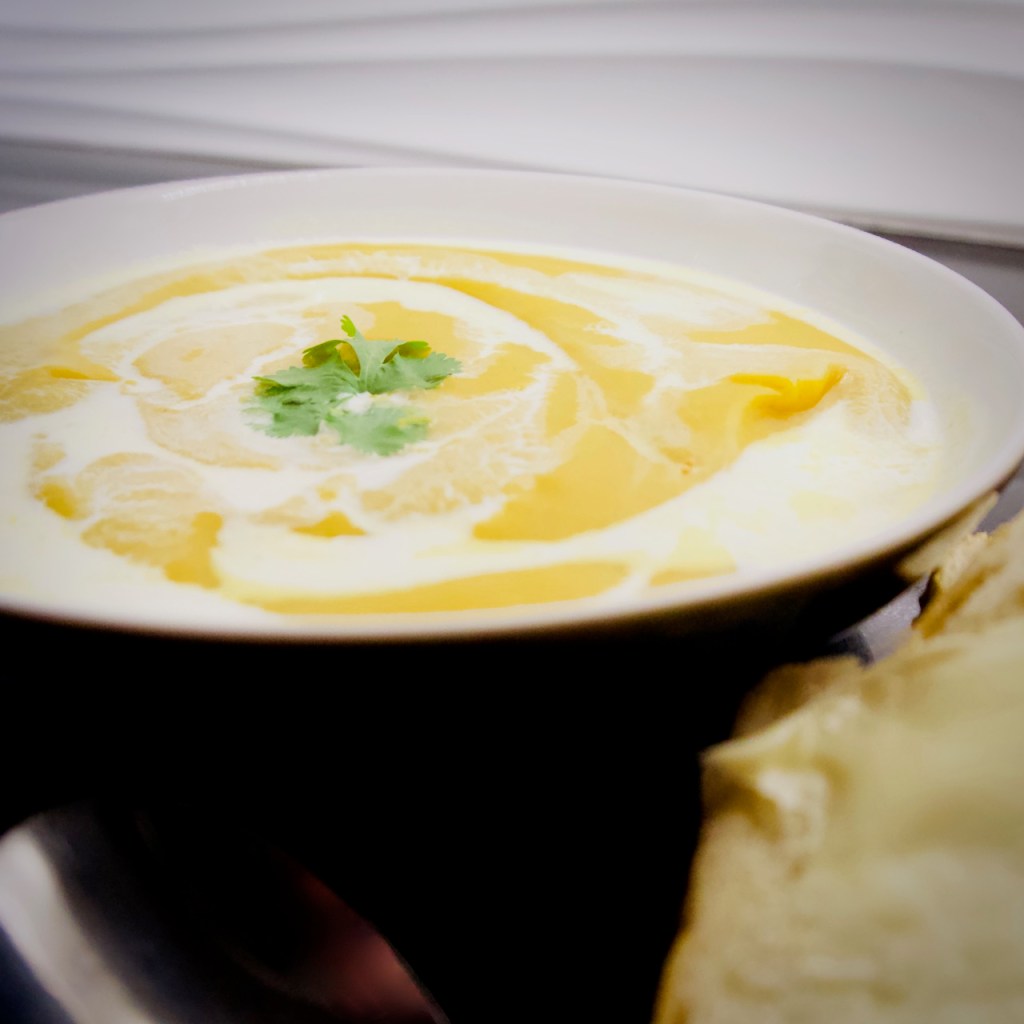
    It’s a super thick soup, almost a puree, hence really filling. Plus:

    • There’s 485% of your daily recommended dietary allowance of vitamin A. Essential for keeping all your vital organs in working order!
    • There are only 309 calories per serving, or 15% of calorie intake on a 2000 calorie per day diet.
    • The fat content is just 2g, only 3% of your daily recommended dietary allowance.

    With it being so low in calories and fat it’s good for those currently on a weight loss plan (like me – again!). Although I may have negated all the goodness with the “drop” of cream and fresh slices of bread!

    Let me know if you have any other lentil soups for me to try and I hope you like this one!

    Ingredients

    • 1 tbsp olive oil
    • 1 onion diced
    • 1 kg sweet potatoes peeled and diced
    • 1.5 L vegetable stock
    • 210 g red split lentils
    • 1 tsp ground turmeric
    • 1/2 tsp mild chilli powder
    • Freshly ground salt and pepper
    • 1 tbsp coriander chopped

    Directions

    1. Gently heat the oil in a large soup pot and add the diced onion to soften it, stirring occasionally for about 4 – 5 minutes. Then add the diced potatoes and continue to stir for a further 3 – 4 minutes.
    2. Add the vegetable stock, lentils, ground turmeric and mild chilli powder.
    3. Stir well, bring to the boil and turn down to simmer gently for 20 –25 minutes until all the mixture is completely softened. Remove from the heat.
    4. When the soup has cooled a little, blitz it in a blender / food processor and return to the pan, season to taste, garnish with the chopped coriander and then serve.
    5. Serve with fresh bread.
  • Processing Vacation on Order for 2020

    Processing Vacation on Order for 2020

    I think we ran out of frozen peaches in April 2019. Corn even sooner.

    May was tough. That transition between enjoying the previous seasons’ harvest and the new harvest felt like eons. Even though, I do tend to allow myself asparagus from California and Mexico in the spring, it’s not the same as eating local fruits and vegetables grown by people you know and care about.

    By June, I had promised that I would work even harder to preserve 2019’s delectables and make it past May 2020 in good shape.

    I started by canning pickled garlic scapes. It was fast and easy, but I’m a canning chicken, so it was stressful to try a new recipe. A resulting complication of my chicken-ness was that I decided to eat all the scapes before they would have a chance to go off – it was likely a completely unnecessary panic and the reason we have none in storage.

    When late July arrived, I was certain I was ready for the pending influx of goods. But food started coming at me faster than ever — it was a very good growing season after all.

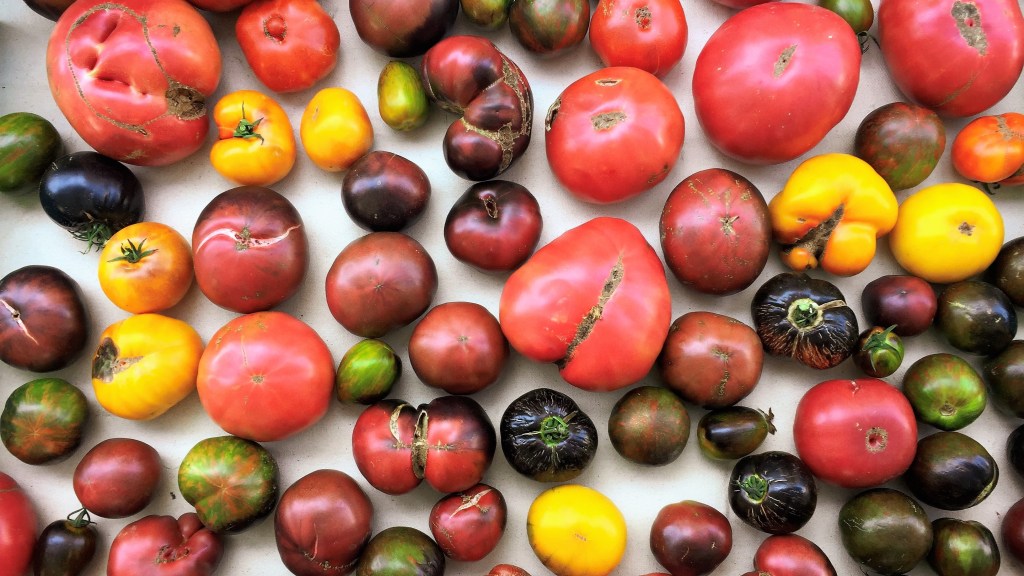
    Peaches, blueberries, green beans, corn and tomatoes.

    As we carried case after case through the door, I started to feel overwhelmed. Do work that pays the bills or process food became a dilemma that I just didn’t have an answer to.

    And, while I figure therocketnarcissist and I processed more than 300 pounds of food, all of it grown by people we know, I’m feeling like our freezer stockpile is dwindling. We’ve had a busy and mentally draining fall, so the freezer has been raided close to every day.

    Spaghetti sauce gone, tomato curries gone, corn stash cut by half.

    This year, I spent extra time looking for a good freezer salsa. I made about 60 cups mild or hot salsa – but the supply is shrinking – and fast. It’s just so damn good. And is incredibly useful as a base for a Mexican themed fried rice.

    All this makes me think that rather than take a biking vacation, an August 2020 processing vacation might be in order. I’m curious, have you ever taken a processing vacation?

    Of note, I can’t even begin to imagine what it would have been like to farm with such abundance coming our way this past summer. Kudos to all the farmers that worked hard to keep up and feed us the best fruits and vegetables that the Squamish-Lillooet region has to offer.

    In case tomatoes are a plenty next year too, here’s a link to the salsa recipe.

  • Wonder really is a survival skill

    Wonder really is a survival skill

    I read this quote as I skimmed The Curious Nature Guide: Explore the Natural Wonders All Around You, by Clare Walker Leslie and it stuck with me. It’s at the heart of what I hope my kids get out of school… and life, really. 

    But maybe it’s for just that reason–how busy we are and distracted and disconnected we are–that wonder really is a survival skill. It might be the thing that reminds of what really matters, and of the greater systems that our lives are completely dependent on. It might be the thing that helps us build an emotional connection–an intimacy–with our surroundings that, in turn, would make us want to do anything we can to protect them. ~ H. Emerson Blake in the foreword to Wonder and Other Survival Skills

    It’s wonder that helped me survive the last year, too.

    Exactly a year ago, I quit my decade-long secure government job, launched myself into self-employment and simultaneously became really ill. I left work and needed my first of many blood transfusions a few weeks later. I’d been struggling with severe anemia for years and my condition had eluded a definitive diagnosis.  

    By February I received a lymphoma diagnosis and in March I was receiving life-giving and equally barbaric chemo and antibody treatments. 

    I worked in bed for the winter–one of the luxuries of self-employment– and in the spring began a slower version of gardening. 

    My year was all about survival, but also wonder. Wonder at the drugs that saved me, and the plants they were originally derived from. Wonder at my family, who I would love to live with for a long time, and would grieve so much to leave. Wonder at how sick I had become, how I’d fallen between cracks in the medical system, how I looked “fine” and pale when I was barely floating through my days with dangerously low hemoglobin– the oxygen carrying component of blood.

    And there was wonder at how ridiculously great and high I felt the first time I received a blood transfusion. Wonder at how my fingers and lips turned pink–how I was reanimated with blood. Wonder that strangers literally gave me the gift of life. Wonder at the cost of my drugs–$10,000 for two days’ treatment every month. Wonder that our health care system paid for them. Wonder at how much care was missing in treatment, and also wonder at how much care was offered from lab techs, ER and chemo nurses, and angel friends.

    HomeGrown

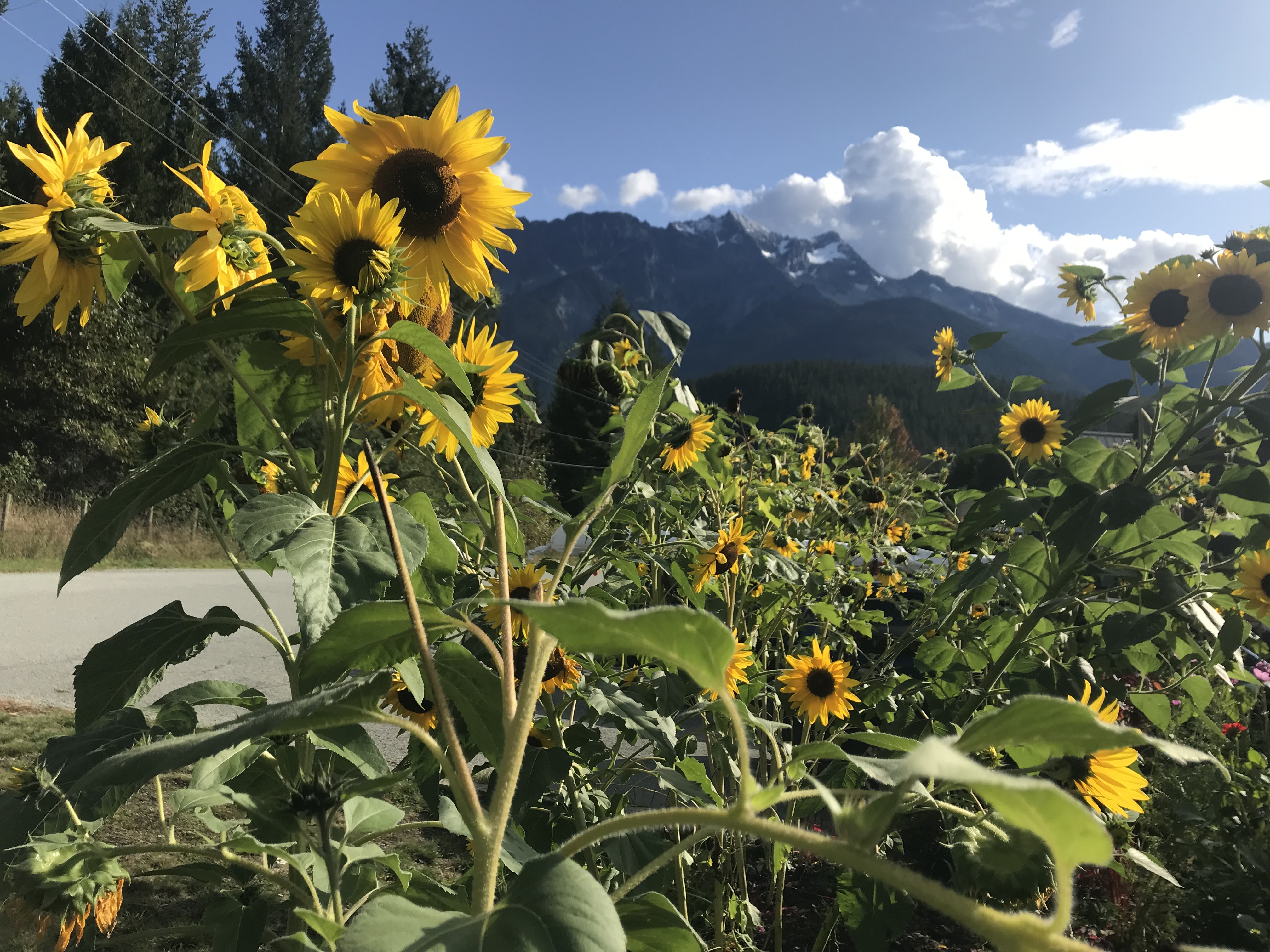
    And my wonder garden grew in spite of me, and continued to offer gifts: the wonder of harvesting garlic in between summer rain storms, celebrating epic and endless dahlia blooms, eating broccoli and peas for days, and enjoying such a bounty of tomatoes that the last batch sat ripening in egg cartons on my counter even last week. Wonder at the soil–lush, rich, buttery and black that I’ve been building in my garden for the last few years. Wonder at the sunflowers that provided so many blooms abuzz with bees and then food for weeks to so many different kinds of birds. 

    SunflowerJungle

    I also experienced confusion and wonder at the suffering of so many people I saw in treatment and in our community. I felt the sadness of illness and accidents and the losses of loved ones.  Wonder at the gaping holes and the ways we try to soothe and patch them.

    I had a few days after my second round of treatment when I entered a black pit of despair. Nothing made sense. I saw no reason for my suffering or anyone’s suffering and no reason for living or sickness or treatment for it. But then tulips bloomed and that made sense. It a crack of enchantment. A thread of wonder. A signal that something small was still right in the world. 

    It’s foggy and cold today. There are cracked chestnuts, a precarious pile of birch logs, a dull axe, a frosty table and a barbeque abandoned for the season on our deck. The leaves are still hanging onto the overhanging chestnut tree, now wilted and brown. I’ve been harvesting the last scrubby bits of kale, chard, parsley, chives and celery leaves sticking out of straw mulch, as I surrender to buying greens over the winter.

    Mel'sHappyPlace

    I survived the year, along with my garden, along with my kids, along with my partner, along with my dog, along with my work, thanks, in part, to the balm of wonder.

  • Best of Pemberton Fall Dinner: Pine mushrooms and deer burgers!

    Best of Pemberton Fall Dinner: Pine mushrooms and deer burgers!

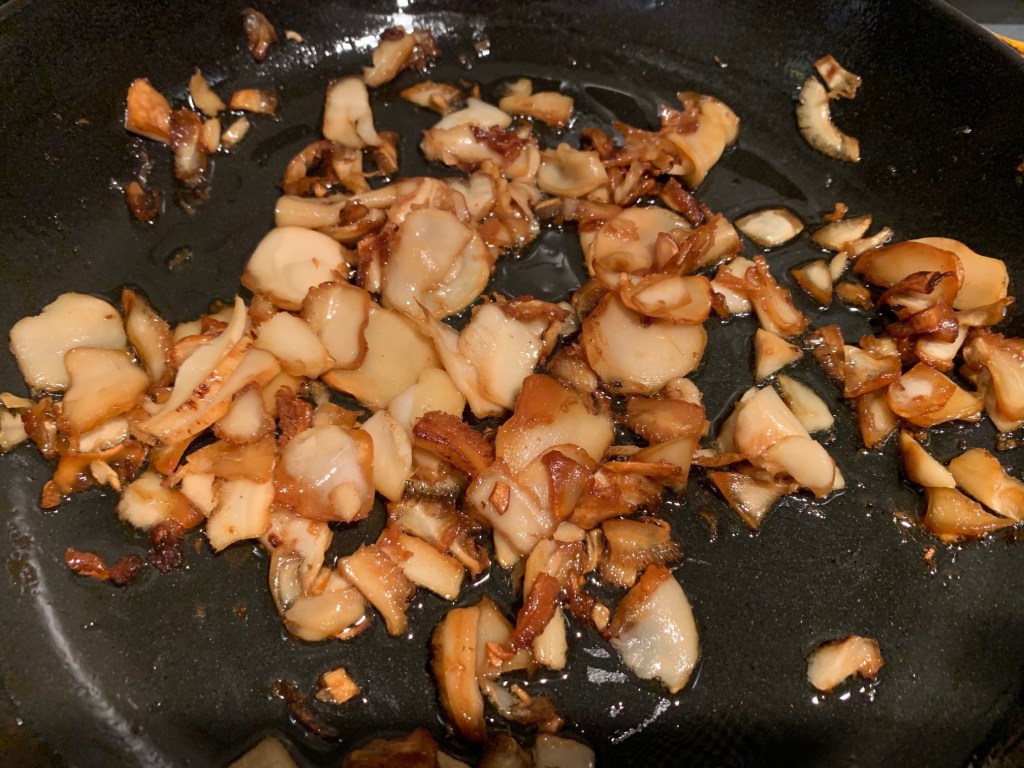
    This is a good time of year for eating well in Pemberton. Hopefully fresh deer meat, winter squash, mashed Sieglinde potatoes, and sautéed pine mushrooms! A healthier plate will also include sautéed chard – but I prefer to save my blanched chard to add to chilli and soup when it goes down so harmoniously with bold tomato flavour and spices. I used to dislike pine mushrooms but my tastes changed a few years ago when I ate them prepared very simply. Sautéed in olive oil, then drizzled with a tablespoon of fresh lemon juice and just a dash of gluten-free soy sauce…I can’t eat enough of them! Cheers to good fall meals using Pemberton’s finest local ingredients.

    Sautéed Pemberton Pine Mushrooms (serves 4 as a side dish, or 1 for a scrumptious snack)

    Ingredients:

    4 large pine mushrooms, well-scrubbed and clean

    2 tbs pure olive oil

    1 tbs fresh lemon juice

    ½ tsp gluten-free soy sauce

    Method:

    Scrub your pine mushrooms well.

    Slice VERY thinly into 2 mm slices. Thin slices are the key to flavourful and crispy pine mushrooms.

    Heat olive oil in a large cast iron skillet. Sauté mushrooms over medium heat until nicely browned and crisp. Turn off heat and add lemon juice and soy sauce. Enjoy!

    Pemberton Deer Burgers: (serves 4)

    Ingredients:

    1 lb ground deer meat

    2 tbs pure olive oil

    ½ medium yellow onion, fine dice

    1 tsp salt

    1 tsp pepper

    1 tsp prepared English mustard

    2 dashes hot sauce (optional)

    2 tbs chives, chopped.

    Method:

    Combine all ingredients. Form into patties. BBQ on high for about 10 minutes and flip burgers halfway through. Remove from heat when cooked through. Enjoy!

  • Winterizing your garden

    Winterizing your garden

    The crops are in, the first frost has decimated whatever was left, markets are over, but the work isn’t over yet. In fact, it’s often one of the busiest times for farmers. That last push is crucial, and it can be difficult to get motivated in the cool mornings and reduced daylight. Most farmers are close to burnout by this time. My partner and I like to take a well deserved vacation in November so there’s a real fire under our asses to meet that Halloween deadline. Besides the usual firewood stacking and yard clean up, I’ve posted my autumn to-do list:

    PLANTING:  Most people are stoked to plant in the spring, and busy garden centers at that time are proof. Fact is, the fall is the best time to plant and deals can be had. I like to plant perennials, spring bulbs and fruit trees. Garlic, of course, should always be planted now. They will stay dormant throughout winter and get the earliest possible start in the spring. Cool wet weather should get their roots established before the hot dry summer.

    PRESERVING SURPLUS: This is the time to use up what’s left. Pickle, make jams, freeze, dehydrate and juice. It’s a shame to see your hard work wasted. Trade, barter or give it away.

    DIGGING/STORING/COVERING TENDER PLANTS: If your favourite plant is pushing its winter hardiness zone, you will have to protect it or move it indoors. Perennials should be cut back and mulched, roses and hydrangeas should be hilled with dirt. Really tender stuff should be potted and slowly acclimatized to the indoors. We are busy at this time digging up hundreds of dahlia tubers and storing them in crates in our garage. Some root crops can be mulched and covered with plywood and harvested throughout the winter.

    REMOVING THE POLY FROM HOOP HOUSES:  If you don’t do this now, you will inevitably be shovelling and/or waking up to a collapsed greenhouse.

    SHUTTING DOWN AND DRAINING WATER LINES: If you don’t do this now you will inevitably be facing split lines and fittings in the spring. Roll up hoses and hang them up.

    SERVICE MACHINERY: This is the best time to fix broken stuff, maintain and winterize anything mechanical. Put it away in a dry spot.

    COVER CROP: Fall rye and legumes are excellent amendments and protect your soil from erosion and weeds. Plant them now and turn the green carpet under in the spring. Topdressing with manure is also an excellent idea.

    FERTILIZING: This is often overlooked at this time. Look for high potassium (K) to increase hardiness and Phosphorus (P) for early root growth in the spring. Feed anything that didn’t thrive and seemed depleted. If you soil tends to be acidic, lime now to raise PH as it takes many months to adjust.

    RAKE LEAVES: While this can be done in the spring, it’s easier to do now when they’re dry and they can be used as mulch or compost. Whatever you do, don’t burn them, you just smoke out your neighbours. Cleaning up under fruit trees is important to prevent the spread of  pests and disease.

    CLEARING AND BURNING BRUSH: With the leaves gone, its easier to brush cut. It’s also often the safest time to burn it.  Theres nothing better than watching “Hippie TV” on a cool autumn evening.

    PICK STUFF UP:  It’s a drag to find rusted tools and odds and ends when the snow melts.

    TAKE NOTES: While your memory is fresh, this is a good time to reflect on your successes, failures and what you plan to change next year.


  • Soup for (F)all seasons!

    Soup for (F)all seasons!

    I just took the dog for a walk. It was chilly and windy. It was Fall in Pemberton.

    There’s only one thing for those kind of days and that’s a delicious, hearty bowl of soup with some fresh crusty bread, still warm if you can find it.

    I have two go to recipes. Roasted Butternut Squash, one of my all-time favourites, and Cock-a-Leekie which I love because it harks back to the Scottish side of my family and is quick and simple to make, well my version anyway!

    To make my uncomplicated variation all you will need is celery, leeks, carrots, potatoes and chicken breasts cooked together to miraculously become a wonderful warming soup.

    The traditional version includes other ingredients including prunes and oatmeal, and I have never made it this way, but the simplified version allows all the vegetables to shine – especially the leeks who are the stars of the bowl!

    Whichever version you attempt this will certainly warm you up on a cold Fall, or even Winter’s, day. Enjoy!

    Ingredients

    • 2 sticks of celery, sliced
    • 2 leeks, sliced
    • 2 carrots, sliced
    • 4 to 5 potatoes, diced
    • 2 chicken breasts, cubed
    • 1 to 1.5 litres chicken stock
    • Salt and pepper

    Directions

    1. In a large stock pot heat 1 tablespoon of vegetable oil and add in the celery and leeks and cook over a medium-high heat to soften.

    2. Add in the carrots and potatoes.

    3. Pour over the stock.

    4. Add in the chicken.

    5. Add salt and pepper to taste.

    6. Bring everything up to boil and cook for 25 to 30 minutes or until the potatoes have softened and the chicken is cooked.

    7. Serve with fresh bread.

  • Doomsday Gardening

    Doomsday Gardening

    First of all I’m not a doomsday prepper, but  in these parts I know a few who are. I doubt however many of them have  put much thought about what they could grow and eat to sustain themselves.  Canned and processed food could get boring pretty quick. With all this talk about  climate change, mass extinction, nuclear disasters, and displacement from war and environmental degradation, I have  put some thought about how my garden might look in a post-apocalyptic world. Resourceful homesteaders will no doubt have the best chances of survival. City folk, no matter how wealthy, will be screwed. In this scenario, I am assuming there will be little availability of clean water for irrigation, access to fertilizers, electricity to heat greenhouses, gas for equipment etc. Time spent outdoors may be limited due to the harsh elements.

    I have put together a short list of the hardiest, most foolproof, lowest maintenance crops that will thrive without any care while you idle away time in your bunker. Lazy gardeners without much of a green thumb, take note.

    RHUBARB: This is the vegetable that doubles as fruit. Tart and nutritious and delicious when mixed with something sweet. It is one of the first things to sprout in the spring. I believe its impossible to kill once established. I assume in the worst case nuclear holocaust there will just be rats eating rhubarb. You can go to a farmstead that has been abandoned for decades and can always tell where the garden was by the rhubarb patch that has thrived without any care whatsoever.

    ASPARAGUS: Probably the next thing to sprout in the early spring. Once established it will spread and return year after year, pushing though thick grasses and weeds. It can be eaten raw or quickly boiled. It propagates from both seeds and roots.

    RASPBERRIES: A raspberry bush will produce pounds of berries for a couple decades. Some varieties will produce all growing season. Rich in vitamin C, they can be dried or made into jams. The canes will die off annually and send up even more shoots the following year. Suckering roots will keep spreading and create a big patch in a few years. Although they like a fair amount of water to produce large berries a good layer of bark mulch should retain enough moisture to do the job.

    JERUSALEM ARTICHOKES: A member of the Sunflower family (Sunchokes). These tuberous roots can provide the starch as your staple.  They are invasive and spread (give them room).  Extremely prolific yield from a single tuber – all you have to do is leave a small percentage in the ground and they will  return indefinitely. They keep for quite a while in a cool area.

    AMARANTH: This is an ancient grain that the Hopi indians made bread from. It grows tall and quickly with large blooms of burgundy flowers that eventually produce an abundance of seeds that can be crushed to make a type of flour. Although an annual, they readily self seed so there will be no need replant. It is now mostly used as an ornamental cut flower, so you can  also have a nice arrangement in your bunker.

    MINTS: This is a very large family of herbs, with a myriad of flavours from lemon to chocolate. They can be used to enhance foods or make tea. They are good at soothing a bellyache and inducing sleep. An established mint patch is virtually indestructible and will continue to spread.

    HAZELNUTS : Also called filberts, they are native to this area and can be naturalized easily. They are a good source of protein. You may have to kill the squirrels and birds before they raid the tree, but hey, that could be some additional meat protein.

    GRAPES : Not only fabulous fresh or dried as raisins, wine might end up being the most valued product to uplift your dampened spirits. A grape vine can live for centuries in the most marginal soils.

    CANNABIS: This is the most essential and versatile medicine you can grow. Seeds are nutritious and can be made into oil. It can be used to calm and provide inspiration. It’s easy to grow – that’s why it’s called weed.

    So here you have it. When the shit hits the fan and you want to survive beyond what your 36 hr emergency kit offers, you’d better start planning your own doomsday garden because I don’t intend on sharing when push comes to shove.