Recently we went on a bit of road trip, starting out by heading to the Canmore / Cochrane area and then heading down to Fernie and Nelson. Our last stop, while covering some 3,000 kms, before heading home was to Peachland. We found a lovely little AirBNB right slap bang in the middle of wine country! (Don’t worry we both sampled wine and brought some back with us! 😉 )
However, it was our host that offered us the peaches, and right from her very own garden.
(Did you know? Peaches have been cultivated in the Okanagan since the 1890s and are available July through September.)
Anyway, who was I to say no? Of course, having received said peaches I had to find the right recipe with which to showcase them.
Okanagan Peaches
I wanted to make some kind of pie and have been searching for the ultimate pastry recipe for ever. Well I think I finally found it with this recipe for a Rustic Peach Galette with Orange [and Ginger – which I didn’t add as it’s not my very favourite!].
The pastry in this galette is melt in the mouth soft, explodes with the flavour of the oranges (even more so as I used the orange juice to bind it all together) and has a lovely crumbly texture. In fact, it was to die for – no exaggeration!
The peaches were soft and not too sweet and really showcased the very best of the Okanagan.
For all the above reasons, this recipe is a keeper and I would encourage you all to try making it before peach season is over. It is can be especially enjoyed warm from the oven with a nice helping of decent vanilla ice cream.
Peach Galette
Ingredients
Pastry
1 cup all-purpose flour
1 tsp granulated sugar
1/2 tsp salt
1/2 cup cold butter, cut into small cubes
1/4 cup ice water
Filling
4 peaches, sliced 1/2 thick
2 tbsp granulated sugar
1 tbsp all-purpose flour
1 tbsp orange juice
2 tsp grated ginger
1/4 tsp salt
2 tbsp butter
Additional Ingredients
1 egg
2 tbsp milk
2 tbsp coarse sugar
1 small sprig basil
1/2 cup ice cream
Directions
In a medium sized bowl, mix together 1 cup of flour, 1 teaspoon of sugar, and 1/2 teaspoon of salt. Add the butter, and using a fork crush and mix the butter into the flour until it is coated and becomes the size of small peas. Add the water 1 tablespoon at a time and mix until it forms into a dough. Shape into a 1 inch disc, wrap and place in the fridge for at least 1 hour.
Preheat oven to 425°.
In a medium sized bowl, whisk together 2 tablespoons of sugar, 1 tablespoon of flour, orange juice, grated ginger, and 1/4 teaspoon of salt, until smooth. Add the peach slices and toss gently to coat.
Remove the dough and place on a large, lightly floured, piece of parchment paper. Roll the dough out to a 14-15 inch circle. Starting from about 1 inch from the edge, layer the peach slices on their sides clockwise, one at a time, ensuring they lay on top of each slightly. Continue, working your way to the centre of the galette until the galette is filled. The peaches will be higher in the centre than the edges. Fold the edges of the dough up in 2-3 inch sections, over top the outer layer of peaches covering them by about half. Dot the peaches with 1/2 teaspoon chunks of butter.
In a small bowl, whisk together the egg and milk to make egg wash. Brush a light layer of egg wash on the crust then sprinkle with coarse sugar.
Place the galette on a baking sheet or pizza stone and bake for 20 minutes, until the peaches are bubbling and the crust is gold brown. Allow to cool for at least 20 minutes before serving.
Serve with a scoop of vanilla ice cream and a few small basil leaves.
10 . BE PASSIONATE. Always remember despite the ups and downs you are doing something that you LOVE to do. If you don’t, the negative results will come through in your product and others will ingest that. Treat it as a lifestyle not a job. If you’re in it for the money, you’ve chosen the wrong profession. Expect joy, disappointments, successes and failures.
9. SET REASONABLE/ ACHIEVABLE GOALS. It’s so easy to take on too much and to try to grow everything. Just because you planted a ton of seedlings and tilled a huge garden bed, doesn’t mean you can maintain it. Focus on what you do best and keep it simple. Create a niche and take baby steps.
8. TREAT PLANTS LIKE DEPENDENTS. Plants are living entities that require food, water, shelter, love and care and then there’s the point where they mature and you have to let go by harvesting, letting go to seed, and waking up one fall morning to see that a frost has killed off all your annuals. Just like kids, adolescents and adults, it’s all a cycle of life.
7 . SAVE SEEDS. There’s often a single plant that out-performs the rest. Let it go to seed, collect and store for the following year. That’s exactly how humans created an agrarian society and prospered. Food security and biodiversity are now more important than ever.
6. KEEP YOUR OVERHEAD LOW. There are all sorts of fancy gadgets, expensive planters, machines and tools you will need once a year. Plants couldn’t care less. Borrow, rent, fix and improvise. Be efficient and devise ways to save time. Most farms go bankrupt, don’t be a statistic.
5. KEEP IT NATURAL. Look to nature for inspiration and explore organic, biodynamic and permaculture methods. Remember that a garden is part of the ecology. Consider birds, insects and animals are all part of the cycle. Mother Nature is the wisest gardener of all.
4. BUILD YOUR SOIL. Even if your planting in fertile ground, plants take nutrients and once you harvest you’ve created a deficit. Build and maintain a compost pile, rotate your crops, plant cover crops and nitrogen fixing legumes.Test your soil occasionally and amend as needed. Good soil is the foundation of a healthy and bountiful garden.
3. KEEP LEARNING. Its literally impossible to know it all. Read, experiment, discuss, research and always be interested in finding out more. Teach others as that re-inforces your own knowledge.
2. SHARE. Whether it’s your experiences, successes, failures or the final tasty product. That’s what creates a healthy garden and farm community. Use the barter system. Someone else has too much or too little compared to you so trading balances things out.
1. MULCH. This simple technique will save you hours of weeding and watering, while preventing erosion , encouraging beneficial micro-organisms, creating humus and future soil.
Thanks to Carlee Cindric, the tireless event producer with Tourism Pemberton, behind Slow Food Cycle Sunday, for taking time out from organizing, to share this reminder of what Pemberton’s signature home-grown festival is all about. Connecting consumers with their food and the farmers responsible for it, seems more and more vital, as the UN releases its report forecasting the human population on Earth will go to 10 billion by 2050, and the way we eat and grow will have one of the most profound impacts on our planet, its habitability and climate stability, of almost any other thing we do. The headlines might read “world food security at risk” and “agricultural practices add to climate threat”, but what’s important to grasp (i.e. hook your soul’s momentum onto) here is that the way we grow our food (and our beer! and our booze! and our flowers!) offers one of the very best and most powerful ways we have of stabilizing the climate. It’s not a foregone conclusion. Don’t give in to despair! Get on your bike. And go meet some growers, who are practicing regenerative techniques and nurturing the soil that feeds us.
by Carlee Cindric for Tourism Pemberton
Do you Slow Food? It’s the 15th year of the annual Slow Food Cycle Sunday presented by the Pemberton Valley Supermarket! That’s quite an achievement given the modest beginnings of this favourite community event.
Most compatible road-mates: tractor and bicycle. Photo by Dave Steers
Founded in 2005 by two locals with a shared vision of the importance of farmland and connecting consumers with farmers/producers, the Slow Food Cycle Sunday has grown into a larger cycling festival complete with live music, food, drinks, art, crafts, treats and more – all with a local, grassroots vibe.
Visit The BeerFarmers, one of Slow Food Cycle’s founding farms, and learn how long it really takes to grow and brew a beer. We’re talking field to tap.
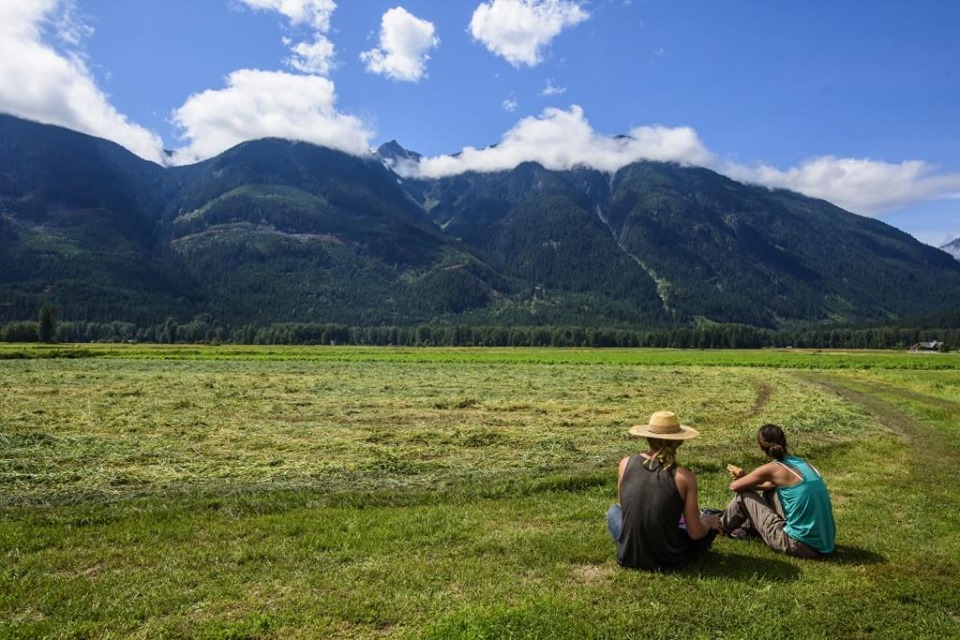
Pemberton’s Slow Food Cycle Sunday is an important event for Pemberton because it brings together consumers and producers in a unique ‘green’ agri-tourism experience, drawing participants from the Sea-to-Sky Corridor, Vancouver and worldwide. The event shines a spot light on the slow food movement – food that is produced or prepared in accordance with local culinary traditions, typically using high-quality locally sourced ingredients – and the importance of farm land, eating locally and supporting local food producers.
The event invites participants to choose their own cycling adventure using an interpretive map highlighting the various participating farms and venues along Pemberton Meadows Road. Participants can set their own pace and decide which farms along the 25 kilometer roud-trip route to visit. Along the way, participating farms open their ‘doors’ for the day and host a variety of vendors selling and sampling everything Pemberton has to offer from baking and honey to coffee, Pemberton potato fries, hamburgers and of course Pemberton fresh fruit and veggies.
Laughing Crow Organics have been “setting up” a sunflower maze for your pleasure at Slow Food Cycle, growing sunflower babies from seed for a field of sunny dreams experience.
We’ve got a few new farms/venues and vendors joining us for year 15 which helps to keep the event new and exciting for those participants who return year after year.
The Slow Food Cycle Sunday will take place on August 18. We encourage folks to register online before the event at slowfoodcyclesunday.com. Don’t forget to bring your helmet and water and remember to follow the rules of the road.
We look forward to hosting you during this celebration of Food, Farmers and the Joys of Biking! For more information, visit slowfoodcyclesunday.com
The amazing thing about Slow Food Cycle is that, just by showing up, you are being part of the event. But if you want to further inject your energy into the day, you can sign up for a 2 hour volunteer shift at the registration table.
This is a guest post by Cindy Coughlin, a Pemberton-based HR professional, coach and facilitator, who operates Thirst for Change Coaching, where she blogs knowledgeably but equally engagingly about things other than gardening. When she told me recently she had unexpectedly become a happy garden-sitter, I begged her to write about it for Traced Elements. I had literally just seen Dawn Johnson that morning, and learned that Dawn’s squash plants grew over the wheelbarrow, obscuring it entirely, as it awaited Dawn to return from a camping weekend and get to the garlic harvest. So I share Cindy’s awe for this Eden in which she has apprenticed herself. So happy to welcome Cindy to the Traced Elements community. ~ Lisa
+++
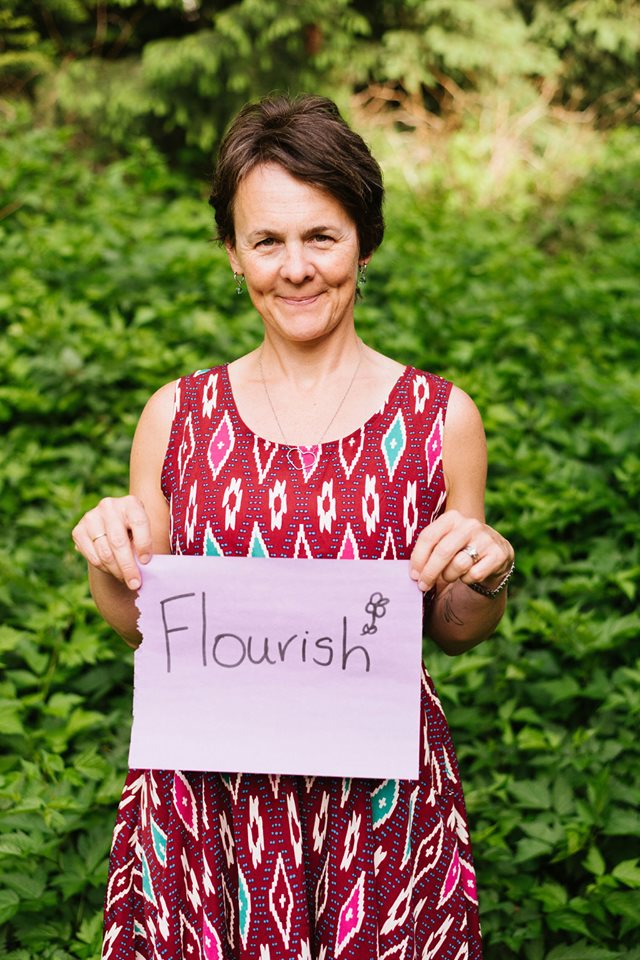
Flourish. This is my word this year. It originally started as part of a peer mentoring group where my main focus was on getting my consulting business up and running. We had to come up with a theme or a word. I picked Flourish. Well, actually I picked “Nourish to Flourish” – the idea being that I put in the care and attention to help build up my first year of going it solo.
Cindy Coughlin chooses to Flourish. Photo by Cathy Goddard
Nourish, according to the dictionary, means to cherish, foster, keep alive, to strengthen, build up, or promote.
Flourish is to thrive.
And this mantra, this intentional approach has quite naturally carried over to other aspects of my life.
I’ve been working with my awe-inspiring, plant-whisperer neighbour and friend, Dawn, in her spectacular garden. I approached her in the spring and asked her to put me to work. Now to give you some context as to how outside my comfort zone this is – when I was younger and had the list of chores split with my sibs, I’d be adamant about staying inside and doing the laundry, vacuuming, etc. When I moved to Whistler and started off as a lifty, it was the worst job I could imagine. I hated working outside (I know weird, right, cuz I love riding and skiing and playing outside). I also really hate big bugs – especially of the 8-legged nature.
Plant-whisperer Dawn Johnson. Photo by Cindy Couglin
But this spring and summer, working in the garden, have nourished me in the best ways.
Here are three things I’ve learned about getting dirty:
Paying Attention
I need to be paying attention. I’ve been reading books about trees, books about bears, books about over-tourism. I’ve been watching tons of the stunning newsfeeds on the climate emergency. All of these are asking me, begging me, to step up my game, consider my impact, take some type of action – start somewhere. And now I feel the pull to pay attention. To pay attention to my food. To pay attention to how nature provides. To pay attention to the interconnectedness.
Recently I was trying to cut some lettuce, quite close to a flower which had a busy bee in it. I could see the bee was getting agitated with me being so close. So, instead of wildly flapping my arms to scare away the bee, I just stopped and watched. The bee did its bee thing in the flower and then moved on. I felt so filled up. Co-existing and working with nature.
Feeding my Soul
Dawn and her family went away for a week and I was trusted with taking care of everything while they were gone. Isn’t that incredible – I was TRUSTED to take care of a garden – my mom would literally think I’d been taken over by aliens.
And it was incredible. Everyday I’d check on the budding plants. I’d chat with the chickens and bees. I’d cut some lettuce and some yellow little squashy thing for dinner salad. I’d find that zucchini hiding under a massive, prickly leaf – happily earning my stripes by scratching my arms while I cut the stem. I’d just stand and stare and admire. I’d thank the garden for everything. I’d tell the garden how beautiful it was.
I tend to just take. Take from this earth. I feel like I’m starting, albeit in a small way, to give back. I’m starting to see, really see. And by seeing, by paying attention, I am feeding my own soul. I am seeing the interconnectivity. I am part of the impact and I can make new, different choices.
And I’m learning. Dawn to me is like Yoda was to Luke. Like Mr. Miyagi was to the Karate Kid. Her wisdom and unwavering passion is a gift to this world. And I feel so filled up as I watch, listen, try things out and learn. I’m learning how to garden. I’m learning to care for my food. I’m learning to take only what I need. I’m learning about eating food that is in season and waiting, anticipating, for things to come back next season. Meaning, going without in the off-season – oh the anticipation will make it so much sweeter.
All the Good Eats
The little yellow squashy thing that I thought was just an ornament has this beautiful mild flavour with just the right amount of crunch. The edible purple flowers that my Albertan-meat-and-potato husband is welcoming in his salad – taken in very small quantities because the bees love them so much – are so good. The cukes and zukes that seem to grow 5 inches overnight – no one believes me – but I think if I sat and watched them for 24 hours, I’d actually witness them growing. And the flaves from these are incredible!
I’m completely impatient for the carrots and so am happily pulling them as babies in service of giving space for the others to grow nice and big and sweet. Have you ever pulled a carrot from the earth, dusted it off and ate it right there? Nothing tastes better.
And the pièce de résistance, the biggest surprise of all has been the asparagus. Dawn simply broke off a piece and handed it to me right in the garden while she took a mighty crunch from her own piece. No salt and pepper, no butter. I took a tentative bite and was shocked to find out this is what asparagus actually tastes like. Almost 50 years old and I have just experienced what asparagus is supposed to taste like for the first time in my life.
If I can do this, anyone can do this. I am getting dirty. I am working it out with the 8-legged-who-shall-not-be-named. I am learning. I am growing. I am nourishing. I am flourishing.
It seems to be that time of year again! So many people I know are offering up their excess zucchini’s as they have too many and don’t know what to do with them!
So when my neighbour put out a post saying she had some up for grabs I volunteered to take one of her hands. And it was a monster! So much so that I made to make up half as much again of the recipe I found. This meant that I could make four mini-loaves and one standard size loaf. Good job I’m a fan of zucchini bread.
Besides, I gifted back two of the mini-loaves for her, and her family, to enjoy! 🙂
The Mini Zucchini Loaf recipe I found included walnuts which I didn’t have on hand, but the pecans worked just as well!
So, if you have any spare zucchini’s I won’t say no. 😉
Ingredients
2 cups grated zucchini (about 2-3 zucchini)
3 cups all-purpose flour
1 teaspoon kosher salt
1 1/2 teaspoons baking powder
1 1/2 teaspoons baking soda
1 tablespoon cinnamon
1 cup sugar
1 cup packed brown sugar
1 cup vegetable oil
3 large eggs
1/4 teaspoon almond extract
1 cup chopped walnuts
Directions
Preheat oven to 350 degrees. Coat two [or three] 5 1/2 by 3-inch loaf pans with nonstick spray, line with parchment paper, and then spray paper.
To reduce the moisture, press the grated zucchini between sheets of paper towel. When most of the moisture has been absorbed, you can fluff with your hands or a fork and then set aside.
In a small bowl, mix together flour, salt, baking powder, baking soda, and cinnamon.
In a large bowl, combine sugar, brown sugar, vegetable oil, almond extract and eggs and mix until well combined. Stir in the zucchini.
Add dry ingredients to the bowl of wet ingredients and mix well. Fold in nuts. Divide batter between the two mini loaf pans. If you have extra batter, you can drop liners into a muffin pan and make a few zucchini muffins.
Bake for 35-45 minutes. Use a toothpick to test – if it comes out clean, it’s ready to take out. Let cool for about 10 minutes on wire rack before removing from the pan to cool completely.
In the spring, I sprinkled a small mason jar of biodynamic preparation 500 under my fruit trees and around my garden beds, just as Anna Helmer had shown me. There didn’t seem to be a very specific science to it, although I videoed her doing it and watched it over several times to make sure I had the insouciant wrist flick just right.
It seemed kind of random and messy, which should suit my style to a tee, but I felt weirdly anxious that I would screw it up by flinging the droplets around too wildly, causing the cosmic magic that had been channeled into this precious jar of “water” to elude my little patch of earth.
When Helmer’s Farm hosted an open house in late April, I was there, dragging the kid and his best friend, who amused themselves for hours, eating potatoes cooked over a fire, gently terrorizing the ducks, and eventually holing up in the sandpit.
They also took a turn stirring the great vat of biodynamic preparation, which I suspect was part of the Helmers’ agenda for hosting an open house – to crowdsource some sweat equity from the farm visitors.
I took my turn with the stirring stick, thinking I was really helping things along until Doug Helmer took over and showed me how it was really done, the vigorous stirring that must take place for several hours, creating vortexes, then disrupting them by swirling the water the opposite direction, channeling a winter-buried cow horn full of celestial magic into a kind of homeopathic preparation for the soil.
Once again, as I yielded the stick and accepted a small jar of preparation, it became apparent that I was benefitting a lot more than I was contributing. But as my farmer friends keep reminding me: if there isn’t a willing consumer at the other side of the field, their work is for naught. It might feel imbalanced, when I see how hard they work, but supporting that work makes you an important partner.
Charles Massy is a 60-something year old Australian pastoralist, self-professed shit-disturber and the author of Call of the Reed Warbler, who has become a growing voice for regenerative agriculture. He contends that, given agriculture influences several major earth systems, adopting a more regenerative approach offers the biggest potential to save the planet from the climate crisis. Regenerative farming is “nearly two and a half times better at burying carbon in the ground than anything else” in large part because of its commitment to nurturing soil health and rebuilding soil organic matter.
He came to these views from the near-decimation of his family farm, and its slow recovery into a commercially thriving business, through the trial and adoption of many regenerative practices. A PhD in his 50s helped provide a framework for his ideas.
Massy sees regenerative agriculture’s success as being dependent on farmers who shift their practices to become part of this solution. But equally, it’s on consumers. The movement will only work if the farmers’ products are supported by the urban community. “It’s a two-way partnership.”
Anna Helmer and her family have been growing for Farmers’ Markets for 20 years. She acknowledges that it’s easy for consumers to hit the weather-insulated grocery store or order up home delivery from SPUD, but contends that farmers’ markets offer one key advantage – something she has come to think of as ‘mutual appreciation.’ She writes, “This is an energy generated at the point of contact between primary producer and end consumer at market, notably at the transaction stage. I take your money, you take my potatoes. We are both appreciative of the other. The feeling builds each week, from season to season and year to year and really can’t be re-created in other retail environments.”
It’s the spark of contact that makes magic. Direct, human to human, contact. Built into that transfer of energy – my money, your product, eye contact, appreciation – is the recognition that we are interdependent, that through this simple interaction, we are defending the life force, and creating a more beautiful planet together.
Every Friday, from June until October, the Pemberton Farmers Market offers the opportunity for these kinds of sparks to fly. Helmer’s Farm is there, as well as Four Beat Farm, Devine Gardens, Willowcraft Farm, Blackwater Creek Orchard, Spray Creek Ranch and Rainshadow & Seed to Culture. The Square Root Food Truck is back, alongside Whistler Elixir, Nidhi’s Cuisine, Rosalind Young’s gypsy wagon the RomniBolta (Rosalind Young), Birken House Bakery, and new this year, Lori Ternes. You can also pick up From the Garden Shed’s lavender, herbal remedies from Evelyn Coggins, enjoy a massage from Inner Space Massage, or browse PawWow Pet Products, Rock the Feather, Gallup Pottery, Oh Suzana’s glassware, Betty Mercer’s repurposed silver and Aenahka Creations’ leatherwear.
But it’s not just about shopping. With community groups setting up, live musicians playing each week, and a host of special events, from Bard in the Barn, to the Zucchini Derby, Slow Bike Race and Stone Soup celebration, the magic of the Market is really in the gathering.
“Our vendors work together almost like a family and the overall community spirit makes it a welcoming event,” says Market Manager Molli Reynolds. “The barn is such a lovely structure that eliminates the need for individual tents and that brings us all together ‘under one roof’.”
That community vibe was recognized last year when the Pemberton Farmers Market was awarded Farmer’s Market of the Year 2018, in the medium category, from the BC Association of Farmers Markets. Yes, our little community Farmers Market is the best of its size in BC.
Because magic is a joint effort. Creative sparks, like any kind of new life, require the DNA of more than one human to come together. Which is why Fridays under the Barn are one of my favourite kinds of gathering. The raw ingredients are all there – fresh produce, food and drinks and treats, live music, play zones, community organizations, great people. Just add yourself, and see what happens.
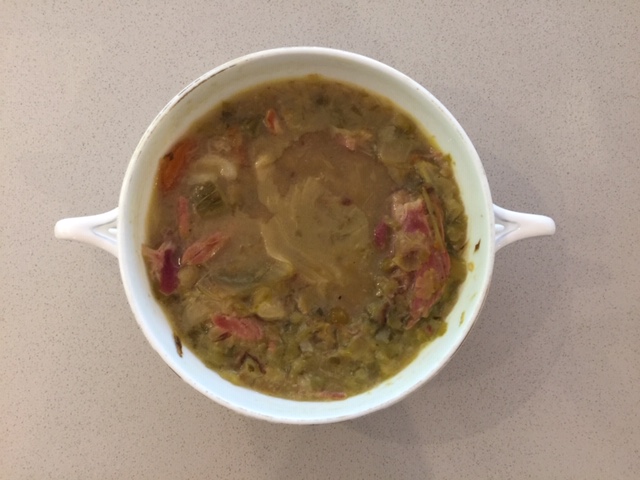
I have experimented for quite a few years with ham and pea soup – switching out the green peas for yellow peas. The yellow peas never softened enough for a good soup and they varied a lot from brand to brand. Green peas soften well. Of course, it helps to simmer your soup for at least 3 hours. A UK friend of mine who used to cater large events called it “the best ham and pea soup I have ever had”. Thanks to that high praise I am posting it today. Pemberton ingredients include carrots, and if you have a source, the ham itself. This soup goes well with a nice piece of warm cornbread. I like the recipe out of the ReBar cookbook by Audrey Alsterburg and Wanda Urbanowicz – an incredibly well-written and inspiring cookbook by two Victoria chefs.
Professional-Quality Ham and Pea Soup:
Ingredients:
1 large ham bone with about 2-3 cups of ham still on it (after baking a 4-5 lb bone-in ham the night prior)
1 bunch green onions, chopped
2 tbs pure olive oil
2-3 cups chopped green cabbage
2 large carrots, chopped
1.5 cups parsley, chopped
8-10 cups water
1 450-gram bag of dried green peas
2 tsp pepper
Method:
Sauté green onion in olive oil.
Add cabbage, parsley, carrots, and pepper and sauté until well caramelised.
Add ham bone, water, and green peas.
Bring to boil.
After soup comes to a boil, turn heat down and simmer 3-4 hours.
Remove ham bone and go through the ham that has fallen into the soup to make sure no gristle or pieces of fat remain in the soup.
Remove all large ham pieces and cut into bite-sized pieces and then put back into soup. Enjoy!
Q : How do you make a million dollars farming? A: Start with 4 million!
As far as business models go, none is as bizarre as farming. There are very few winning formulas. It’s either large scale corporate agribusiness (which has its fair share of hidden costs) or struggling small-scale mom-and-pop operations. There really is no middle ground. It’s feast or famine, so to speak.
The reality is our food system is broken and has been heavily subsidized since it became a transportable industrialized commodity. The sticker price on food rarely reflects its true value. Farmers markets offer a more equitable price point, but the math still rarely adds up.
Competition in most sectors is healthy to keep businesses up to date and prices in check. In farming, it’s devastating. Huge mechanized monocultures, using underpaid labour, utilizing relatively cheap petroleum for fertilizing, harvesting and transportation are no match for a local farmer growing the natural way. Throw in crop insurance, subsidies, GMO’s and shareholders and it’s a lose-lose for both sides. One model is unsustainable environmentally the other is economically unfeasible. It’s a David vs Goliath scenario. That’s why the local, organic and fair trade movement has developed to help level the playing field of this uphill battle. The disparity gap is massive.
When I asked for something pricey, my mother always said “Money doesn’t grow on trees.” Eventually I proved her wrong, but she had a point. A fruit tree, for example, may not bear a sizeable crop for 8-10 yrs. During this time it will need annual maintenance and constant care. Same can be said for the fence that protects it, the irrigation system that waters it and the root cellar to store the fruit. Everything is a long term investment. It is said you plant “pears for your heirs.” I call my fruit trees my RRSP’s.
So why would anyone even attempt to become a farmer?
Passion, sustainability, and the romantic notion of working with nature in the outdoors are all good reasons.
Yes you can eke out a living like the pioneers did, but with today’s expenses, it’s hardly a get rich quick scheme. Most thriving farms either started out small and slowly grew within their means, such as in my case, or they were inherited complete with infrastructure. Other options are leasing land, buying into a co-op or renting out your land and hiring farm hands while you work your real paying job.
The big dilemma surfaces eventually: Do you stay small, subsist and struggle, or do you invest large and go big, making it even more risky. Either way is tough and requires hard work… Almost all will need winter employment and additional sources of income. When doing our books, I often get discouraged. My wife has to remind me sometimes we’ve chosen a lifestyle not a career.
Can you imagine going to the bank and asking to borrow money for a farm start up in Pemberton with your list of capital projects and expenses? A couple million for the land and a couple more for housing, outbuildings, power, irrigation, equipment, supplies etc. That doesn’t even include the operating costs such as labour, permits, insurance, taxes, fuel, tools, amendments and general overhead.
Now you have to explain that you’re going to sell your produce at a few dollars per pound, provided the weather and other environmental conditions co-operate. Our short growing season rarely offers a second chance. Over half the year brings in little or no income. Every concept is risky. Almost everything is perishable with a short shelf life. Now you have to market your goods. Do you get a fair price toiling away a couple days a week at farmers markets, drive all over delivering to restaurants, or do you succumb to the middle man and sell it at a discounted wholesale price? The middle man can make as much or more on the transaction alone. Any potential investors out there interested yet? I can picture the Dragons tearing a strip out of that business plan.
So how on earth does one make a living farming? Hard work and determination is needed, but still won’t guarantee success alone. Diversifying, simplifying, creating a unique niche market, marketing, networking, packaging, bartering, preserving and value-adding your harvest into products is really the only way to justify small scale farming. Farmers should spend as much time in the kitchen, office and garage to be successful. Reinvesting, organization, maintenance and long term planning are essential.
There is a relatively new category of farmer that seems to be proliferating: “Le Nouveaux Riche Fermier.” They are recognized by their huge mansions set in the middle of the field, a long tree lined paved driveway with a large elaborate locked gate. The obligatory white picket fence, brightly painted barn and shiny tractors. The owners are rarely seen outdoors and never with dirty fingernails. It’s often hard to see what they’re doing from the road. So what are they cultivating anyways? Tax breaks and the right to brag that they are trendy farmers at the country club, I suppose. If you assume all that bling was acquired through farming, you’re fooling yourself. It’s a false front.
Just because you can afford to buy a farm doesn’t automatically make you a farmer. They are actually taking away usable land and degrading true farm culture.
If you’re in it for the money, you’re literally wasting your time. There is not a single small-scale farmer that tracks their time and would ever attempt to calculate a wage. For them, their lifestyle is priceless. There is no point in tying to make sense of the economics. You work your ass off and hopefully reap something from what you sow.
So the next time you wonder why that pineapple from the Philippines is cheaper that those local grapes at the farmers market, just remember your comparing apples and oranges.
I started my tomato seedlings on March 24th which is at least two weeks later than usual. It wasn’t until the snow really started to melt that I felt motivated, but better late than never.
My Dad is the self-titled Second Best Tomato Grower in West Vancouver. I can’t vouch for whether #1 deserved the title as I never met him, but as far back as I can recall, my Dad has grown tomatoes. Not the weird multi-coloured heirloom ones, just the basic varieties of Big Beef, Early Girl and red Cherry tomatoes, that look like, you know, tomatoes. My Dad is known as Tomato Grampa to his Grandkids to differentiate from the other Grandpas; not sure if they were lucky enough to have nicknames.
I remember the first greenhouse Dad built in the house I lived in until I was 24. It had poly sheet walls on a thin frame, and a plastic corrugated roof. My mother, sister and I were instructed to donate any pantyhose that had runs, as they made wonderful flexible slings for vines and fruit; this is back in the day when women wore pantyhose at work and most other places so there was an endless supply. After I left home, my parents moved into a new house and Dad built a hot tub inset in the raised deck off the kitchen; the heat from the tub heated the enclosed glass greenhouse he built under the deck. It was ingenious and the tomatoes flourished.
When I lived in various apartments in the city, I always had a tomato plant on my deck donated by my Dad. When I moved to Pemberton, I finally had room for a garden, so started my own plants from Dad’s seedlings. As he did, Dad taught me to save the seeds from the biggest and best fruit by placing the seeds onto a paper towel and letting it dry. Label it, fold it up and put it someplace you’ll remember. No cleaning or fancy storage required. For many years, I have grown the babies from my Dad’s original plants, and I still save my seeds the same way. I hope one day to pass along their progeny to my son.
Last year I started 72 plants, and all but two came up. Of those 70, 6 didn’t survive the transplant into the ground (I don’t have a greenhouse, yet…) so I asked my husband to pick up 6 to replace them. He came home with a flat of 36 instead. They were so cheap, he says. This happens every year as my husband has little faith in my leggy and straggly transplants, but by the height of the season they have stalks as thick as my thumb. Unlike my Dad’s orderly greenhouse rows, my boxes are overcrowded, a Tomatazon rainforest. My carpenter husband builds straight and orderly trellises with end cuts for his bought plants, while I pick up weirdly-shaped deadfall from the woods, as pantyhose are no longer a staple of my wardrobe. My boxes are whimsical and interesting; his are uniform. Nevertheless, all our plants do well, so I spend a good part of my fall canning, drying and giving away tomatoes. I always complain about having too many but every year I still start 72 plants, in case half don’t make it, and every year my husband buys more.
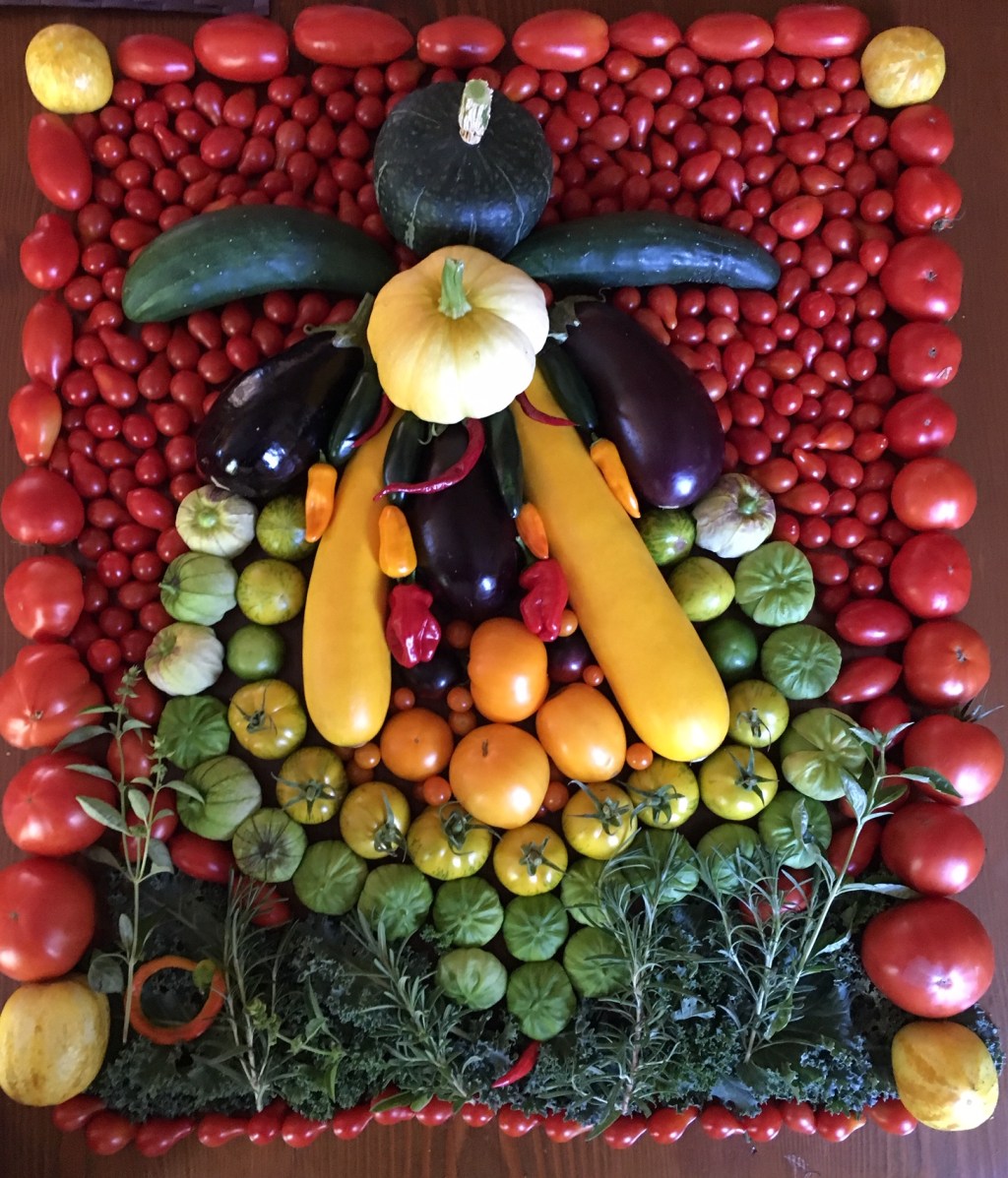
When life gives you an abundance of tomatoes, make art. Photo, and vegetable art, by Nancy Lee.
When my parents moved into their current seaside apartment, Dad gave up starting his own plants. Now I donate a plant or two, some of which I get the side-eye for (Green Zebra, Big Yellow, Indigo Cherry or Roma) as he prefers the basic round red tomatoes you can slice and put on a sandwich. He also buys a plant from the local nursery, since my garden tomatoes don’t seem to flourish as much in the ocean breeze as in the Pemby heat.
As I write this a week after planting, most of my seedlings are starting to pop up, and I expect we’ll have another bumper crop. I have a heavy heart though, as Dad isn’t doing well, and likely won’t be here to enjoy tomatoes this summer. I will always be thankful for all you taught me Dad, and every time I eat a warm tomato fresh from the vine, especially the round red ones, I will think of you.
“What’s this?” asked my clutter-resistant husband, observing the giant mason jar of oily plant matter on the counter.
“Ohh, it’s medicine! It’s called Balm of Gilead,” I explained.
“Oh. But what is it?”
“Cottonwood tips in oil.”
“Hmm. And what’s it good for treating?” he asked, in an impressively neutral manner, eyes scanning to the brand new bottle of olive oil next to the stove that was now suddenly, dramatically, near-empty.
I reamed off a list of benefits from Balm of Gilead, the old herbal remedy – that I’d just copied out carefully into my new Plant Allies notebook – using information I gleaned from Natalie Rousseau’s blog. The resinous buds are rich in salicin which your body converts to salicylic acid, the active ingredient in aspirin. Good for sore muscles, rheumatic conditions, simple wound healing, as an expectorant chest rub to treat a boggy spring chest cold. Bees also use the resin to protect their hives.
“Plus,” I enthused, “it’s helping me be more in tune with this place, with the seasons, and what’s outside our door.” He’s knows that “tuning in to the deeper rhythms” is kind of my jam right now, so, even though I could see his brain calculating the cost per millilitre of this little experiment, as compared to the cost per unit of a bottle of generic aspirin tablets, as weighed against the likelihood of me ever 1. completing this project and 2. treating anything with it, he nodded quietly, and put the jar back on the counter.
Since moving to Pemberton from the land of eucalypts and snow gums, I had acquired the habit of thinking that black cottonwood (Populus balsamifera ssp.) are kind of junk trees – the wood is too wet to burn well, the snowfall of the seeds in May wreak havoc on friends’ allergies, and the branches crash to the ground, making them kind of hazardous to live directly under under. Even though wonderful plant mentors like Evelyn Coggins,Dawn Johnson and Connie Sobchak have offered me other ways of thinking about cottonwood, thanks to their contributions to The Wellness Almanac – great bird habitat! good for erosion prevention! great shade in a sweltering Pemberton summer! a beautiful scent! a medicine! – those attributes felt like supplementary prizes, making up for basic deficiencies in character.
Then, in February, I joined Kera Willis and Guliz Unlu for an all-day workshop, offered through Mountain Horse School, “Lightning Seeds: Opening the Gateway of What’s Possible.” The hook had been set, when Kera asked:
What happens when we invite natural rhythms, cycles and energies to help us create the changes we wish to see, in both ourselves and the wider world?
What if we could get out of our own way?
What if we could remember ourselves into a state of embedded belonging within the natural world?
“In the same way a lightning strike may ignite an instant blaze or slow burn that smoulders for months, these awarenesses and experiences may take root eagerly within us, or they may take months (or even years!) to percolate down through our soil,” wrote Kera.
Befriending my tree neighbours has been an outcome with a long slow germination. First there was ignorance, curiosity, longing, admiration of those with more knowing. Years of that.
Lightning Seeds beneath a big old cottonwood. Photo courtesy Kera Willis/Guliz Unlu.Besa. Photo courtesy Kera Willis/Guliz Unlu
Then, facilitated by Kera and Guliz, a group of us were invited to stand in the crunching snow in the shelter of a cottonwood and consider: what is the smell of lighting? what is the sensation of green? what secret desire might we share with a horse, a tree, a non-verbal witness? How might be hold ourselves if we courted wonder, if we invited animals to approach us, instead of steam-rolling our way into the thick of things, without waiting, without listening, without receiving?
We ended our explorations at the mixing table, hands-on, pouring melted beeswax and cottonwood oil into containers, inhaling the aroma. Connecting with our senses. Relating.
A month later, on the first day of spring break, I found myself at the base of a massive cottonwood that grows beside the creek behind my house. I wouldn’t have known it was a cottonwood. But I was sniffing around the ground like a truffle pig, and when I found dropped branches with the tell-tale resinous buds (quick sniff for confirmation, month-old memory of sitting at Kera’s table still fresh), I gazed up, to locate the source. Oh. There she is. Wow. Your majesty. I couldn’t help but bow. Her crown was stunning. So different from the conical tops of the Douglas-fir and red cedar that have filled my winter days.
I picked the buds from winter-fallen branches, taking in the scent, and I kind of chatted away to the tree. First, I acknowledged her presence. Big step. I’ve walked by plenty of times, head in my own thoughts, brushing by like strangers. So we began the dance of becoming friends. I accepted her, without assessing her worthiness, just as I do when I become friends with someone. And I offered myself as a potential friend, and complimented her on her lovely qualities – like the fact that the branches she drops in winter storms are rich with buds that are full of medicine for spring coughs, muscle aches and pains, wound healing. I accepted the offering.
She’s a local here, (a coastal dweller, her kin are native to western North America) and the flood plain is her habitat – she can take root in pure sand or gravel along riverbanks, and absorbs water through her roots to help control flooding.
I’d brought the wee lad with me, beckoning him outside with the promise of a “creek patrol.” I had showed him Natalie’s blog post, with her step by step photo instructions of making a poplar salve, and explained what I was wanting to do. I pulled out my little jar of salve from February and we both inhaled it. He absorbed it all quietly, then ran to find a basket for me, and his raspberry picking container (yogurt container with string to hang around the neck) from the bottom drawer.
As I plucked the buds from fallen branches he hustled back and forth between the creek and mother tree pouring water on it as “an offering.” Also leaving branches against its trunk in case it felt compelled to be a Fort anytime soon. It has been almost a year since we last talked about the idea of offering thanks to the trees and living things around us – and maybe we owe it to Wild Kratts, but he’s bought into that idea completely.
(Cut to last night’s first fire, with deadfall we collected from the forest floor.
Dad: “trees are so awesome because they give us firewood!”
Boy: “No, trees are awesome because they give us oxygen. That’s more important than fire wood. If you don’t have oxygen, you can’t LIVE!”)
Making offering. Moss, dirt, creek water.
This is the seed I want to plant in his heart, I thought, as I was collecting buds from the forest floor : there is so much abundance here as long as we remember to acknowledge and give thanks and give something in return. This is the dawning that is, at last, awakening in me.
The smell of cottonwood resin, which I found kind of medicinal and stenchy in February, is now something I inhale with intention and gladness. (Especially given that my hands are covered with it, right now, after I opened the lid of my brewing jar to see how things were looking. Word to the wise: when they say, “only fill your jar 3/4 full, because the buds will swell”, they mean it. Oh grasshopper. So much to learn.)
Now that I have begun to enter into relationship with that great tree, I see her – from my window, out in the yard, walking the creek – all the time, and it doesn’t make sense to not nod in greeting. After all, we’re friends. Even if I never use the oil, medicinally, some “medicine” has been gained, in this, small glimpse at the significance of the phrase I have heard my Lil’wat neighbours use: all my relations.
Using a ratio of one part buds to 3 parts vegetable oil (I use olive oil), soak the buds for at least three weeks, stirring gently once a day to expose all bud surface areas to the solvent.
I use 500 ml canning jars and cover the tops with paper towel secured with canning rings. This prevents stuff from falling into your oil but also allows the moisture from the buds to escape. Keep the oil in a warm place (in the oven with the oven light on) to help gently dissolve the resins into the oil.
When your soaking is complete, allow the jars to sit at room temperature overnight then strain out the buds. Let the oil sit covered with a clean tea towel for another 24 hours at room temperature and then decant it into jars, cover tightly, label and store in a dark place.
You can apply it to sore spots as is or mix it with other infused oils and essential oils, add some melted beeswax and presto: an absolutely fabulous homemade version of “Tiger Balm”.
















 Traced Elements