Category: musings

  • Food Security in the Sea to Sky corridor is not just about farmland

    Food Security in the Sea to Sky corridor is not just about farmland

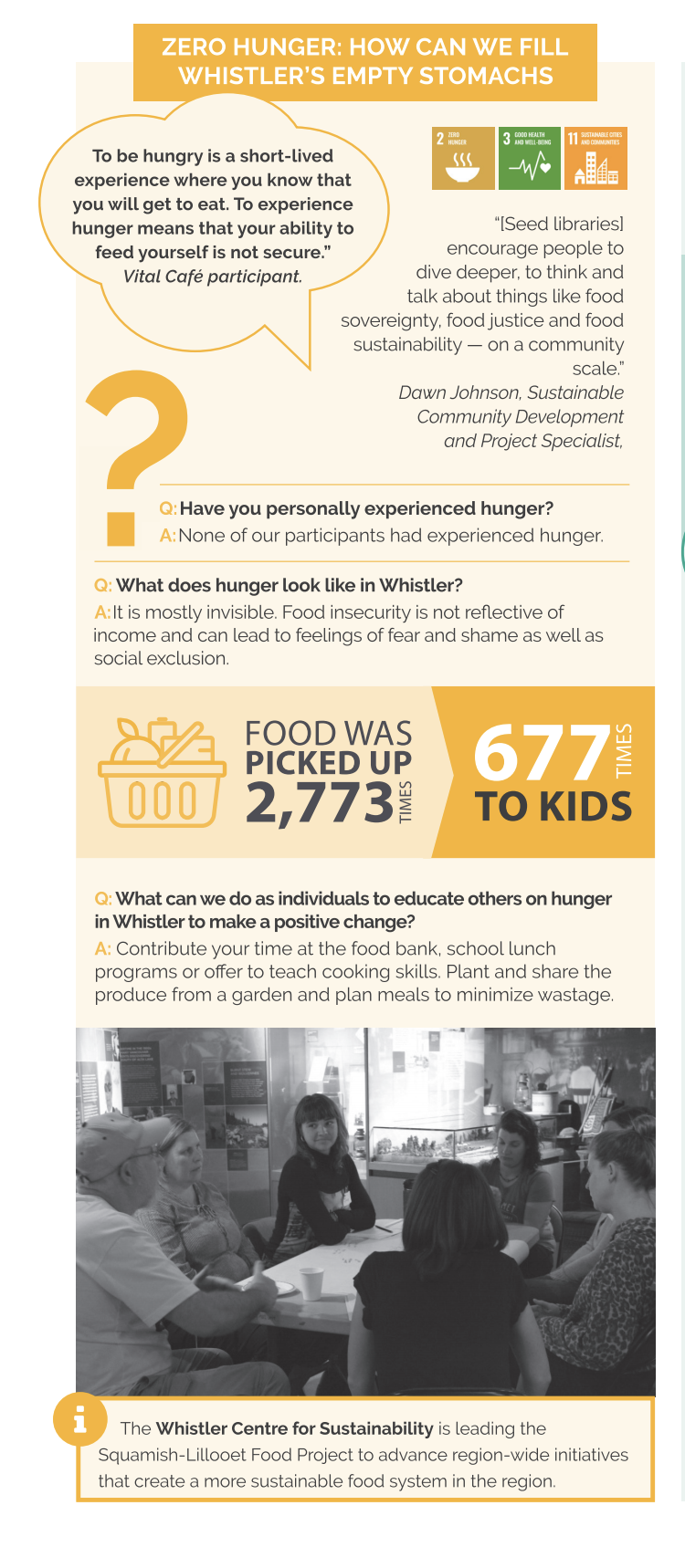
    Traced Elements contributor, change-agent and local gardening guru, Dawn Johnson spoke recently on food security in this podcast with host Kim Slater, for the Community Foundation of Whistler’s Vital Signs project.

    Listen to the conversation here.


    Global food security is not looking great, shared Dawn, so we need to look at building our resiliency, on a grassroots level, right now.

    Screen Shot 2020-03-05 at 11.54.31 AM

    Food security is a complex issue that touches the entire food system – it’s about a lot more than answering the question: “In our area do we have enough food to feed our people?” 

    It’s about people being able to access food, and in BC the biggest barrier for food security isn’t related to how much food we can grow here, or what the food cost is, but to how much income people have available to spend on food.

    Some great organizations are working on this through the corridor and that’s a strength – Helping Hands Society in Squamish, the Whistler Food Bank, the Pemberton Food Bank, Stewardship Pemberton Society. 

    1 in 6 children in BC belong to families who are concerned that they don’t feel they’re feeding them as weak as they could.

    Food production is getting more challenging for growers, with climate being more erratic.

    Food costs in BC have been increasing by 10% in the past 10 years, but over that time, our wages have only increased by 2.5%. People with lower incomes are spending so much more of their income on food. Someone on social assistance spends 44% of their income on food. There’s a clear correlation between income and food security. We need to support people to have better income in order to address food security.

    Screen Shot 2020-03-05 at 11.53.53 AM

  • Take Only What We Need

    Take Only What We Need

    It was 1989, I was in Grade 12.

    It was right around the time when David Suzuki started showing up outside the Nature of Things to talk of global warming (or climate change as it is now more accurately reported). Leaders around the world were taking steps toward protecting our environment – even H.W. Bush went on to ban CFCs to protect the ozone layer.

    I was lucky – or admittedly privileged – because I had access to a car. This privilege meant that I could choose a co-op work term outside of town limits. I got my first choice: an outdoor education centre for local elementary schools.

    I learned a lot about our world that year. My mentor was a devout naturalist, conservationist and environmentalist, but also, incredibly kind, engaging and completely immersed in the challenge of changing people’s minds.

    He propelled people to think zero waste. Especially when it came to food. Every day-long lesson included a pre-planned low-waste lunch for 30 people – and a lesson about compost.

    He had built the most interesting compost box that reminded me of an old tickle trunk replete with finished edges, a latch, and a key. He told stories of his months spent finding the perfect reclaimed materials.

    For maximum insulation (to keep the compost hot) during big snow months, each wall of the compost trunk was built from two pieces of metal that sandwiched several inches of yellow spray foam inside – I remember because he kept a small slice of the material pasted to one of his many super cool tri-fold science displays.

    When he lifted the lid of the compost trunk in the middle of winter, the steam from the compost billowed toward the little faces of wonder. The fanfare was inescapable. In truth, he even made shoveling compost fascinating.

    The interactive lesson ultimately left the kids yearning to contribute some of their lunch to the steaming heap. But once he realized their interest in throwing food away for the sake of contributing to a process, he quickly changed the game.

    He would first show the new kids the previous group’s food waste, and then turn the compost to bury yesterday’s remnants. Next, he challenged them to leave a pure rich black mostly untarnished soil canvas for the next group to admire and match. It was a certain lesson in take only what we need. Of course, a child’s food was exempt if they accidentally dropped it, so as not to ruin a perfectly good streak out of simple misfortune.

    This lunch hour entertainment was just a small segment of his bigger plan to change the world. I often think about that mentor and wonder if he feels nearly as cynical about the limited change as I do. That was 31 years ago.

    He made zero waste feel immensely important then, but now I’m just not sure where we’re at in this world.

    I’m conflicted about standing up – and acting as he acted. It’s hard to lead in the face of what seems like a stagnant world. But, to be fair…

    There are a million cool tools out there now to measure your impact and to guide you in prioritizing your changes. The most interesting tool I’ve found so far, is the CNN Green House Gas (GHG) emissions quiz.

    Take it right now, if you’re looking for a challenge: www.cnn.com/interactive/2019/04/specials/climate-change-solutions-quiz/

    *SPOILER ALERT*

    I reveal a section of the quiz in my words below.

    In the food portion of the quiz, you’re asked to drag the solutions to rank the ones you think would have the biggest effect on curbing climate change. As spoil-alerted, I’ve cheated and given you the solution here.

    1st – throw away less food – this would be similar to taking 511 million cars off the road.

    2nd – eat a plant-heavy diet – this would be similar to taking 479 million cars off the road

    3rd – cook over clean stoves – this would be similar to taking 115 million cars off the road

    4th – compost your waste – this would be similar to taking 16.5 million cars off the road

    Now, when you saw “cook over clean stoves”, it might have led you to think, “I can make a difference if I wipe my stove down every day… really?” Well, that’s not what they mean.

    They are talking about half the world population cooking over gas, wood-fired stoves, or even the deemed-deadly open fire pit.

    So, clean stoves might seem like a place for improvement, but throw less food away creates nearly 4.5 times an impact over reducing “dirty” stoves, and it amounts to no small numbers. Plus, reducing waste is a shocking 30 times better than simply composting.

    The unfortunate thing is that a lot of avoidable waste in North America comes down to excess. Sure, in some cases, this is food left in fields, retail stores and processors but according to Love Food Hate Waste Canada, 47% of avoidable food waste in Canada is from consumers tossing goods that they don’t eat.
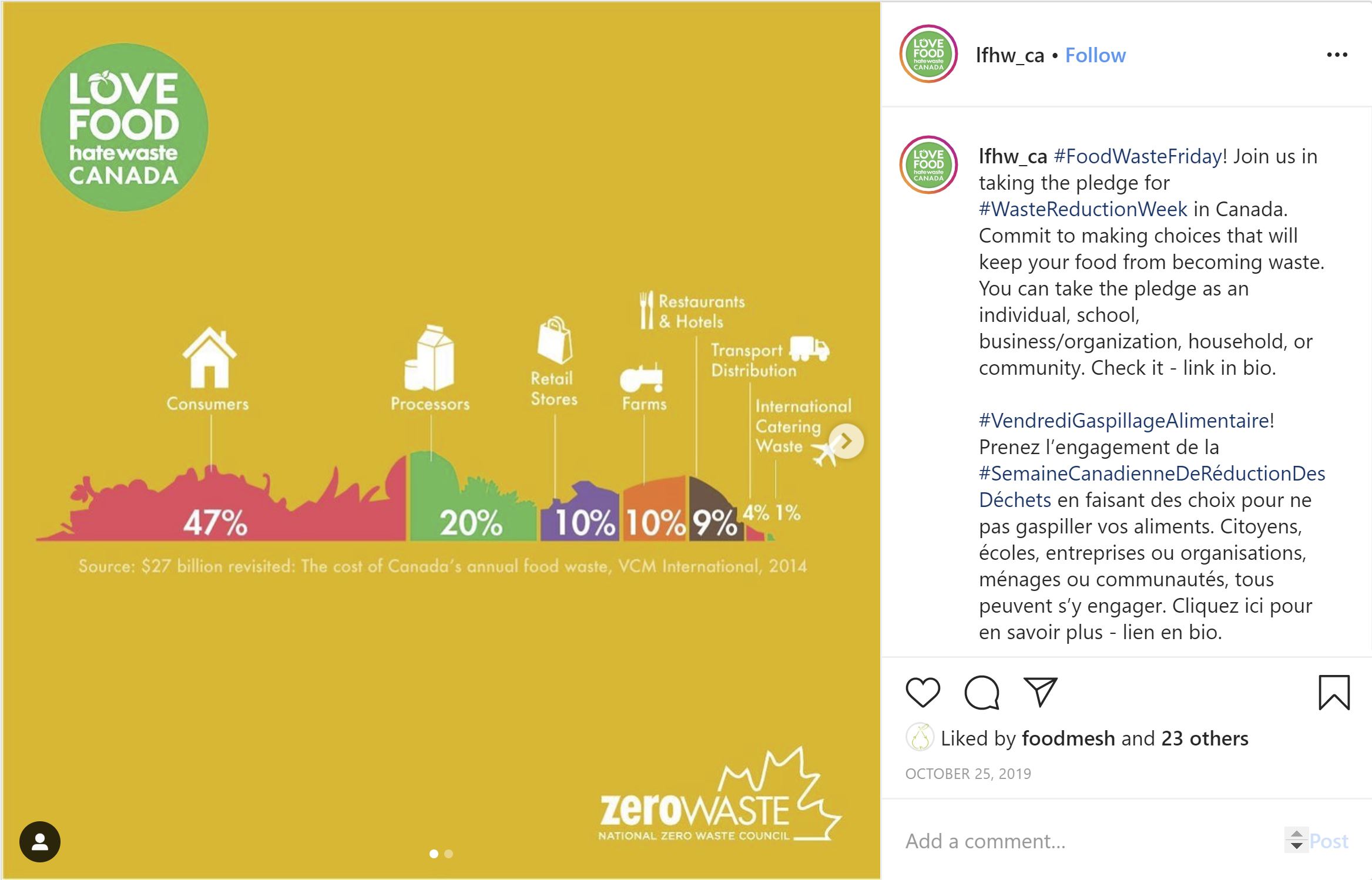
    47 percent avoidable

    I’m not saying that I’m not guilty. I am. Some weeks, our compost bin is 90% unavoidable food waste (e.g. corn husks, eggshells) and the very next it’s 90% avoidable food waste (e.g. moldy bread, risky rice). And sometimes it takes us 3 weeks to fill a bin and the next bin is full in 3 days.
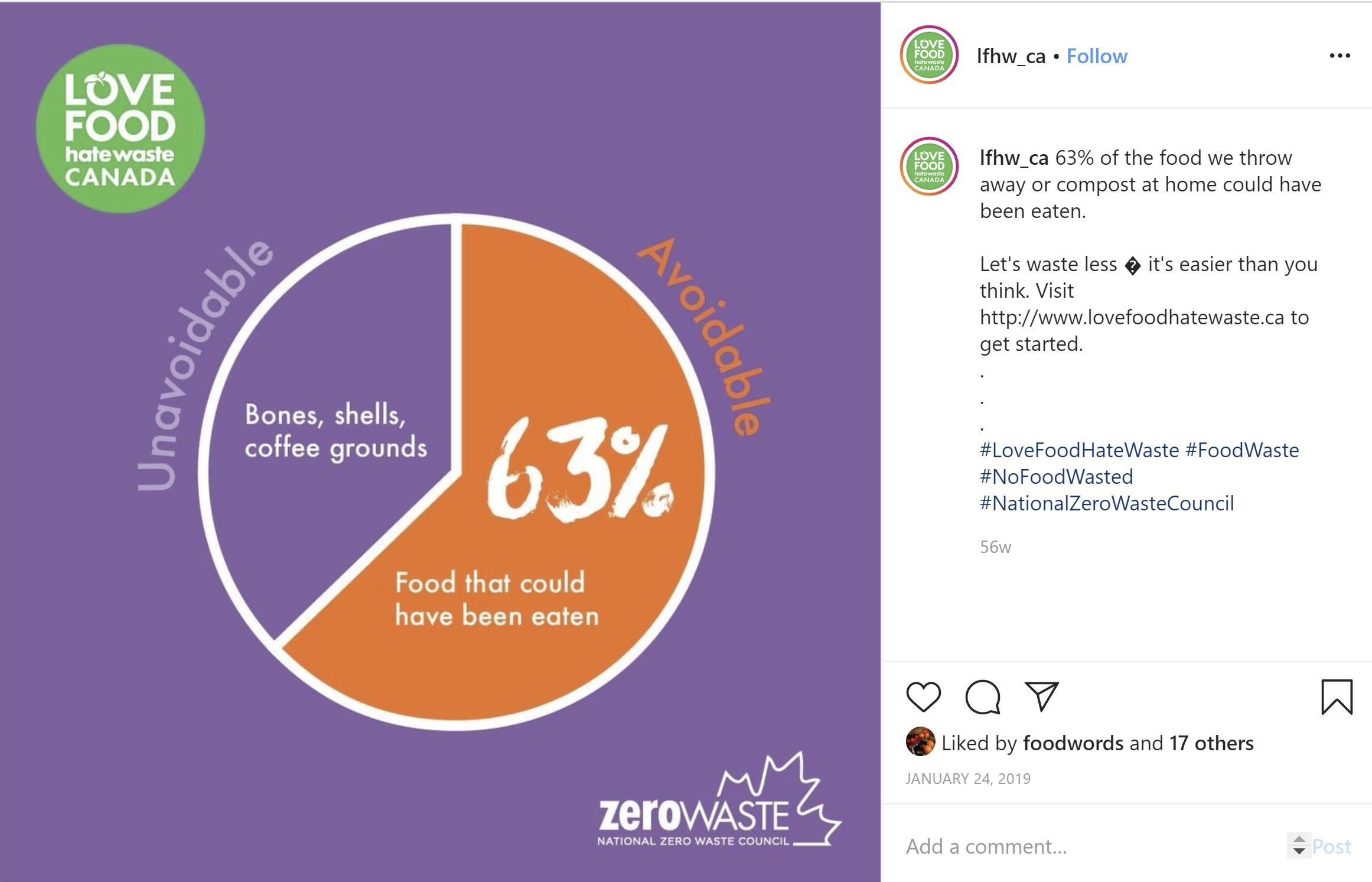
    Avoidable vs Unavoidable

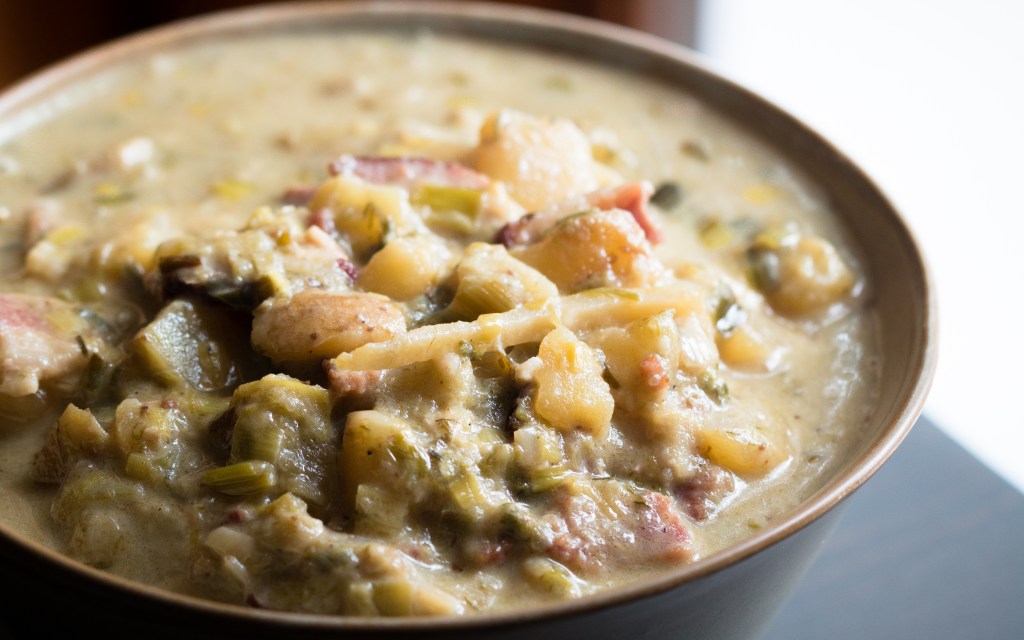
    Sure, life goes sideways sometimes and you’d do better to throw out those suspicious leftovers. But, for the most part, avoidable food waste stems from over purchasing — or not processing and storing the food when it’s on the edge of no return (e.g. freezing bread or making clean-out-the-fridge soups for the freezer).

    And, did you know the number of GHG emissions for avoidable food waste is completely dependent on the type of food that we waste. For example, processed foods, meats and cheeses have higher inputs, and therefore we are wasting more GHGs in the entire process of growing, processing, packaging and even cooking them. Not just the GHGs in getting them to our home, chilling them, driving the compost to centralized composting and the processing of that avoidable compost.

    Milk waste

    So, if you’re cutting the questionable edges off of your cheese every week, it’s time to cut back on cheese purchases.

    I hope this is a certain lesson, if not simply a lesson to myself, to take only what we need. After all we might just remove the equivalent of 511 million cars from the road. Wouldn’t that be cool!

    Writer and cook Lisa Severn is making a refrigerator soup this week.

  • Calgary Eats: A Cookbook Review

    Calgary Eats: A Cookbook Review

    A few weeks back, I ordered Calgary Eats because a number of signs told me to.

    My favourite food photographer & YouTuber Joanie Simon was working on Phoenix Cooks – another Figure 1 Publishing book.

    I’d seen the stunning cover and layout of Vancouver Eats. Given my aversion to shellfish, Calgary Eats, a farmland-locked town, made more sense to me.

    I’d been following Figure 1 publishing online for quiet some time, and I was dying to get my hands on any of their cookbooks.

    For this review, I wanted to give you, my cooking cohort, a good sense of what’s inside Calgary Eats. So I set up coloured sticky notes, blue for “must make” and yellow for “would love to make, but…” And the number of sticky notes were plenty.

    I was delighted when I opened the book. The layout is gorgeous. Each chef is honoured with a portrait of themselves, with some donning the traditional buttoned-down whites and others in street wear. And below that image, there is a paragraph or two on each chef’s philosophies or history. A born and bred in Calgary status gives reason to some recipes, while others are informed by a much different life, like work in a chemistry lab or life on a South Korean farm.

    In this documentation of Calgary’s current food scene, you will find, long-time chefs, famous chefs and popular-with-their-customers chefs. There are self taught chefs, highly trained chefs and highly trained train-the-trainer type chefs. I suppose if you’re heading east to Calgary you might take this as a restaurant guide to help you pick local must-tries – but a warning to weary, it ain’t light. It’s a hard cover.

    On my list of “would love to make, but…” dishes, you’ll find things like:

    “Eat to the Beet” Salad

    Without a doubt, I know this salad would taste divine with its beets prepared 3 ways. But, I’m left to wonder, who has time for an elaborate salad?

    Whiskey-Glazed Elk Ribs with Pickled Cucumber Salad

    This is something that our household would devour with its beautiful barbecue sauce made of molasses, ginger, apple cider vinegar and whiskey. But these will have to be beef or pork ribs. Elk just isn’t something we have access to.

    On my “must make” list of dishes, you’ll find things like:

    Tomato-Gin Jam

    When I saw this recipe my mouth began to water. It looks easy to make and features the brightness of sherry vinegar and the punchy evergreen-ness of gin. The recipe calls for pairing it with a Grilled Goat Cheese Sandwich, and I was excited to notice the image presents a brie style goat cheese. This is on my list for next year when cherry tomatoes are in their prime. I’ll try to remember to keep you updated.

    Ricotta-Stuffed Pasta with a Preserved Lemon-Thyme Butter Sauce

    While this recipe would take much longer than beets 3-ways, I’d be willing to go the distance with this one. The recipe comes in pieces: preserved lemon compound butter, homemade ricotta and a good-for-stuffing pasta dough. And it seems you could divvy up each piece of this recipe to create new recipes. In fact, I might even put the compound butter on toast.

    So far, I’ve made a few recipes.

    Falafel with Yogurt Dip

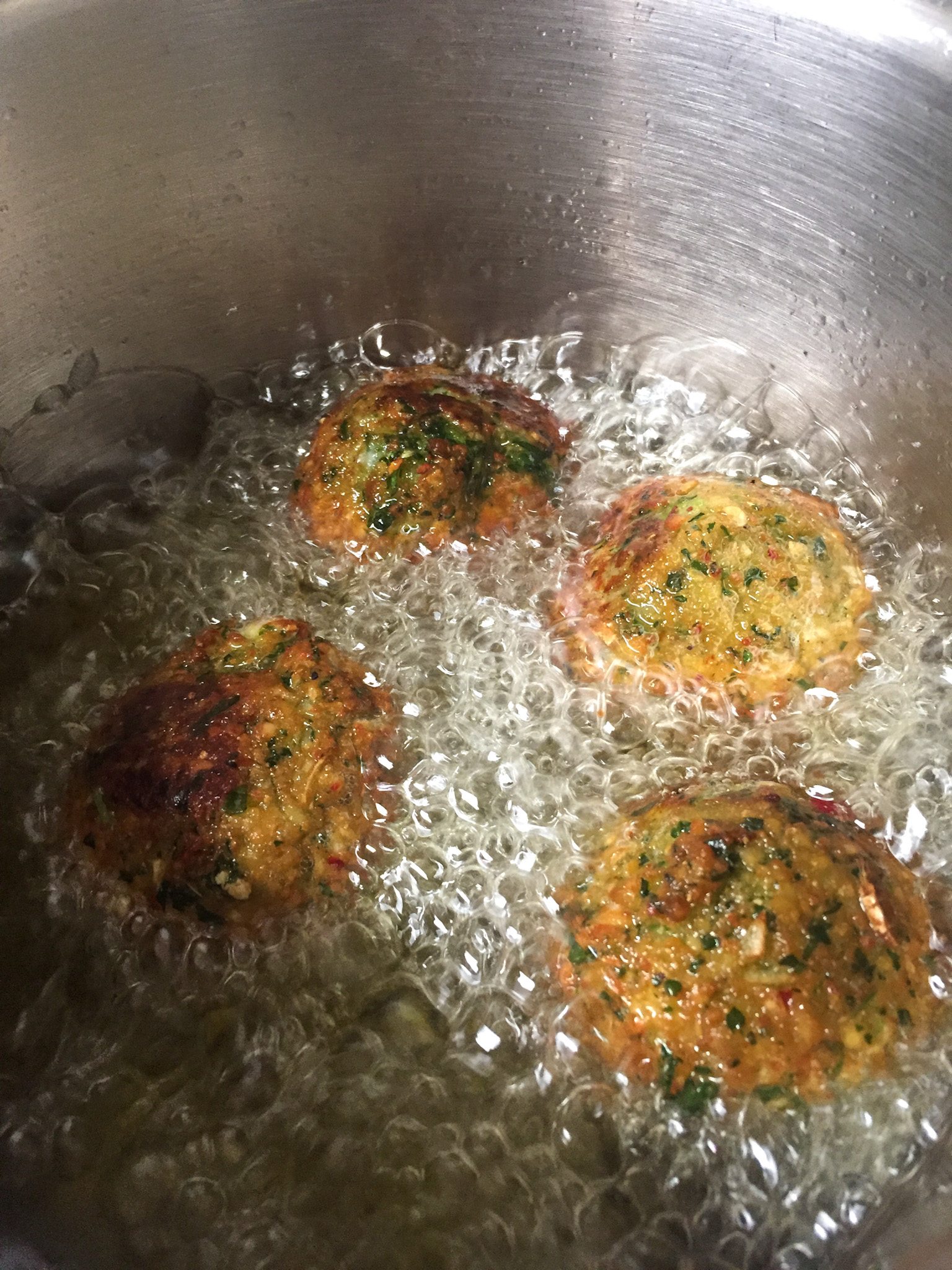
    I make falafel all the time. But I wing it from various internet recipes with tons of substitutions. Since making this recipe, I’ve sworn that I’m done with winging falafel. This recipe is exactly as promised: fluffy and flavourful falafel [that] will change your life. In fact, I dare you to make it.

    BTW: I’ll be doubling this recipe next time. UPDATE: I doubled the recipe and it was enough for leftovers after serving with the recipe below. I added a couple of images, so that you can see the falafel.

    Falafel frying

    Dukkah-Fried Cauliflower with Green Olive and Harissa Aioli

    I made this as a side dish to the falafel. I am also done with the internet on a recipe like this. This page is already filled with fingerprints, I can’t even image what it will look like 6 months from now – it’ll probably be the messiest page in the book, a true sign of a great recipe.

    BTW: This recipe contains a lot of steps, but if you have a spice grinder and food processor, you are all set. It’s quick and easy.

    Falafel cooked

    Although, Calgary is farmland-locked, there are a number of shellfish recipes in here. So, for seafood lovers, don’t despair, you have a may options with this cookbook (even a few that aren’t listed in the table of contents).

    My neighbour shared some frozen self-caught halibut with us, so I might try Roasted Halibut with Chilies, Dungeness Crab, Bean Ragout and Grapefruit sans crab, next.

    Happy cooking, friends.

  • Unearthed: why mushrooms are the perfect symbol for the Dark Season, and why it’s totally okay for you to do LESS this Christmas

    Unearthed: why mushrooms are the perfect symbol for the Dark Season, and why it’s totally okay for you to do LESS this Christmas

    Sometimes when I tell myself to breathe, it triggers panic – as if by drawing attention to this innate, unconscious, automatic action, breathing in and out suddenly becomes improbably difficult. Meditation, swimming laps, yoga… all these experiences often contain a few extremely panicked moments when I gasp, unable to catch a breath that has suddenly awakened to itself, like an animal realizing it is trapped and throwing itself at the bars of the cage.

    It’s weird. “Here, notice this amazing thing you do. Breathing. Doesn’t it calm you down?”

    “OMFG. I can’t get enough air. I’m going to die!”

    I feel a little bit the same about this time of year: Mild fluttery panic somewhere beneath the rib cage.

    Up until now, you may have known this feeling as par for the course, as the essence of Shoulder Season, these days of Waiting for the Snow to Seriously Fly. The panic flutter channels as a kind of scarcity fear that ripples onwards and onwards, as the days shorten, darken, flip over, tumbling towards the bottom of the year: will there be enough snow? Will I get enough work? Will I ski enough days to pay off my pass? HOW many days left before Christmas? Have I got something for everyone? Will there be enough food to make it a feast? Will I manage to get through all the social occasions without melting down? Do I have enough of a tribe that I won’t be lonely?

    This year, thanks to Pemberton-based teacher Natalie Rousseau and her online programs, 13 Moons and The Witches’ Year, I have gleaned a slightly broader perspective on this time of year. I see that these questions arise from a deeper and older one: Will the light return? Every season that saw pre-industrial people store their harvests away and duck into shelters to weather the winter and live alongside the literal fruits of their labours, the consequences of their actions over the course of the preceding year, was a time of reckoning and resolution. It was a season of living with the question, what have I done with my time? Was it good enough?

    Rousseau calls this time of year, a 52 day period that runs from Samhain or Halloween to Yule or Winter Solstice, The Dark Season.

    I’ve come to think of it as a time of Unearthing. Of things not wanting to stay in their boxes, getting untidy, becoming pushed forth. Stories. Emotions. Stuff we’ve tried to bury, all heaving up, surfacing in strange ways, asking to be noticed, remedied, attended to.

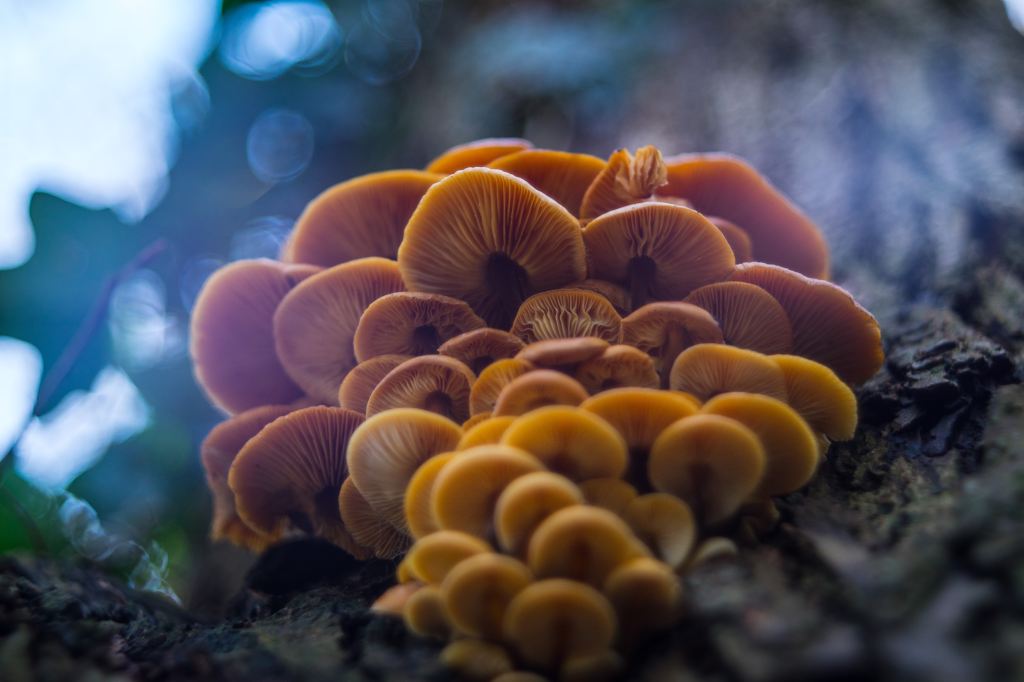
    For weeks, as I’ve learned of friends’ relationships breaking down and buried frictions waking up, tidied up the receipts of the year, seen stories I wrote months ago land in print, or stood in front of my pantry, outside the mushrooms were pushing themselves up with quiet force. Surfacing. Unearthing themselves. What did it all mean? Paul Stamets, the author of Mycelium Running, calls mushrooms “mycomagicians.” They are not afraid of endings, of decay. They are, in fact, “the grand recyclers of our planet, disassembling large organic molecules into simpler forms, which in turn nourish other members of the ecological community. Fungi are the interface organisms between life and death.”

    Kind of the perfect symbol for the Dark Season. Beneath our feet, beneath this surface of frosty soil that will soon be buried even deeper by metres of snow, (may it be so), vast intelligent complex fungal networks underscore and entangle everything. This is the season in which we glean a tiny window into that, as the fruit of all that complexity pops up. The question was never, “have I done enough?” But: Have We? Collectively, not just as little tribes, but in concert with the life force surging invisibly beneath our feet, all around us.

    Much is being unearthed, heaving to the surface, in these days, of unraveling climate systems. Much of our collective behaviour is nestling in for the winter, and demanding a reckoning. Sure makes you want to run for the nearest all-inclusive beach resort. Or beg the gods for the happy oblivion of a powder day.

    But before the flight, or fight – before the adrenalized response – the Wheel of the Year, the cycles of history, have built in this beautiful terrifying moment, this awful awe-full moment, a chance to be still and consider: have we done enough? Where have we fallen short? If we are gifted a new breath and a new day and another season together, what shall we plant in this beautiful living Earth? What shall we bequeath the future?

    “For most of our human evolution on this planet this was a season of rest,” says Rousseau. “And our souls still crave it. Important work happens in the catacombs and secret chambers of our soul during this season, even if our culture doesn’t recognize it.”

    Her prescription is generous, if not counter-intuitive to what we tend to expect of ourselves at this time of year: slow down. And notice.

    The year breathes its long sigh, and here, at the bottom of the breath, there is a pause. It’s okay if it makes you panic, a little. Notice that too. (Eventually it settles, I swear.) The pause is the most beautiful gift of the year, the echo of the harvest, in which all possibility hovers, looking for a place, a body, a community in which to land, to come into being once the light returns.

    This post first ran as a column in Pique newsmagazine, Velocity Project: how to slow the f*&k down and still achieve optimum productivity and life happiness. 

  • Processing Vacation on Order for 2020

    Processing Vacation on Order for 2020

    I think we ran out of frozen peaches in April 2019. Corn even sooner.

    May was tough. That transition between enjoying the previous seasons’ harvest and the new harvest felt like eons. Even though, I do tend to allow myself asparagus from California and Mexico in the spring, it’s not the same as eating local fruits and vegetables grown by people you know and care about.

    By June, I had promised that I would work even harder to preserve 2019’s delectables and make it past May 2020 in good shape.

    I started by canning pickled garlic scapes. It was fast and easy, but I’m a canning chicken, so it was stressful to try a new recipe. A resulting complication of my chicken-ness was that I decided to eat all the scapes before they would have a chance to go off – it was likely a completely unnecessary panic and the reason we have none in storage.

    When late July arrived, I was certain I was ready for the pending influx of goods. But food started coming at me faster than ever — it was a very good growing season after all.

    Peaches, blueberries, green beans, corn and tomatoes.

    As we carried case after case through the door, I started to feel overwhelmed. Do work that pays the bills or process food became a dilemma that I just didn’t have an answer to.

    And, while I figure therocketnarcissist and I processed more than 300 pounds of food, all of it grown by people we know, I’m feeling like our freezer stockpile is dwindling. We’ve had a busy and mentally draining fall, so the freezer has been raided close to every day.

    Spaghetti sauce gone, tomato curries gone, corn stash cut by half.

    This year, I spent extra time looking for a good freezer salsa. I made about 60 cups mild or hot salsa – but the supply is shrinking – and fast. It’s just so damn good. And is incredibly useful as a base for a Mexican themed fried rice.

    All this makes me think that rather than take a biking vacation, an August 2020 processing vacation might be in order. I’m curious, have you ever taken a processing vacation?

    Of note, I can’t even begin to imagine what it would have been like to farm with such abundance coming our way this past summer. Kudos to all the farmers that worked hard to keep up and feed us the best fruits and vegetables that the Squamish-Lillooet region has to offer.

    In case tomatoes are a plenty next year too, here’s a link to the salsa recipe.

  • Wonder really is a survival skill

    Wonder really is a survival skill

    I read this quote as I skimmed The Curious Nature Guide: Explore the Natural Wonders All Around You, by Clare Walker Leslie and it stuck with me. It’s at the heart of what I hope my kids get out of school… and life, really. 

    But maybe it’s for just that reason–how busy we are and distracted and disconnected we are–that wonder really is a survival skill. It might be the thing that reminds of what really matters, and of the greater systems that our lives are completely dependent on. It might be the thing that helps us build an emotional connection–an intimacy–with our surroundings that, in turn, would make us want to do anything we can to protect them. ~ H. Emerson Blake in the foreword to Wonder and Other Survival Skills

    It’s wonder that helped me survive the last year, too.

    Exactly a year ago, I quit my decade-long secure government job, launched myself into self-employment and simultaneously became really ill. I left work and needed my first of many blood transfusions a few weeks later. I’d been struggling with severe anemia for years and my condition had eluded a definitive diagnosis.  

    By February I received a lymphoma diagnosis and in March I was receiving life-giving and equally barbaric chemo and antibody treatments. 

    I worked in bed for the winter–one of the luxuries of self-employment– and in the spring began a slower version of gardening. 

    My year was all about survival, but also wonder. Wonder at the drugs that saved me, and the plants they were originally derived from. Wonder at my family, who I would love to live with for a long time, and would grieve so much to leave. Wonder at how sick I had become, how I’d fallen between cracks in the medical system, how I looked “fine” and pale when I was barely floating through my days with dangerously low hemoglobin– the oxygen carrying component of blood.

    And there was wonder at how ridiculously great and high I felt the first time I received a blood transfusion. Wonder at how my fingers and lips turned pink–how I was reanimated with blood. Wonder that strangers literally gave me the gift of life. Wonder at the cost of my drugs–$10,000 for two days’ treatment every month. Wonder that our health care system paid for them. Wonder at how much care was missing in treatment, and also wonder at how much care was offered from lab techs, ER and chemo nurses, and angel friends.

    HomeGrown

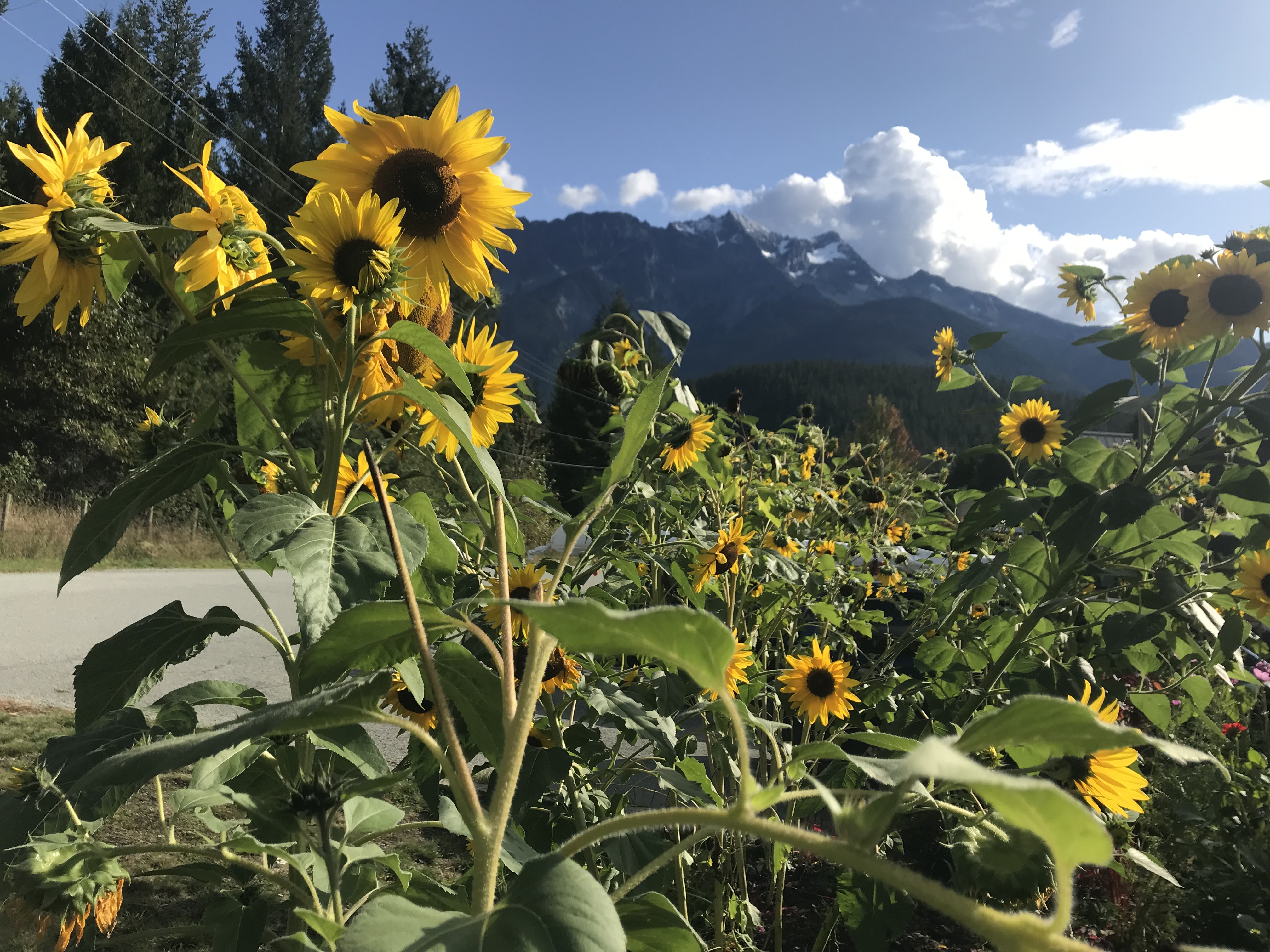
    And my wonder garden grew in spite of me, and continued to offer gifts: the wonder of harvesting garlic in between summer rain storms, celebrating epic and endless dahlia blooms, eating broccoli and peas for days, and enjoying such a bounty of tomatoes that the last batch sat ripening in egg cartons on my counter even last week. Wonder at the soil–lush, rich, buttery and black that I’ve been building in my garden for the last few years. Wonder at the sunflowers that provided so many blooms abuzz with bees and then food for weeks to so many different kinds of birds. 

    SunflowerJungle

    I also experienced confusion and wonder at the suffering of so many people I saw in treatment and in our community. I felt the sadness of illness and accidents and the losses of loved ones.  Wonder at the gaping holes and the ways we try to soothe and patch them.

    I had a few days after my second round of treatment when I entered a black pit of despair. Nothing made sense. I saw no reason for my suffering or anyone’s suffering and no reason for living or sickness or treatment for it. But then tulips bloomed and that made sense. It a crack of enchantment. A thread of wonder. A signal that something small was still right in the world. 

    It’s foggy and cold today. There are cracked chestnuts, a precarious pile of birch logs, a dull axe, a frosty table and a barbeque abandoned for the season on our deck. The leaves are still hanging onto the overhanging chestnut tree, now wilted and brown. I’ve been harvesting the last scrubby bits of kale, chard, parsley, chives and celery leaves sticking out of straw mulch, as I surrender to buying greens over the winter.

    Mel'sHappyPlace

    I survived the year, along with my garden, along with my kids, along with my partner, along with my dog, along with my work, thanks, in part, to the balm of wonder.

  • A question of growth

    A question of growth

    I read somewhere that your garden is a reflection of your personality.

    My garden has gone off-script.

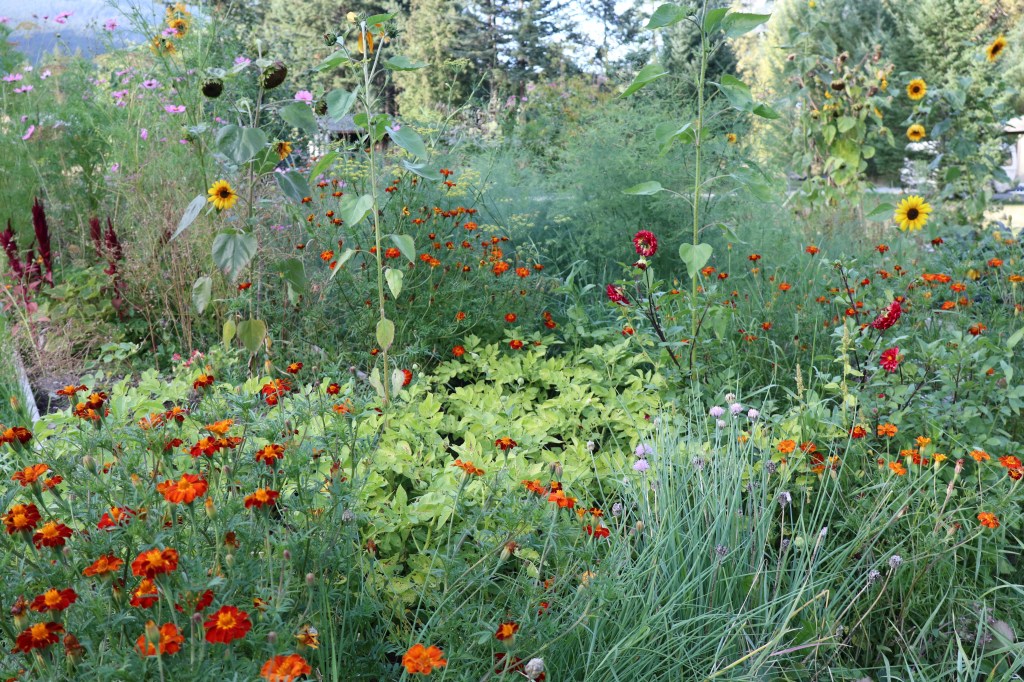
    It is wild, unkempt, rangy, not willing to commit to any one single thing beyond the belief that there are mysterious forces at play in the natural world to which I surrender control. It’s utterly prolific and not in any way linear or orderly. It’s an offering to pollinators.  On any given day there are so many different bees and wasps and butterflies and dragonflies that the air shimmers and vibrates. It’s been full of weeds since I discovered some of those weeds (hello purslane! hello plaintain!) are edible or medicinal, so opted to welcome them, taste them, invite their medicine in, instead of battling them. Battles are so rarely won.

    IMG_1536

    Last season, and all the seasons before in which I’ve engaged in this yearly experiment, all I could see were the flaws, the lack of order, the ample evidence that if a pioneer-era family were depending on my skills, we’d all be dead, that my late grandmother would shake her head at how few life skills I have.

    food_velocity1-1-8f860220b7694f98

    Today, with the cosmos, dill-weed, sunflowers towering over me, I am okay with this. I have realized that self-sufficiency isn’t as worth cultivating as community is. And each year in the garden, I have learned that I am part of a community of pollinators, of birds, of earthworms, of black bears that I shoo away, but who still win their fair share, of beet-green-nibbling deer (*shakes fist at air*), of rats (*insert unpublishable curses and shudders*), of friends who gift seedlings and starts and neighbours with abundant fruit trees and a willingness to share. This eco-system membership card comes with no assurances or written guarantees, and yet, I suspect I am more resilient in this club, than if I had invested my loosely focussed energy in a stockpile of canned goods, some guns, and a padlocked larder full of canned peaches.

    IMG_1608

    My garden is wildly prolific right now. And in a few months, everything will be dead.

    This is the way of the wheel of life. This is what is true, as much as I might like to push it away: every possibility grows out of an ending. And the endings keep coming around.

    The other night when racing-brain-syndrome pushed sleep away, I reached for a book of Mary Oliver poems. Turned on the light and read until my mind settled into the hammock of Oliver’s words, and I slipped back to sleep with these lines resting on my chest:

    “Every year we have been witness to it: how the world descends into a rich mash, in order that it may resume. And therefore who would cry out to the petals on the ground to stay, knowing as we must, how the vivacity of what was is married to the vitality of what will be? I don’t say it’s easy, but what else will do if the love one claims to have for the world be true?”

    Mary Oliver Lines Written in the Days of Growing Darkness

    Growth has been the mantra of this diseased era, the Anthropocene. Globalised growth detached from place or relationship. Growth, unrestrained by upper limit or sense of limitation or restraint. Growth without end.

    The folly.

    When Kate Raworth, the British economist and author of Doughnut Economics,  remodeled the way we look at the economy, she drew, instead of a pyramid, or a supply chain or a spreadsheet or the colonization of other planets, a doughnut.

    doughnut

    The first thing she did was draw a big circle around the outside of the economy and say: this is the limit, defined by the Earth’s life-supporting capacity. And here in the centre is a hole, and it represents everyone we’re failing. The challenge is to live within the doughnut – the space between the limits of social justice and planetary systems.

    When you trade growth-without-end for doughnuts and gardens and the wheel of the seasons, you have the courage to accept limits, to be still, to acknowledge endings and loss and the discomfort of never really nailing it. You also give yourself permission to start over, again and again, to risk it on relationships, to know the wealth of a table loaded with good food and air vibrating with bees, the difference between a larder and a hoard.

    IMG_1524
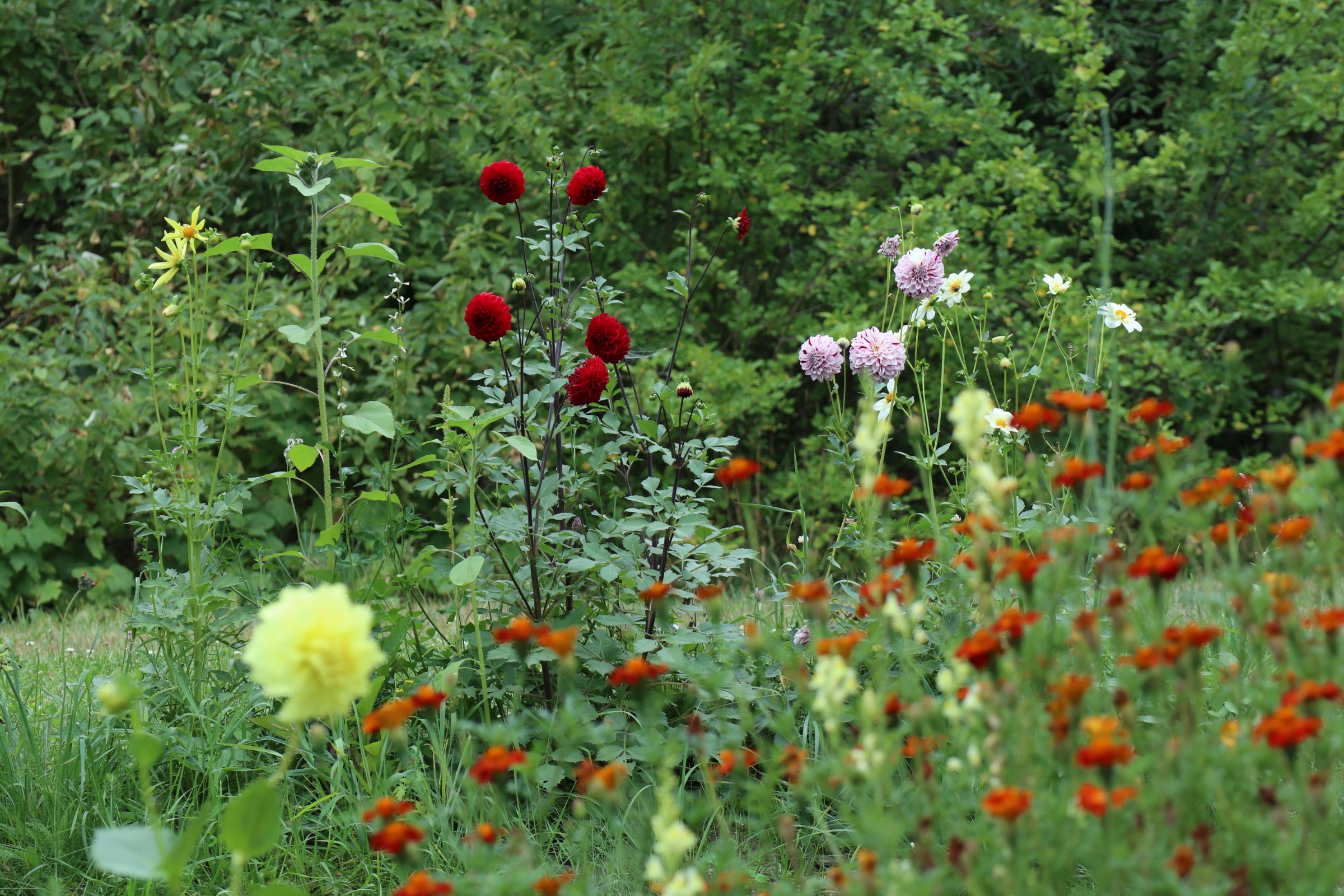
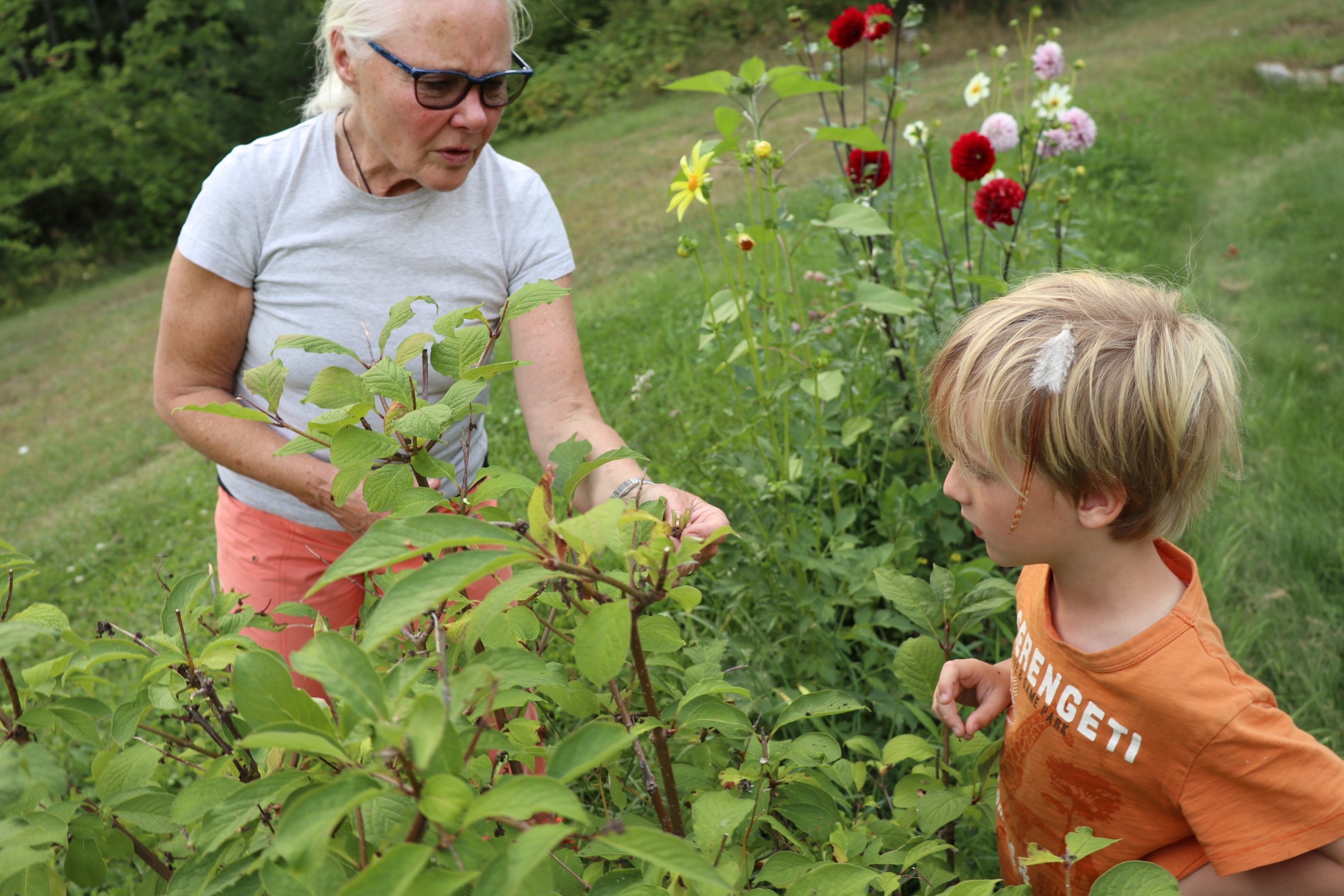
    my gardening guru, whose garden is most definitely not a shit-show, sharing her cuttings, dahlias and wisdom with the next gen

    I pile clippings and weeds and garden detritus onto a bed, and prep another for next year’s garlic, and steadfastly ignore those that are gone past the point of no return. I offer the birds free-rein at the sunflowers. I collect coriander seeds that dried on the stalk when I let the cilantro go to flower, and the surfaces and corners of the house fill up with brown paper bags full of drying seed pods and flower heads – reminders that this will all come around again, and this full lush vivacious moment is a good time to think about what to offer to ensure the vitality of what will be.


  • My top 10 best farming and gardening practices

    My top 10 best farming and gardening practices

    10 . BE PASSIONATE. Always remember despite the ups and downs you are doing something that you LOVE to do. If you don’t, the negative results will come through in your product and others will ingest that. Treat it as a lifestyle not a job. If you’re in it for the money, you’ve chosen the wrong profession. Expect joy, disappointments, successes and failures.

    9. SET REASONABLE/ ACHIEVABLE  GOALS.   It’s so easy to take on too much and to try to grow everything. Just because you planted a ton of seedlings and tilled a huge garden bed, doesn’t mean you can maintain it. Focus on what you do best and keep it simple.  Create a niche  and take baby steps.

    8. TREAT PLANTS LIKE DEPENDENTS. Plants are living entities that require food, water, shelter, love and care and then there’s the point where they mature and you have to let go by harvesting, letting  go to seed, and waking up one fall morning to see that a frost has killed off all your annuals. Just like kids, adolescents and adults, it’s all a cycle of life.

    7 . SAVE SEEDS. There’s often a single plant that out-performs the rest. Let it go to seed, collect and store for the following year. That’s exactly how humans created an agrarian society and prospered. Food security and biodiversity are now more important than ever.

    6. KEEP YOUR OVERHEAD LOW. There are all sorts of fancy gadgets, expensive planters, machines and tools you will need once a year. Plants couldn’t care less. Borrow, rent, fix and improvise.  Be efficient and devise ways to save time. Most farms go bankrupt, don’t be a statistic.

    5. KEEP IT NATURAL.  Look to nature for inspiration and explore organic, biodynamic and permaculture methods. Remember that a garden is part of the ecology. Consider birds, insects and animals are all part of the cycle. Mother Nature is the wisest gardener of all.

    4. BUILD YOUR SOIL. Even if your planting in fertile ground, plants take nutrients and once you harvest you’ve created a deficit. Build and maintain a compost pile, rotate your crops, plant cover crops and nitrogen fixing legumes.Test your soil occasionally and amend as needed. Good soil is the foundation of a healthy and bountiful garden.

    3. KEEP LEARNING. Its literally impossible to know it all. Read, experiment, discuss, research and always be interested in finding out more. Teach others as that re-inforces your own knowledge.

    2. SHARE.  Whether it’s your experiences, successes, failures or the final tasty product.  That’s what creates a healthy garden and farm community. Use the barter system. Someone else has too much or too little compared to you so trading balances things out.

    1. MULCH. This simple technique will save you hours of weeding and watering, while preventing erosion , encouraging beneficial micro-organisms, creating humus and  future soil.

  • The Do Over

    The Do Over

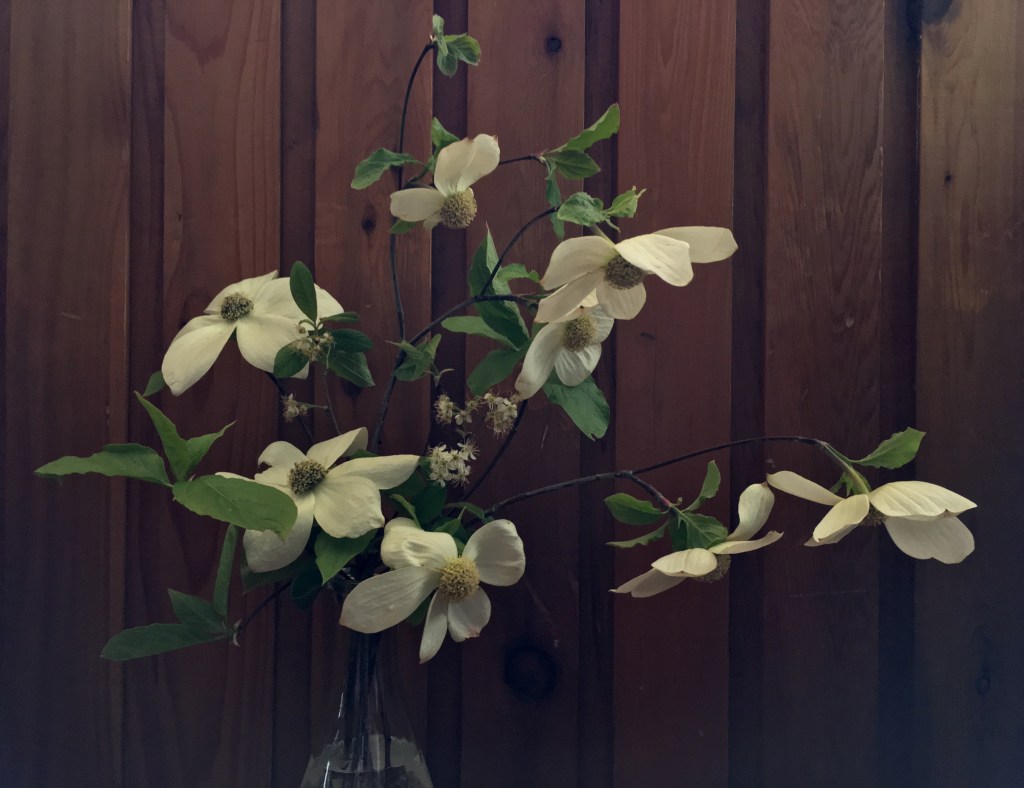
    My favorite strip in the ol’ daily commute is in full bloom: Dogwood Row aka the false flat of Nairn Falls. When this magical time finally happens I know spring has officially arrived. These native beauties symbolizes this time of the year perfectly: rebirth and resurrection, durability and reliability, strength and resilience.

    So, life has felt a little backwards lately and I’ve been dormant like the bulbs I planted in the fall: slowly growing in hibernation, slowly surfacing to flower. While the green glow of spring delivers a healthy dose of new beginnings there will always be things that don’t survive the winter.

    The beauty is, you can always replant.

    Spring offers up a chance to do over everything from last year… literally, start fresh, change the pattern and do it better. Prune away the dead to promote new growth, leaving some things the same (they’re called perennials for a reason) and don’t forget to tend to your evergreens as they are there for you every season.

    IMG_8308

    It’s not always as simple as it seems: a large puzzle with small pieces. Sometimes you’re rewarded beyond expectation in an instant and sometimes patience is a virtue.

    But by saying yes to growing new things and experimenting with new varieties we can create a new palette to work with.

    There is little risk in gardening if you’re willing to fail and get your hands dirty. Notable and new to my garden this year are Jerusalem artichokes, shiso and fennel (which will actually be nowhere near my garden because it’s friends with no one). Oh, and way more flowers! Because why not? And pollination is key to life. Other plants are bound to sneak their way in too.


    When supported by a cast of usual suspects: beets, carrots, cabbage, cauliflower, cucumber, tomatoes, brussel sprouts, squash, cantaloupe, onions, garlic, strawberries, raspberries, blueberries, peppers, peas, beans, all the herbs, chard, radish, daikon, celery, kale, romaine, greens, kohlrabi, leeks etc, one can be nourished and flourish quite well.

    There is a good chance I’ve already said this but I’m just going to keep saying it:

    Grow what you love, try new things, revisit old favourites and savour the process.


  • A Farmer’s Ode to the Cabbage

    A Farmer’s Ode to the Cabbage

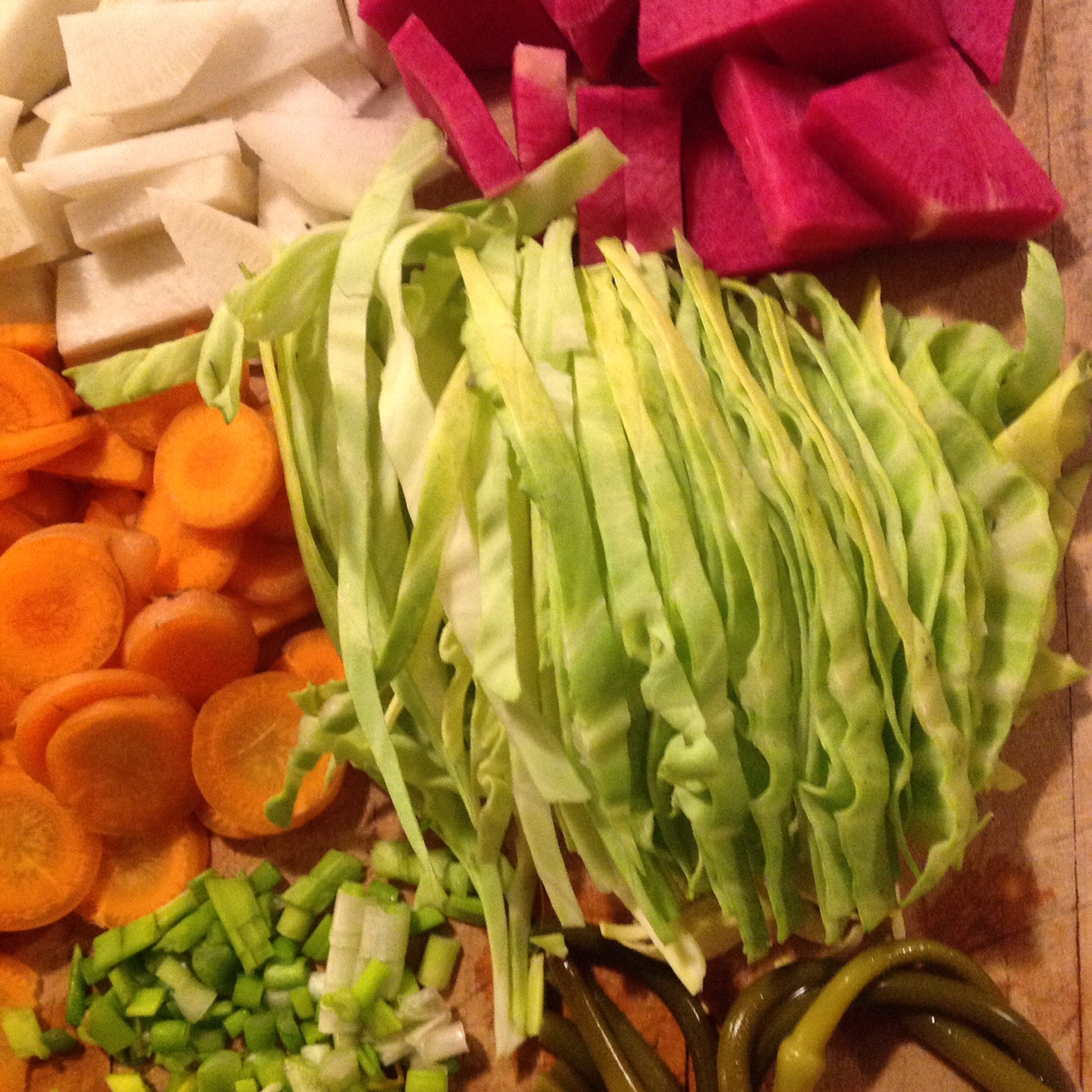
    IMG_3737
    Prepping dinner in late February.  Note “green onions”, carefully harvested from some storage onions that decided it was time to start sprouting.

    Note:  This post the product of a farmer itching for the snow to melt, of Lisa Richardson’s gentle encouragement to not be ashamed by my lack of posts since last May, and also a plug for a new page on our farm website that talks about VEGETABLES.

    It tries to answer questions like “What’s this?” or “How can I cook that?” or “Can I freeze these?” that I get asked from time to time as a CSA farmer.  I also admit to eating cabbage for breakfast on a regular basis.  Feel free to have a look if you’d like.  http://fourbeatfarm.ca/news/

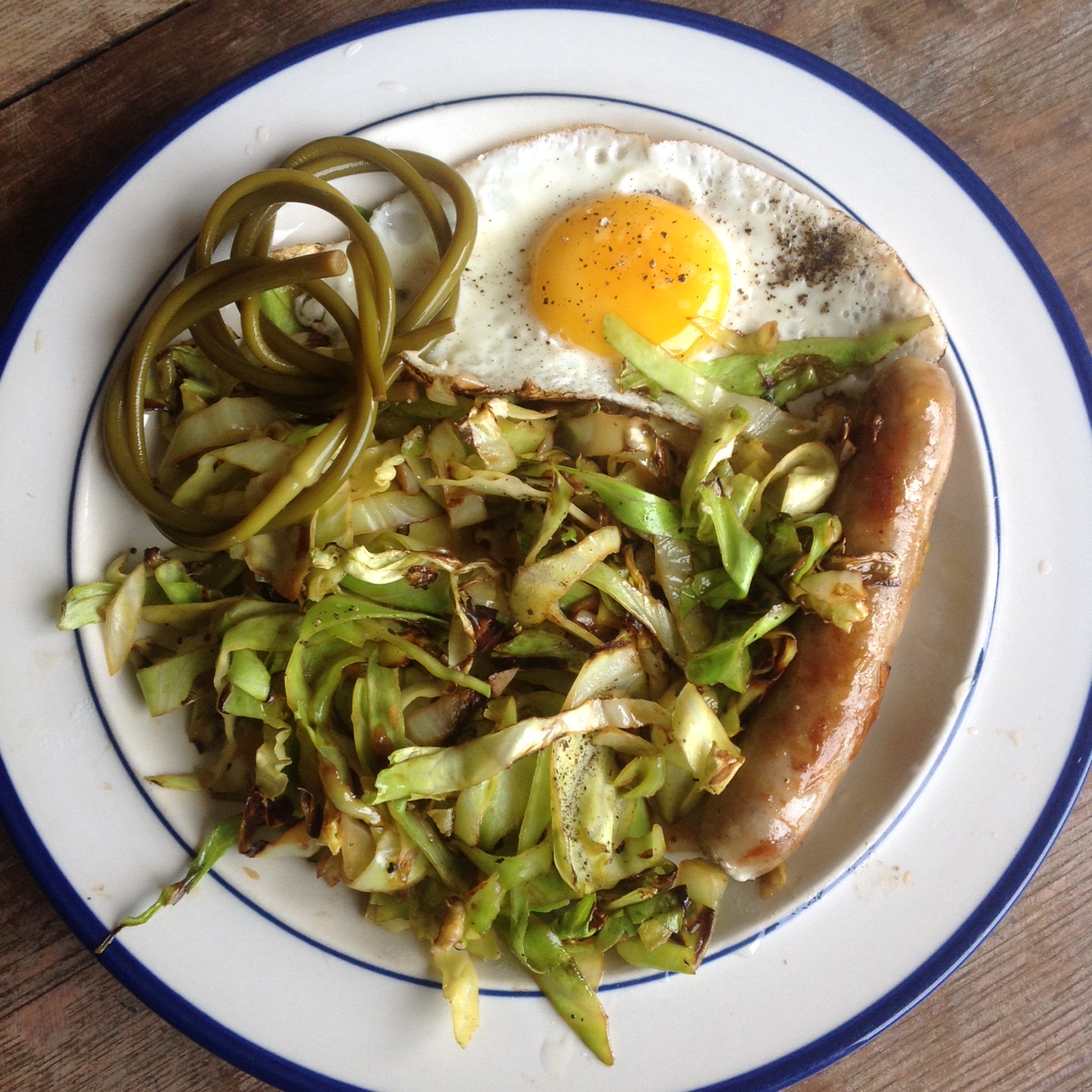
    IMG_3723.JPG
    A breakfast option for the Pemberton loca-vore.  Includes an average portion of cabbage, pickled garlic scapes from last summer, and some additions from friends at Spray Creek Ranch.

    Now, to ramble…

    Last week, the spare room where I store my personal supply of winter produce had its annual conversion into a spring “grow room” for this year’s seedlings.  Anyone else have ~8000 allium roommates right now?  No?  Oh well, just me then.  We will be co-habitating for a few weeks until the seedling greenhouse gets set-up and temperatures climb a bit.

    Because of this new roommate situation that I have come to believe is normal, I spent a few hours picking through the bins of winter storage vegetables.  Since I haven’t been to the produce section of the grocery store all winter, there wasn’t much left.  I salvaged the best to cram into the fridge and imminent meals, and that about took care of it.  Let me begin by saying that, despite my attention to detail when it comes to processing and storing vegetables in the main farming season (destined for CSA and farmers market shoppers), my winter set-up for personal use is…well…simple.  Or lacking.  Depends how you look at it. Let’s call it “rustic” to be nice.

    It’s a small room in the house.  It’s separated off and slightly insulated by a blanket over the doorway to avoid wasting woodstove heat from the hallway.  The window stays cracked open to let in cold air and keep the bins of veggies comfy.  When we get a cold snap, I make the crack smaller.  When we get a mid-winter thaw, I open the window a bit more.  If I remember.

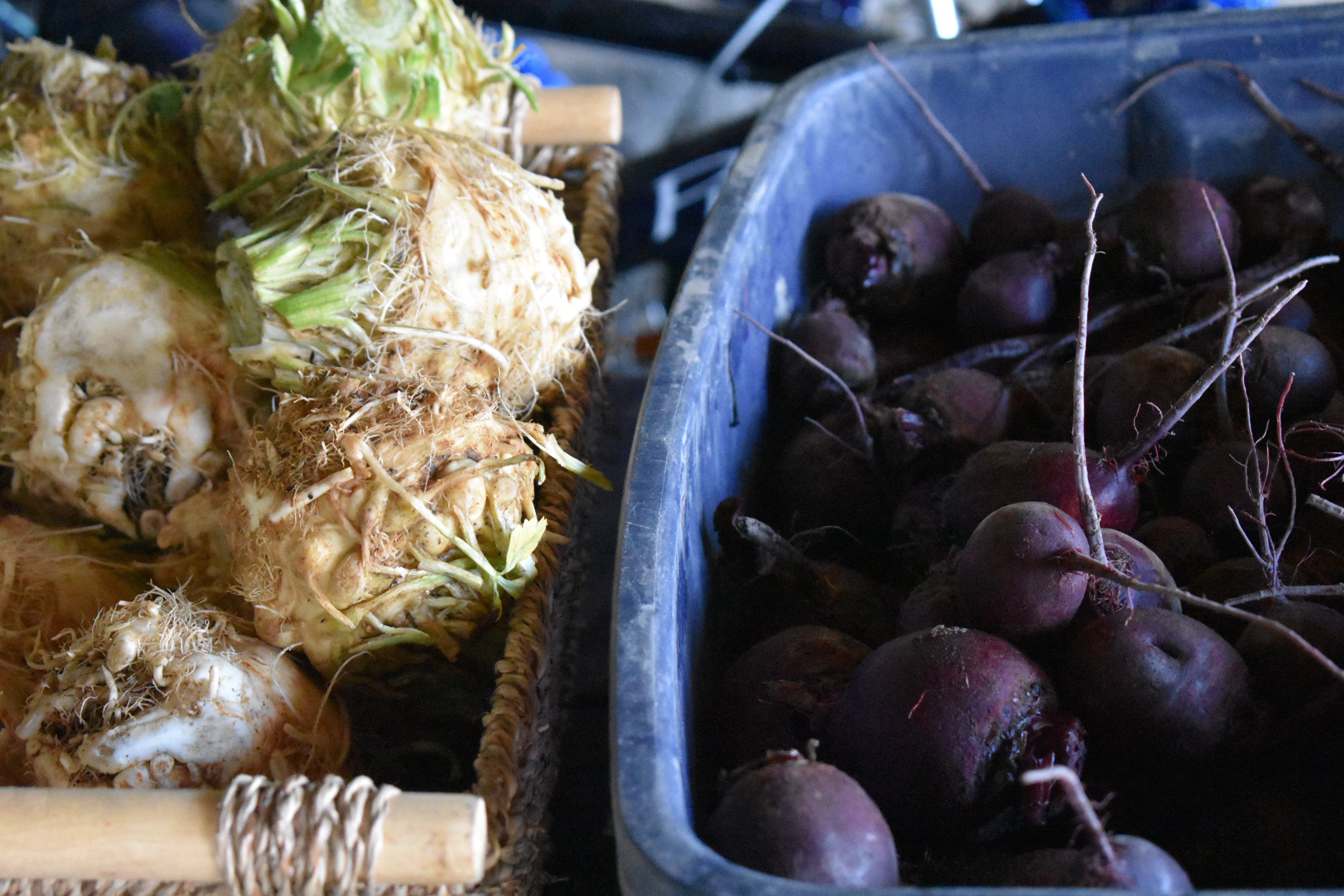
    This has successfully kept beets, carrots, turnips, watermelon radishes, cabbages, rutabaga, celery root, kohlrabi potatoes and onions in fine shape until at least early March.  There are some sprouty bits.  Occasionally one will turn to mush and cause a small amount of slime to touch those around it.  These now-slimey neighbours get rinsed off and put in soup or fed to the draft horses (onions exempt, they go direct to compost and bypass the horse trough).

    DSC_0529
    Winter storage veggies at their prime for fall CSA members.  Mine do not look like this now.

    By March, things kept in such un-fancy conditions tend to look a little tired.  Rutabagas are starting to sprout wild hairstyles.  Celery roots are looking a bit shrivelled.  But the cabbages?  Oh, the cabbages.  They’re like a breath of fresh air.  Dozens of them have been sitting in a Rubbermaid bin in the house for nearly four months and they are still crunchy, juicy, sweet, and willing to join in to up the freshness factor of just about any meal.

    If you’re looking for ideas about vegetables, recipes, or curious about how this particular farmer likes to eat her veggies year-round, I’d welcome you to check out a resource we are growing to help our friends and CSA members with the age-old question “What is this?”  (holds up a cabbage shaped like a cone, an alien-resembling kohlrabi, or a yellow beet).

    http://fourbeatfarm.ca/news/

    Seriously though, those cabbages.  They’re just what a farmer needs this time of year.

    IMG_3751
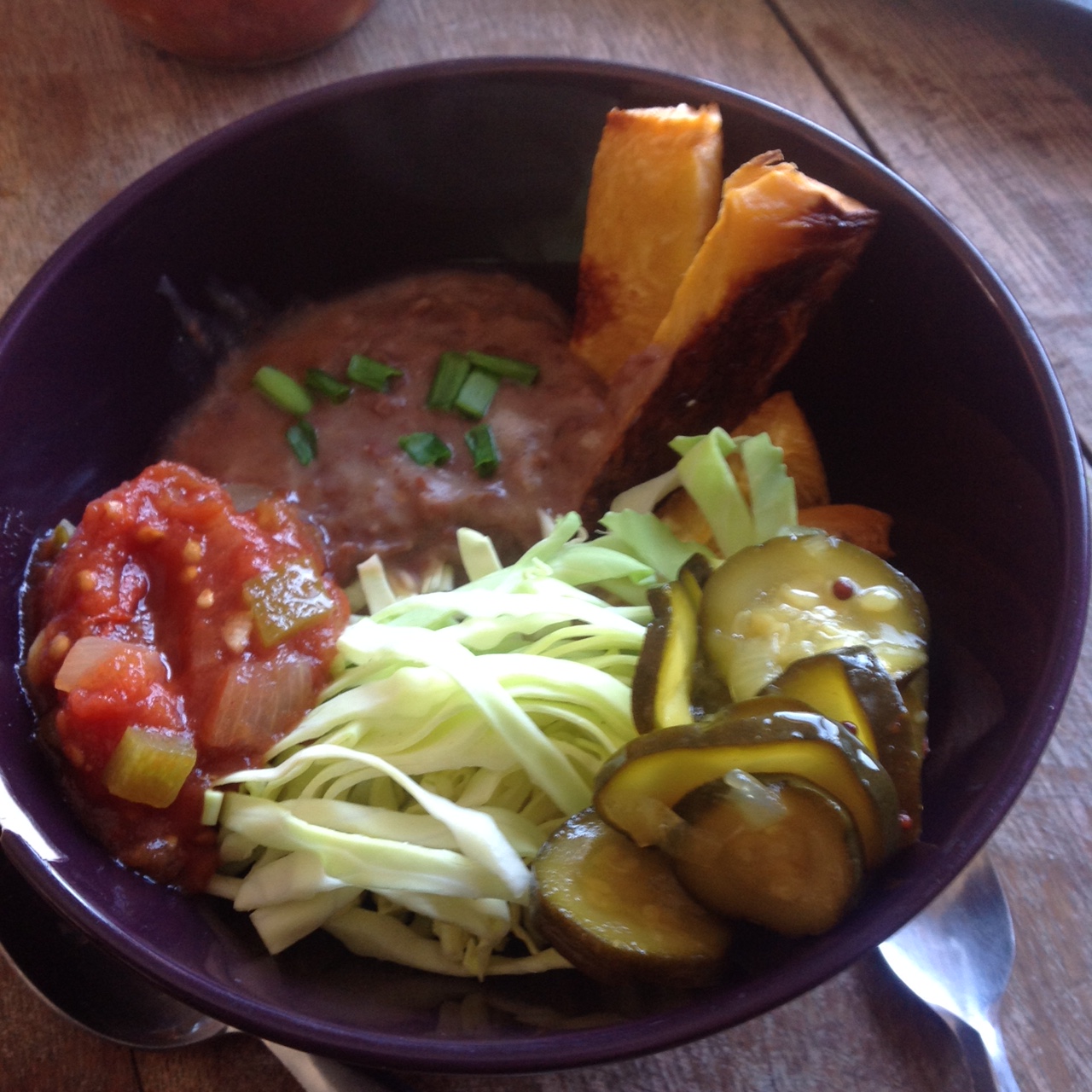
    A friend of mine called this a “Winter Glory Bowl”.  Not sure if she was joking or not, but we’ll take it.  Canned salsa from our summer tomatoes, refried beans from some shelling beans we grew and froze, sweet curry zucchini pickles, and roasted rutabaga.  I don’t know if they’ll be serving it at any restaurants anytime soon, but it was a perfect sweet & sour,  hearty & crunchy combination of food from the farm for a post-snowshoe lunch.