Category: musings

  • Farming for Change: introducing writer-farmer John Alpaugh

    Farming for Change: introducing writer-farmer John Alpaugh

    As a child I avoided eating vegetables as if they were toxic. The final scene of many dinners was a stand off between my parents and I over an untouched side of raw carrots. Eventually they surrendered, not willing to torture me or forego sleep to prove a nutritional point. For many years after these victories I avoided vegetables altogether. It is a strange turn of events that today I am working on a small organic vegetable farm.

    Like many people in British Columbia, I am not from here. I have the indistinct story of being from Ontario. After graduating from Dalhousie University last spring, I moved back home to work for my parents and save some money. When the fall came around, I built a bed in my car and set off for a road trip through the United States. I had a ski pass and a National Parks pass, and I was going to see the natural splendour that is so celebrated.

    As I approached the end of my trip and the bottom of my bank account in the early spring of 2020, I had to decide what to do next. Rounding the turn and heading north from California, BC appeared to be a natural conclusion. In the past, I had spent my summers working on golf courses. I wanted to continue working outside, this time putting my efforts towards work I felt was part of a solution, environmentally and physically. I went on GoodWork.ca, a jobsite connecting eco-minded workers with sustainable work.

    One posting caught my eye: Laughing Crow Organics in Pemberton, working as a farmhand. I emailed Andrew Budgell and Kerry McCann, the owners and operators of the farm. A few days later, I had a Skype interview from the visitor’s centre in Yosemite Valley, and they offered me the job. I started looking for a place to live that would also be financially sustainable.

    Kerry McCann, Laughing Crow Organics’ co-owner: “People need to eat.”

    But soon after this, the world entered a pandemic, and suddenly every plan was on shaky foundation. No one had any idea what would be possible a week, a month, a year from now. I was in Lake Louise staying with a friend from home when COVID hit, planning to continue west. He had been laid off from his job at the hotel, and we both decided to head east and wait things out.

    I got in touch with Kerry. Would there still be a job for me? People still need to eat, she said. “We will be growing plants and feeding people and we will need your help.” A month after my first cross country drive, I turned around and headed back west.

    Immediately I knew I had made the right decision. Even in May, at the height of COVID confusion, Pemberton was a pocket of normalcy. The next month, when Black Lives Matter demonstrations erupted across North America, the events of the world felt even further away. In both instances, I wondered what part I played in it all. What is my responsibility?

    Farming was an attempt to answer this question. Our food systems are some of the most oppressive systems we have, environmentally, socially and economically. Like many others in the capitalist mindset, optimization has been focused on profits, rather than quality. As a result, large scale agriculture has sterilized the growing process in an effort to grow more food for less money. These costs do not evaporate. They are passed down the line onto the health, the environment, the worker, and the consumer.

    When I was on the road, I did most of my shopping at Walmart. It was the cheapest option, and they let me sleep in the parking lot, so it was convenient, but I knew there was something wrong with this decision. By spending my money on cheaper food, I was inevitably supporting practices I do not believe in. Cheaper food is cheaper because it exploits workers, and abuses the environment.

    Eating is a completely different experience on the farm, one I am very fortunate to have. The work is fair, the pay is honest, and our relationship with the land is respectful. We give it what it needs, and it repays in kind.

    Unfortunately, there is an observed problem of access to good food, one that can often be drawn on lines of racial inequality. Buying organic is often out of reach, and Walmart or McDonald’s appears to be the best or only option. But when I go to market, and see what our customers get for $30, in quality and quantity, I cannot believe I shopped at Walmart. If I were a customer, which I have no doubt I will be in the future if I am not still an employee, I would be proud to be supporting better practices, and to be receiving a better product.

    To be an activist does not necessarily mean you must be on the front lines with a picket sign. It can be as simple as making more informed choices at the grocery store. By supporting local, small scale sustainable agriculture, we are supporting the health of the earth, the health of ourselves, and the health of society. It is an act of liberation and solidarity. The more we choose to buy from farmers who are doing the right thing, the more this opportunity will be presented to others.

    I needed to find myself on a farm before I truly grasped this, but awareness is free to anyone, and it is often the most powerful thing we can do.
  • An end to the fits and starts

    An end to the fits and starts

    I recently, well 33 days ago, signed up for a creative workshop that asks that you ship something every day for 100 days.

    It’s hard. I am a “do it when the muse shows up” creative. And, this course teaches you to accept creativity as a career — a position where people expect you to show up and do the work.

    Prompts remind you that people who have creative careers submit below average work as often as they submit just good enough work — and rarely submit creative genius. And the prompts posit that hope, that plane-is-delayed-painstaking-waiting-hope, for the creative genius to show up is what keeps us comfortably sitting in that mythical land of writer’s block.

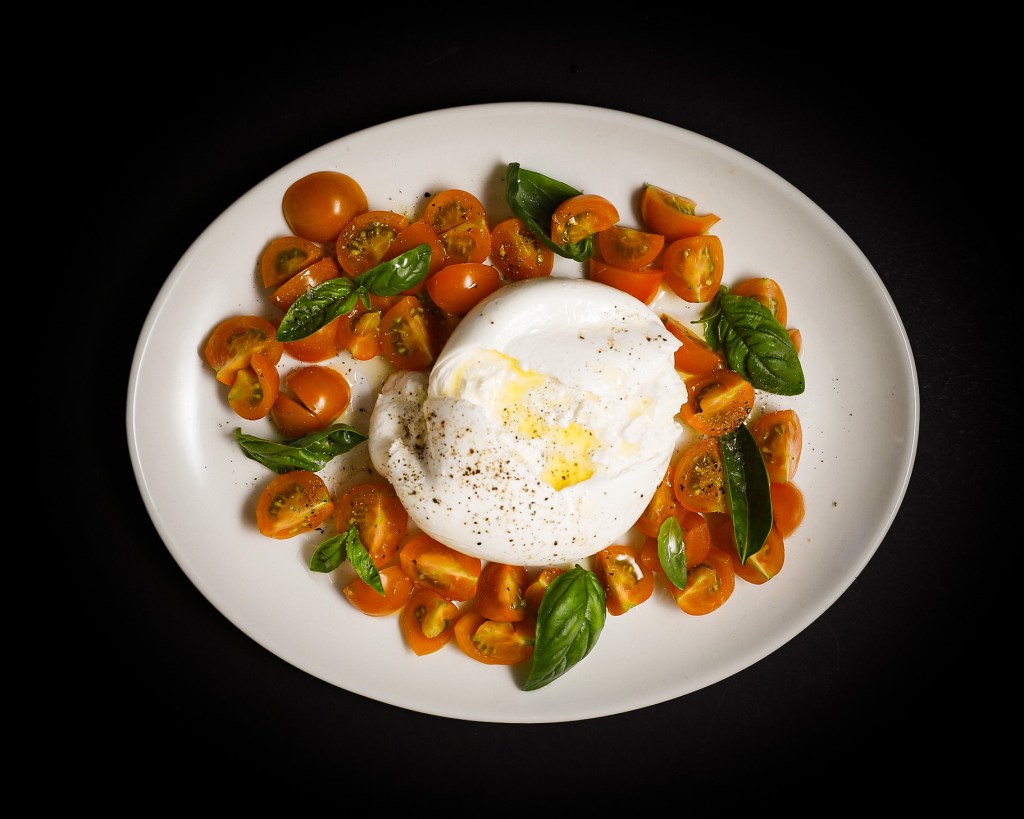
    I don’t write a story every day, but I am sure to make an observation. Sometimes that observation includes photography (like the cherry toms and burrata). My genre is creative non-fiction. Here is a compilation of a few of those observations (your thoughts in the comments will be welcomed).


    I pull open the door, without recalling that it’s weighted with jams, chutneys and quickles. The energy of my pull slams the door against the wall with a big thud and subsequent clinking of jars.

    It’s Friday. Farmers’ Market day.

    And fridge cleaning day.

    For the millionth time, I check the temperature, and it’s still set to as low as it will go. I shake my fist, as if my landlord above our suite can see me. This fridge, from brand new, has always been too cold for fragile veggies. I sigh.

    I yell over the jammy beat of the Grateful Dead, “Honey. I think a refrigerator risotto will clean this out! Can you do the prep while I go to market?”

    “Fennel. Carrots. Zucchini. Fava beans. Garlic. Patty Pans. Beets. Roasted…on risotto. How’s that sound?”

    “Honey…?”


    I rip open the bag. The dirt-laden pickling cucumbers present a distinct earthy smell that reminds me that it’s August. I carefully weigh six and a half pounds. A wave forms as I dump the cucumbers into an enormous bowl full of crystal-clear water.

    I’m drenched. I go to the drying rack and grab a fresh shirt.

    I return to the kitchen to find emerald green oblongs floating in murky brown water. I’m mindful, as I drain the swamp – so as not to need another shirt. I guide the spray hose and jiggle the bowl full of soon-to-be pickles. The force of the tap dislodges most of the brown wilted blossoms from which these little delights grew.

    As the stainless basin once again fills to the brim, the brown feathery blobs float to the top – and with an odd sense of wonder I think about how long it’s been since the flowers perished.


    The room fills with light, and a small rumble follows.

    My husband snores next to me. I consider waking him to watch the light show, and help calm my nerves. Instead I watch alone, and wonder how many forest fires we can expect from this rainless lightning storm.

    I can’t sleep, so I open social media and people are posting images and videos of massive lightning rods that reach to the horizon. Exactly the kind of lightning that starts forest fires, I muse. It takes time, but I fall asleep.

    I hadn’t checked the wildfire map even once this summer. It’s been cool and rainier than the last 5 years. The moment I hear the espresso machine, I grab my phone. More than 100 new fires dot the map with the likelihood of more remote fires still to be identified.

    Ten new fires in the farming town just 30 kms north are noted. Each fire, according to the elevation lines, is well into the mountains, and still, it is nerve wracking.

    Rain is expected in the days to come, but I hope farming can continue with the suppressive smoke that is reportedly filling the valley floor. I think about how they will maintain their livelihoods should another state of emergency befall the farmers’ work of feeding their communities. The prospects look grim.


    Thanks for reading. Is there something you’ve been doing in fits and starts that could use a 100 day push? Share in the comments below – I’d love to know.

    ~Lisa Severn

  • The Honour stands of Birken

    The Honour stands of Birken

    The Birken / D’Arcy corridor is unique to the Sea to Sky Region. Unhurried, non-commercial, safe, sparsely populated and relatively unchanged throughout the nearly 3 decades I’ve lived here. In fact, there is less here now than there was back then. Its downtown consists of an old resort at Gates Lake, open for a few months, and a telephone booth (there is no cell service). The Demographic is also interesting. It’s more affordable and out of the way and therefore attracts misfits, homesteaders, bohemians, red necks, hermits, draft dodgers, hippie relics, adventurers and commuters to Whistler. There are few, if any, employment opportunities, therefore those who stick it out have become resourceful, artistic and enterprising.

    The climate is more arid, being on the cusp of the interior and in the rain shadow of the Coast Mountains. Spring comes early.  We see more sunny days, warm days, and cool evenings. Its narrow valley is  protected by steep mountains. It is not a  conventional farming community like Pemberton with acres of flat tillable ground. It is however a great hobby gardening area. Its soils are well drained, mineral rich and ideally suited for fruits, berries, and garlic. Its waters are crisp and clean. I don’t believe a single person uses pesticides. It is sought after for bee keepers for this reason as well as its natural bio-diversity.

    PIC 5 plant sale

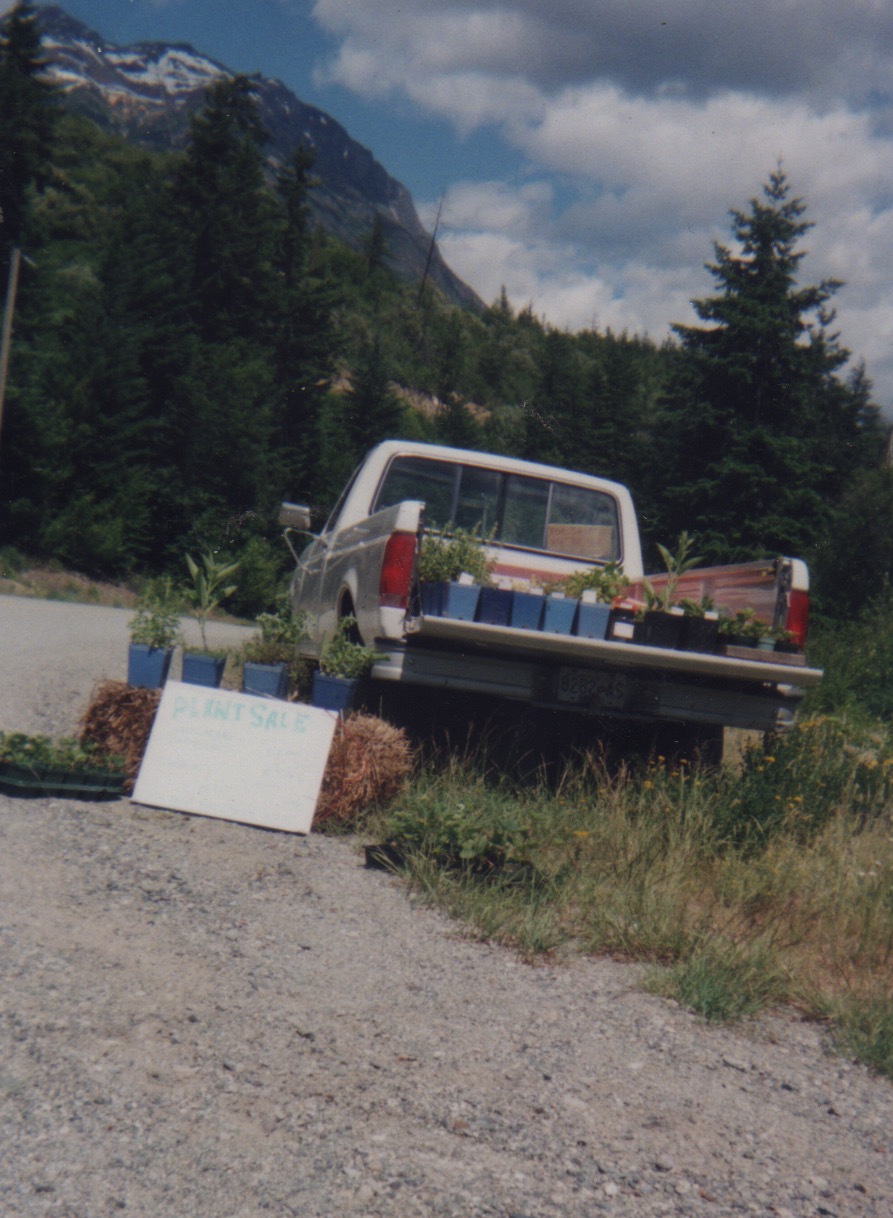
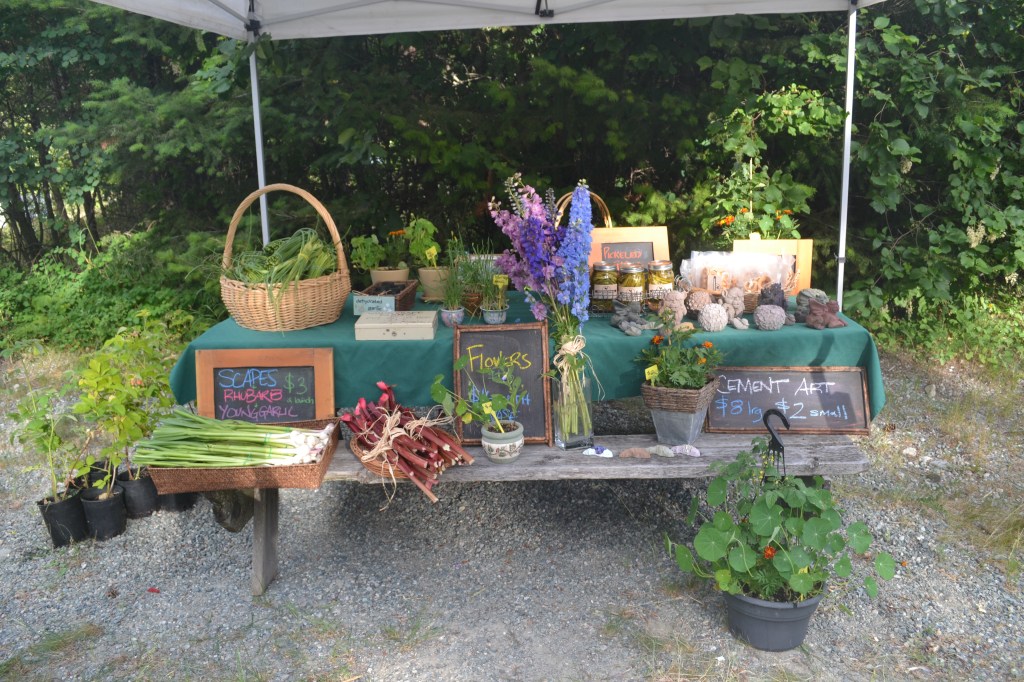
    I started putting plants and surplus veggies at the top of my driveway with a jar for cash many years ago, mostly for my neighbours. The above photo is circa 1995. I called it the Beer Stand back then. If I had enough for a case for the weekend it was a successful week. Over time it got consistently busier and we added more products. It became the Entertainment Stand where, in good weeks, we could go to a restaurant or even a concert. Our farm is now a registered business and after a good year we can take a vacation at the end of the season. Keeping it stocked is now a part-time job (farming, of course, is full-time), but I have to say it’s the best job I’ve ever had.  I joke when being leisurely that I’m currently working my job . The operating costs are extremely low so every sale is a bonus. Farming itself is extremely labour intensive with a low profit margin and high risk. We could never afford to pay someone to sit and serve customers. It’s really the only viable way of doing business in a rural area. If we bring perishables back from the market they quickly go up there in the fridge. We can offer an ever-changing wider selection of items than we would at the farmers market, can keep things fresh and pass our cost savings on to the customer. Win, win, win!

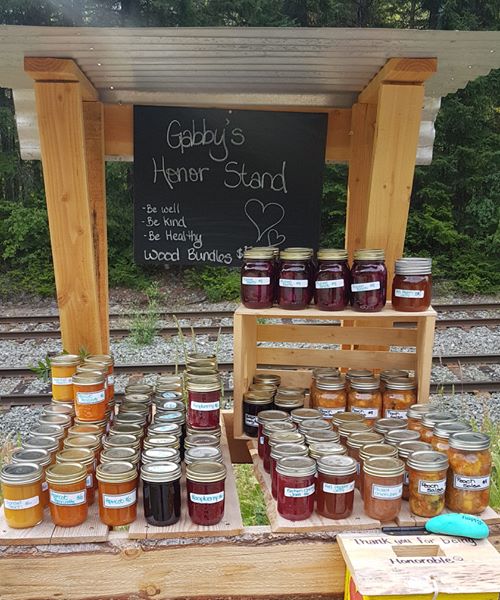
    Generally people are honest and since it’s the honour system, we accept e-transfers and IOU’s. Someone, who we caught pinching out of the change jar, returned years later with a letter of apology and a $50 bill. This restored our faith in humanity and the honour system. What comes around goes around.

    115823217_10157015108455755_4358984688747848677_o

    Birken has now become a valley with many honour stands offering everything from jams to fresh pasta to firewood. It’s a place of cottage industries, where hobbies help many with spare cash. They range from tents, and  permanent shelters to coolers. Many interested in setting up their own stand have contacted us wondering if we would be offended by the competition. We look at it the opposite way. The more the merrier! It has started to become a destination place for a casual drive picking up things along the way.  Those coming up for a swim in our many lakes can grab some fruit to munch on. Campers and boaters can pick up a fresh bouquet and something to add to their dinners on the way home. We’ve had nothing but positive feedback. It reminds many of their country childhoods and a simpler time when everything was local and fresh and neighbours shared.


  • A festival of weeds: eat more dandelions

    A festival of weeds: eat more dandelions

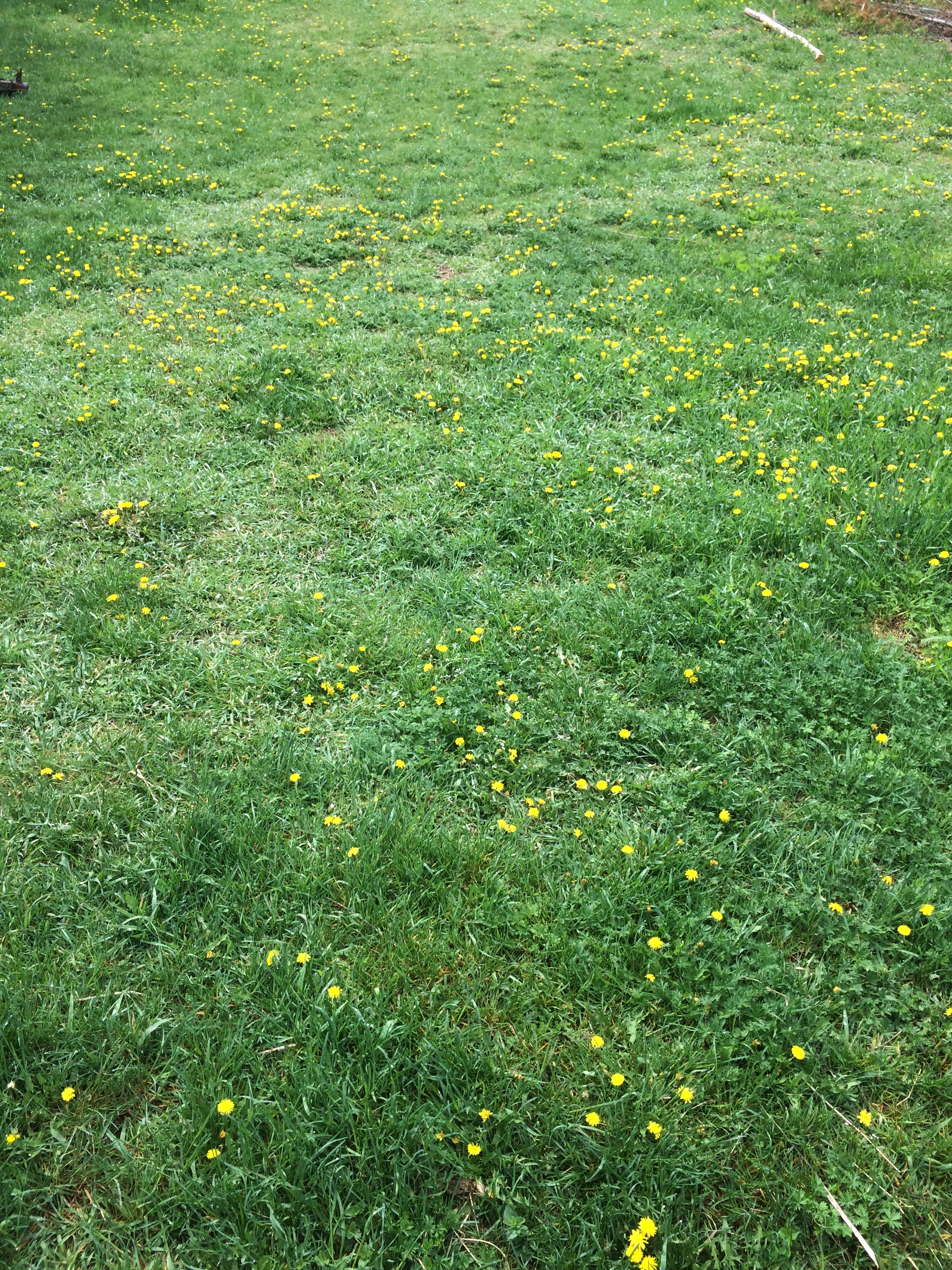
    Could a food chain that whispers of global vulnerability make me reconsider the value of my yard as part of my personal supply chain? I cultivate weeds better than anything. My yard is a festival of dandelions.

    IMG_9770

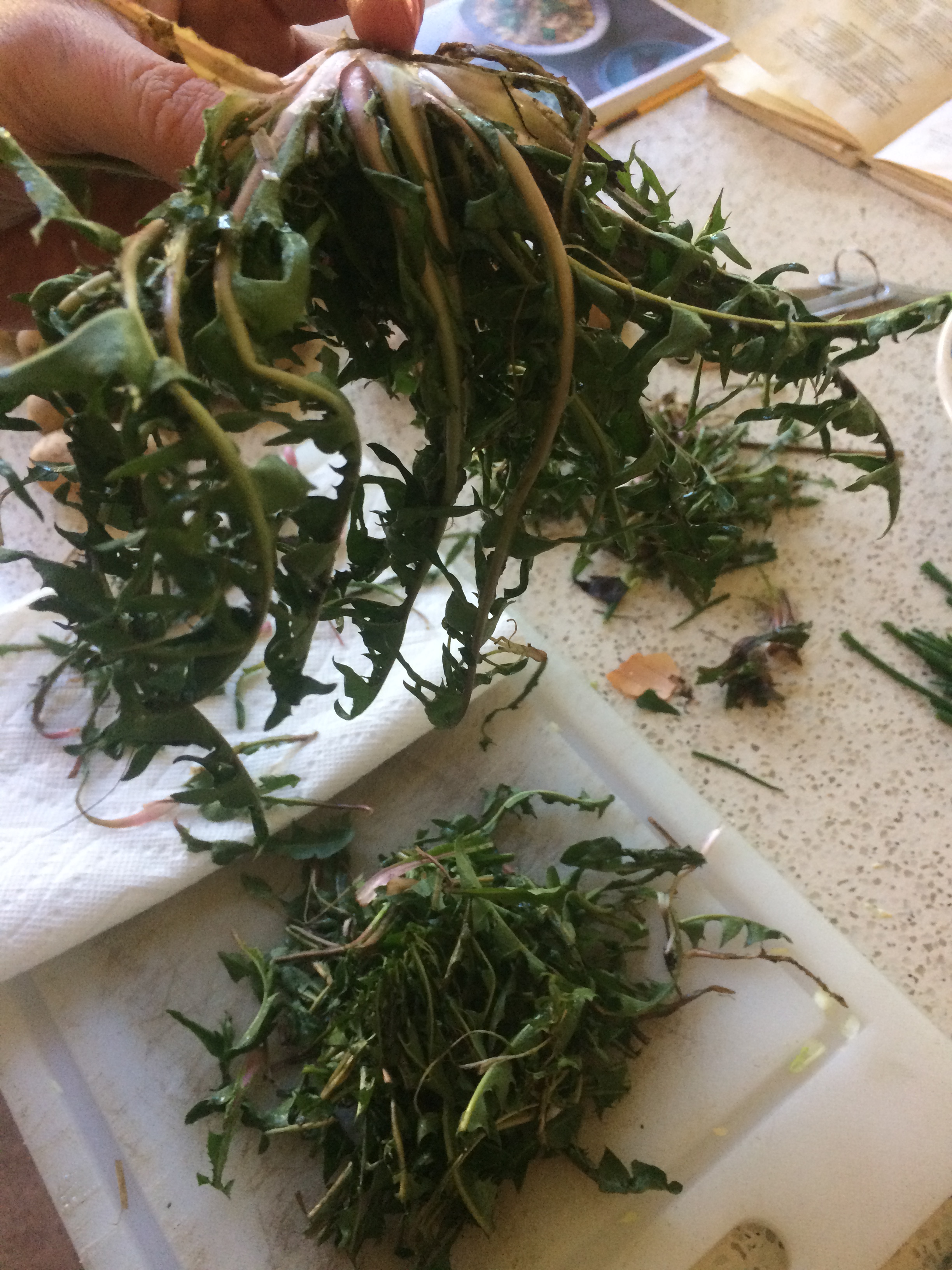
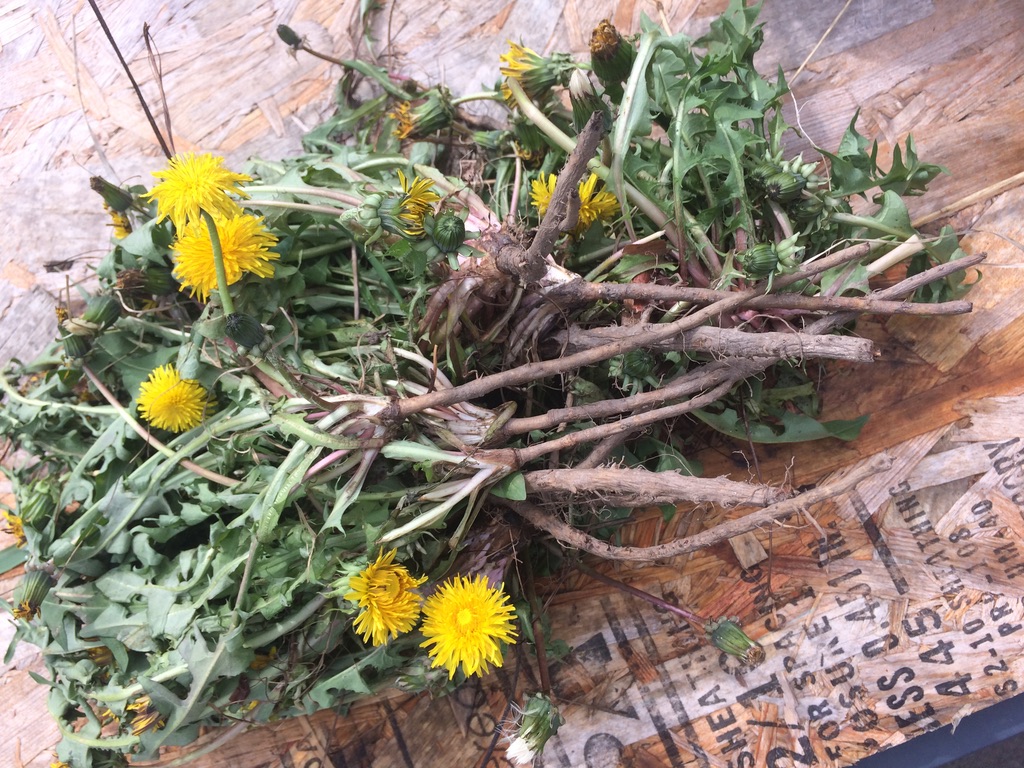
    There is nothing to be gained by declaring war on this. But everything to be gained by researching all the medicinal and nutritional benefits of dandelion and declaring it my most successful garden crop ever. So, with a nudge of encouragement from Natalie Rousseau, whose plant ally for early spring in her 13 Moons course was dandelion, I cooked up a dandelion saute, as the evening’s serve of greens.

    It tasted… so… weedy.

    The seven year old sniffed and said, “No.” Husband’s verdict: “not for the permanent recipe collection.”

    I went to instagram to announce this state of affairs.

    IMG_9074

    And was encouraged by friends not to give up.

    So I did some more research. They are SO GOOD FOR YOU. My coffee-to-wine IV line slash coping technique has short term effectiveness, (upping and downing me as required), but I’m not in love with the long term consequences (like looking haggard. I embrace witchiness but I’m not ready to be a hag just yet.) The promise of clear skin alone convinced me to keep trying – if not to disguise or balance the taste of dandelion, then to acquire.

    Two weeks into my experiments with dandelion (and with even more available in my yard, yay abundance!)  it’s some combination of all of the above.

    865964C7-5F3D-4BB3-A0DC-14A000007B20_1_105_c

    Susun Weed has taught that information in wild food is healing to our cells, it nourishes them with fewer glitches, it returns us to a state of health that aligns with an older Earth, because the receptor sites for minerals in our cells, are primed for the nutrients found in wild food.

    the optimum nutrition is the nutrition from the wild plants. ~ susun weed

    Dandelion is a member of the Asteraceae (daisy) family, a spring tonic and blood purifier. Dandelion leaves and roots relieve chronic stagnation in the liver, while the flowers can relieve a stagnant depressed spirit.

    “It grows almost anywhere: wild in fields, lining trails, in suburban yards, breaking through cracks in city sidewalks. Its constant presence is a reminder of its persistence to live as long as it can under any condition.” ~ Christine Buckley, Plant Magic

    It was actually imported to North America as a spring green and boasts the scientific name Taraxacum officinale, meaning the official remedy. Like, for everything.

    Its strengths are as a tonic, diuretic, alterative, antirheumatic, bitter, cholagogic, hepatic, exhilarant, mild laxative and nutritive.

    Dandelion – Are tap-rooted biennial or perennial herbaceous plants, native to temperate areas of the world. Dandelions are thought to have evolved about thirty million years ago in Eurasia, they have been used by humans as food and herb for much of recorded history. Dandelions are one of the first plants to bloom in the spring and therefore are a very important source of nectar and pollen early in the season. Its tap-root will bring up nutrients for shallower-rooting plants, and add minerals and nitrogen to the soil. Dandelions are even said to emit ethylene gas which helps fruit ripen.

    IMG_9127

    Christine Buckley, in her new (and highly recommended) book Plant Magic includes dandelion in her herbal arsenal – she makes vodka tincture with the flowers and takes that jar of liquid sunshine as deep winter medicine, confessing it is her favourite plant for being “scrappy, fierce, life giving and cheery.”

    Buckley recommends to use the roots for sluggish digestion – dandelion will not just kick your digestive system into high gear, it also improves bile production in the liver, so you can digest fats and eliminate toxins from your body with more ease.  This will reduce inflammation in the body, make your skin look better, help your metabolism and allow the liver to cleanse the blood.

    It’s high in mineral content and inulin, a type of fibre, which is an excellent prebiotic.

    Are you sold yet?

    The leaves are great spring salads – waking up our systems. It’s a tonic, so that means you can take it, every day, and little by little, you will improve.

    “It is the ultimate preventative medicine,” says Buckley. And high in potassium, too.

    So long as the leaves are green, they’re edible. They become progressively bitter, so start with tender spring leaves. It also is packed with vitamins A, E, K, b6, B1 and C. Temper the bitterness with other ingredients (like plaintain leaves, garden herbs, seeds, nuts, shaved cheese, dried fruit.)

    So, with that data fomenting in my brain, my community of wild advisors offered tips on incorporating this super food into my diet.

    IMG_9128
    Christine Buckley’s must-have new book, Plant Magic

    Holly Joseph recommends: “The roots are nice and hot right now. Add to a stir fry, they taste so good! Brush them off under the hose. They are long and thin right now. And taste pretty peppery. I just cut it up right from the garden and put it right into my stir fry. Made it kind of spicy!”

    Asta Kovanen’s advice: “My tip is to cut wild greens in slowly. Add them in small percentages to your regular veg and then your palate can adjust without major assault.”

    Leala Selina Martin said: “I often will juice them as the larger they are the more bitter. They are so good for you though!”

    Sarinda Hoilett advised: “It’s all in the balance of flavours. Macadamia nuts (although gift from heaven) are expensive and hard to find…you can substitute cashews or even avocado and try for a creamy citrus blend to balance the bitter 🍃, And mix them with other greens or drop a few in a sweet smoothie.”

    Dandelion Cream Salad

    20 dandelion leaves, finely chopped, main stem rmoved

    1/2 cup macadamia nuts

    1/4 cup diced red bell pepper

    1/4 cup coconut water

    93617264_547637935955773_8913051030801154986_n3 tbs lemon juice

    1 tsp Celtic salt

    Massage chopped dandelion leaves well with salt to break down the fibre. Let sit for at least 5 minutes. Blend nuts with coconut water and lemon to cream. Mix well to coat dandelions with cream  and add red bell pepper. This salad is a wonderful way to get the great nutrition of dandelion with a reduction of the bitterness.


    EOJO8586

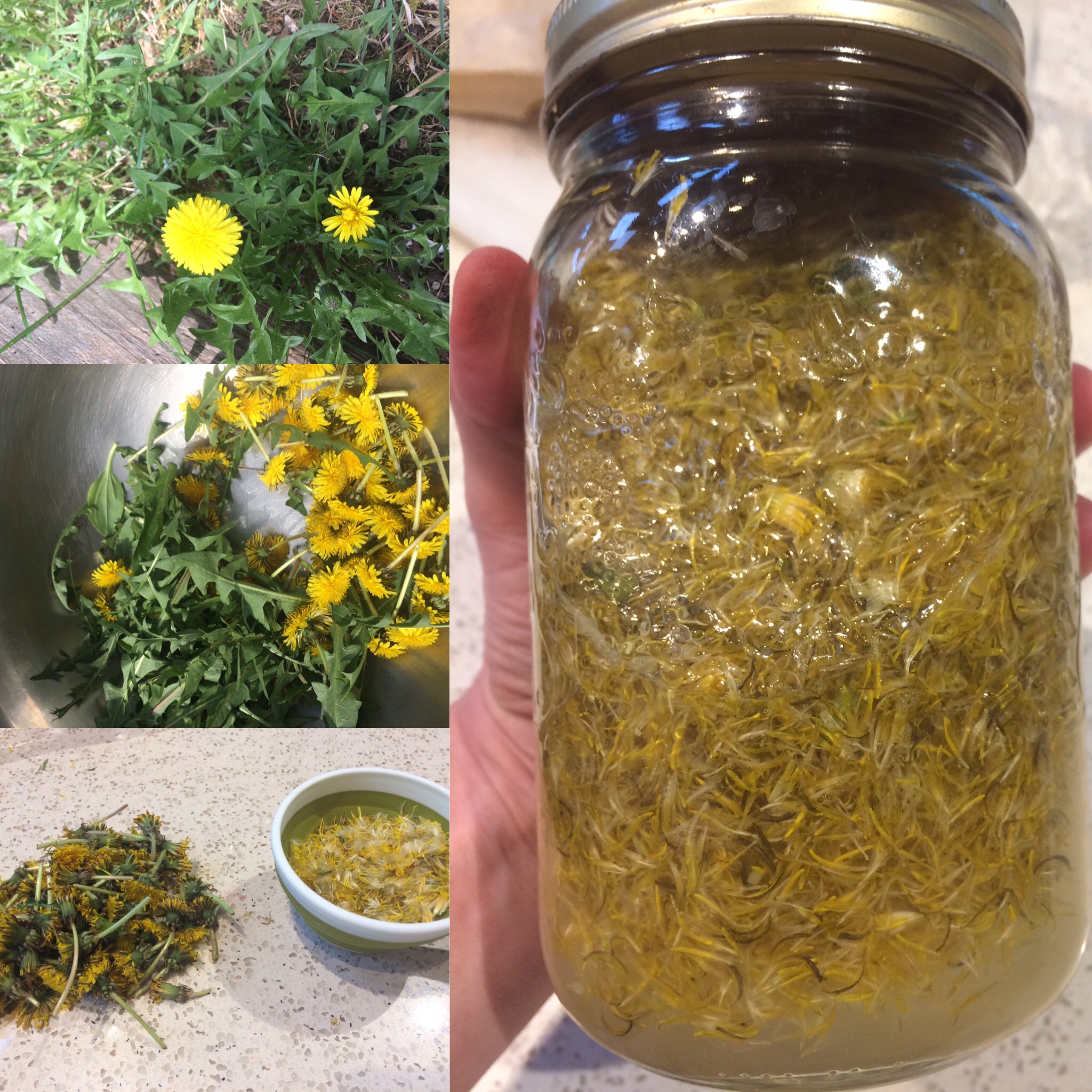
    After great success with Natalie’s dandelion cordial, making Christine Buckley’s winter rescue tincture (as I call it the “dandy brandy”) is next on my list.

    1 ½ cups dandelion flower blossoms

    1 cup honey

    1 cup brandy

    Put the flowers in a glass pint jar. Dissolve the honey in the brandy by stirring or whisking vigorously together. Pour the brandy and honey over the flowers, label and store in a cool dark place for 6 weeks. Bottle your tincture but don’t hide it away so well that you forget about it by winter.

    3321C13A-9284-428D-88D8-4AF3F8561DEE_1_105_c

    Pemberton-based clinical herbalist, Evelyn Coggins,advised, after reading this post: “I love to hear this topic of wild medicine/wild food being shared as miraculous, magical news… because it is all that. A weed is just a plant that hasn’t learned to grow in rows. The bitter principal of dandelion is tricky. We like sweet, salty and to some degree sour but bitter rarely. Maybe we are cautious because the toxic constituents in plants are most often present as alkaloids and alkaloids are bitter. It must have been a real learning curve to distinguish between toxic and beneficial bitters. The beneficial bitters aid digestion and many traditional aperitifs employ plant based bitters. Gin and tonic is a good example. Gin is prepared from juniper berries and they are bitter. Bitters act on the bitter receptors on the tongue and start a chain reaction that leads to the increased flow of bile into the digestive tract and all the nutritional value that ensues from there. It is not surprising that the liver leaps into action with bitters since poisons must be metabolized and hopefully rendered harmless by this organ. I agree that one must start slowly when turning to bitter plants but the journey is so worth it.”

    I’ve been a client of Evelyn’s and can’t recommend her highly enough.

    Now, more than ever, is a time to treat nature as an ally, not a servant/slave, and to behave with honour, humility, curiousity and gratitude.

    Just because you use the derisive word weed doesn’t mean this plant has no value.

    Finally, leave some for the pollinators. They matter in this lovely web, perhaps more than anyone. Not to mention, the roots reach deep into the soil to bring up nutrients, so they’re working healing magic on the Earth, not just our bodies.

    Thanks to Tanina Williams, who first introduced me to the idea of making dandelion jelly, for sharing this video:


  • Thank you to the Vegans

    Thank you to the Vegans

    As discussed in my last post I think we owe vegans in particular an enormous debt of gratitude. These deadly viruses originate with wild animals in captivity caged inhumanely alongside domesticated animals for human consumption in markets mainly in China, but also it has been reported Indonesia and Thailand. What will happen in future and how and if this will be monitored is another matter.

    Vegans are against the use of any animal product for consumption and their choices are truly admirable. We have so many ethical food producers here and ethical and sustainable hunting practices yet unfortunately there will always be people who abuse a shared trust. Also, whenever we purchase packaged meat in the grocery store and are not connected with the hunting of the meat ourselves or the raising of the meat ourselves or by people we know in our own community (shout out to those very important and hard-working people in Pemberton now and how grateful I am to you) then we honestly cannot say for sure that the meat was raised ethically.

    So if you find this all too much to process (pun not intended) then you can just go vegan. And if that is too much to process then you can at least go partially vegan. I find vegan eating particularly easy at breakfast and lunch. Oatmeal and oat milk (yay – oat milk has 4g of protein per cup!), toast with peanut butter, etc.

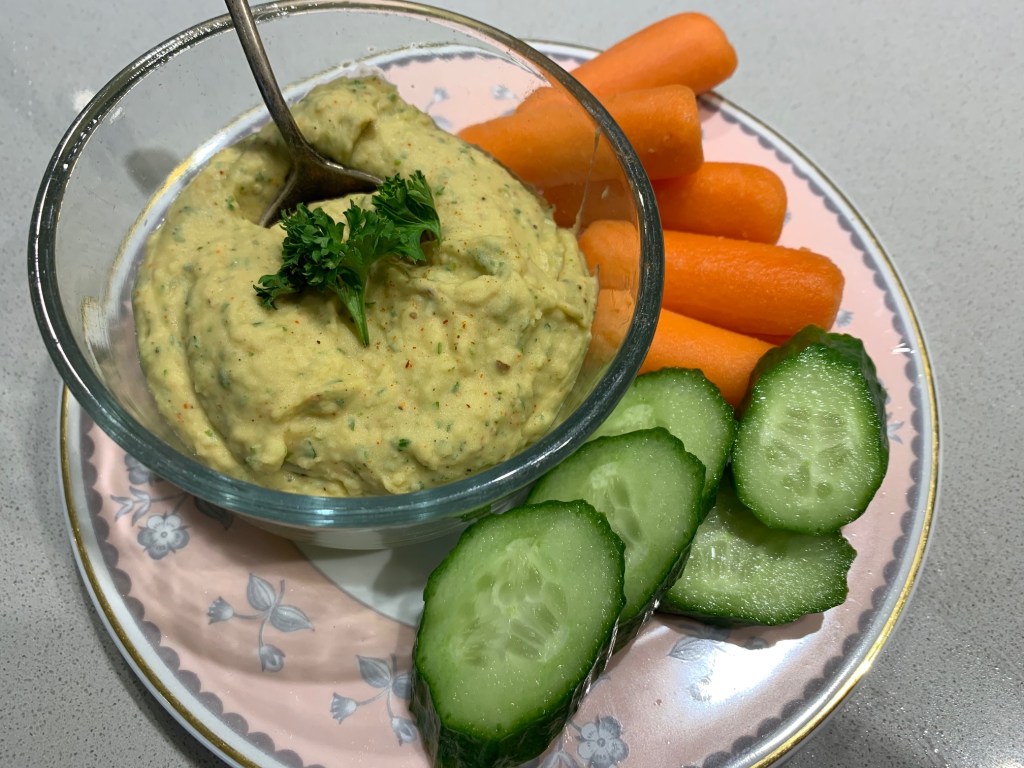
    For lunch I like to serve bean dips and veggies and even a light lentil soup. I just tweaked a bean dip I found online that in its original posted form was bland and blah. This one is zippy and fluffy and very delish. Please enjoy and thank you again to the vegan community.

    White Bean Dip with Pemberton Garlic and Parsley:

    Ingredients:

    15 grams of small white cannellini beans

    **Method for dried beans: Soak a bag or two of dried cannellini beans overnight. In the AM, drain water and put beans in slow cooker and add water until beans are covered by two inches. Cook on low 8 hours. When tender, put 15 gram portions of beans in containers and freeze for future use.

    2 cloves Pemberton garlic

    4 dashes hot sauce (I like the Cholula brand from Mexico)

    1/3-1/2 cup pure olive oil

    3 tbs fresh-squeezed lemon juice

    1/3 cup Pemberton-grown parsley

    1 tsp salt

    1 tsp pepper

    1 tsp paprika

    Method: Blend all ingredients together in Cuisinart. Adjust salt and pepper to taste. Serve with sliced cucumbers, celery, carrots or sweet peppers.

  • Supply Chains…And a Challenge for Pemberton’s Non-Gardeners

    Supply Chains…And a Challenge for Pemberton’s Non-Gardeners

    How is everyone doing? I have been thinking about so many of our assumptions lately. That the tourists will come. That Whistler Blackcomb will open. That our kids will be in school. That I can get on a plane and fly to Italy. That I can ride the ferry. That I can go to the store and purchase what I need.

    Our supply chains:

    I read a locally published book about a decade ago called The Cucumber Tree – a memoir by a man growing up in Vancouver in the 1940s and 1950s. He recalled evenings with his family; dinner was always at home. Never would they go out for dinner or even out to other people’s homes for dinner parties. Dinner was prepared and eaten at home, every night.

    We just have assumptions that we can go out for dinner and that we will be able to travel. And this is a new assumption. It has only been since I was growing up that going out with the family was a thing. And to recall, it only occurred on a special occasion. I do not remember too much of it going on but if we did eat out, it was to a family-run pizza restaurant in my neighbourhood in Vancouver. We have so many lifestyle assumptions under fire right now.

    Back when my parents were growing up food supply chains were different and going back further your family and your home was a big part of the supply chain. You ate what you grew. You preserved what you could for the winter.

    Here in Pemberton yes, we are very lucky to have farmers and so we would assume that we will always have access to good healthy food. Yet…

    Many articles are being written lately about growing a “Victory Garden” and that if you can you should be more food secure within your own backyard. It is time to get cracking. If we are not gardeners then this would be the time to start. If you don’t grow anything then maybe this year grow one thing – one thing that you aren’t going to be reliant on anyone else for. If you live in a townhouse or condo in town, can you grow your own herbs? Sprouts? Micro greens? If you have a yard but simply don’t garden, start with one, two, or three items that will sustain you. I would lean towards items that are hardy like chard, kale and spinach. Fresh herbs – parsley, cilantro, dill, basil, chives – make a meal.

    A Note on Veganism:

    I am thinking vegans and vegetarians are pretty pissed off at the world, with Covid-19 originating from the filthy Wuhan, China wet markets and the disgusting treatment of wild animals caged for human consumption there. I think we owe vegans and vegetarians enormous respect, and I think they have every right to be angry. Maybe this is that time to pursue veganism or vegetarianism, or to pursue this way of eating as best we can.

    I read all the Little House on the Prairie books by Laura Ingalls Wilder when I was a kid. My favourite was Farmer Boy and how the Wilder family grew all their own food, spun their own yarn from the merino sheep they raised, and were successful in their efforts. Do you think there were any vegans back then? When the supply chain began and ended with you and your family throughout the year, where did alternative eating come in? Something to chew on. Respect the planet, have knowledge of where your food comes from, and if you can, raise it, grow it, hunt it yourself.

    What would you eat if you had to grow, raise or hunt it yourself?

    A meal from my own yard, by a minimal gardener (who may become a proper gardener this year):

    Sautéed garlic scapes (sautéed in hazelnut oil, which I would have to learn how to make)

    Spinach salad garnished with cilantro, dried saskatoons, and toasted hazelnuts, with a dressing of hazelnut oil and minced garlic

    Fruit salad of chopped apples, cherries, plums, and apple-pears

    Barbequed deer steaks (hunted locally by my spouse)

    If I were to get serious about my victory garden I would plant spuds, beans, hardy greens and romaine lettuce. I am considering a small backyard chicken coop. It would be a lot of work, but individual food security is a worthy goal. I consider weeding back-breaking labour after about 15 minutes of crawling around in the dirt, mosquitoes buzzing in my ears, and the relentless Pemberton sun beating down on me. Again, I salute the farmers. We are lucky to live among them, now more than ever.

  • Sobering Advice for New Impulse Gardeners

    Sobering Advice for New Impulse Gardeners

    first gardenOne of the few businesses that has and will continue to thrive throughout the Covid crisis is the garden and small farming sector. The sudden interest  in our food security, sustainability and living off the land  is at a level I have never seen before. This is great. It is something that anyone involved in small farming has been advocating and working towards for a long time. I have seen the progression from the early farmers market days, trying to convince consumers what organic meant and  that local was best, to the vibrant markets we have now. It’s been a slow and steady growth, business-wise. Something is different now – maybe self-isolation has give folks time to think about what’s really important in the game of life, how vulnerable and dependent on the system we are.

    I would never discourage anyone to garden. Even a few patio planters, home landscaping or a herb garden can bring anyone joy. Warning, it can be addictive. There’s always more to learn. It’s grounding and healthy for body and mind. Do it.

    What I’m seeing as the result of the pandemic, is a mad rush to become self sufficient in a very short period of time. People are “panic buying” chickens, livestock, incubators, fencing, potting soil, seeds and any garden supplies as if it were toilet paper. As a side hobby, gardening is awesome, but the reality is you will most likely spend more on retail supplies and work hard for a small harvest. You will have successes and even more failures. You will enjoy the fruits of your labour so much it will seem worth it. Unfortunately, it won’t make you self-sufficient right away. Sorry.

    I’m not quite there yet, myself and that’s after 27 years of homesteading, with 5 years of schooling and lots of  related work and business experience. My first veggie garden was in 1994. It was a lot of work. I had mediocre results. There was no Google. I winged it. I decided I would try to live off what I grew. I lost 50 lbs, before I gave in to groceries and meat. Not advisable as a weight loss diet.

    I don’t like bursting people’s bubbles, because I have always said I live in one myself. I have learned mostly through trial and error, and it pains me to see others about to make the same mistakes I made through naivete and inexperience. I have the need to explain to those new to this way of life that it’s just not a short term process that can be accomplished in a season. For most small business plans, they say you shouldn’t see a return on your investment for 2 -3 yrs. For small farms change that to decades. Available land, infrastructure, supplies, labour and overhead will eat into any profits. If you plant a fruit tree you might not see a reasonable harvest for 8-10 years. Soil needs to be built up over several years. You need a rough plan, expect slow incremental growth and lots of long term commitment.

    It’s all possible with patience, capital, sweat equity and a good team.

    Study it as much as you want, it’s endless. The reality is you will inevitably learn from your mistakes and Mother Nature will always throw you a curveball or two.

    My advice is to start small with realistic goals and low expectations. Think about by whom and how everything will be maintained, especially if you plan to return to  your regular work in the future. Don’t “put the cart before the horse” by buying livestock before you have fencing and shelters or plants before your beds are prepped. Be patient. Timing is everything. Ask questions. Don’t overspend on fancy tools and gadgets from Lee Valley, exotic plants, and pricey greenhouses. Do a few things well instead of trying everything.  Be efficient. Think about how you can work with nature in the simplest ways.  Don’t bite off more than you can chew. Enjoy, it’s a long ride.

  • Perceptions of the Heart

    Perceptions of the Heart

    It is the heart that always sees, before the head can see.‘ – Thomas Carlyle

    The hawthorn trees are budding in the garden and will probably flower in May, well before we are able to safely move around our community once again. In its way, hawthorn is the perfect metaphor for our time.

    In the Celtic Tree Oracle, the hawthorn card advises restraint, waiting, keeping to oneself and focusing on mental rather than physical activity.

    Hawthorns will vigorously defend their space. Who hasn’t run afoul of one of these trees? If you push forward too quickly with reckless disregard for the fearsome spines lining the branches, some of which can be an inch long, they will pierce your skin to produce a deep, ragged tear before you can stop and extricate yourself. My entire family has lost flesh and blood to local hawthorn.

    Conversely hawthorns can also be generous with their gentle medicine. Across time, extracts of hawthorn have been used as medicine for the human heart. Just like every member of this community, hawthorn can be hard-hearted if its personal space has been invaded and soft-hearted if treated with respect.

    We are heartsick or broken-hearted these days. We wake expectantly to the possibilities of the day only to remember with sinking hearts that the enemy is still within our gates and our lives are irrevocably altered.

    The neuroendocrine and electromagnetic functions of the heart are well documented but only in literature and legend is the heart widely accepted as an organ of perception and communication.

    We evaluate everything emotionally as we perceive it. We think about it after.

    – Doc Childre

    Perceptions of the heart drive the tears, panic and anxiety that are never far from our waking hours and often stalk the vivid dreams of our nights as well.

    According to Chinese traditionalists, the heart stores the shen. The notion of shen is roughly equivalent to the spirit. If the heart is sick, the spirit becomes homeless to wander the body without focus. Its energy is scattered and every organ system is affected.

    Practitioners of Western medicine have long observed that depression can be symptomatic of heart problems. When the heart is made healthy again, the depression dissipates. In both philosophies then, medicine for the heart is medicine for the entire physical body and the spirit.

    I vividly recall one of my teachers saying years ago that everyone over the age of 50 years should be taking hawthorn. This one statement permanently etched in my brain the tonic and remedial properties of hawthorn tea.

    Medicine for our hearts can be easily made from hawthorn. Leaves, flowers and berries contain significant levels of oligomeric proanthocyanidins (OPC’s) – the good stuff in brightly colored fruits and vegetables that may protect the heart and cardiovascular system. Happily for our purposes, these small condensed tannins are readily soluble in hot water.

    If you are lucky enough to have access to a hawthorn tree, you can harvest the leaves and flowers in spring and the berries in late summer to extract those OPC’s either into a tea or a decoction that will help you to take heart in these trying times.

    When harvesting hawthorn, I learned early on to form a clear intention, approach the tree slowly and listen for permission. I have been taught since childhood to never take without asking and to ask only for what I can use.

    You can prepare a tea from fresh or dried plant matter. Simply chop or grind the leaves and/or flowers and soak in hot water that has just come off the boil. For dry herb try 1 teaspoon to 1 cup water and for fresh try 1 tablespoon to 1 cup water. Steep for at least 15 minutes with a towel over the teacup or pot to keep it hot.

    For berries make a decoction by bringing 3 tablespoon fresh or 1 tablespoon dried to a slow simmer in 3 cups water for 20-30 minutes. Bubbles should be barely breaking the surface in the pot.

    Strain your preparations into a cup and add any flavorings you want, such as honey, lemon or cinnamon. Teas should not be prepared and refrigerated for more than 36 hours as they may start to ferment.

    As for what you should be doing in this time, I suggest you set aside your thoughts and words to follow the perceptions of your heart for it knows the path that is right for you.


  • Herbal Hallucinations: is this all a dream?

    Herbal Hallucinations: is this all a dream?

    Earlier in the New Year, I was examining the contents of my “witch’s cabinet” (as the friend who gifted me the antique armoire named it), taking note of the herbs that should ideally be used up before spring foraging starts up again.

    IMG_20170501_084636_934

    I pondered starting a micro-dosing program. Not with psychedelics, of course, but I was playing with the concept using herbs, spices and novelty. This seemed a good alternative for those of us who cannot—or don’t want to—ingest consciousness-altering substances, but who still enjoy playing with our lived realities by changing patterns of consumption.

    IMG_20190913_163957_909

    It would also serve my fondness for do-able projects—taking on something subtle, like opening a window to let in fresh air rather than taking down a wall in order to build an addition to the house. Where the idea eventually landed was here: I would make at least one new recipe a week for the year.

    IMG_20180824_184239_013

    Fast forward a few weeks into late February. I returned to Whistler from Japan; COVID-19 was just beginning its global sweep out of China, and Japan was one of the early hard-hit countries. A few days after returning I developed a cough and sore throat, and was suddenly quarantined with the fear that I would be patient-zero in Whistler. After testing negative for the coronoavirus, however, I remained in quarantine with Influenza-A.

    Because of the flu, I couldn’t eat, but nevertheless started poking around the kitchen more intently. What exactly did I have in here to support health and immunity? (What did I have, given that the Canadian government was recommending we have two weeks worth of food and limit visits to the grocery store).

    OLYMPUS DIGITAL CAMERADue to a tiny pantry that comes with townhome living, I don’t have stocks of dried legumes and flour (yet!) but there is a substantial stash of otherwise semi-filled jars. There are herbs and spices galore, both from my personal interest in flavours and foraging, and because one of my sisters is a certified herbalist.

    20190706_190434

    In the fridge I found elderberry syrup and a stash of liquorice root and juniper berries (anti-virals). There was a jar of chaga from my parents property in the Cariboo, as well as clover flowers from their yard. My mother dehydrates kale by the wagon-load to crumple into soups, rice, or casseroles, and I found two bags as well as her dried apple-slices. The freezer contains steamed nettle that I’d completely forgotten about and a bag of chopped rhubarb to boot. My mini-stash was actually awash with interesting bits & bobs. Dandelion root, yarrow, calendula… harissa, nasi goreng mix and lemongrass. Local and exotic side by side.

    Now, what to do with it all?


    Screen Shot 2020-03-24 at 4.03.54 PM

    These are strange and stressful times. Most days I feel a strong need to create something— anything. And I’ll call it a win for the day even if it’s just making a nice cup of herbal tea or trying out a new soup recipe (**disclaimer, I don’t have young children; a friend with a young one told me her goal for the day was just peeing by herself, so fair enough**).

    OLYMPUS DIGITAL CAMERA

    Making all these concoctions is my way of coping with unprecedented circumstances. I know others are coping and working it out differently. Some need to chill out, eat chips and ice- cream, and soak up the stillness. I do that, too, but it seems that right now, tiny influxes of new flavours are foodie medicine for my beleaguered soul. Sage-and-lemon-balm tea. Cauliflower taco bowls. Lemony lentils. And yes, banana bread.

    My most recent experiment—a hibiscus infusion with ginger and citrus—is from a cookbook that I’ve had for years but have never used as much as in the past two weeks: Amy Chaplin’s At Home in the Whole Food Kitchen. That one book alone has delivered to my plate smashed baby potatoes with garlic & caper sauce, corn-grit blueberry muffins, a coconut curry and turmeric lemonade.

    I’ve even taken time to write the author to thank her for her recipes.

    What is happening to me? I didn’t even like to cook until I was 30 years old… but it turns out I’m a Taurus through and through. Ruled by the sensual. Now that I’ve got the time to appreciate the gifts of the senses, it’s grounding me. A little less news, a little more time to breathe in the smell of garlic, grind up coriander seed, or drop a bit of cardamom into my morning coffee.

    IMG_20180429_111422_544

    It’s simple, effective and delivers the variety I crave while we’re all house-bound more than normal.

    I wish you all well on your own journeys through this… oh, and please send any recommended recipes my way!

  • Plant Yourself: A Recipe for Being Here

    Plant Yourself: A Recipe for Being Here

    I was originally going to call this post “A Recipe for Ordinary Wonder.” I’ve already written about wonder here, and while I think it’s essential, it remains a little ephemeral. It slips beyond the edges of our understanding. I feel the medicine of this particular moment needs to be earthy, grounded, real. Needs to be practical enough to lift us out of our fear and isolation. It needs to come in bite sized pieces, like good dark chocolate.

    I’m a horse and nature based teacher. Or rather I was, until the recommendations for social distancing led me to decide to cancel my spring break camps and enter self imposed quarantine as I’ve taught students from all over the Sea to Sky corridor (and the world, via Whistler) over the last two weeks. Yesterday while picking out the paddocks, I asked myself this question: if I’m not able to teach in person– to create the kind of meaning filled and deeply felt transformative encounters between horses, humans and land I feel we so badly need right now– what can I offer through other means that can give people the skills to create experiences for themselves?

    There’s a lot of writing swirling around about reconnecting and seeking stillness right now. What I think we’re being invited to do is to expand our consciousness past our own perspective. To broaden it past the narrow road of our individual lives and the lives of our families; to open to the collective whose voices move close against the boundaries we’ve made around ourselves. As I write this, an image comes into my mind of a dog shaking its head: one of those proper shakes where their ears flap up against the sides of their skull, and you can almost hear their brain rattling around in there, rearranging their neural pathways.

    These times we’re in are like that. We’re being shaken out of our patterns. We can choose to steel ourselves against what’s happening and create more rigidity in response to change (which we know we’re going to see a lot more of in this lifetime…) or we can get curious and explore it as an adjustment in our perspective, an ear shake that opens us to something wider than what we were.

    I want to give you a set of tools, something real and grounded and simple, that you can play with. Play with these with your kids. Pull one out each day and see where it takes you. You don’t need anything special. Just your body and the body of the world. Some of them might seem a little silly. That’s on purpose. They’re meant to enliven the younger parts of ourselves. That’s often where our biggest perspective shifts lie and where the more authentic parts of ourselves are buried. They’re also meant to give us the kind of connection we crave right now, an empathetic, felt sense of being known by an other. It’s just that, in this case, “the other” isn’t human. Even better! Nature is endlessly forgiving of our bumbling attempts to re-mind ourselves of our relationship with her. There’s no judgement here. Think of these exercises as lighthearted games, little valentines we can exchange with the more-than-human-world that surrounds us.

    If you try these, I’d love to hear about your experiences in the comments. Share your valentines with me. (I promise I won’t judge you either. ❤ )

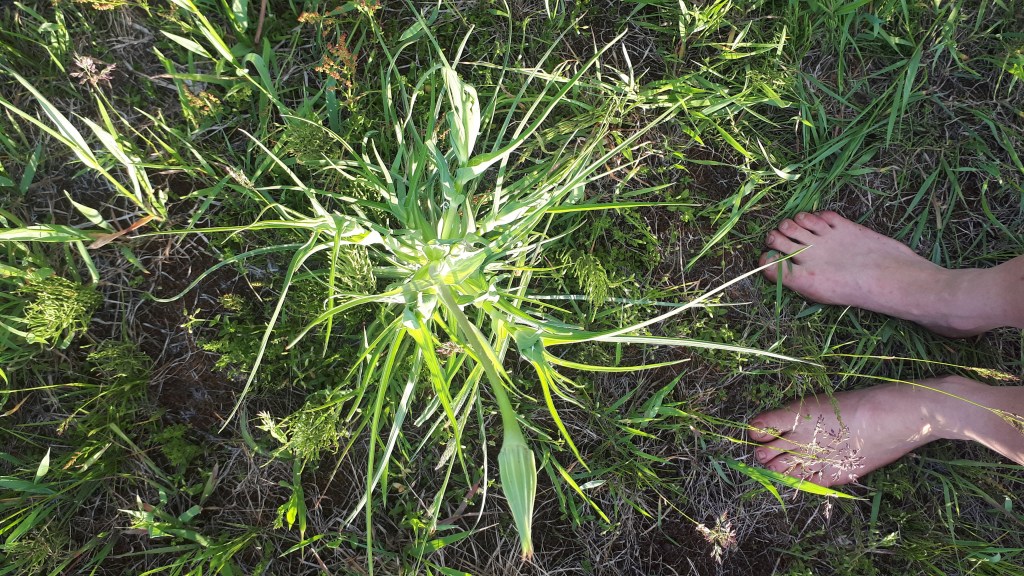
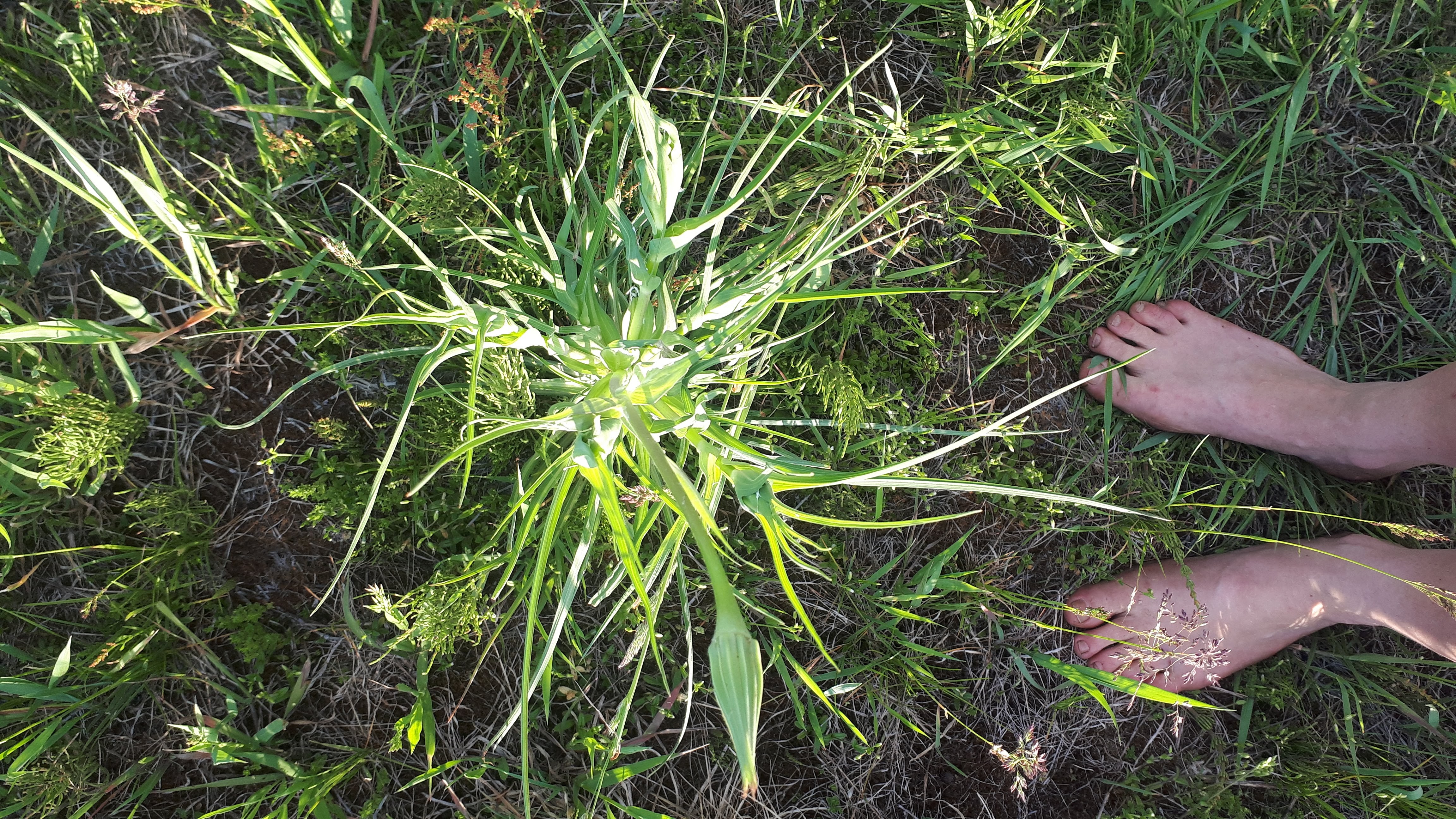
    1. Take off your shoes. And your socks. Find a patch of ground that looks warm and safe and inviting and stand on it. If you want more, go for a little walk. If you’ve tried a warm and inviting patch of ground already, try standing on snow. Try pavement. Try mud. Try exploring a liminal zone by walking from a shadow to sunlight, and track the differences in temperature with the bottom of your feet. Want to level up? Watch my video, “Place Based Walking,” for some ideas. Or walk on some gravel for a free acupressure session. (Top tip: touching the earth barefoot grounds and stabilizes the electromagnetic systems in the body. It literally rewires us to attune to the larger electromagnetic field of the earth, which helps us to come closer to a state of heart and brain coherence. Think of this as your antidote to all the wireless technology we’re saturated with, and the true savasana with which to end your online yoga class.)20190526_193441 (4)
    2. Let yourself be touched. The next time you’re out on a trail– or in your backyard, for that matter– notice the shrubs and trees that lean close to the edge of the path. It may be an errant twig that brushes across your cheek, or a cottonwood limb that’s come down across the over the course of winter. Or perhaps a low hanging cedar branch that brushes the top of your head and releases its scent. Just before you move out of the way, stop. Let yourself come into contact with this tree. You are nature touching nature. See how many different trees, bushes and branches you can let make contact with. Try not to do it on purpose. What happens if you turn off the path and into thick brush? Is it easier to find the gentlest way through? Is there something in your walking that becomes a kind of dance? An intimate exchange with the life forms we’ve believed to be inanimate all around us? What thoughts do we dance with in our psychic space in this same way? What reaches always toward us,  yet remains unnoticed? What do we cut through in order to continue to travel in the direction we want to go? What does it take for us to be touched by a different  part of nature in this way? A rock? A lake? How would we have to move our bodies to make contact?
    3. Fall in love with something small. Go outside. You can go to your favourite patch of woods or rock or field, or give yourself a challenge and start on a sidewalk or in the middle of your street. Your goal now is to wander. To meander with no destination in mind until something tiny calls your attention and makes you stop. Look down in the direction of your feet and keep your eyes soft. Look at the trunks of the trees. Look at everything without really looking at it. Keep your attention soft, like a photograph that’s not quite in focus. Wander until something, of its own accord, pulls your attention toward itself. It might be a bright green wolf lichen, or a pattern the compression of the snow has left in last summer’s dried grass. It might even be a chocolate bar wrapper with half of its colour worn away, held to the ground by a fallen stick. Once something tiny calls you awake, then give yourself to it entirely. Bend down and get close. Learn everything you can about it without causing harm. Then stand up, zoom out again, let your attention go soft, and start wandering again until something else calls to you. If you’re with your family or a friend for this, tell each other something you love about the tiny thing you discovered without giving away its identity. See if they can guess what it was. (Top tip: if you can cultivate this kind of “falling in love outside of yourself”, this sense of your attention being called to something of its own accord, it’s the best state of consciousness for finding mushrooms and other medicinal plants, and a profound way to activate our intuition. This form of listening to the being-ness of the world has been essential to the survival and evolution of human beings up until the last hundred years or so, when we started to place our emphasis on the rational, linear parts of our cognition.)
    4. Look up. Go to where there is nothing a human has made between you and the sky and look up. Bring a blanket and lie on a rock and look up. Let the sun heat your eyes behind your closed lids. Sit with your back against a tree and trace the line its trunk makes on the way to the sky with your gaze. Follow that line out into the crown of the tree, as if you were drawing the lines of each branch into the sky with your mind. Or look at clouds and then trace them in your mind’s eye in this same way. At night, look up at the stars. Imagine you are sailing on a ship a thousand years ago and this is the only map you have to guide you into the unknown. Learn a few constellations, or trace lines between the stars and make up your own patterns and give them names. Learn a star or a constellation as a family and know that every time you go outside and look up at it, you are connected. Look up. We need to remember the world is bigger than us again. (PS: I have a secret theory I have only anecdotal evidence to prove, but I’m still going to share it with you anyways: I think looking up in this way– actively tracing and engaging the muscles of our eyes in unfamiliar patterns of movement, specifically looking up into the worlds that exist above the plane human live on– causes our vagus nerve (and our autonomic nervous system, which governs our heart rate, breathing, digestion, hormone levels, AND THEREFORE OUR STRESS RESPONSE) to shift from fight/flight/freeze back to social engagement.)
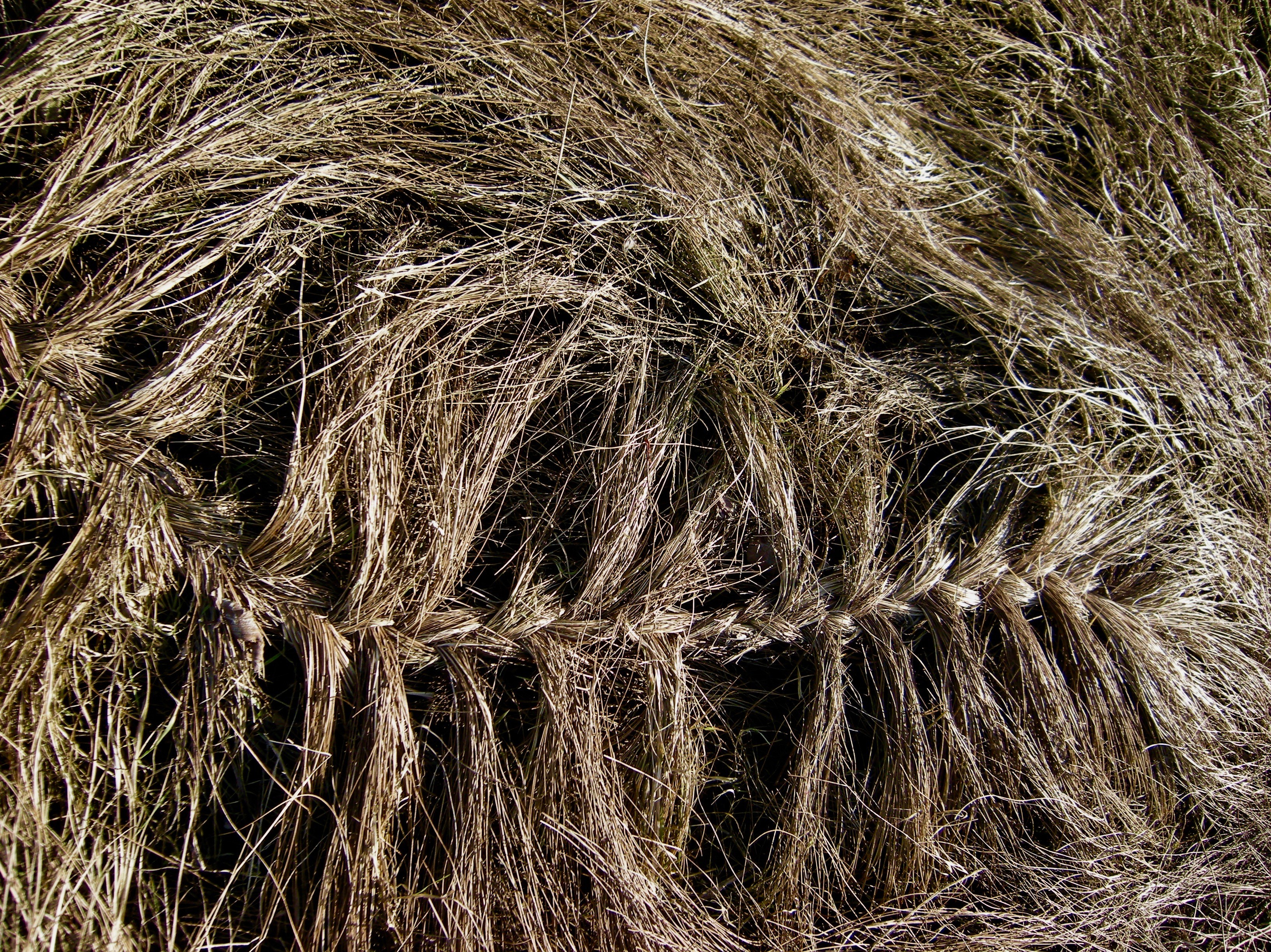
    5. Leave a gift. Make something beautiful out of some bits of nature you find around you. (Three year olds are great at this, as they haven’t yet been trained out of this kind of reciprocity with their environment. ) Arrange a line of pinecones that marches across your street and makes someone else wonder. Create a spiral made out of pine needles for the wind to blow away. Line up twenty sticks from longest to shortest. Write “I love you” in pebbles across the valley trail. It doesn’t have to be profound, and it doesn’t have to be ‘Art’. Making and creativity are part of the basic tenants of humanity. Nature is always taking chaos and creating something more complex and more beautiful. How can we invite some of this elemental and playful creativity into our lives? How do we share our energy with others in ways that add to the glorious mystery of the natural world? Be inspired by the ephemeral earthworks created by Andy Goldsworthy or the morning altars offered by Day Schildkret, but don’t get trapped by the idea that your gift has to be a grand gesture. Gratitude, giving, and making are ancient parts of our being. Make something now, in this field where we’re standing, with just the materials of the field itself, for nature herself to wonder about. DSCN2734