Author: mikoiko66

  • Our 2018 Farming Season in a nutshell:  Part 2 (Late Spring/Early Summer)

    Our 2018 Farming Season in a nutshell: Part 2 (Late Spring/Early Summer)

    This is the second instalment of Mike Roger’s recap of the rollercoaster farming season of 2018. For part 1, click here.

    So, here we are at the end of April, with a grow room full of tiny, compromised seedlings (see part 1).  Our hydro bill is through the roof and we have a lot of expenses. Most farmers have already tilled up their beds and are starting to plant the hardier varieties outside. We are feeling defeated. Why bother turning the soil if we don’t have anything to plant yet? It’s only an open invitation for weeds.

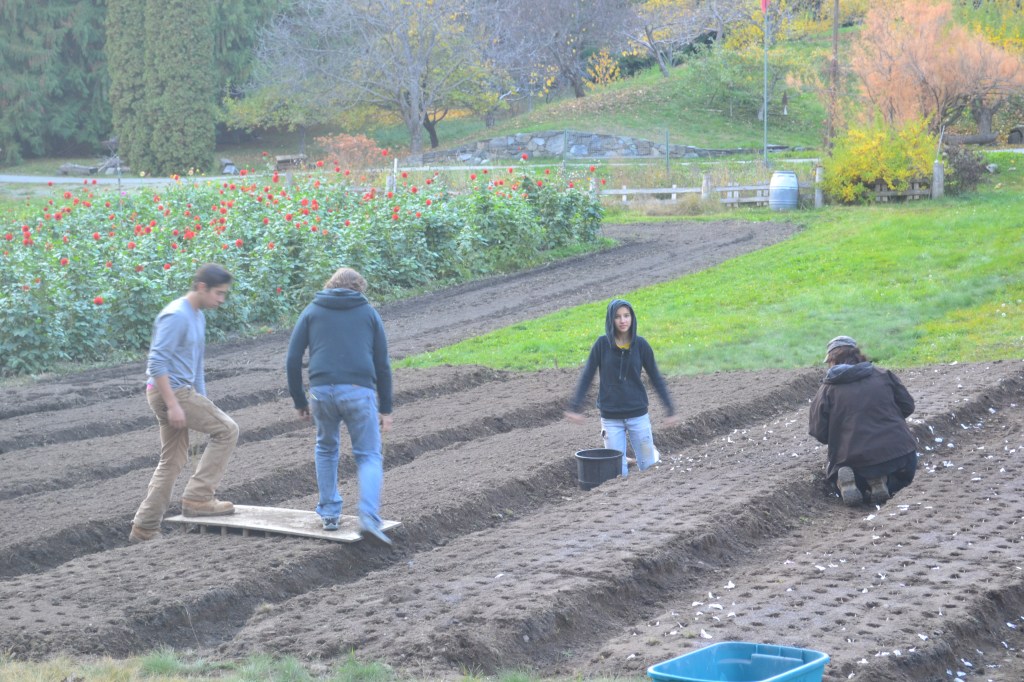
    In farming, if you’re not an optimist, you’ve already lost the game, so despite it all, we prepare our beds, not knowing what or how much we’re going to grow. We cover the fresh soil with drip irrigation and bio-mulch, a bio degradable plastic film to suppress the weeds and wait for whatever seedlings have survived to mature enough to transplant.

    Our only farm income in the spring is our annual Mother’s Day plant sale. Less than a month away, things are looking grim. Our neighbours have come to count on us to find heirloom varieties of tomatoes and other starts you may not find at the nursery. Luckily the tomatoes fared better than the delicate exotic flowers that we spent a lot on seeds for. Miraculously we had a successful sale, factoring in our perennials such as raspberries, rhubarb and herbs.

    Farming is so profoundly weather-related — the nicer the spring, the better off you are. Well, not in our case. May was extremely unseasonably hot (aka “Maygust)”. We knew we had to get our starts in for the traditional Victoria Day holiday deadline. We literally watched our tiny compromised transplants shrivel in the hot sun. The top of the soil would be bone-dry midday  and watering at this time often magnifies the sun’s rays. We lost even more plants and were forced to direct seed in the blank spaces between the survivors. We also had to resort to purchasing expensive starts from the nursery for many plants we couldn’t wait to sprout.

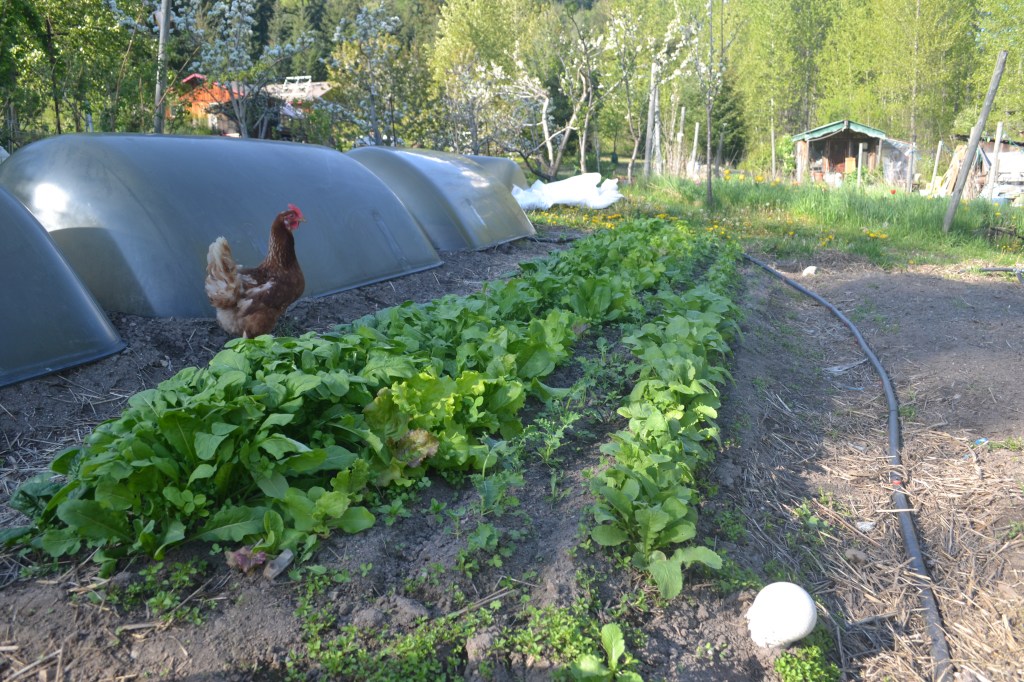
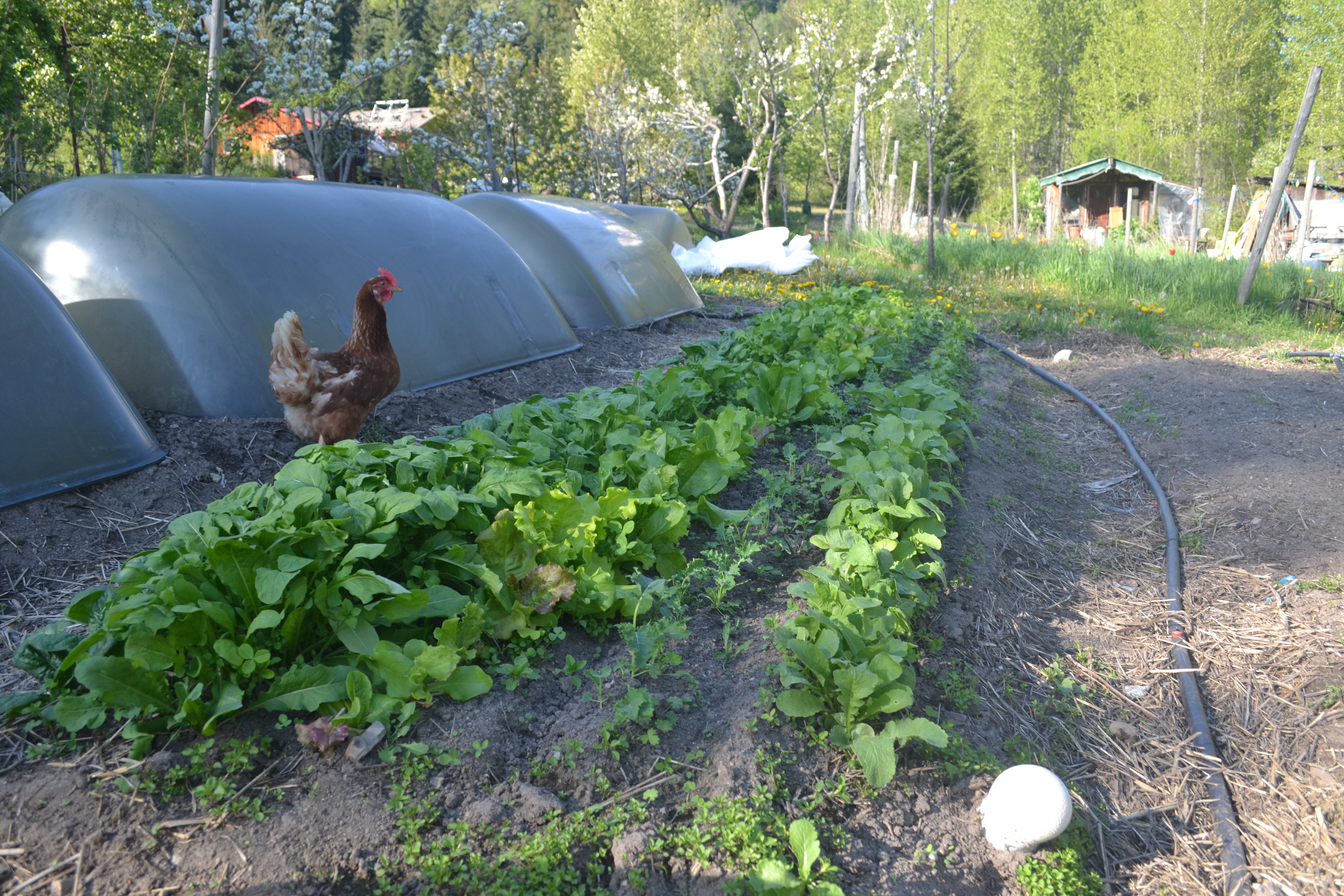
    Most of the things we focus on growing in our niche market are late season – heat-loving and slow-ripening – such as fruit, berries, tomatoes, flowers, and garlic. June is a make or break month, weather-wise. It sets the stage for yields by establishing buds and  deep roots to prepare for the summer.  A cold spell in June, for some reason, has become common here in recent years. This is fine for those growing brassicas, spinach, radishes and early season crops. During June, however, this weather pattern (Juneuary) lasted the entire month! It seems we got hit worse in Birken than in Pemberton. A few hundred feet in elevation results in a few degrees which can make a huge difference. The general rule is that below 6 degrees C, most plants just stop growing.  The nightly lows were often around 7 in Pemberton and less than 5 in Birken. We were burdened with covering  the plants up at night (with bubbles from the old Wizard chair), something we normally did in April.
    DSC_0021

    Farmers Markets have become big business. There is pressure to extend the season on both ends, regardless of what’s available from the weather dependent farmers. Again, this is okay for cool weather crops and artisans, but not for us. Nonetheless, we have to  book and pay for our markets long in advance.  So here we are into July and we’ve got nothing  fresh for our scheduled markets. Do we just cancel? No! We need money to keep the farm running! We had to somehow pull a rabbit out of a hat. We  quickly made some twig baskets and rustic coatracks (hence the Willowcraft name), packaged some dehydrated garlic and apples, made some vinaigrettes and raided our kitchen garden of herbs and greens. Of course, our stand looked awesome and our customers were unaware of all our challenges.

    In farming, if you don’t adapt quickly, you’re done.  It’s not like there’s a choice. It’s a life-long lifestyle. I wasn’t going to abandon everything and get a 9-5 job to pay for bills. If it weren’t for credit, I don’t think there would be a single farm in existence.

    Stay tuned for part 3, in which we’re overwhelmed as everything ripens at once, and underwhelmed by the performance of our cash crop, garlic. We finally somehow salvage our difficult season finishing on a (spoiler alert) positive note.
     

  • Our 2018 Farming Season in a Nutshell: Part 1 (Earlyspring)

    Our 2018 Farming Season in a Nutshell: Part 1 (Earlyspring)

    In farming, no two years are ever similar, with hits, misses, trials and tribulations. You often add a few experiments, delete a few duds, and try to improve infrastructure and efficiency. Nature is fickle however, and like anything in life, things rarely work out as planned, you have to roll with the punches and Mother Earth has a hefty left hook.

    This year, we had so many ups and downs I will have to break it into 3 parts: Early  spring, Late spring/summer and Fall

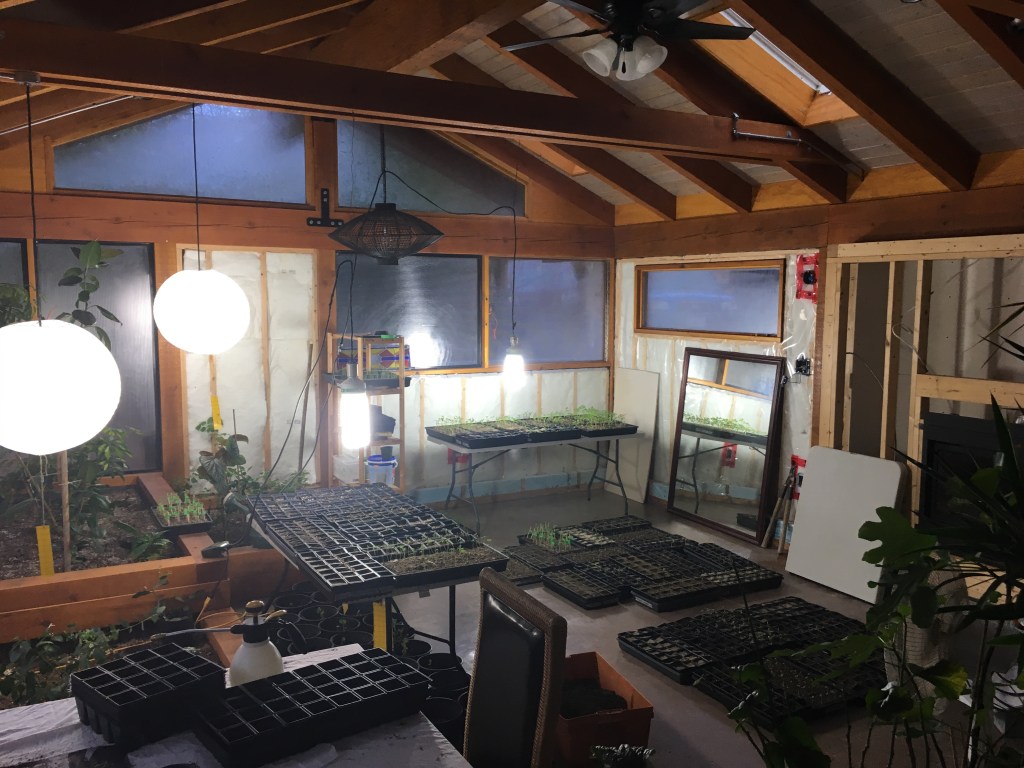
    Our seasons always start optimistically with the first inkling of spring in early March. This year, we were extremely excited to use our newly constructed propagation room, a large solarium with heated floors, grow lights and ventilation. We invested  tons on construction, and more than our usual amount in new seeds, with the intent of going big. We had a line on some recycled potting mix from an indoor commercial operation.  I knew using  outdoor natural soil for indoor plant starts is a big no-no with the possibility of introducing pests or diseases. I felt confident with my score because it started as  certified organic sterilized mix and also sat outside all winter which should have killed any troublemakers and their eggs, plus I had used some before. Most of all it was free, saving me hundreds of dollars in a time that is lean for farmers.

    Our lovely solarium also has tropicals, citrus, coffee, figs etc. As soon as the temp rose , the aphids, whose eggs overwintered on these plants, hatched. Problem number one. We quickly tried to control it with insecticidal soap, but couldn’t keep up. With organic methods, you have to work as many angles as possible – you can’t just go out and buy some strong poison and kill everything in one shot. We tried jets of water and vacuuming, but still couldn’t keep up. We became concerned when these little creatures found the tender sprouts of our seed starts. We purchased 3000 lady bugs and let them do the work. They eventually worked but some damage occurred and we had to re-seed a lot. This was early in the game, and we weren’t too upset. We still had plenty of time to recoup our losses.

    Fast forward a week or two, and we noticed the seedlings are dying off . We get out the magnifying glass to check for bugs: none. Good. We assumed the plants are damping off, a condition that often occurs in wet, cold soil. We cut back the watering and crank up the heat. This only made the situation worse. Eventually we noticed tiny fruit flies hanging around the plants. Problem number 2. This was perplexing as there was no fruit anywhere and the sprouting vegetation was fine. These plants were dying from the ground up. Oh no! Fungus gnats! These flies are harmless, but their larva were eating the roots faster than they could grow. The damage had been done before we even diagnosed the problem. Those thousands of flies were laying tens of thousands of eggs in the soil. Now what? We called the company that sold us the ladybugs and ordered a bug with a fancy name that eats gnats. We had luck with biological controls (that’s the term when you introduce something natural to control a pest) with the ladybugs vs aphids, so we were confident. We disposed of the trays, re-seeded again and released thousands of these critters all over to deal with the gnats. We didn’t really know yet how these gnats were introduced and assumed they also overwintered on the tropicals in our above freezing solarium. Time was running out on our seeding window, but still felt we could pull it off.

    Unfortunately this didn’t work as well as planned. The control pests didn’t multiply as fast as the gnats. The flies kept on hatching which meant the roots were still being eaten.

    But where the hell did these bugs come from in the first place? I called the person I got the recycled soil from and asked him if they ever had issues with fungus gnats. He shamefully replied yes, but hadn’t mentioned it at the time, assuming everything would have frozen to death as it sat outside all winter. A quick google search on gnats revealed they have a natural antifreeze in their eggs and larva that can withstand warm winters.

    This dilemma kept me up at night: a large part of our farm income – annual flowers, tomatoes, herbs and veggies, was seriously jeopardized. There is no insurance for this type of thing. I scoured the internet for any solution. One was to douse the soil with diluted hydrogen peroxide (suitable for organic standards). This worked a bit, but not totally as it also killed the control pests in the soil. Now I was back to square one and there were still gnats flying around ready to lay more eggs.  I tried some other control bugs, but they took a few weeks to hatch! No time to waste! I was frantic.

    Next possibility was nematodes – another control bug that lives in the soil. They are expensive, and our seeding budget was getting tighter. I got some leftovers from a friend, but they were out of date. I had no time to rely on something that may not work. Last option? An organic mosquito control for small ponds that apparently works on gnats. This was affordable and I just kept dousing the soil every couple days. It seemed to be working but not after losing thousands of seedlings.

    Now that we knew the source of the problem and a  had a solution, we had to get some fresh potting mix and re-seed for the 3rd time with whatever seeds we had left.

    We were now far behind schedule, but like all farmers we kept ploughing through on a wing and a prayer.

    Come back for part 2 (Late spring/summer), in which I will describe how the weather further shit-kicked us.

  • The pros and cons of having WWOOFers

    The pros and cons of having WWOOFers

    Q; What is a Wwoofer? A: Its a dog that pulls weeds! Jokes aside, WWoof can be an acronym for either World Wide Opportunities on Organic Farms or Willing Workers on Organic Farms depending on the area and its labour laws. They are basically homestay farm volunteers who work 4-6 hrs /day in exchange for room and board. The organization began in the UK in 1971 when there was a revival of back to the land interest, volunteering and adventure travel.

    I can only imagine the logistics of organizing such an endeavour back then, with snail mail and hard copy photos. Since the advent of the internet it is so much easier, with quite a few other similar websites such as HelpX and Workaway.  These new sites have become popular because they’re not just organic farm related. It’s easy, using the same format as a dating web site with profiles and photos from both parties. Fortunately, the meetings are less awkward.

    We have hosted an average of a dozen helpers a year, for the last few years. They come from all places, cultures and ages. There are many pros and cons, but to be honest, so far, about 90% of our visits have been a good experience for everyone involved.

    The pros are:

    • We get to meet new people every few weeks without leaving our bubble. It’s been great to introduce our somewhat sheltered kids to others and their cultures. We always get out the atlas and they explain to us where they are from and where they’ve been. A homeschool geography lesson.
    • We get to be tour guides and ambassadors for our area, showing them our secret spots (only if they promise not to post it on social media.)
    • We’ve become more productive, Many hands make light work, whether it’s tediously picking berries, cleaning garlic or heavy work such as firewood. This leaves us more time for other projects and leisure.
    • We get to share our wholesome lifestyle and food with others who may have otherwise never experienced an authentic BC mountain environment.
    • We have made some fleeting as well as long term friendships, with a few repeat visitors. and have even stayed with some while travelling abroad.
    • We get to teach others new skills and teaching is learning.

    The cons:

    • It takes work to organize work for others and stay productive. It takes a game plan and most farmers are constantly adjusting plans, especially due to weather.
    • Sometimes people are just not compatible (remember the dating analogy). I can tell within hours if the person grew up in an urban or country setting. While most are adaptable, some are just out of their element, scared of wildlife or not accustomed to isolation.
    • You have to assume they don’t know a thing, explaining and demonstrating exactly how you want something done and setting the pace, especially if you plan to leave them unsupervised.
    • You may have to accomodate their dietary restrictions, religious or cultural practises. You have to be polite, politically correct, entertain them and drive them around. It can be a hassle and an invasion of privacy. You have to have blind faith and trust in a total stranger.

    Like I said, on the whole its been mostly great for us, but it’s not for everyone. It’s hard not to discriminate and develop stereotypes, but that’s human nature as we look for the most compatible fit. We are weary of bringing the elderly, disabled and the permanently transient. We have to accept that different cultures have different work ethics. We have to choose the right candidates at the right time depending on the season.

    There are no set rules or contracts, and the only repercussions come in the form of reviews. We have chosen to do between 2 -3 week stays, mostly to keep things fresh and avoid complacency. A recent couple who have had some negative experiences elsewhere noted that most other hosts require a minimum as opposed to a maximum stay. My response was “with a private cabin, wholesome work and farm fresh food, most travellers don’t want to leave. We treat others how we would like to be treated.”

    DSC_0020


    We


  • Navigating through all the Greenwash

    Navigating through all the Greenwash

    Theres no doubt people in these parts are more and more concerned and conscious about what they ingest. After all, you are not only what you eat but also what your food ate. The organic food industry is a multi-billion dollar industry and continually growing. Making sense of labeling or the lack of it can be confusing. Organic regulations and labeling requirements differ from place to place and across different certifying bodies. Despite the popularity of farmers markets and kitchen gardens, here in BC most of our organic produce comes from California because they offer a consistent supply year-round. We are inevitably bound by their rules. Is it GMO, biodynamic, freerange, freerun wholesome, naturally grown? What does any of it mean? We just want good clean nourishment with the least harm to the environment. Right?

    Is imported organic the best choice? It’s often overly packaged, travels hundreds of km’s, employs underpaid and often vulnerable illegal workers, and is heavily subsidized. Often  farms are big unsustainable monocultures owned by big corporations. If they follow a few rules, there’s a certifying agency that will approve it. When there’s millions at stake  and corporations involved, there is always a possibility of corruption. Produce also quickly loses its nutritional value within its shelf life, and tasteless varieties that keep best are preferred. Think California strawberries. Profits can come before your well-being. After all, it’s still capitalism.

    So local is the best?

    Yes of course! But, it’s limited in our climate.

    And, no. For a number of reasons. Local organic out of season is either hothouse grown or warehouse stored using lots of energy and infrastructure.  It’s not grown using soil and sunshine. The worst part of the “local” label is that here, as long as it was grown in BC, it can be called local. A Pemberton berry farmer here has no competitive advantage over the thousands of acres of commercial product flooding the market as local. Even a Fraser Valley potato can be sold here as local.

    That’s wrong.

    So what is a small scale farmer or even  a gardener, who has unadulterated naturally  grown surplus, to do?

    Certifying is complicated, time-consuming and expensive. Saying that it’s organic is unlawful and disrespectful to those who have jumped through the hoops. What I see all the time is the “no spray” label: this is extremely deceptive because there are a myriad of organic sprays that all good growers use, such as: Bt, neem or horticultural oil, and insecticidal soap. So can you say it’s no spray and feed it tons of miracle grow? I guess, because no one is going to question or test it.

    At our small farm we advertise ourselves as “Local and Sustainable” – which at fist glance sounds like a bunch of corporate bullshit, same as what we see from big companies globally. However we are truly local. We have been in corridor for 30 years and farming  and homesteading for 25. We have only done business from Squamish to D’arcy. We have never bought, sold or repackaged anything from a middleman. We only do markets and farm-gate sales. We were once certified but found it costly and it wasn’t advantageous for our small scale. We have never deviated from the practices we learned that are acceptable. We are a mom and pop family business and feel our integrity is as important as a healthy environment. We welcome anyone to come and see how we do things.

    So the message here is: get to know your farmers, pay them a visit and buy direct and fresh in season. Ask questions. There is no shortage of greenwash out there so buyer beware.


  • Whats All The Fuss About Garlic?

    Whats All The Fuss About Garlic?

    There aren’t too many plants or food items that gets growers more excited than garlic. Sure, some folks get mushroom fever in the fall, and cannabis is all the rage, but garlic gets almost all gardeners hyped.

    Why? After all, it’s just another onion (allium). Onions don’t command upwards of $15/lb. I’ve never heard of a Leek Festival. Apparently the labourers who built the pyramids were partially paid in garlic — I don’t think that shallots would have even got the Sphinx completed.

    Garlic is easy to grow, but it takes some practise to get big high quality bulbs. The most important thing is to start with very large locally grown cloves that are proven and acclimatized to our region.

    Never attempt to plant (or eat) store-bought imported crap, especially from China. Most of it is bleached, irradiated and fumigated to prevent sprouting. It could be years old and grown in a toxic environment. Yuk!

    I truely believe the Pemberton to Lytton corridor grows some of the finest garlic in the world. In all my travels, in which I’m always scouting for garlic at markets, I have never seen or tasted better. We are fortunate to be able to grow both the more hardy and flavourful hardnecks and the more typical softnecks grown in the south. We are blessed with mineral rich soils, pleasant weather in October for planting, just enough insulating snow, an early spring, ample rain into June and a hot dry summer to force bulbing and easy harvesting. The most perfect scenario!

    My interest in garlic happened unassumingly about 25 years ago by reading a book called the Garlic Testament. It was a zen and the art of growing garlic type novel written by a hobby garlic farmer in New Mexico. It was part informative, part biography, part philosophy. I don’t think it even comes close to the best book written on the subject, but the lifestyle intrigued me. That autumn, I bought 5 lb off an old hippie friend who lives on the Highline Road and the rest is history. I now grow over 12,000 bulbs.

    The local homesteaders of the 60’s, 70′ and 80’s were probably unaware that the were planting the seeds of a future craze. The Rocombole Variety was introduced by the “back to the landers” between D’arcy and  Seton; the Red Russian from the Doukhabour settlement up in the Haylemore and Barkley Valleys; the Porecelains from the commune at the Langstaff Farm in Birken.  If you’re a misfit, garlic is the crop for you.

    Nowadays, everyone with a garden has caught the fever. Take a drive up the Meadows and you will see lots of patches, big and small. And why not? It’s easy, healthy, tasty and gets people excited, talking and posting photos on social media… about a bulb in the onion family. Go figure.

    The Annual Garlic Festival , Saturday August 25th at Willowcraft Farm in Poole Creek (Birken) is being sanctioned and promoted by the Pemberton Arts Council this year. Everyone is welcome after 4pm. There will be food, drink, live music and of course… Garlic!

  • Irrigation Irritation. Don’t raise your plants to be spoiled brats.

    Irrigation Irritation. Don’t raise your plants to be spoiled brats.

    Someone once asked me when the best time to irrigate was. My cynical answer was when it’s raining!

    Technically the best time to water is before plants get thirsty and this is usually the morning. Watering in the evening is less ideal, as it leaves time for mould and diseases to develop. Simply sprinkling after a hot day is better than nothing, but no more than a band aid solution. Besides keeping seedlings constantly moist, the general rule for established plants is water “deep and infrequently” — kind of like an old married couples’ lovelife. But seriously, the average rainfall soaks in a just a couple of inches, so you can’t really count on it. So watering in the rain makes sense, so you can pay more attention to the younger shallow rooted vegetation when the weather clears up.

    Different plants have different water requirements, and this too changes throughout the season and its life cycle.

    Blueberries, for example, are a shallow rooted bog plant and love as much water as you give them. An established fruit tree, on the other hand, can have a root system as big as its crown, and may only need a good soak in a dry spell. Also, if you spoil your plants with constant watering, they will do what spoiled kids do for themselves… very little. You must let your plants search for that deep water, which is also where the most minerals are. Also a slightly stressed plant will tend to produce more, thinking its reproductive cycle is in jeopardy. This is a fine line that good gardeners closely monitor.

    On the most basic level, plants need three things to survive besides light, a daily given. These are air, nutrients and, of course, water. Without water, there is no life whatsoever. Water is essential for delivering the nutrients to the roots.

    Too much water for too long will suffocate the plants by filling in the air pockets in the soil. Too little and the cell walls dehydrate, causing wilting. Prolonged or frequent wilting will compromise or kill your plant.

    Automated sprinkler systems are great for the suburban landscape and lawn, but are not practical for the small scale hobby farmer over several acres. A good gardener has an  intimate relationship with his or her dependents’ needs. As I mentioned previously, these  watering needs change from plant to plant and season to season. Grouping plants with similar watering needs is wise. Automation is convenient for a small area if you’re going away for a bit, but it’s like leaving your teenagers home with a stocked fridge. I prefer drip systems — they conserve water and you can let them run for a whole  day to get that deep watering. Overhead sprinklers are prone to clogging, evaporation, uneven distribution, wind and even sun damage from magnifying the water droplets.

    Growing plants is often like raising children. They need lots of attention when they are young, but eventually you need to quit spoon-feeding and let them find their way. You should still check on them when they’re grown up and offer a care package every now and then.

  • lessons about diversity inadvertently learned by a chicken farmer

    lessons about diversity inadvertently learned by a chicken farmer

    Once upon a time way back in the day, as my made-up legend goes, a farmer tripped and fell returning from the chicken coop, smashing his eggs.  A couple of valuable lessons were learned at that moment that still ring true today. Firstly: “Don’t put your eggs all in one basket.” Another adage, assuming the eggs were fertile, is “don’t count your chickens until until your eggs have hatched.”

    Now these wise words go well beyond the tragedy of broken eggs with respect to farming. The true moral of the story is life in nature is unpredictable and there are so many variables. Therefore DIVERSITY is your best insurance when raising crops or even livestock. Nothing is guaranteed, until the final transaction.

    The rise of monocultures, factory farms and GMOs that treat food as commodities is both foolish and greedy. What was originally designed to provide food security for the masses now appears to be doing the opposite. Mad cow disease, avian Flu, threats to bees, extinction of heirloom gene pools are all human-made problems. Mother Nature always knows best and I think she’s pissed off at our shenanigans.

    Seeing huge fields of one variety of apples in Washington state, or whole towns in California boasting they are the __________ growing capital of the world, makes my blood boil. Talk about risky. Take Gilroy, California, for example. For decades the commercial garlic exporter for all North America was hit with an untreatable white rot mould. This has opened the market for an even bigger producer, China, to dump tons of low quality, bleached, and irradiated toxic garlic on the market. Yuk! Or worse, the potato famine in Ireland, growing one variety of a single staple, all destroyed by blight, starving millions and displacing more.What happens today when a pest or disease goes rampant? The answer is almost always more chemical pesticides. What about nutrient depletion? More chemical fertilizers of course. What about weather related? The droughts, hailstorms, floods – the things we read about in the news somewhere in the world daily and exacerbated by climate change? Often its government bailouts and huge insurance claims or bankruptcy. Why are humans so shortsighted and stubborn? We have been cultivating food successfully for thousands of years. Why did we have to change the program?

    Biodiversity is the key to every balanced ecosystem and we have to look at our gardens in this light.

    At our farm we plant a half dozen different fruit trees every year, not just for variety but more for security. Fruit set often takes a rest after a bumper crop. It’s cyclical like so many things in nature. Pollination is also variable, dependant in temperature, bugs, wind and other factors beyond our control. Remember when we try to control nature it usually backfires. So we have to learn our lessons from our observations, trials and errors taking our clues from nature. Mother knows best.


  • How Farming Chose me

    How Farming Chose me

    The awkward question often arises when meeting people: “What do you do?”

    While in any given day I could list at least a half a dozen of the different things I have accomplished, I’m always hesitant to call myself a farmer. How did this happen to me? I certainly didn’t foresee this while in University studying Landscape Architecture. Problem is I couldn’t sit still at a desk. I needed to be in the dirt with a shovel in my hand rather than a pencil.

    I do come by it honestly having spent my entire adult life landscape gardening. It’s in my blood. I started mowing lawns and gardening at 15. My company was called “Shovels and Rakes.” Researching 400 years of homesteading history in Canada, almost all my ancestors’ occupations are listed as “cultivator”. I’m programmed to grow and nurture plants and be a steward of my little piece of this earth – my attempt at some form of authentic sustainability. It’s my happy place, my spirituality.

    But farmer as occupation is just not glamorous (except at the Farmers Market). As a business model, it rates as one of the lowest paying, highest labour and riskiest endeavours. Unless you are part of the mega-agribusiness, (no thank you), the odds are against you and the competition is fierce. There is no salary, no pension, no paid holidays, no insurance, no benefits or any security whatsoever. You are at the mercy of nature’s elements.

    So why? I know I could use my skills elsewhere, make good money set myself up. The reality is that I have to accept that this life chose me. I am set up! I breathe clean air , access the best water, have a family that is awesome and involved. We eat the freshest food, and spend our days just making a living in the purest sense.  It is not a job, it’s a lifestyle. Oh, and by the way in the winter months, I’m a snowcat groomer. 27 years as a snow farmer as well.