
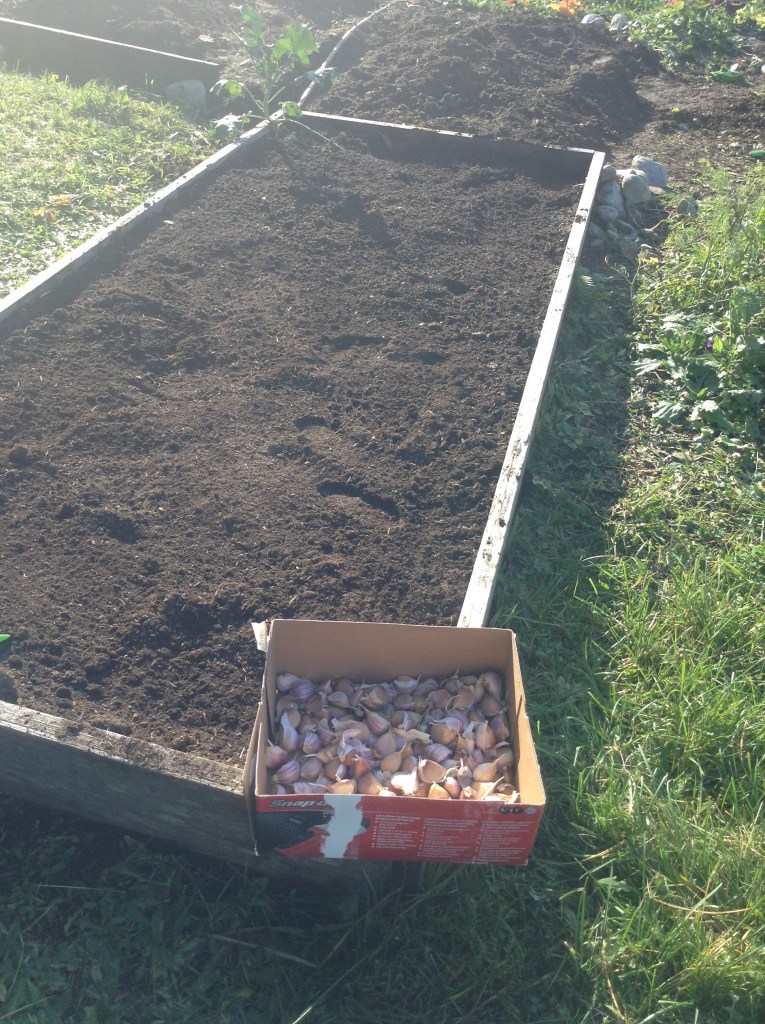
I guess I always did say a kind-of prayer when I planted garlic – “okay then, do your thing.” I’d brush my hands clean of the moist black soil and feel again the improbability of all this growing business – stick clove in soil, anticipate its budding five or six months from now. I mean, how the hell does that even work? Shrug.
“Over to you guys. Here’s hoping.”

And there was a certain kind of hope in the action, a brave kind of reclaiming my right to grow my own garlic and feel a bit empowered, but the prayer itself was largely a faithless one – a parcel dropped by my suspicious feet, with no address, beyond a scribbled “To whom it may concern”.
I am always caught by surprise by the little nubs of green shooting up through the mulch in the spring. It inspires wonder… but the wonder of the doubter… like, “that’s wonderful, but I can’t really believe it actually worked. There must be some trick to this Life business.”
This year was different. (And I don’t think I can attribute it to experience – or to ten consecutive “successful” (knock on wood) garlic harvests.)

I think the difference is that this year, there’s a new word in my vocabulary. The Underworld.

Says the Google:
Hidden deep within the bowels of the earth and ruled by the god Hades and his wife Persephone, the Underworld was the kingdom of the dead in Greek mythology, the sunless place where the souls of those who died went after death.
It’s a word that kept coming up this year, from some of the thinkers I follow, folk who try to parse meaning from news headlines, whose idea of bigger picture involves mythology and ancestors and cosmic time.
What I gleaned from those thinkers is that we could possibly think of this pandemic time, this “lockdown Lite” (as it’s been in BC) experience, as an opportunity to be initiated. An invitation to take things seriously. To go deep. To be confronted. To stop running around like the White Rabbit (“I’m late, I’m late, for a very important date”) and turn bravely and acknowledge Death. To shed some stuff – some of the ego’s favourite props. To emerge out the other side a little wiser… rather than just annoyed and anxious to reclaim my old life, exactly as it was.
The climate emergency is the real event horizon that looms large. Maybe, I thought, COVID-19 might teach us something that can help us approach that bigger drama, treat this as a threshold into a different way of being, instead of just an interruption to our regular programming.

So when there was a brief window through which I could race out to the garden, clear a few beds, and insert cloves, I was in a different frame of mind.
What has happened, strangely, in this last year, is that I’ve been invited by wonderful meditation and wisdom teachers, (thank you Susan Reifer and Natalie Rousseau) to allow myself to feel supported. Like, literally, to sit and close my eyes and feel my bones on the ground and the floor meeting me, and all the bits of my house holding things up and the earth beneath that… everything that rises up to meet the parts of me that settle down.
That was new.
And when I got around to planting this spring, I invited my weedy messy garden to support my little food-growing mission – to rise up to meet the part of me that was sowing seeds and digging down. And to my everlasting surprise, it did.

And whenever I felt the lonely weight of all my feelings throughout the spring and summer, as we practiced physical distancing and hunkered in our wee bubble and I lamented all the things and people I was missing, the falling away of all the things that used to prop my ego up, the shock of lost momentum, the loss of all that had suddenly been cancelled, I walked outside and sensed the trees creating a kind of open-air church around me, all steadfast and able to contain the leakages of my emotions.
And when I got curious about the idea that my great-grandmothers probably lived through pandemics, and did a little ancestry research, I arrived at this powerful sense that I am now the garden, I am now the physical matter in which my ancestors have the opportunity to flourish. I am the place of bloom. I am the landscape of Life and vitality, and they are all informing that, nourishing that, infusing that with richness, with the compost of their own lives.
In short, instead of working in this hopeful-but-not-really-convinced state of reclaiming life, growth, gardening and garlic, I became reclaimed. I was reclaimed by my ancestors, by the soil, by the life force, by the trees around me.
I planted the garlic this year, and I knew, without doubt, that those little cloves were not being cast out into an uncertain future, but that they were being offered back to Life, returned to soil that I tend with care, that I nourish with compost that has been generated from a combination of yard waste, our food scraps, wonderful worms and a host of other microscopic life. I understand that under every foot of soil, are gazillions of microscopic living beings. It is not me, kinda hopeful, against the emptiness. It is me settling down and receiving an immense amount of support that rises up to meet me, from every imaginable direction. Invisible, sure. But, even though I don’t see it, I sense it. I sense it now.
I pushed the garlic into the Earth, and tucked them in for their winter sleep, their journey to the Underworld, beneath a blanket of maple leaves that I scraped up from the yard.
This year, I have come to believe in the Intelligence of All Things, an intelligence that is encoded in all of us, a deep Knowing of what to do. The garlic will lie in its depths through the Dark Season, as the wheel of the year rolls from Samhain (pronounced sow-en in Celtic, the pagan precursor to Halloween) through to Solstice and over into Imbolc, the spring, and then they will rise again.
And it won’t be a surprise. Because this is what Life does. It returns. It sprouts forth, it blossoms, it revels, it fruits, it pares away, it dies, it is absorbed, and it returns.
So I tucked them in to the bed, and I offered my prayer, and this year, it wasn’t: hope you know what to do now… It was “thank you, thank you, sleep well and I’ll see you in the spring,” silently uttered with a little tearfulness and the deepest kind of gratitude and reverence I know.

 Traced Elements