I started my tomato seedlings on March 24th which is at least two weeks later than usual. It wasn’t until the snow really started to melt that I felt motivated, but better late than never.
My Dad is the self-titled Second Best Tomato Grower in West Vancouver. I can’t vouch for whether #1 deserved the title as I never met him, but as far back as I can recall, my Dad has grown tomatoes. Not the weird multi-coloured heirloom ones, just the basic varieties of Big Beef, Early Girl and red Cherry tomatoes, that look like, you know, tomatoes. My Dad is known as Tomato Grampa to his Grandkids to differentiate from the other Grandpas; not sure if they were lucky enough to have nicknames.
I remember the first greenhouse Dad built in the house I lived in until I was 24. It had poly sheet walls on a thin frame, and a plastic corrugated roof. My mother, sister and I were instructed to donate any pantyhose that had runs, as they made wonderful flexible slings for vines and fruit; this is back in the day when women wore pantyhose at work and most other places so there was an endless supply. After I left home, my parents moved into a new house and Dad built a hot tub inset in the raised deck off the kitchen; the heat from the tub heated the enclosed glass greenhouse he built under the deck. It was ingenious and the tomatoes flourished.
When I lived in various apartments in the city, I always had a tomato plant on my deck donated by my Dad. When I moved to Pemberton, I finally had room for a garden, so started my own plants from Dad’s seedlings. As he did, Dad taught me to save the seeds from the biggest and best fruit by placing the seeds onto a paper towel and letting it dry. Label it, fold it up and put it someplace you’ll remember. No cleaning or fancy storage required. For many years, I have grown the babies from my Dad’s original plants, and I still save my seeds the same way. I hope one day to pass along their progeny to my son.
Last year I started 72 plants, and all but two came up. Of those 70, 6 didn’t survive the transplant into the ground (I don’t have a greenhouse, yet…) so I asked my husband to pick up 6 to replace them. He came home with a flat of 36 instead. They were so cheap, he says. This happens every year as my husband has little faith in my leggy and straggly transplants, but by the height of the season they have stalks as thick as my thumb. Unlike my Dad’s orderly greenhouse rows, my boxes are overcrowded, a Tomatazon rainforest. My carpenter husband builds straight and orderly trellises with end cuts for his bought plants, while I pick up weirdly-shaped deadfall from the woods, as pantyhose are no longer a staple of my wardrobe. My boxes are whimsical and interesting; his are uniform. Nevertheless, all our plants do well, so I spend a good part of my fall canning, drying and giving away tomatoes. I always complain about having too many but every year I still start 72 plants, in case half don’t make it, and every year my husband buys more.
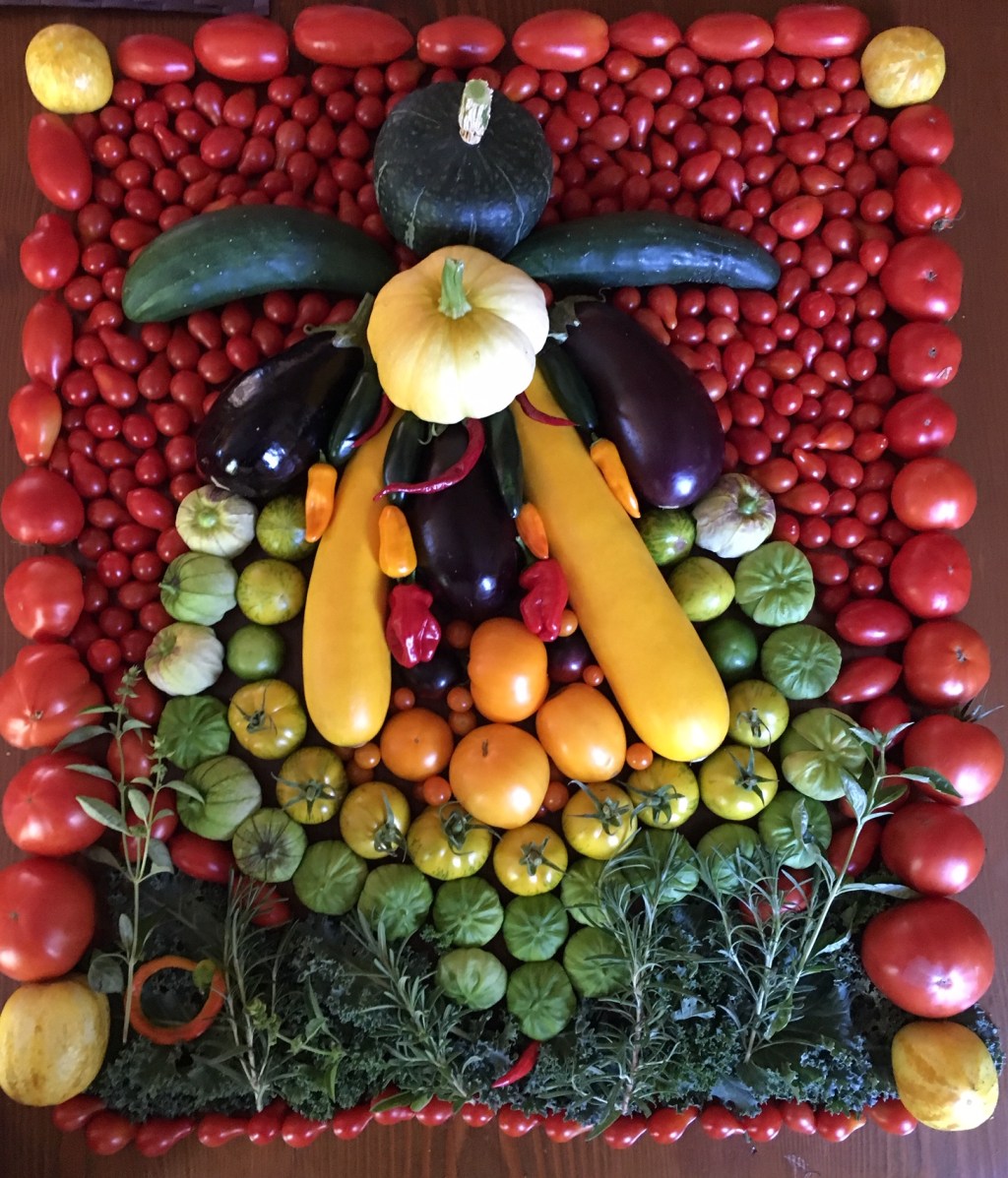
When life gives you an abundance of tomatoes, make art. Photo, and vegetable art, by Nancy Lee.
When my parents moved into their current seaside apartment, Dad gave up starting his own plants. Now I donate a plant or two, some of which I get the side-eye for (Green Zebra, Big Yellow, Indigo Cherry or Roma) as he prefers the basic round red tomatoes you can slice and put on a sandwich. He also buys a plant from the local nursery, since my garden tomatoes don’t seem to flourish as much in the ocean breeze as in the Pemby heat.
As I write this a week after planting, most of my seedlings are starting to pop up, and I expect we’ll have another bumper crop. I have a heavy heart though, as Dad isn’t doing well, and likely won’t be here to enjoy tomatoes this summer. I will always be thankful for all you taught me Dad, and every time I eat a warm tomato fresh from the vine, especially the round red ones, I will think of you.
On my desk right now is a gorgeous little collection of essays called Wonder and Other Survival Skills, put together by the editors of Orion magazine. On its cover, a young girl presses her hand against the surface of a lake: skin of girl meeting skin of lake. From this meeting, a ripple moves.
“Is wonder a survival skill?” H. Emerson Blake asks in the foreword. “The din of modern life pulls our attention away from anything that is slight, or subtle, or ephemeral. We might look briefly at a slant of light in the sky while walking through a parking lot, but then we’re on to the next thing: the next appointment, the next flickering headline, the next task…Maybe it’s just for that reason—how busy we are and distracted and disconnected we are—that wonder really is a survival skill. It might be the thing that reminds us of what really matters, and of the greater systems that our lives are completely dependant on. It might be the thing that helps us build an emotional connection—an intimacy—with our surroundings that, in turn, would make us want to do anything we can to protect them.”
By my own definition, wonder is the ability to travel beyond attention, beyond mindfulness–to truly make an encounter with the world in a way that, for the slenderest of moments, lifts us out of ourselves and returns us back with something more. Something of the ‘other’ we’ve encountered travels with us. A little of the world comes into the interiority of us and lodges there. Permeates.
Winter is a season of rest for most of us land-based folks. A season of living in a place of dreams and visioning (literally, as we get caught up on sleep, and plan for the year ahead.) This is the first season I’ve stopped teaching completely. I felt the need to let the work do a deep dive into silence, and (beyond the day-to-day chores of keeping animals, which never go away), to truly let myself drop out of time. I sleep when I’m tired. I wake up when I wake up. I have breakfast and a cup of coffee, before I go out to do chores. Which sometimes makes me feel like a slacker, but it also feels… luxurious. Luxurious in a simple way I haven’t allowed into my life before. A spaciousness that holds its own kind of wonder.
The other reason I decided to stop teaching completely once the snow hit in December, was I wanted my horses to feel like they belonged to me again. 2018 was our busiest year teaching together (THANK YOU, PEMBERTON!) but I wanted a chance to ride when I wanted to again, instead of working a horse so they would be ready to say ‘yes’ to a student. I wanted to WANT to ride again. To wander about aimlessly bareback with nothing but a lead rope joining me to my horse’s mind. I wanted the horses to be able to choose who came out to play with me, whenever I showed up at the gate with a halter or a bridle.
What’s emerged out of this unravelling is that I was finally able to back Besa, my big paint/Friesian mare. When she came to me 18 months ago, she was an untrained 6-year-old, freshly weaned from being a mamma to a feisty filly. She made it very clear to me- in her lack of desire to be caught and her extreme reactivity, power and athleticism- that I’d have to take my time with her. Given space and the permission to approach me (instead of me expecting to approach her and do what I wanted), she decided that humans were worth being curious about. Her curiosity flowered into full-blown affection. She’s the first horse to come to anyone out of the field now, and she sometimes chooses to pull me (or whoever I’m accompanying into the field) in against her chest with her muzzle, the closest a horse can come to giving a hug.
Besa’s been asking me to do things with her for months (Proper things! With a bridle and tack like all the other horses!) and all summer and fall I just didn’t have the capacity. But these last few weeks I’ve slipped onto her back and let her carry me around our little maze of snow paths in a mutual exchange of trust: I will trust you with my body, if you will trust me with your body. The ‘training’ part of it can come later. For now, all I want is her to turn her head to me, so she can look at me fully out of her huge dark eye: Oh. So now you’re up there now. So that she can yawn and snort and let all the tension go out of her nervous system, and get used to this strange new way that horses and humans can be together.
Perhaps it’s me she’s been waiting for all along. Perhaps I needed to drop into this spaciousness for us to find this way to trust each other.
There’s one essay that stands out for me in this slim little collection that sits on my desk. It’s Chris Dombrowski’s Kana: a father grasps at the nature of wonder. In it, he defines Kana as “a word or figure the Japanese haiku poets used as a kind of wonder-inducing syllable (it translates loosely into English as an exclamation point.)… that heart-stutter we receive when an image of the world takes root in us…”
His essay shares the spell of a day spent morel hunting with his twenty month old son. The way the boy wanders across the face of the burn, trailing a whitetail’s antler behind him, carelessly decapitating the very mushrooms he’s hunting for:
…he is either in a daze of boredom or he is walking kana, penetrated each step by the world, not penetrating it. It’s tempting to call this spirit naïveté, but it’s not: it’s wisdom we lose along the way.”
Perhaps that’s what I’ve been courting this winter: wisdom I’ve lost along the way as I’ve been coerced into ascribing to linear time, to capitalism, to the many demands the constructs of being human impose upon us. There is gentleness here, in this wonder, that doesn’t feel rushed or imposed. A hand resting against the surface of a lake.
I’ve wanted to broaden the scope of my horse and nature based teaching practice to include workshops for adults since I started Mountain Horse School in 2012, but I’ve shied away for a long time. I’ve always felt comfortable with kids because they’re so immediate, so open still to this touch of the world upon them. Grown-ups’ responses are layered. More conditioned. We need more language to access understanding, and experiences that can operate like keys opening the locks of ways of perceiving we’ve long put away. Grown-ups want reasons to pacify our rational, linear ways of thinking, and we want to know if playing with opening the doors to wonder, if walking Kana is ‘worth the investment’ of our time. We’ve become used to being sold meditation through a list of its benefits. A walk in the woods has become a thing we could pay for. Forest bathing, it’s called in the brochures.
What if wonder is the gateway to possibility? What if it’s the only skill that will give us the tools, insight, and power we need to move into (here I am, throwing another book title at you!) The More Beautiful World That our Hearts Know is Possible? What if the benefits of wonder—similar to its more lauded cousin, gratitude—might be the resurrection of a life woven into belonging with the wider world that sustains us?
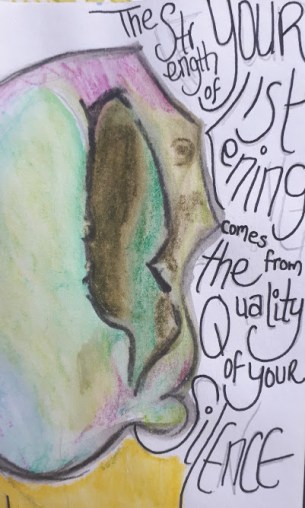
Small watercolour of a whale’s ear bone from the intergalactic spaceship that is my desk. Because of the complexity of their hearing, whales’ inner ear bones are contained within a separate chamber, not encased inside the skull as ours are. It amazes me how much this bone looks like a shell. If I held it to my ear, would I hear the sound of the sea?
It’s not up to me to answer these questions. I can only speak from the lens of my own experience, my own perceptions. In lieu of that, I can say with certainty that this winter’s dreaming I’ve been luxuriating in, this kana I’ve been walking in my own life, feels absolutely essential to the future that comes next. I can say—if I may speak with authority based on the way things feel from the intergalactic spaceship that is my writing desk this afternoon—that it HAS been absolutely necessary. That nothing is currently more important. Oh, the great irony that ‘doing the work’ this winter has actually meant ‘doing less work—!’ (Is that an exclamation mark or is it kana? You decide.)
So, in the spirit of wonder being the gateway to possibility, I’m issuing a little dare to myself. Actually, it’s not little at all. On Feb 17, I’m offering a one day workshop called Lightning Seeds: Opening the Gateway of what’s Possible, in collaboration with my dear friend, animal listener and translator Guliz Unlu. Come play with us as we walk kana in the company of the horses and other animals at Mountain Horse School, and court wonder through a combination of equine guided learning, animal communication, intuitive herbalism, earth wisdom, and soul craft. Curious to know more? Please visit our website or facebook page for all the juicy details!
As Christmas neared, I thought about ways to make the season a little more special for my dad, who is in residential care in Squamish.Home baking is always a treat for him but I knew one item in particular would be most welcome: lefse.A Norwegian flatbread made with several variations, lefse was something Mom used to make for Christmas using Grandma’s recipe, which called for mashed potatoes, flour, milk, butter and a little salt.In the old cabin, she baked it on top of the wood stove after rolling it into tortilla sized rounds.Once one side cooked she flipped the lefse using an old yard stick, then made a stack of ten to twelve which were rolled up inside a tea towel.It was a sticky, floury, messy procedure but worth it when the butter and Roger’s Golden syrup came out; Dad would spread the syrup and butter over the lefse then roll it jelly roll style, holding both ends up to eat it so the syrup didn’t run out.
Well, my attempts at recreating lefse have not been very successful – my potatoes were too wet or I didn’t add enough flour or I was too reluctant to commit to the messiness of it all.Dad ate it but I suspect he was being kind – thank goodness for the syrup.So this year, after a cousin reminded me that one could actually purchase lefse in the Lower Mainland, I phoned around to try to buy some; alas, the sources were too far away or just not feasible.Then I had a brainwave – I would post an ad on the local Buy and Sell sites: ISO someone willing to sell some lefse.Help make an old Norwegian’s Christmas a little brighter.
It took an hour till my inbox pinged and there was a message from a man in Squamish who was willing to trade me some lefse for Pemberton carrots and potatoes.We arranged a time and date and then I started fretting about finding the Roger’s golden syrup which has some substitutes but none that are quite as tasty, apparently.Before I could take my post down, another person responded, saying, “this is the best post, ever!” We chatted and she assured me that if I couldn’t find the Roger’s Golden Syrup, her folks had lots and she would meet me somewhere in Squamish and give me some.People were committed to a successful completion of my mission.
Tuesday rolled around and I texted my supplier that we were on the way and plugged the address into the GPS.They were in full production mode when I arrived; here was a couple who did not hesitate to embrace the lefse mess.He had made a round metal plate to place on top of the electric burner of the stove and they had ordered a proper ridged rolling pin and a thin flipping stick for easier manipulation of the rounds.It was his job to flip and tend the lefse while his wife prepared the dough and rolled it into the proper shape.
Here, have a seat and taste it, they encouraged me, spreading one piece generously with butter.Now, I have never really been a fan of this treat (some people say lefse tastes and feels like burnt newspaper with flour on it) but theirs was spectacular – soft and not too floury – perfectly cooked.We talked about how often they made the flatbread and what traditions they associated with it, discovering mutual friends and sharing Christmas stories.I left with twelve pieces wrapped in a napkin.Don’t worry about the napkin, she said, I buy them at the thrift stores for nickels and dimes, then send them off full of baking.
When I got to Hilltop House, Dad was participating in a word game wherein the participants had to offer words beginning with particular letters of the alphabet for a variety of prompts in under a minute.They were already at S – Somewhere hot–Sedona–Something yummy–Smoothies–Something you eat at Christmas-Stollen. I was not surprised to hear that Dad had said lefse earlier in the game for that particular prompt and the other residents were pleased to get a first hand glimpse of this item they had not heard of.
Dad and I went back to his room and I set up our little feast of lefse, butter and Roger’s Golden Syrup (which I found at Save-on.) While Dad rolled up his first piece, I relayed the story of how I’d procured it and he got a good chuckle in between bites. Christmas season did indeed get a lot brighter because of that home baked treat.





 As Christmas neared, I thought about ways to make the season a little more special for my dad, who is in residential care in Squamish.

 Traced Elements