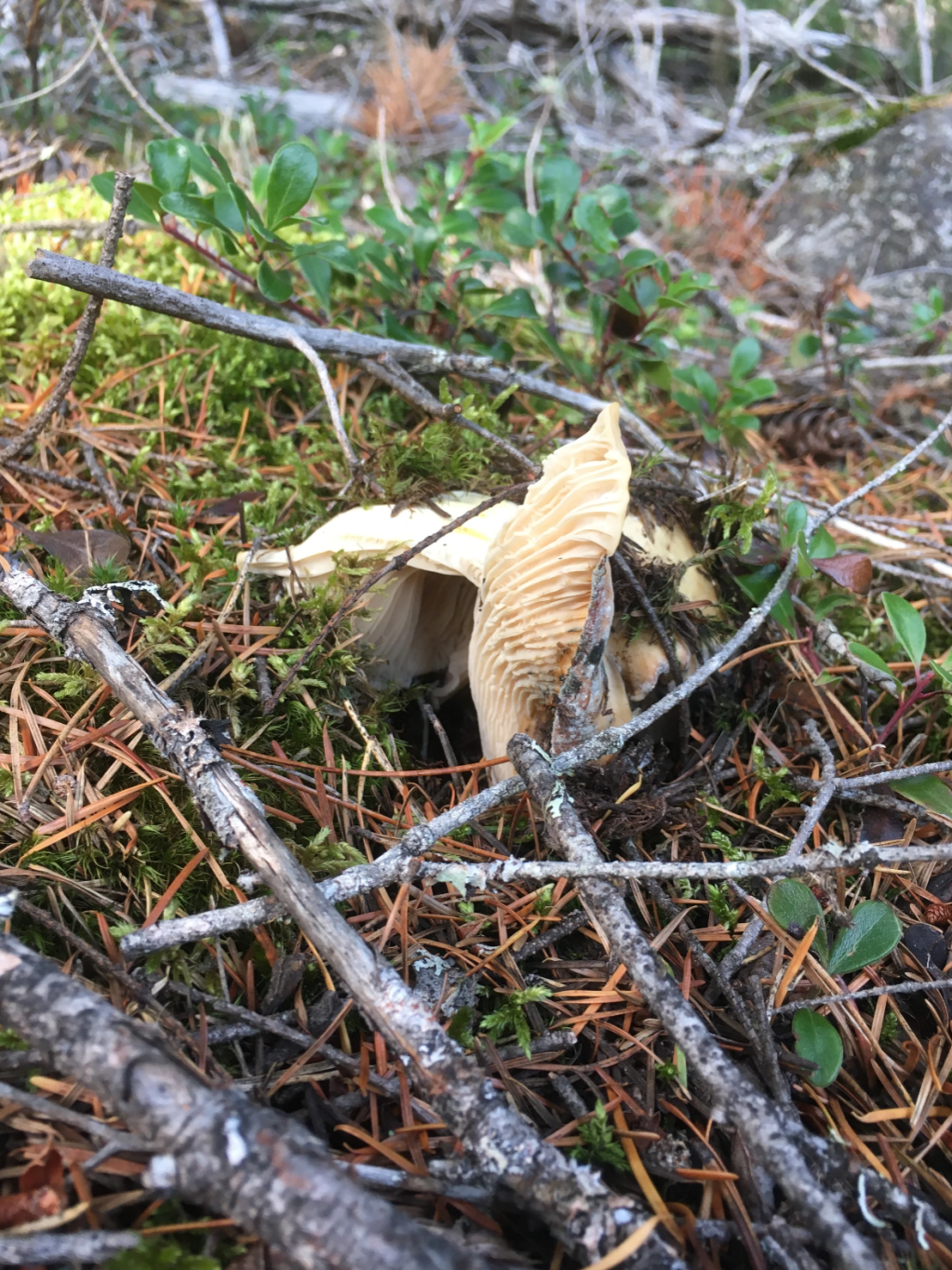
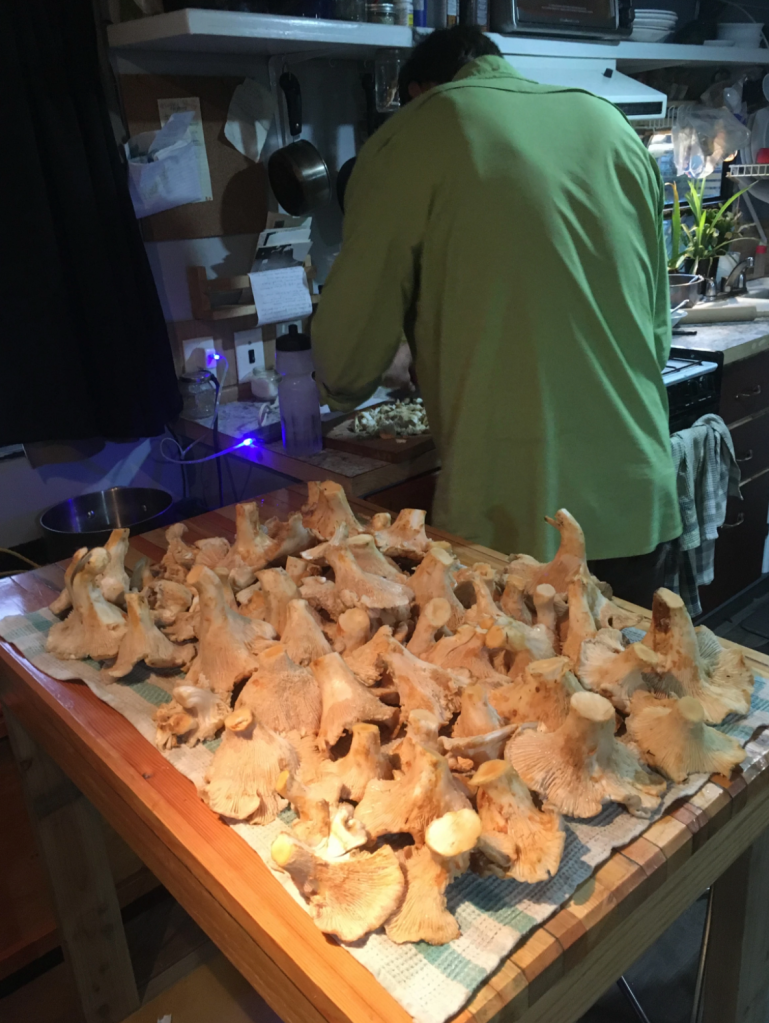
Once again, I went for a walk in the woods and was shocked by the bounty that nature provides when I make the time to search it out. Look at those beauties!
In case you haven’t gone mushroom hunting, it’s a delight. I leave the house with a vague destination, no peak to bag, no panorama to catch, no goal except to meander slowly and pay attention. It is so nice to just BE: to be present, to smell the forest, to remember which direction I came from, and pick where I want to go. To watch the world work its magic slowly, growing with seasons and time, and to forget about needing to DO all of the time. I carry a wicker basket, so the spores of the mushrooms can fall out as I walk (a trail of breadcrumbs to the mushroom patch once they fruit too!). I carry bear spray, water, snacks, I bring the dog, and with no rhyme or reason, I explore!
You can see in the first picture- chanterelles can be mischievous, hidey little devils. Sometimes, as with most hunts, it’s best to expect to find nothing so that I can’t come away disappointed. Sometimes, however, when you find one, there are probably more around. Chanterelles are in season right now, they like partly sunny, wet, mossy forest floors. And in the right conditions, can be as big as my face!
Once I get chanterelles home, I clean them with minimal water and a toothbrush. Water makes mushrooms mushy – but since they pop up out of mossy forest floors they often need some kind of cleaning.
I think chanterelles are best fried in butter until they lose all of their moisture. When they start turning brown and crispy, add them into pesto or stirfry. YUMM!!
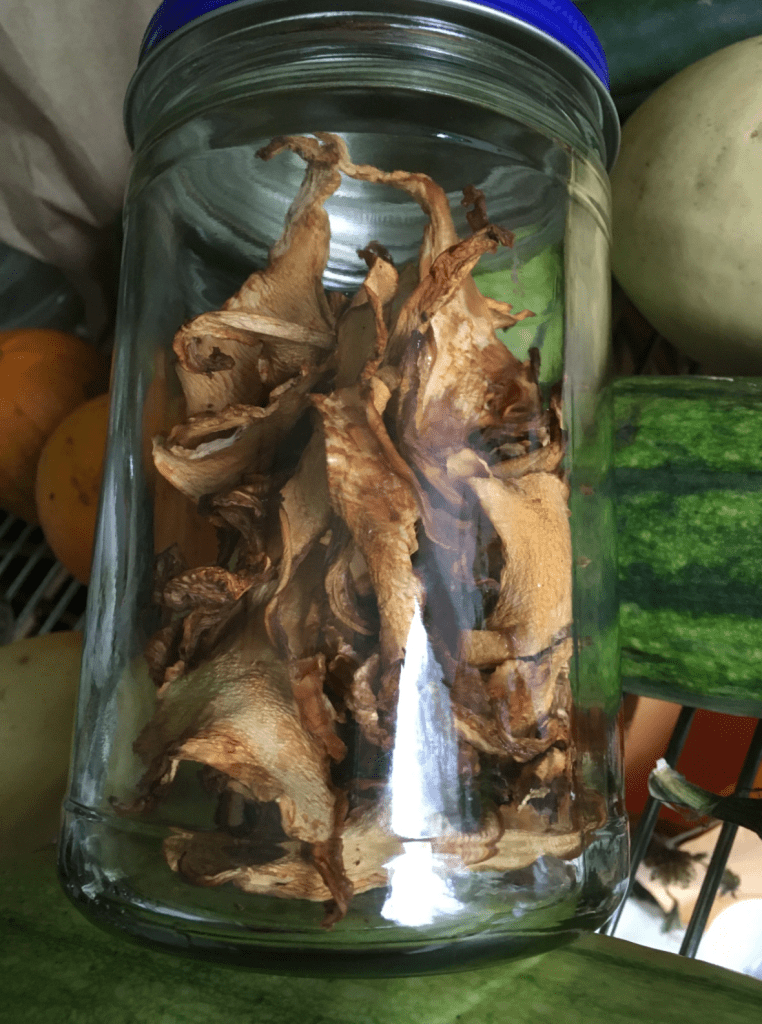
And in the situation when I have so many I can’t cook them all at once, I like to dehydrate the rest and save them for later.
A cream of chanterelle soup late in winter really makes home feel cozy and warm!! And I love the memory of the adventure that brought my food to my home. Meals paired with memories taste even better.
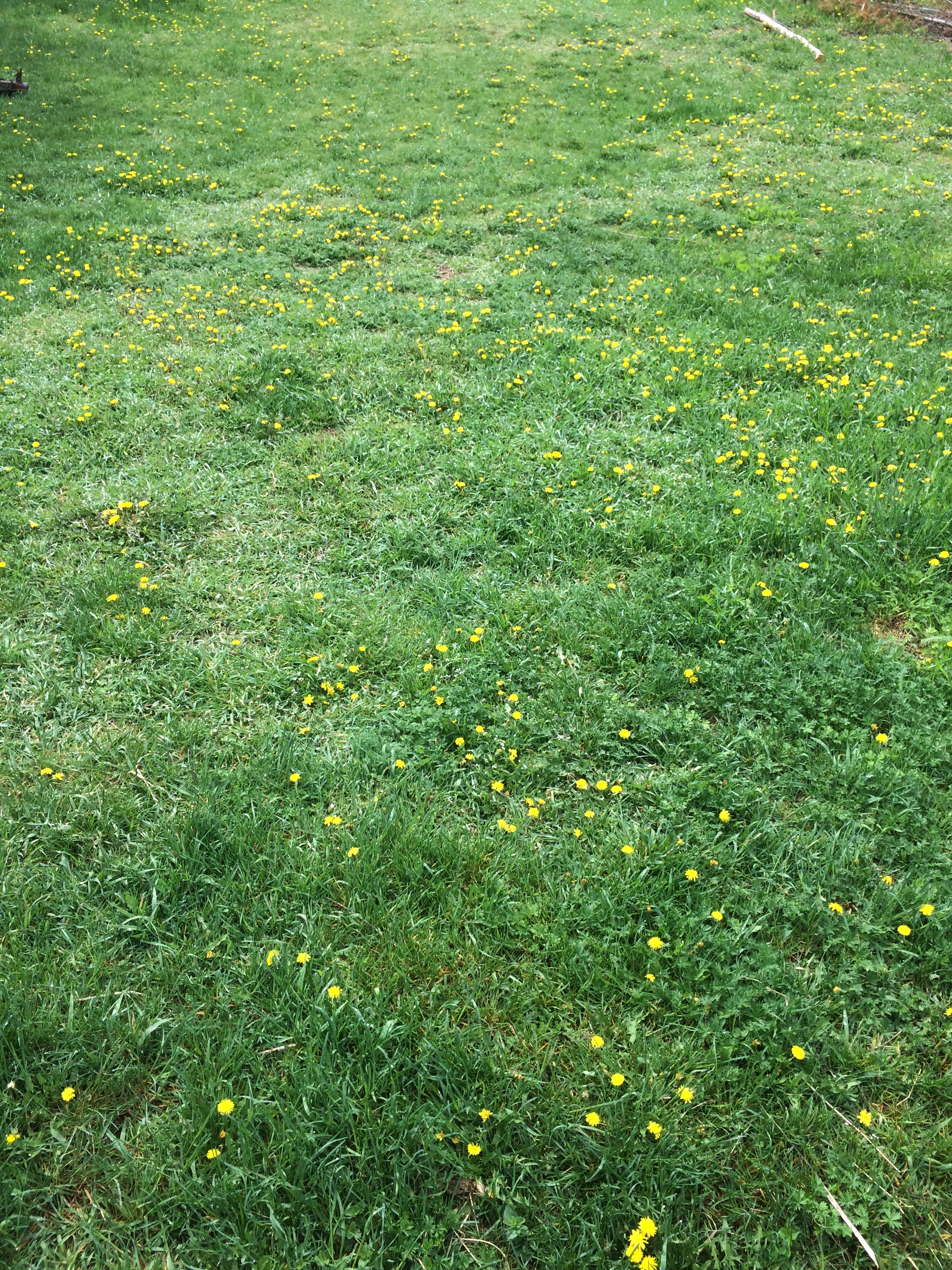
Could a food chain that whispers of global vulnerability make me reconsider the value of my yard as part of my personal supply chain? I cultivate weeds better than anything. My yard is a festival of dandelions.
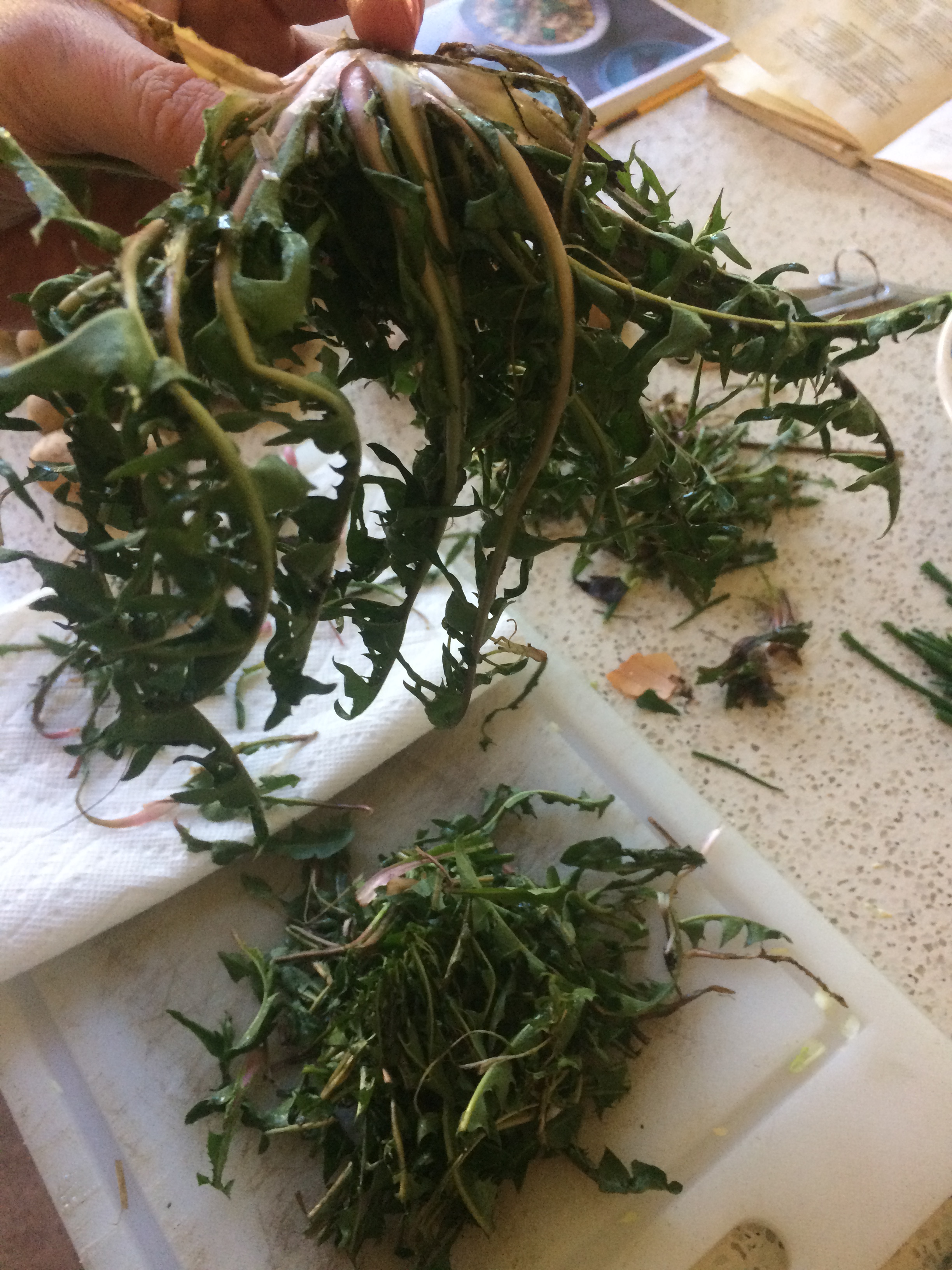
There is nothing to be gained by declaring war on this. But everything to be gained by researching all the medicinal and nutritional benefits of dandelion and declaring it my most successful garden crop ever. So, with a nudge of encouragement from Natalie Rousseau, whose plant ally for early spring in her 13 Moons course was dandelion, I cooked up a dandelion saute, as the evening’s serve of greens.
It tasted… so… weedy.
The seven year old sniffed and said, “No.” Husband’s verdict: “not for the permanent recipe collection.”
I went to instagram to announce this state of affairs.
And was encouraged by friends not to give up.
So I did some more research. They are SO GOOD FOR YOU. My coffee-to-wine IV line slash coping technique has short term effectiveness, (upping and downing me as required), but I’m not in love with the long term consequences (like looking haggard. I embrace witchiness but I’m not ready to be a hag just yet.) The promise of clear skin alone convinced me to keep trying – if not to disguise or balance the taste of dandelion, then to acquire.
Two weeks into my experiments with dandelion (and with even more available in my yard, yay abundance!) it’s some combination of all of the above.
Susun Weed has taught that information in wild food is healing to our cells, it nourishes them with fewer glitches, it returns us to a state of health that aligns with an older Earth, because the receptor sites for minerals in our cells, are primed for the nutrients found in wild food.
the optimum nutrition is the nutrition from the wild plants. ~ susun weed
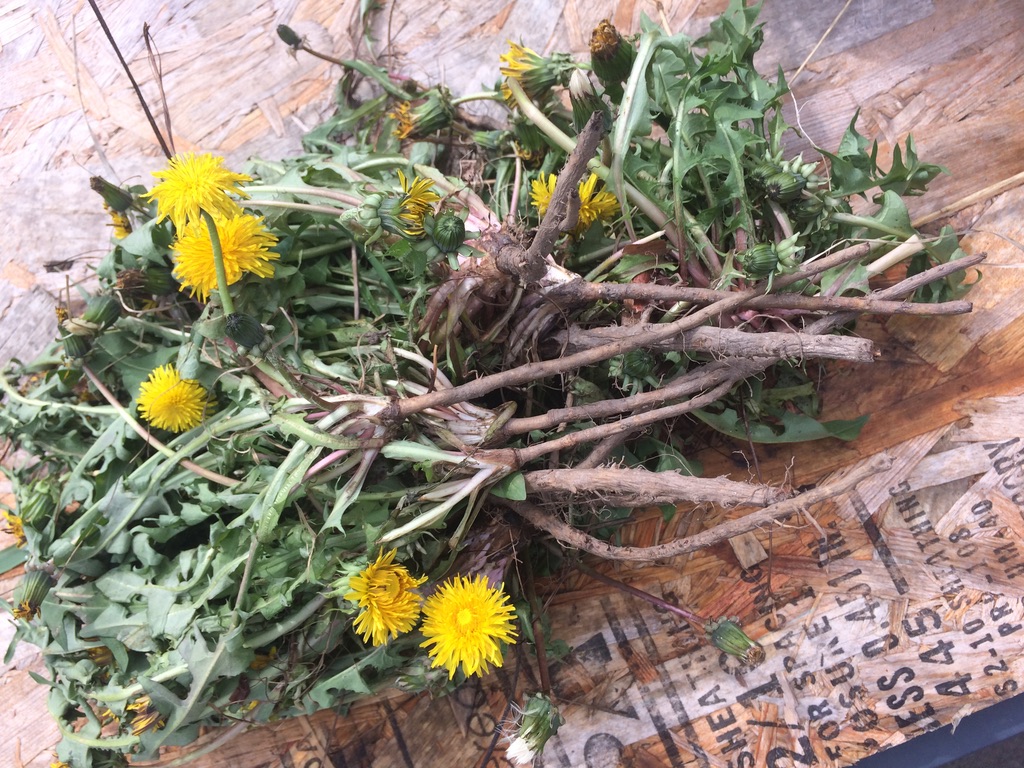
Dandelion is a member of the Asteraceae (daisy) family, a spring tonic and blood purifier. Dandelion leaves and roots relieve chronic stagnation in the liver, while the flowers can relieve a stagnant depressed spirit.
“It grows almost anywhere: wild in fields, lining trails, in suburban yards, breaking through cracks in city sidewalks. Its constant presence is a reminder of its persistence to live as long as it can under any condition.” ~ Christine Buckley, Plant Magic
It was actually imported to North America as a spring green and boasts the scientific name Taraxacum officinale, meaning the official remedy. Like, for everything.
Its strengths are as a tonic, diuretic, alterative, antirheumatic, bitter, cholagogic, hepatic, exhilarant, mild laxative and nutritive.
Dandelion – Are tap-rooted biennial or perennial herbaceous plants, native to temperate areas of the world. Dandelions are thought to have evolved about thirty million years ago in Eurasia, they have been used by humans as food and herb for much of recorded history. Dandelions are one of the first plants to bloom in the spring and therefore are a very important source of nectar and pollen early in the season. Its tap-root will bring up nutrients for shallower-rooting plants, and add minerals and nitrogen to the soil. Dandelions are even said to emit ethylene gas which helps fruit ripen.
Christine Buckley, in her new (and highly recommended) book Plant Magic includes dandelion in her herbal arsenal – she makes vodka tincture with the flowers and takes that jar of liquid sunshine as deep winter medicine, confessing it is her favourite plant for being “scrappy, fierce, life giving and cheery.”
Buckley recommends to use the roots for sluggish digestion – dandelion will not just kick your digestive system into high gear, it also improves bile production in the liver, so you can digest fats and eliminate toxins from your body with more ease. This will reduce inflammation in the body, make your skin look better, help your metabolism and allow the liver to cleanse the blood.
It’s high in mineral content and inulin, a type of fibre, which is an excellent prebiotic.
Are you sold yet?
The leaves are great spring salads – waking up our systems. It’s a tonic, so that means you can take it, every day, and little by little, you will improve.
“It is the ultimate preventative medicine,” says Buckley. And high in potassium, too.
So long as the leaves are green, they’re edible. They become progressively bitter, so start with tender spring leaves. It also is packed with vitamins A, E, K, b6, B1 and C. Temper the bitterness with other ingredients (like plaintain leaves, garden herbs, seeds, nuts, shaved cheese, dried fruit.)
So, with that data fomenting in my brain, my community of wild advisors offered tips on incorporating this super food into my diet.
Christine Buckley’s must-have new book, Plant Magic
Holly Joseph recommends: “The roots are nice and hot right now. Add to a stir fry, they taste so good! Brush them off under the hose. They are long and thin right now. And taste pretty peppery. I just cut it up right from the garden and put it right into my stir fry. Made it kind of spicy!”
Asta Kovanen’s advice: “My tip is to cut wild greens in slowly. Add them in small percentages to your regular veg and then your palate can adjust without major assault.”
Leala Selina Martin said: “I often will juice them as the larger they are the more bitter. They are so good for you though!”
Sarinda Hoilett advised: “It’s all in the balance of flavours. Macadamia nuts (although gift from heaven) are expensive and hard to find…you can substitute cashews or even avocado and try for a creamy citrus blend to balance the bitter 🍃, And mix them with other greens or drop a few in a sweet smoothie.”
Dandelion Cream Salad
20 dandelion leaves, finely chopped, main stem rmoved
1/2 cup macadamia nuts
1/4 cup diced red bell pepper
1/4 cup coconut water
3 tbs lemon juice
1 tsp Celtic salt
Massage chopped dandelion leaves well with salt to break down the fibre. Let sit for at least 5 minutes. Blend nuts with coconut water and lemon to cream. Mix well to coat dandelions with cream and add red bell pepper. This salad is a wonderful way to get the great nutrition of dandelion with a reduction of the bitterness.
After great success with Natalie’s dandelion cordial, making Christine Buckley’s winter rescue tincture (as I call it the “dandy brandy”) is next on my list.
1 ½ cups dandelion flower blossoms
1 cup honey
1 cup brandy
Put the flowers in a glass pint jar. Dissolve the honey in the brandy by stirring or whisking vigorously together. Pour the brandy and honey over the flowers, label and store in a cool dark place for 6 weeks. Bottle your tincture but don’t hide it away so well that you forget about it by winter.
Pemberton-based clinical herbalist, Evelyn Coggins,advised, after reading this post: “I love to hear this topic of wild medicine/wild food being shared as miraculous, magical news… because it is all that. A weed is just a plant that hasn’t learned to grow in rows. The bitter principal of dandelion is tricky. We like sweet, salty and to some degree sour but bitter rarely. Maybe we are cautious because the toxic constituents in plants are most often present as alkaloids and alkaloids are bitter. It must have been a real learning curve to distinguish between toxic and beneficial bitters. The beneficial bitters aid digestion and many traditional aperitifs employ plant based bitters. Gin and tonic is a good example. Gin is prepared from juniper berries and they are bitter. Bitters act on the bitter receptors on the tongue and start a chain reaction that leads to the increased flow of bile into the digestive tract and all the nutritional value that ensues from there. It is not surprising that the liver leaps into action with bitters since poisons must be metabolized and hopefully rendered harmless by this organ. I agree that one must start slowly when turning to bitter plants but the journey is so worth it.”
I’ve been a client of Evelyn’s and can’t recommend her highly enough.
Now, more than ever, is a time to treat nature as an ally, not a servant/slave, and to behave with honour, humility, curiousity and gratitude.
Just because you use the derisive word weed doesn’t mean this plant has no value.
Finally, leave some for the pollinators. They matter in this lovely web, perhaps more than anyone. Not to mention, the roots reach deep into the soil to bring up nutrients, so they’re working healing magic on the Earth, not just our bodies.
Thanks to Tanina Williams, who first introduced me to the idea of making dandelion jelly, for sharing this video:
Earlier in the New Year, I was examining the contents of my “witch’s cabinet” (as the friend who gifted me the antique armoire named it), taking note of the herbs that should ideally be used up before spring foraging starts up again.
I pondered starting a micro-dosing program. Not with psychedelics, of course, but I was playing with the concept using herbs, spices and novelty. This seemed a good alternative for those of us who cannot—or don’t want to—ingest consciousness-altering substances, but who still enjoy playing with our lived realities by changing patterns of consumption.
It would also serve my fondness for do-able projects—taking on something subtle, like opening a window to let in fresh air rather than taking down a wall in order to build an addition to the house. Where the idea eventually landed was here: I would make at least one new recipe a week for the year.
Fast forward a few weeks into late February. I returned to Whistler from Japan; COVID-19 was just beginning its global sweep out of China, and Japan was one of the early hard-hit countries. A few days after returning I developed a cough and sore throat, and was suddenly quarantined with the fear that I would be patient-zero in Whistler. After testing negative for the coronoavirus, however, I remained in quarantine with Influenza-A.
Because of the flu, I couldn’t eat, but nevertheless started poking around the kitchen more intently. What exactly did I have in here to support health and immunity? (What did I have, given that the Canadian government was recommending we have two weeks worth of food and limit visits to the grocery store).
Due to a tiny pantry that comes with townhome living, I don’t have stocks of dried legumes and flour (yet!) but there is a substantial stash of otherwise semi-filled jars. There are herbs and spices galore, both from my personal interest in flavours and foraging, and because one of my sisters is a certified herbalist.
In the fridge I found elderberry syrup and a stash of liquorice root and juniper berries (anti-virals). There was a jar of chaga from my parents property in the Cariboo, as well as clover flowers from their yard. My mother dehydrates kale by the wagon-load to crumple into soups, rice, or casseroles, and I found two bags as well as her dried apple-slices. The freezer contains steamed nettle that I’d completely forgotten about and a bag of chopped rhubarb to boot. My mini-stash was actually awash with interesting bits & bobs. Dandelion root, yarrow, calendula… harissa, nasi goreng mix and lemongrass. Local and exotic side by side.
Now, what to do with it all?
These are strange and stressful times. Most days I feel a strong need to create something— anything. And I’ll call it a win for the day even if it’s just making a nice cup of herbal tea or trying out a new soup recipe (**disclaimer, I don’t have young children; a friend with a young one told me her goal for the day was just peeing by herself, so fair enough**).
Making all these concoctions is my way of coping with unprecedented circumstances. I know others are coping and working it out differently. Some need to chill out, eat chips and ice- cream, and soak up the stillness. I do that, too, but it seems that right now, tiny influxes of new flavours are foodie medicine for my beleaguered soul. Sage-and-lemon-balm tea. Cauliflower taco bowls. Lemony lentils. And yes, banana bread.
My most recent experiment—a hibiscus infusion with ginger and citrus—is from a cookbook that I’ve had for years but have never used as much as in the past two weeks: Amy Chaplin’s At Home in the Whole Food Kitchen. That one book alone has delivered to my plate smashed baby potatoes with garlic & caper sauce, corn-grit blueberry muffins, a coconut curry and turmeric lemonade.
I’ve even taken time to write the author to thank her for her recipes.
What is happening to me? I didn’t even like to cook until I was 30 years old… but it turns out I’m a Taurus through and through. Ruled by the sensual. Now that I’ve got the time to appreciate the gifts of the senses, it’s grounding me. A little less news, a little more time to breathe in the smell of garlic, grind up coriander seed, or drop a bit of cardamom into my morning coffee.
It’s simple, effective and delivers the variety I crave while we’re all house-bound more than normal.
I wish you all well on your own journeys through this… oh, and please send any recommended recipes my way!
“Seeds are software, and we have the seeds” -Representative of the chemical giant Seminis, just before selling out to Monsanto
Usually, plantain is a quiet, unobtrusive little plant. She is known for her excellent healing properties, her usefulness as a spit poultice, and her excellent nutritional properties. She is generally soft spoken, and most people are surprised to notice she has been underfoot all along. She is like coffeeshops in Vancouver: ubiquitous. But lately plantain, sometimes called ‘white man’s foot’ for the way she has followed our footsteps across North America, has been shouting at me. She is poking me with her seed spears. Every time I turn around, there she is. Usually when this happens it means the particular plant that is ‘shouting’ has some particular medicine I need to pay attention to. My resistance is generally high. You think I would actively cultivate some sort of porosity towards these sorts of encounters, but no. When a plant is trying to get my attention (or most things, for that matter) my first response is resistance. When I finally let plantain in all I do is look at her for a moment, but that look takes a photograph that embeds her in my mind and from there she begins to communicate with me.
Plantain
Because of the way the summer has gone- hot and dry- Plantain is setting seed earlier than usual, and with an abundance I did not notice last fall. Perhaps she is foretelling the future, but it is more likely her actions are a reflection of the present. (When a plant is stressed, their seed production tends to be prolific. Cue the fallen black cottonwood I stood in the ruins of this past spring, who released her white parachute fluff designed to float her future progeny over the entire province OVERNIGHT WHILE SHE LAY DYING ON THE GROUND, while most of the trees were barely starting to open their little seed casings.)
But that is not what I want to tell you. What I want to tell you is that I want to cry. Each time a Plantain seed spire touches my ankle it is a reminder that things will never be the way that they were. A reminder that I do not have the time and that I am doing too much, too fast, to really listen, to really hear, to really feel any of it. There is grief in these too-early seed spires. Grief that the world is burning; that part of the morphic field of these seeds will always contain the memory of smoke.
I believe a plant is a part of a specific ecosystem’s innate intelligent awareness made incarnate, and that a seed is the plant’s answer to the questions of its times. And the answer will be different, even among similar species, if they are growing in different locations. A seed is this wild intelligence made portable, designed for dispersal, a portable currency of consciousness.
So if we really want to rejoin the dance, if we really want to be a part of what is going up in flames around us, what is burning and the new seeds that will be born out of this fire, we need to eat of the wild, NOW. We need to take a little of the otherly intelligence that is the essence of the natural world into our bodies so that we can start to belong to the place in which we are standing. Perhaps this is the beginnings of true reconciliation. Or at least the seeds with which to begin.
Please don’t think I am being trite. I am not making small of atrocities that have been committed both by and against humanity. I am not saying that by taking yet another thing from the wild we can heal from the many woundings of the entitlement we have been taught to assume. I am saying that we need to begin to build a bridge to another way of being, of living, of feeling, and that if we can ingest the local wild plants that are doing that all around us in the places where we live, who have not cut themselves off from the responsiveness of the wild innate intelligence of their own sovereignty, then we begin to take those transforms of meaning into our cells, and that begins to alter us.
Do you remember at the beginning when I said Plantain shouted at me? Well obviously she didn’t, at least not in words. But when I started to pay attention- when I started to unravel the thread of meaning she held for me- she led me here. When I went out to shoot the pictures for this post I stripped a handful of her seeds from their spire, winnowed their husks away by breathing into my palm, put them into my mouth and chewed. They popped between my teeth like chia seeds, and had a similar mucilaginous texture. They didn’t really taste like much but maybe that’s a good thing. Something about pulling the seeds from their stalk felt familiar, the way I sometimes recognize the face of a stranger I have not known in this life.
Plantain- the tall darker seeds stalks are ready to be harvested
Plantain seeds, slightly winnowed by blowing into my palm
Beside the Plantain (and remaining mostly quiet all this time) was a stand of Dock, with seeds also ready for harvest.
Dock seeds dried on the stalk and ready for harvest
Dock seeds close up- note their papery hulls which do not need to be winnowed- they can be ground along with the seeds
So here is where we get to the practical and super-actionable and amazing part of this post: you can make flour from both these seeds. Yep, that’s right. SUPER SOVEREIGN INTELLIGENCE WILD MORPHIC FIELD FLOUR WITH BONUS SUPER NUTRITION! (Or as we more quietly call it, Plantain/ Wild Dock Flour.)
Plantain/Wild Dock Flour
Simply go out and gather as much Plantain and Dock seeds as you have the patience for, checking that the ground the plants grow in is free from contaminants and roadside pollutants. There is no need to winnow (separate) the seeds from the hulls as from both kinds of seeds’ hulls are edible and add extra fibre to your flour, as would happen if you added rice bran. If the seeds do not pull off the seed heads easily when you are harvesting, they are not ripe yet and should be left on the plant to mature. As with all wildcafting/foraging, be considerate of the plant’s needs to reproduce and other animals who may depend on the seeds as a food source. (A good rule is to not harvest more than 25% of the yield of a patch, but in the case of weeds like Plantain and Dock (which are prolific) you can sometimes take a little more without ill effects.
If you wish to increase the nuttiness of the flavour of your flour (OR if you are worried about bugs, OR if you are not sure your seeds are completely dry) you can roast your seeds on a cookie sheet in the oven, stirring several times at 200 degrees until seeds have darkened slightly.
Store whole in airtight containers until ready for use. Grind seeds and hulls in a coffee grinder until they reach a flour like texture. Substitute 1 for 1 to replace up to 1/2c of flour called for in the recipe to add extra nutritional value and wild intelligence to whatever you are baking.
Author’s note: The seed harvesting in this piece was originally inspired by Katrina Blair’s book ‘The Wild Wisdom of Weeds: 13 Essential Plants for Human Survival” which is an excellent resource for anyone wanting an accessible way to learn to incorporate edible weeds into their diet!
My need to forage continues. This week’s victim: Saskatoon berries. Just try walking past the currently loaded bushes of perfectly plump, deep purple berries – I dare you. Even Shadow comes to a complete skid stop to forage on the lower quarters of these native shrubs. Our mission over the last week was to beat the bears to the berries around our place and hit up a few other spots I’d been scoping. We were more than successful; stained fingers, a full bucket and swelled bellies. I figured the best way to capture these jewels was by channeling my inner Julia Child and baking a pie. So, here we go!
Step Uno: make your crust. Use your favourite double crust recipe or try mine.
2½ cups flour – tsp salt – 1 cup unsalted butter (frozen) – 6 to 8 tbsp ice cold water
Combine the flour and salt in a medium sized bowl. Then grate the butter into the flour. I cut the butter into two halves and grate one at a time, leaving the second in the freezer until I’m done the first. Once both blocks are done use your hands to combine the flour with the butter by gently rubbing it through your hands. It doesn’t need to be fully incorporated but what your looking for is a bunch of little “butter peas” coated in flour. I’m ghetto and don’t own a pastry cutter but if you have one then small cubed blocks of butter cut in will give you the same effect. I have found that grating the butter gives great distribution in the pastry with a very flaky end result – BINGO! Now add most of the water and blend until just combined. Turn the mixture out onto your working surface and bring together the dough by kneading it into a ball, using more water if needed. Separate the ball into two with one just a bit bigger then other and shape them both into flat-ish discs. Cover separately with plastic wrap and retire them to the fridge to rest for at least an hour.
Step Two: the filling. (Plus turn on your oven to 425°F now to preheat it)
5 cups Saskatoon berries – 3 tbsp flour – ⅓ cup sugar – zest of a lemon (optional)
Combine everything together, easy-peasy.
Step 3: build your pie.
Take the smaller disc out of the fridge and place it on a floured surface. Grab your rolling pin and push the disc out to about a ¼“ thick and place into your pie plate. Pour those prepped Saskatoons in next! Scatter a few slivers of butter over the top of the berries. Grab the last disc and flatten it out to the same thickness as the bottom, re-flouring the surface if needed. The reason for the last dough disc being a bit bigger is that the filling of your pie usually makes a mini mountain and you want to ensure you’ve got plenty of dough to blanket the whole hill, and then some. Before layering on the dough topper, wet the edge of the bottom dough with water – this helps them stick together. Crimp, roll or pinch the dough layers together. Brush the top of the pie with a beaten egg and slice a few air holes into the top.
Step Quatro: Bake and wait.
Place your pie on a baking sheet and into your preheated oven. Bake at the preheated 425°F for 15 minutes then lower the temperature to 350°F for an addition 45-60min or until the crust is golden brown. Cool on a wire rack.
Step Five: eat now or freeze for later.
I chose to freeze my pie and savor it later this fall with friends when we’re craving a taste of summer. Luckily, I saved a bit of the filling and had just enough left over dough to make 4 mini tarts. They were consumed quite quickly.
There is a CBC story that recalls a visit by the Duke of Edinburgh to a small town in the Yukon many moons ago. He stops for a meal at a local diner and as the waitress reaches to remove his dinner plate she warmly says to him, “Save your fork Duke, there’s pie”.
Wives’ tale or not the phrase has stuck with us for generations… and this pie for sure warrants saving your fork.
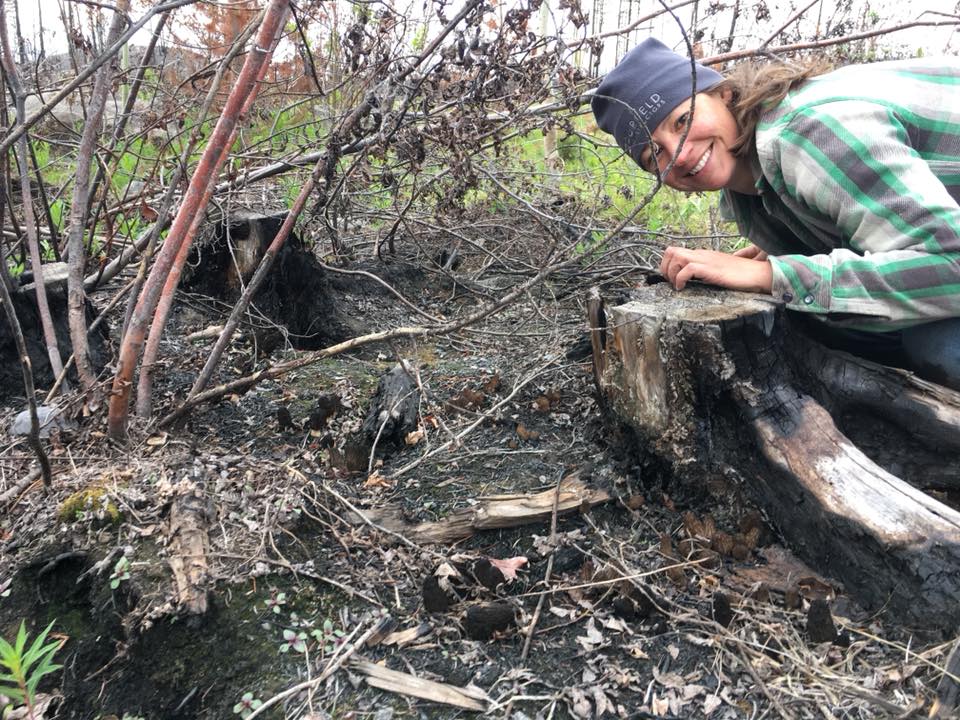
The previous extent of my mushrooming has pretty much focused around the fall when the fruiting bodies emerge from beneath the moss, on the sides of logs, and through the cottonwood leaves. Pines, chanterelles, shaggy mane, and combs tooth are all I really know well enough to harvest and eat without being worried I might kill my family. But this year, it was the spring harvest of morels that called. My partner in crime suggested we bring the kids. They (the kids) are low to the ground and possibly more enthusiastic about picking mushrooms than we are. They had a small taste of the exciting morel hunt a couple of years ago picking in the Boulder Creek fire zone. We were all excited about finding a few morels to cook, save, trade.
We decided to pick in the Elephant Hill Fire zone that burned about 192,000 hectares in the Cariboo last year. While this is undoubtedly devastating on many levels, fire is part of the natural disturbance regime of that forest type. Many species that grow in that area are fire-adapted or fire-dependent. For example, the thick bark of mature Douglas-fir can withstand moderate fire (check out the fire scarred trees at One Mile Lake). Deep roots of vaccinium species (blueberries, huckleberries, etc) survive and send up an abundance of new shoots in following years. The cones of pines trees have a waxy coating which opens in response to the heat of the blaze, scattering seeds onto soil newly fertilized by nutrients in the ash. Many forest types require fire to stay healthy, to regenerate. Indigenous people throughout the world incorporated fire into their traditional landscape management. Lil’wat people extensively burned areas within their Traditional Territory to promote food production, and “the hills were just like a garden” (Baptiste Ritchie in Turner, 1999). Root vegetables such as: Indian potatoes or skewnkwina, yellow avalanche lily or sk’am’c , and tiger lily or skimuta (Lilium columbianum) and many berry crops were managed through controlled burning to produce better crops (Turner, 1999).
Fire suppression to protect homes, communities, forest “crops” and other interests have impacted this natural disturbance regime. Without fire, forests are susceptible to disease such as the mountain pine beetle and over time, stagnate. Forests that historically burned regularly in a patchwork pattern now are subject to catastrophic, widespread, high intensity fires that change the way the forests regenerate. Soils become hydrophobic, resulting in a vegetative moonscape and flash flooding (we saw this near Loon Lake). Fire-adapted species can’t withstand the intensity. The list goes on.
However, I digress. Back to the morels.
Morels and wild mushroom harvesting in general are a huge industry. In preparation for the onslaught of mushroom pickers, the Secwépemc people (whose Traditional Territory we were picking on) implemented a permitting system, created designated campgrounds, and on-the-ground safety support. Permits in hand, we tested a few places on the way up to our destination. We kind of thought we may need to be picking with elbows out like on an epic powder day but were pleasantly surprised to be alone. Within a couple of minutes of jumping out of the truck the kids were shouting in excitement.
But we did not expect what waited for us only a short distance from our cabin. The forest floor was littered with morels in places. Over the course of a couple of short and easy days picking, we harvested all we needed for ourselves and close friends, so abundant in the immediate area we stayed in sight of the truck the entire time. In places, you had to really watch where you stepped so that you didn’t crush these highly camouflaged gems.
The kids, in total disregard to the cloud of mosquitos, picked solidly and without complaint, filling their buckets amidst cries of “Jackpot!”. “Partner Alert! I need help!”.
We hypothesised about abundance, distribution, ecology. I was excited to come home and learn more. I wanted to know why morels appear after a fire, and the question seems somewhat unanswered by science. While much research has been conducted in recent years regarding the extraordinary and fascinating importance of mycelium or “mushroom roots” in the forest floor (check out this video– SO COOL!), morel ecology, spatial distribution, and abundance are not widely researched. In order to make sense of one hypothesis, it helps to have basic knowledge of the mushroom life cycle.
Some scientists suggest that after a fire destroys many of the plants the morel hyphae may have been working with, the hyphae are stimulated to form fruiting bodies and send their spores far and wide in hope that some will land in areas with living plant roots. Totally plausible in my eyes.
It is fascinating to think about how ecosystems are adapted to respond to catastrophe. It gives me hope in our changing world. If a morel mushroom can withstand the hottest of fires and not only survive, but thrive, can we heal our hurting planet? Can our natural world adapt fast enough for climate change? Is that part of why our hearts are buried so deep in our chests? I like to think that is why for some of us, our fears, happiness, vulnerability, our joy are buried in emotional vaults that they are just waiting to be tested, to have the opportunity to rise up, to spread, to be released.
It makes me think about the projects I am working on right now, which have a strong focus on “resiliency”. It seems to be the new buzz word, superceding sustainability. Like the theory of morels acting out of a need for survival, I wonder what the catalyst will be for individuals and communities to summon the vision of resiliency into the action of resiliency. It is already happening, I know, but at the same time it feels like our world is constantly bracing, building, preparing. I am grateful to celebrate the ways in which our community builds resiliency. Great weekends away with great friends. Breaking bread, sharing food, spreading ideas.
I employed a variety of methods to preserve my bounty but focused on dehydrating. My favourite morel recipe so far was a simple Risotto Bianco with morels and garlic scapes sautéed in butter. If anyone is inspired to go hunting for morels, I think that area will still be good until mid-June or so. Keep a watch on fires happening this summer and plan a trip for next spring. Like most trips to the woods, it deeply satisfied the nerder naturalist and philosopher in me!
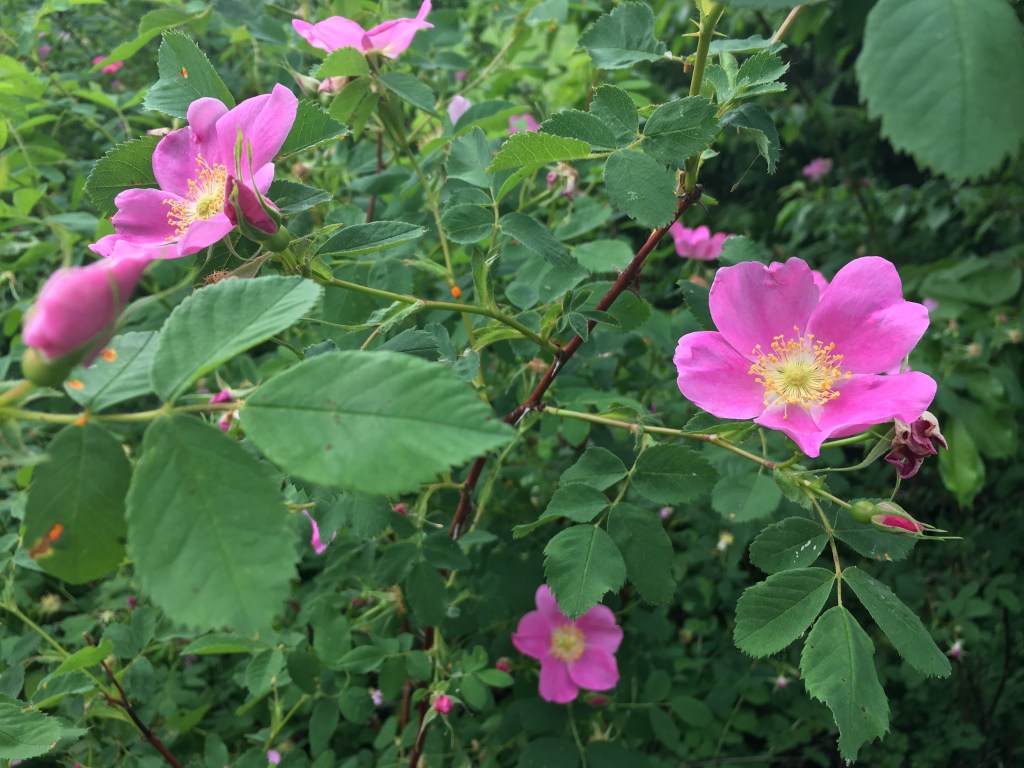
For me the art of slowing down and smelling the roses has turned into taking advantage of the surplus of this native shrub behind my house, plucking their petals and creating something delicious. As it is in my garden where I rarely follow my planting plans the same holds true to my style of cooking; recipes are but a base. I’ll admit my first batch, from a recipe I followed, did not set. This led me to taking matters into my own hands, going with the flow and trusting my strong sense of jamming. So, queue up some Bob Marley as I guide you to making your very own wild rose jelly.
INGREDIENTS
≈4 cups wild rose petals, lightly packed
4½ cups boiling water
¼ cup fresh lemon juice
5½ cups sugar
2 pkgs liquid pectin
Other: cheesecloth, jars, lids, tops, a big pot & lots of love
Start by foraging for rose petals: try to pick in areas away from the roadside and pick higher then a dog may pee! Give them a small bath in the sink to get rid of the majority of bigger bugs and pick out any of the greens. Don’t stress too much about getting everything, as you’ll end up straining the lot later. Place them in a nonreactive bowl, cover with the boiling water and allow steep for 1-2hrs. The petals will lose their colour and look quite dull but patience is key here.
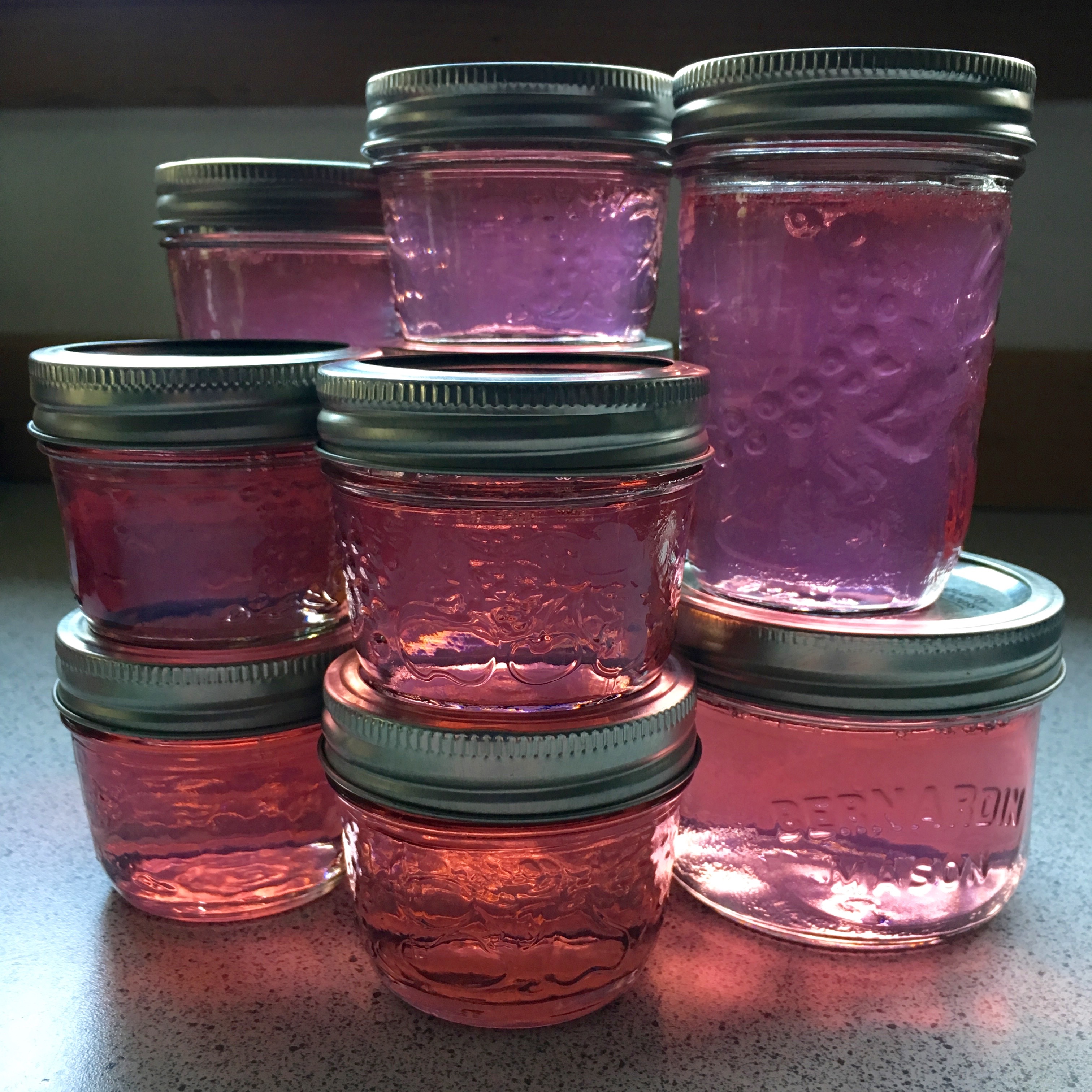
While your petals are steeping prepare your jelly vessels. This recipe makes approximately 8-9 cups of liquid gold; I use a mishmash of 125ml and 250ml jars and usually prepare a few more then what’s needed, just incase. Wash every thing then put the lids and tops in a pot submerged in water and place on the stove over medium-high heat. Jars can go on a cookie sheet in the oven at 250°F. You want these to sit in their respective mediums for at least an hour.
When you’re satisfied with how long the petals have steeped or you can’t wait any longer get ready for some magic. Add the lemon juice and watch the water go from blah to vibrant pink! It’s science.
Pour the petals and water through a strainer lined with cheesecloth straight into a big pot squeezing all the liquid out that you can. You want 4 cups of rose water; if you’re a bit short just add a bit of filtered water. I found this recipe made the right amount of water so you should be fine but feel free to measure if you’re not sure. I like to wing things. Add the sugar and bring up to a boil, stirring to ensure all the sugar incorporates into the rose water. Once at a hard boil keep it here for 2 minutes skimming any foam off the top. After the time has elapsed remove from the heat, add the pectin and stir to combine for 5-6 minutes – no less – more is okay but no less.
Now you’re ready to put your creation into jars and await the sweet satisfying sound of popping lids. Some recipes call for a water bath to finish the canning process but I’ve never done that. I just go with what my mom taught me, which is what’s outlined here, and it’s never failed me just like her.
This simple tasty treat can be enjoyed may ways but my favourite thus far is on coconut ice cream or straight out of the jar… Happy jammin’!
One thing I need to tell you right now is this – if you are going to go foraging for stinging nettles do not wear sandals. The other thing I need to tell you is if you want to go foraging for stinging nettles you may have to wait until the spring of 2019.
Which leads me to the point of this month’s post. Procrastination is not your friend if you want to forage.
I have been known to procrastinate, especially when it comes to anything I would categorize outside of “work”. This spring I enrolled in a year-long course designed by local Natalie Rousseau called 13 Moons -and I have been learning about foraging and “kitchen witching”. The recipes are so inspiring, and I am excited about deepening my connection to the land and the seasons by incorporating more native plants into my diet.
So far, I have been able to get out there for two stinging nettle harvests and one elderflower harvest. The nettles were steeped into teas and blended into smoothies that I believe have drastically reduced my usual hell storm of hay fever symptoms. The elderflower blossoms were infused into a delightful cordial that has been mixed with Pemberton Distillery gin and soda for drinks on the deck with friends, prosecco for an elegant cocktail at a Mother’s Day gathering and sparkling water for a refreshing lunchtime drink…all with delicious results!
I was hoping to get dandelions and lilacs for more cordials and tea infusions but fear I may have missed my opportunity…but maybe I can gather some this weekend? And therein lies the problem, the native plant does not wait for the procrastinator. It may be best to pin my hopes on the next round of edibles on my list – wild roses. I plan to use the petals to make a herbal honey, to infuse with oil for skincare, and to dry for tea blends.
If you go out foraging:
Be sustainable and ethical – don’t overharvest or strip entire plants. Try to harvest small amounts from numerous plants so your forage doesn’t harm the plant and leaves plenty of food for the insects and animals that rely on it for a food source. Always make sure you are prepared to process your harvest properly so it doesn’t go to waste.
Be safe – it is always good to cross-reference a couple of resource books and if possible, learn from a real life person who has been wildcrafting or foraging for a long time. Thanks to Dawn Johnson for taking me out on an elderflower adventure!





 3 tbs lemon juice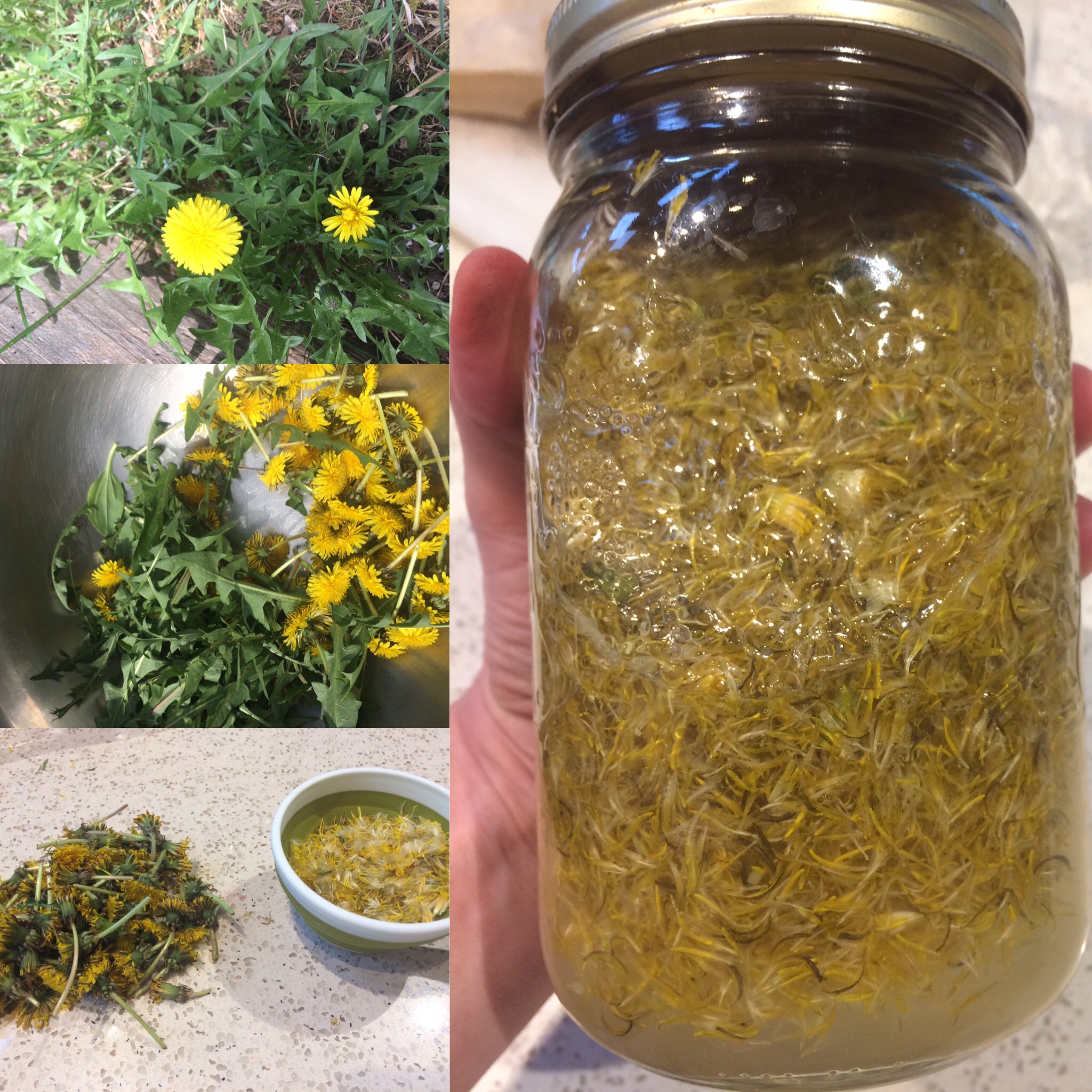



 Due to a tiny pantry that comes with townhome living, I don’t have stocks of dried legumes and flour (yet!) but there is a substantial stash of otherwise semi-filled jars. There are herbs and spices galore, both from my personal interest in flavours and foraging, and because one of my sisters is a certified herbalist.









 Traced Elements