This is the time of year when the freezer can be very full (a good problem to have). If there is deer meat to go in, something must come out. In my case, the many bags of apples I peeled and sliced two months ago! This is a recipe that uses up those apples well and is seriously the best apple cake I’ve ever had – in convenient muffin form. It is also fairly healthy with good fats and whole grains.
These apple muffins are an adaptation of Shelley Adams’ “Joey’s Apple Cake”, found in her first cookbook Whitewater Cooks – Pure, Simple and Real (2005). Shelley Adams is my food mentor (she doesn’t know that) and I have adapted so many of her recipes over the last 12 years. Her recipes have good bones. I have usually adapted them to be whole grain, reduced sugar and sometimes grain-free. This recipe was also altered by making muffins instead of cake (which is quite finicky as it calls for a Bundt pan and the cake always stuck to it). Enjoy!
Whole Grain Apple Muffins (yield: 36 muffins)
Ingredients:
3 cups spelt flour (*you can also use 2 cups spelt and 1 cup almond meal OR you can use 2.5 cups spelt flour and 1/2 cup oat bran)
1/2 cup white sugar
1/4 cup brown sugar
3 tsp cinnamon
1/4 tsp cardamom
1 tsp baking soda
½ tsp salt
1.5 cups grapeseed oil
3 Pemberton eggs
3 tsp almond extract
4 cups finely-diced Pemberton-grown peeled and cored apples (I use a Cuisinart and pulse the apples until they are just shy of applesauce texture. They should still have lumps).
Method:
Preheat oven to 350C
Blend pureed apples, oil, eggs and sugars in stand mixer. Blend well. Add cinnamon, cardamom, flour, baking soda and salt. Blend well.
Scoop batter into silicone muffin pans (I like silicone pans because the muffins don’t stick).
Bake at 350C for 26 minutes. Cool 15 minutes in pans, then invert onto cooling rack.
Longtime champion of local food, Glenda Bartosh, turned her attention to apples this week, and discovered that our very own Traced Elements regular, Mike Roger, is quite the apple man. Glenda gave us permission to repost her column here.
Photo by Glenda Bartosh
Apples, apples, apples. They’re everywhere this time of year, especially southern B.C., including Sea to Sky, so you don’t have to hit the Okanagan.
From West Van to Birken and beyond, you’ll find apple trees, babied and pampered, dwarfed and full-sized. And neglected old troopers that tug at your heartstrings—twisted and tortured, maybe 100 years old—still bearing fruit, in yards, orchards and ditches, where the goodness is yours for the taking, as gleaners well know. Even Whistler has a tree or three. (Ask Feet Banks about them apples.)
Fresh juicy apples; dried apples; apple chips. Apples baked, boiled, canned and pied. My 92-year-old mom, who’s lived a long and happy life eating many an apple, recommends a dab of peanut butter on an apple slice.
If you’re of a certain age or from the prairies, you’ll smile at the memory of bobbing for apples (the apples were bobbing, hopefully not you!), and the sing-song “Hallowe-e-en a-a-apples!” called out on doorsteps when, truth be told, we were hoping for candy, not apples at all. And who’d ever want one now in their trick-or-treat bag?
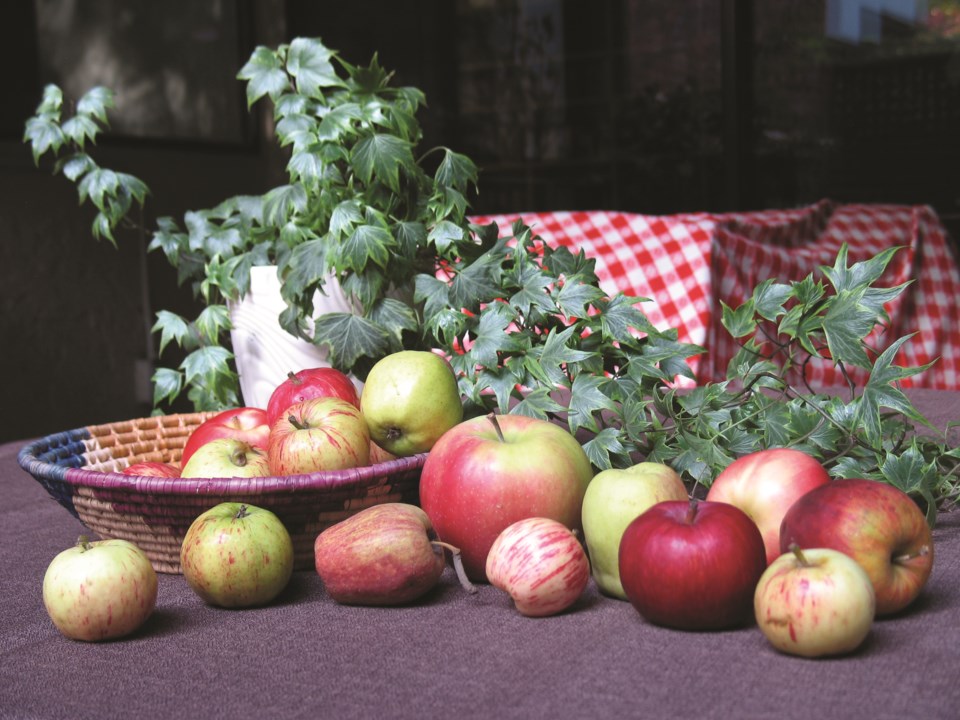
Poor apples! They’re so common we take them for granted, not realizing what a rich and noble lineage they come from, and how good they are—for health, nutrition and pleasure—especially those heritage varieties.
We have some 7,500-plus kinds of apples on the planet, but most of us can name, maybe, six. McIntosh—the original big Mac—so ubiquitous in Ontario, where it was first grown by one John McIntosh, in 1811. Delicious apples from the States. Spartans, created by R. C. Palmer in Summerland in the 1930s by crossing Macs and a pippin. Maybe Galas and Ambrosias, and the ever-green Granny Smith, a friendly apple from Australia, circa 1868.
But how about Grimes Golden, which could be a rockstar? Or the Hubbardson Nonsuch. Blacktwig. Buckingham (The Queen). Greening from Rhode Island, going back to 1650. The Gano. The Gennet Moyle. All poetic, and all apples grown in southwestern B.C. since the 1850s, and now sought after by many a heritage apple buff and association, including the Royal B.C. Museum, UBC’s Botanical Garden and Mike Roger of Willowcraft Farm near Birken.
Mike, who plants six apple trees a year, is known for helping out on older farms dating back to the 1950s and bringing heritage apples such as sweet Annanas; super-tart Cox Orange Pippins; or humungous Boskopps (great for cooking) to Sea to Sky farmers’ markets.
Photo courtesy Willowcraft Farm
“The heritage varieties are usually grafted onto full-sized trees, like, 30 feet [9.1 metres] tall and 25 feet [7.6 m] in diameter, so they’re massive. They can give several hundreds of pounds of apples,” says Mike, who’s also known for making amazing apple juice—150 litres in a few hours—by running a gunny sack full of ground apples through a top-loading washing machine on “spin.” (The juice pours out the drain hose—how excellent is that?) Recent commercial varieties, by contrast, are grafted onto semi-dwarf or dwarf rootstock so they’re easier to pick.
As for that noble apple lineage, cast your mind back 10, maybe, 12 thousand years, to the earliest proto-apples in Neolithic Britain and Europe—wizened little things, more like crabapples.
Wild apples spread like crazy, but what we think of as an apple today most likely came from the Caucasus Mountains of Asia Minor, near where 17th-century historians located the Garden of Eden. BTW, there’s no scientific evidence confirming it was an apple that tempted Eve. It was just (forbidden) fruit, possibly a fig or apricot.
We have Ancient Romans to thank for breeding apples for size and taste, although they don’t grow true from seed (ergo the above-mentioned grafting). Plato, for one, could name about two-dozen apples, and in ancient Assyria, apples were served at a wee gathering for 69,000-plus people hosted by the king. A thousand oxen were also on the menu.
Apples are a key ingredient in classical Arabic cooking. I love how Farouk Mardam-Bey in Ziryab: Authentic Arab Cuisine points out that at the centre of every apple, we’ll find a five-pointed star, “the symbol of knowledge and power.”
As for an apple a day keeping the doctor away, it’s true. All the fibre in apples is good for your gut, plus it helps you feel full. Several studies show that apples’ polyphenols help prevent heart disease and lower the risk of stroke, while the flavonoids and anti-oxidants could help fight cancer.
University of Michigan researchers, who concluded that apples’ only health benefit was an avoidance of prescription drugs, analyzed just how big that beneficial apple should be: At least 7 centimetres in diameter and 149 grams. But an Italian study showed significant benefits in reducing heart disease and cholesterol when people ate two apples a day versus consuming the same amount of sugar and calories in apple drinks.
If all this makes you curious about branching out, ahem, and re-thinking apples, excellent. And if you’d like to branch out when the snow flies, and try some lovely homemade baking featuring all kinds of apples—maybe even from their own orchard in Naramata—head to Ian Gladstone and Joni Denroche’s cozy cafe at Cross-Country Connection in Lost Lake Passivhaus, just a short walk from Lot 5 in Whistler Village.
Joni’s taught me a great new trick: Simply wash, core, then slice your apples and freeze them. Use them, as is, for baking, or freeze them on a pan before bagging, so they don’t stick together. Voilà! A “super-cool” snack straight from the freezer.
Glenda Bartosh is an award-winning journalist who tips her hat to everyone who helped with these apple tales, including my mom, Feet, Mike, Joni, Ian, Bob Deeks, Lisa Richardson, Pauline Wiebe, Cate Webster, Paul Burrows, and Bob Brett. Long live the apple buffs!
You already know that fall is my favourite time of the year. It also happens to be one of the busiest times of year for me at work. So busy that sometimes it feels hard to find a full breath. A breath that I can get behind: my normal rhythm. Yet one thing that constantly replenishes my soul is when my house if full of friends and family. It’s then that my breath returns to normal – no matter what. This is why every year I muster up some energy to host Thanksgiving dinner, even if all I want to do is sit in silence.
Initially I thought I’d post some great, amazing Thanksgiving recipe the day after dinner but I could not find any words and you can’t force something that’s not there. Instead I chose to harness the good vibes from a room full of laughter, sing-a-longs, amazing food and love, to put my garden to sleep. It was the perfect remedy and the bonus? – I got to do it with my dad. However, I thought I’d share a recipe for a pie that usually graces my Thanksgiving feast but just didn’t have time to make. I mean I barely got the turkey in the oven on time and that only happened because my mom did it!
This is apple season. When your parents show up with a massive bag of said fruit from a friend’s tree on the Island and you’re eating at minimum and apple a day, or two, but barely making a dent in the stock, you make pies.
So, without further ado… here is Apple Cheddar Pie: an instant crowd pleaser and a delicious breakfast supplement.
Step Uno: make your crust.
2½ cups all purpose flour – TBSP sugar – TSP salt – 1½ cups grated white cheddar (kept cold in fridge until ready to use) – ¾ cup grated butter (frozen) – ½ cup ice-cold water (maybe a bit more)
Add the flour, salt and sugar to your mixing bowl and combine them. Then grate your butter into the bowl and add in your cheddar. Next start gently rubbing the ingredients through your hands; you’re aiming to get a “pea like” texture (you may recall me using this method in my previous pie recipe). Pour the water in and use your hands to bring the dough to together. I always end up turning it out onto my counter to finish kneading it. Separate the dough into two balls with one slightly larger then the other. Flatten them out to resemble small saucers and a place in the fridge for at least an hour.
Step Two: prepare your apples.
8-9 apples peeled, cored & cut into eighths – juice of half a lemon – cinnamon, nutmeg, ground clove – a sprinkle of cornstarch
Place your apples in a bowl, add in your preferred amount of spice, squeeze the lemon on top and sprinkle that cornstarch… then toss.
Step 3: build your pie.
Preheat your oven to 375°F. Roll out the smaller disc on a floured surface, place it in your pie dish then add your apple mixture. Before rolling out your second dough disc and topping the apples with it, dot them with a bit of butter. Seal the edges together and then cut some shapes in the top crust or keep it simple with a few little knife slits that will allow the air to escape. Brush the pie with an egg wash (I forgot but you should really do it).
Step Quatro: bake & wait.
Place the pie on a baking sheet and pop it in the oven. Let bake for a least an hour or until the crust is golden brown. Allow it to cool on a wire rake for an hour or more… I am not capable of this step. Not even a little bit.
Step Five: consumption.
Serve this bad boy with some ice cream or nothing at all.
So if you’re wondering what to do on this rainy weekend and have a bunch of apples, you should make this pie and fill your house with people to share it with.
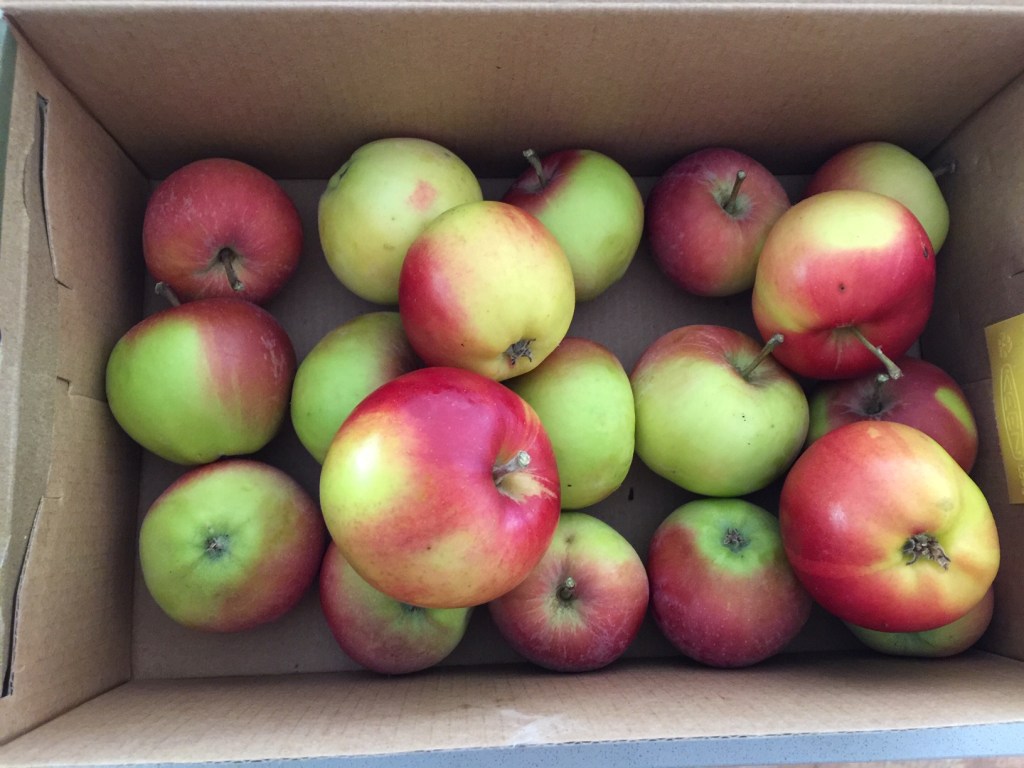
If you are not lucky enough to have effective cold storage, your harvest supply of apples may be looking a little tired right now. If so, I have two fantastic recipes that take advantage of less than perfect, small, slightly shriveled apples that you might be tempted to compost.
Also, I made tarte tatin recently with a fresh supply of delicious coastal apples that were perfectly ripe, and freshly picked. The recipe was from Martha Stewart’s Baking Handbook and is available at the Pemberton Library. I adapted her Pate Brisee recipe by using spelt flour and the results were tasty!
We are also onto the “dregs” of cricket chirping. Cricket chirping is one of my favourite sounds. They started in late July and almost mid-October I hear a forlorn cricket or two at night. They sound kind of lonely. Cheers to the persistent crickets who usher in shorter days and frosty weather.
Here are two recipes to use when you have processed all your nice large apples and are left with tiny ones that aren’t much use. These recipes just call for tiny pieces of apple and you don’t need to peel them first. Also the tuna patties are super quick, and also portable for lunch on the go. The rice pudding recipe is cooked for 6 hours in the slow cooker and is so easy and a real treat on a frosty evening. One is fast, one is slow, but both simple and easy.
Quick Tuna Burger Patties:
2 cans drained flaked tuna in water
¼ cup real mayonnaise
¼ cup almond meal
1 egg
1 tbs Dijon mustard
½ tsp salt
½ tsp pepper, or to taste
¼ cup chopped fresh dill
¼ cup finely chopped apple, unpeeled
Method:
Mix all ingredients together and form into 6 patties. Fry on medium low heat in 2-3 tbs olive oil until nicely browned on each side. The longer they cook, the better they will hold together so don’t rush the frying.
Slow Cooker Rice Pudding:
2.5 cups whole milk
½ cup whipping cream
1/3 cup Arborio rice
1 tsp cinnamon
¼ cup white sugar
½ cup finely chopped apple, no need to peel first!
1 tsp vanilla
Method:
Place all ingredients in a 2 quart soufflé dish and put that dish into a slow cooker crock. Cover with lid and cook on LOW for 6 hours. (Do not cook on high heat as the milk won’t cook as nicely.)
Tarte Tatin recipe can be found in Martha Stewart’s Baking Handbook, published by Clarkson Potter and available at Pemberton Library.
Rice pudding prior to cooking
Tarte Tatin: doesn’t look as good as a slice of pie, but the flavour is rich and texture is dense!





 Traced Elements