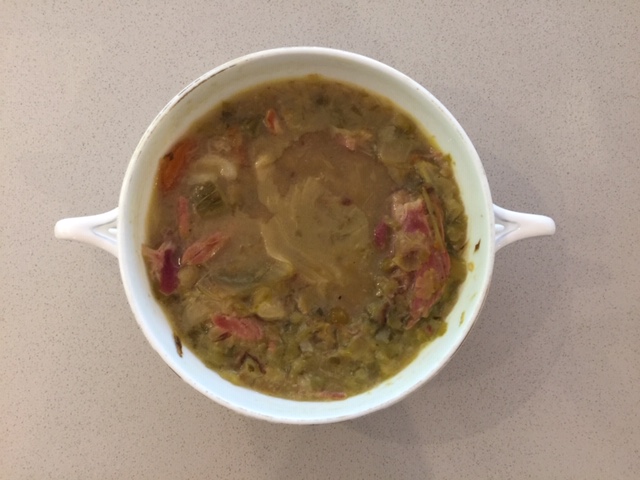
I have experimented for quite a few years with ham and pea soup – switching out the green peas for yellow peas. The yellow peas never softened enough for a good soup and they varied a lot from brand to brand. Green peas soften well. Of course, it helps to simmer your soup for at least 3 hours. A UK friend of mine who used to cater large events called it “the best ham and pea soup I have ever had”. Thanks to that high praise I am posting it today. Pemberton ingredients include carrots, and if you have a source, the ham itself. This soup goes well with a nice piece of warm cornbread. I like the recipe out of the ReBar cookbook by Audrey Alsterburg and Wanda Urbanowicz – an incredibly well-written and inspiring cookbook by two Victoria chefs.
Professional-Quality Ham and Pea Soup:
Ingredients:
1 large ham bone with about 2-3 cups of ham still on it (after baking a 4-5 lb bone-in ham the night prior)
1 bunch green onions, chopped
2 tbs pure olive oil
2-3 cups chopped green cabbage
2 large carrots, chopped
1.5 cups parsley, chopped
8-10 cups water
1 450-gram bag of dried green peas
2 tsp pepper
Method:
Sauté green onion in olive oil.
Add cabbage, parsley, carrots, and pepper and sauté until well caramelised.
Add ham bone, water, and green peas.
Bring to boil.
After soup comes to a boil, turn heat down and simmer 3-4 hours.
Remove ham bone and go through the ham that has fallen into the soup to make sure no gristle or pieces of fat remain in the soup.
Remove all large ham pieces and cut into bite-sized pieces and then put back into soup. Enjoy!
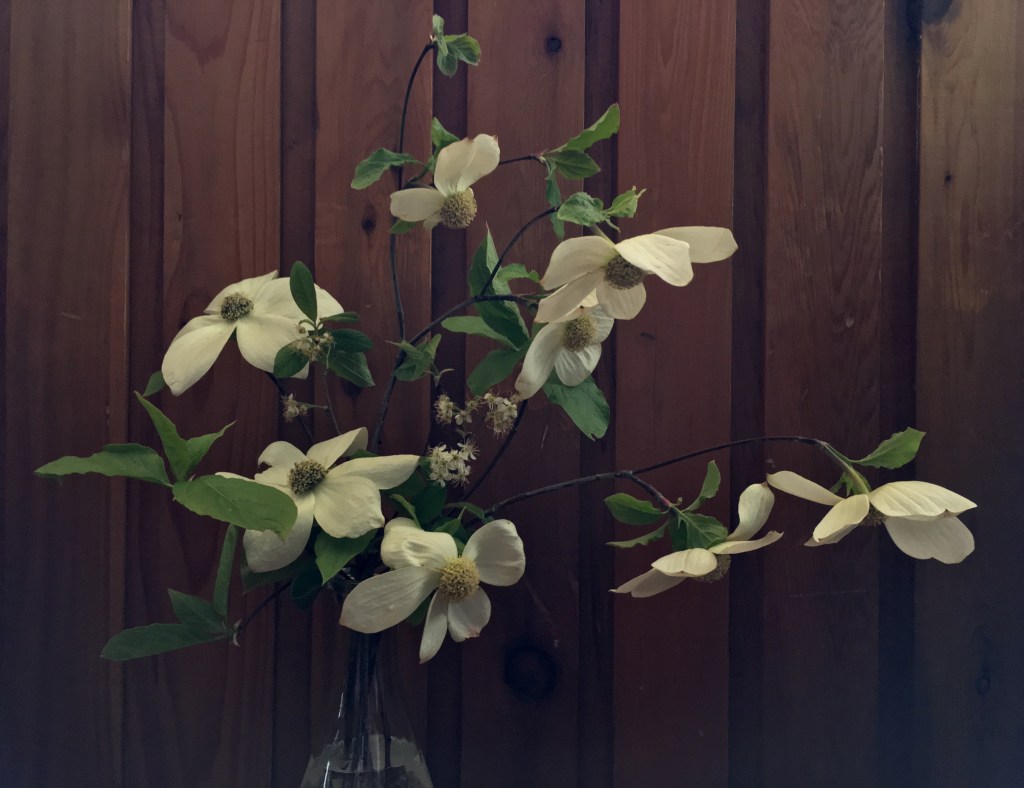
My favorite strip in the ol’ daily commute is in full bloom: Dogwood Row aka the false flat of Nairn Falls. When this magical time finally happens I know spring has officially arrived. These native beauties symbolizes this time of the year perfectly: rebirth and resurrection, durability and reliability, strength and resilience.
So, life has felt a little backwards lately and I’ve been dormant like the bulbs I planted in the fall: slowly growing in hibernation, slowly surfacing to flower. While the green glow of spring delivers a healthy dose of new beginnings there will always be things that don’t survive the winter.
The beauty is, you can always replant.
Spring offers up a chance to do over everything from last year… literally, start fresh, change the pattern and do it better. Prune away the dead to promote new growth, leaving some things the same (they’re called perennials for a reason) and don’t forget to tend to your evergreens as they are there for you every season.
It’s not always as simple as it seems: a large puzzle with small pieces. Sometimes you’re rewarded beyond expectation in an instant and sometimes patience is a virtue.
But by saying yes to growing new things and experimenting with new varieties we can create a new palette to work with.
There is little risk in gardening if you’re willing to fail and get your hands dirty. Notable and new to my garden this year are Jerusalem artichokes, shiso and fennel (which will actually be nowhere near my garden because it’s friends with no one). Oh, and way more flowers! Because why not? And pollination is key to life. Other plants are bound to sneak their way in too.
When supported by a cast of usual suspects: beets, carrots, cabbage, cauliflower, cucumber, tomatoes, brussel sprouts, squash, cantaloupe, onions, garlic, strawberries, raspberries, blueberries, peppers, peas, beans, all the herbs, chard, radish, daikon, celery, kale, romaine, greens, kohlrabi, leeks etc, one can be nourished and flourish quite well.
There is a good chance I’ve already said this but I’m just going to keep saying it:
Grow what you love, try new things, revisit old favourites and savour the process.
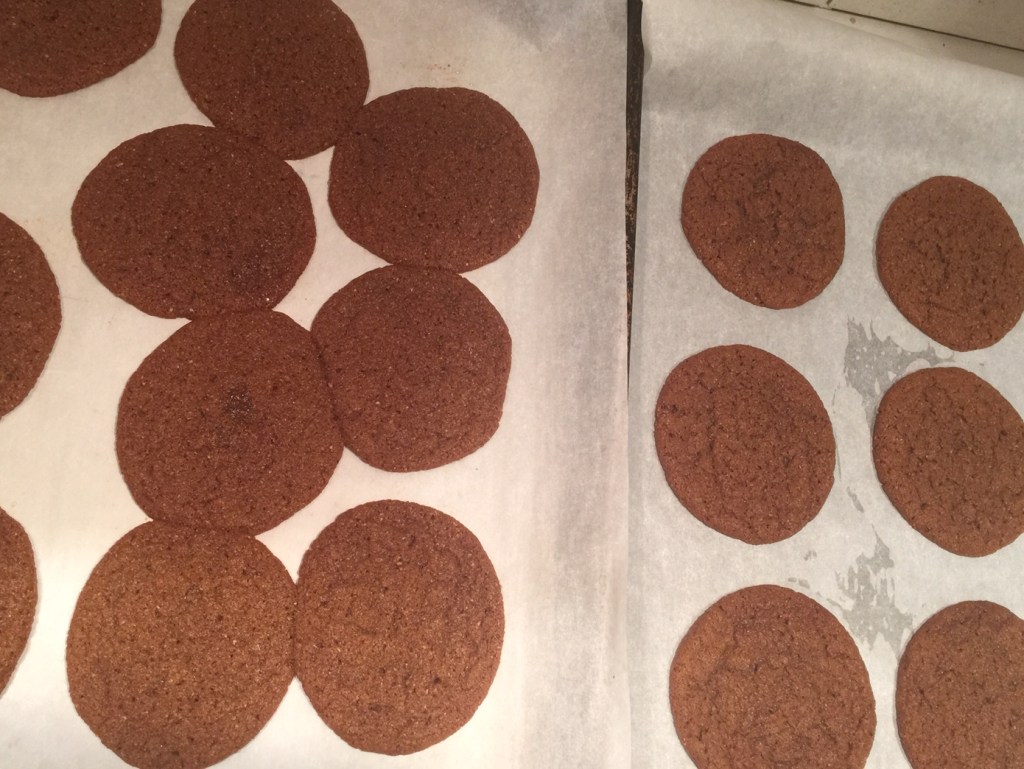
These cookies are adapted from the Silver Palate Cookbook – a staple cookbook in the kitchens of my mother, aunt and gran in the 1980s. I have always loved their “molasses cookies” but in the past few years I have given up baking with white flour. I made this version healthier with 50% less sugar than the original recipe, spelt flour, and also some almond meal. They are very good. They do not feature heavily in Pemberton-area ingredients – except the egg – but today the weather was cold, stormy and winter-like, so ginger cookies seemed like a good match.
Ginger Chews: (Yield: 21 cookies)
Ingredients:
6 oz unsalted butter
½ cup white sugar
¼ cup molasses
1 large Pemberton egg
1 ¼ cups spelt flour
½ cup almond meal
½ tsp baking soda
½ tsp ground cloves
½ tsp ground ginger
½ tsp salt
1 tsp cinnamon
Method:
Preheat oven to 350F. Melt butter on very low heat in a medium saucepan. Add sugar, molasses, and egg and mix well. Then add the rest of the ingredients and mix well. Place 1 tbs balls of cookie dough on 2 parchment-lined cookie sheets. The cookies spread a lot when baking so leave 3 inches in between the cookie dough. Bake for 12-14 minutes. Cool for 15 minutes.
Prepping dinner in late February. Note “green onions”, carefully harvested from some storage onions that decided it was time to start sprouting.
Note: This post the product of a farmer itching for the snow to melt, of Lisa Richardson’s gentle encouragement to not be ashamed by my lack of posts since last May, and also a plug for a new page on our farm website that talks about VEGETABLES.
It tries to answer questions like “What’s this?” or “How can I cook that?” or “Can I freeze these?” that I get asked from time to time as a CSA farmer. I also admit to eating cabbage for breakfast on a regular basis. Feel free to have a look if you’d like. http://fourbeatfarm.ca/news/
A breakfast option for the Pemberton loca-vore. Includes an average portion of cabbage, pickled garlic scapes from last summer, and some additions from friends at Spray Creek Ranch.
Now, to ramble…
Last week, the spare room where I store my personal supply of winter produce had its annual conversion into a spring “grow room” for this year’s seedlings. Anyone else have ~8000 allium roommates right now? No? Oh well, just me then. We will be co-habitating for a few weeks until the seedling greenhouse gets set-up and temperatures climb a bit.
Because of this new roommate situation that I have come to believe is normal, I spent a few hours picking through the bins of winter storage vegetables. Since I haven’t been to the produce section of the grocery store all winter, there wasn’t much left. I salvaged the best to cram into the fridge and imminent meals, and that about took care of it. Let me begin by saying that, despite my attention to detail when it comes to processing and storing vegetables in the main farming season (destined for CSA and farmers market shoppers), my winter set-up for personal use is…well…simple. Or lacking. Depends how you look at it. Let’s call it “rustic” to be nice.
It’s a small room in the house. It’s separated off and slightly insulated by a blanket over the doorway to avoid wasting woodstove heat from the hallway. The window stays cracked open to let in cold air and keep the bins of veggies comfy. When we get a cold snap, I make the crack smaller. When we get a mid-winter thaw, I open the window a bit more. If I remember.
This has successfully kept beets, carrots, turnips, watermelon radishes, cabbages, rutabaga, celery root, kohlrabi potatoes and onions in fine shape until at least early March. There are some sprouty bits. Occasionally one will turn to mush and cause a small amount of slime to touch those around it. These now-slimey neighbours get rinsed off and put in soup or fed to the draft horses (onions exempt, they go direct to compost and bypass the horse trough).
Winter storage veggies at their prime for fall CSA members. Mine do not look like this now.
By March, things kept in such un-fancy conditions tend to look a little tired. Rutabagas are starting to sprout wild hairstyles. Celery roots are looking a bit shrivelled. But the cabbages? Oh, the cabbages. They’re like a breath of fresh air. Dozens of them have been sitting in a Rubbermaid bin in the house for nearly four months and they are still crunchy, juicy, sweet, and willing to join in to up the freshness factor of just about any meal.
If you’re looking for ideas about vegetables, recipes, or curious about how this particular farmer likes to eat her veggies year-round, I’d welcome you to check out a resource we are growing to help our friends and CSA members with the age-old question “What is this?” (holds up a cabbage shaped like a cone, an alien-resembling kohlrabi, or a yellow beet).
Seriously though, those cabbages. They’re just what a farmer needs this time of year.
A friend of mine called this a “Winter Glory Bowl”. Not sure if she was joking or not, but we’ll take it. Canned salsa from our summer tomatoes, refried beans from some shelling beans we grew and froze, sweet curry zucchini pickles, and roasted rutabaga. I don’t know if they’ll be serving it at any restaurants anytime soon, but it was a perfect sweet & sour, hearty & crunchy combination of food from the farm for a post-snowshoe lunch.
There. That’s how you keep your readership small. Those of you still with me have fought through eye-glaze and eye-roll and have resisted page turn. You will notice that even I am struggling a bit to stay on topic, and if only you could see the amount of squirming and fidgeting I am doing as I try to find the right way to write about one of the more under-simplified and over-complicated farming methods of our time.
There is no way around this fact: Biodynamic farming methods involve focussing the power and influence of the entire universe on the health and productivity of the soil, plant, farmer and consumer. The sun, the planets, the galaxies beyond ours: they all matter. The position of the moon matters. It’s complicated. It’s off-putting.
And yet, quite simply, it works whether you understand why or not. In fact, the less time sorting that out, the more time there will be for actual work and that is what really matters.
We do need to talk about it, though. Biodynamics is an approach to farming that combines science, philosophy and common sense and it should not be avoided. Something like this could easily become the future of farming.
You should know that it is a popular farming method in Germany, which has the highest concentration of scientific-minded farmers in the world, a fact I completely fabricated but which I believe could be used for emphasis without harm. I have (in actual fact) heard German farmers speak in excruciating scientific detail about soil science and crop management and then mention in a self-consciously off-hand manner that they also use Biodynamic preparations. Pressed further, they become extremely and remarkably vague about the details. I find this fascinating: farmers like that would not waste their time with something that wasn’t working.
Our farm has been Biodynamic in practice and often certificate since the mid-nineties when my parents attended a conference on the subject and were impressed with the practical experience of the speakers. We have slowly incorporated some methods into our farming practices- and avoided talking about it as we really don’t understand it well enough to explain.
Photo courtesy MC Bourgie
To be honest, I really have not been paying much attention to the whole thing, content to let my parents and sister tell me what to do. It seemed more important to learn things like welding, mechanics and fertility-building cover-crop management. Although I have certainly not mastered any of that, I have gradually pushed Biodynamics up higher on the “things-to-learn-that-will-probably-be-helpful” list.
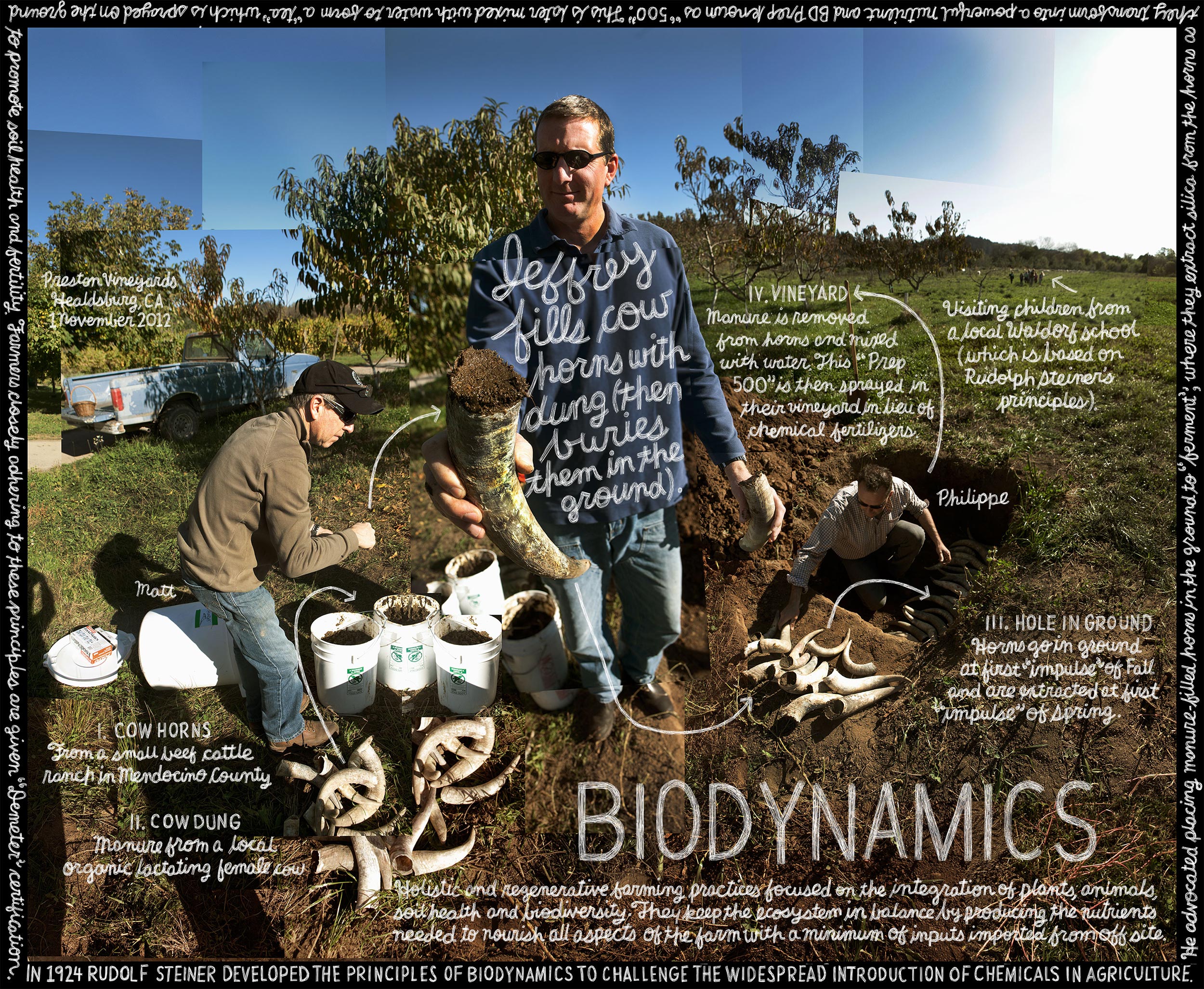
Some Biodynamic practices have been incorporated thoroughly into our farm routine. Mom’s Biodynamic compost heaps, for example, could probably turn old cars into nice, rich, loamy soil. Tree branches certainly presented no difficulty. I follow her directions to build the heap, and I add the preparations (yarrow, chamomile, nettle, oak bark, dandelion, valerian) and marvel at the result a few months hence. It seems like magic, but really it isn’t.
My sister annually buries cow horns stuffed with manure and that becomes the preparation we apply to the carrot field every year. It’s very simple: if we do it, we get great carrots. If we don’t, they are normal.
My mom boils it all down quite nicely: it is a fun way to farm.
Our Biodynamic practice does not extend far beyond this. It really should, or at least could. It is time to experiment with a few more methods, acquire some knowledge, become conversant. Most of all, I want to write about it in a way that can be easily understood. Is that possible? Can we keep it fun?
Photo: MC Bourgie
I am starting at a very, very basic level of celestial understanding. This point cannot be over-emphasized. I cannot even tell you for certain what my birth sign of the zodiac is. I just never found it important. In terms of blind faith however, I am on more solid ground. I can “witch” water wells, for example, and fully support the protection of random wild areas on our farm because grandma said there were a lot of fairies living there. I guess the fact that I now believe with absolute certainty that it is quite likely that plant health is influenced not only by the phases and position of the moon but the universe beyond isn’t such a stretch after-all. You commoners will have to struggle to keep up.
My first self-assigned task has been to read the original lectures, delivered in 1924 at a German agricultural convention by Rudolph Steiner, a philosopher with a practical bent who is also known for starting the Waldorf school system. This I am doing until the snow melts and I don’t have time for reading anymore. Looks like I might be able to make it through the whole works.
Contained in a book called Agriculture, the lectures were commissioned by a group of farmers who had recently begun to use chemical fertilizers. Although the yields of certain cash crops were reaching unheard-of levels, they noted a significant decline in the health of their soils, and the overall productivity of their farms. Alarmingly, they could no longer produce very much at all without the use of the new chemicals.
So far, for about 95% of what I have read, I have not a clue what he is talking about. Every once in a while, however, he talks about potatoes, and I certainly know what they are. They are the hook that keeps me focussed. I keep reading, hoping he will mention them again.
Another point of light is his reasoning for considering the universe in the first place. You can’t describe a person based on the last joint of their little finger, nor describe a farm using one plant in the far corner, but they are strongly related to the whole. If we allow for the possibility that we are the little joint of the little finger of the universe, if becomes obvious that there is a lot going on that matters to us.
We are part of something much bigger.
Stay tuned for the next exciting installment. I am going to be building compost heaps and seeding celeriac at a time suggested by the Biodynamic Calendar: the sun will be in Pisces and the moon in Virgo. I don’t know what this means but hopefully the plants can sort it out.
Anna Helmer farms potatoes in the Pemberton Valley with her family and friends who know she can cook if she must.
It was a year ago to the day while consuming a couple tasty Steam Works IPAs in a Richmond Irish Pub en route to a family vacation in Mexico that I took the plunge and joined the Traced Elements family. Maybe it was liquid courage that egged me on because at the time I was scared to dive into a world I knew nothing about: writing. The only constant I had to offer was my deep love for gardening. As luck would have it I learned I also loved to write – or maybe this whole endeavor came into my life when I needed a new outlet more then I realized at the time.
Regardless: it’s one of my favourite decisions to date.
The winter’s sun, as of late, has been flooding my living space with a warming heat reminiscent of sandy beaches and margaritas while the arctic air swirls around outside. My cheeks are constantly blushed in colour having been kissed by the cold. Overall, I welcome this false warmth; it’s a perfect excuse to devour a bowl of spicy miso ramen, everyday.
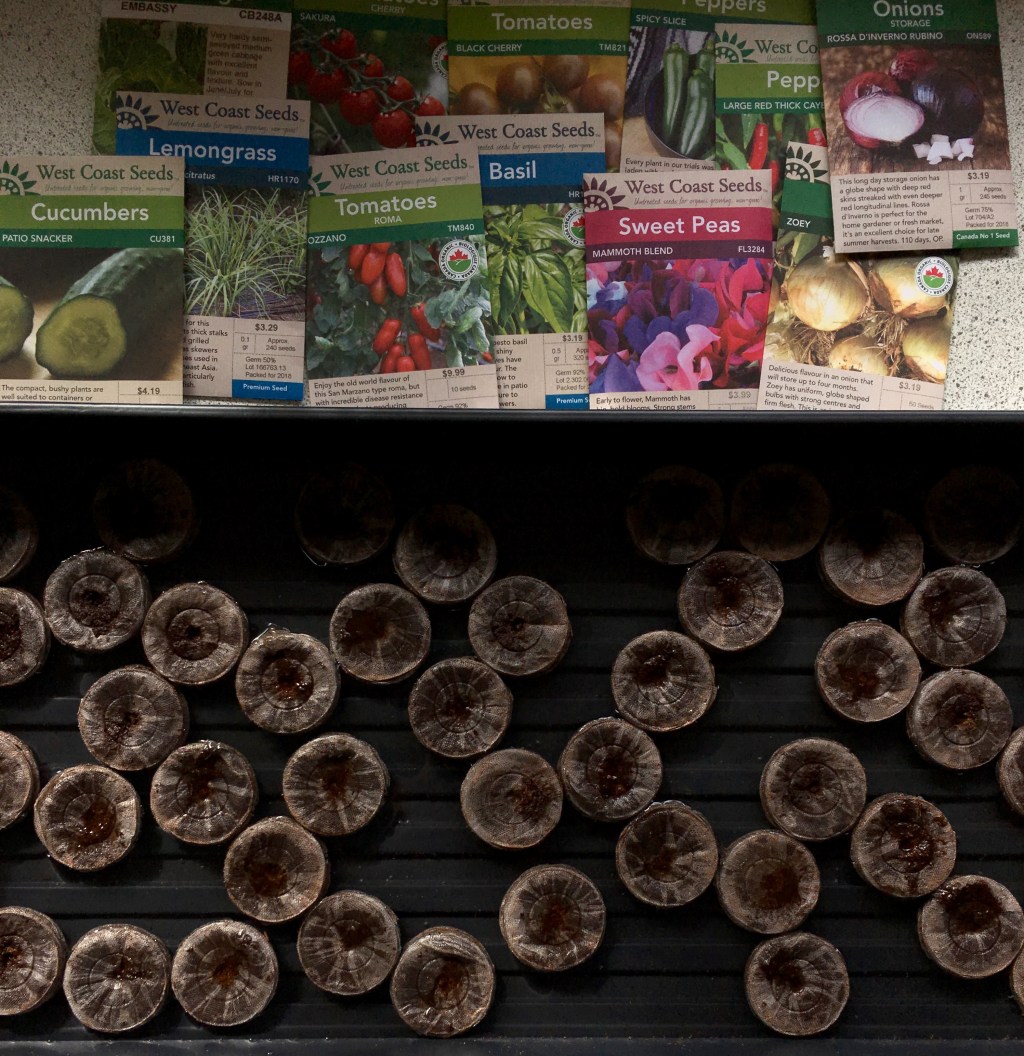
As the days get longer I look forward to my garden springing to life, even if they are currently blanketed in more snow then I can recall in the valley in years, my thoughts are hopeful, green and full of blooms. Many days I get lost and overwhelmed by the potential of things to grow as I browse numerous websites. Basically, my urge to propagate as many cool things as possible usually wins. You already know if you’ve read my other blogs that I’m a firm believer in the, “there is no harm in trying” experimental method.
Seeds; they fuel everything. (A little bit of love doesn’t hurt either.)
Plant anything and something good is bound to come from it. Sometimes there is growth and sometimes there are failures; either way you’ll learn something.
I have been carrying the following quote with me for years but it is only now that I finally feel like I am acting on it (after all spring ushers in rebirth). So, in the words of Byron Pulsifer I leave you with this,
“Passion creates the desire for more and action fuelled by passion creates a future.”
…get ready to see some really cool things from me.
After many years of trying to incorporate deer meat into quick last-minute dinner dishes – and failing – I am happy to report that I have a solution to those last-minute woes. The answer is a jar of Classico pasta sauce – the Italian sausage variety! By chance I tried it one night and it actually complements deer meat.
I have turbo-charged it with a whole cauliflower and some parsley for flavour. But this is an easy last-minute dinner for anyone with deer meat in the freezer. Unfortunately I’ve had to throw out many deer meat experiments over the years. So here’s hoping you enjoy this one, as deer meat has a particular flavour that does NOT mesh well with any old jarred sauce!
Quick & Delicious Pasta Sauce for Deer Meat:
3 tbs pure olive oil
1 large yellow onion, small dice
1 cup chopped parsley
1 whole medium cauliflower, small dice
1 tsp pepper
Salt to taste
1 lb ground deer meat
1 jar Classico pasta sauce (Italian sausage, peppers and onions variety)
Method:
Sauté onion parsley and cauliflower in olive oil over medium low heat until caramelised. Add pepper.
In separate fry pan, brown deer meat.
Add meat to cauliflower mixture.
Add sauce.
Simmer 5-10 minutes.
Serve over a whole grain pasta such as spaghetti or penne. Enjoy!
Now that I’ve described how plants have sex (see last post on Plant Porn), it wouldn’t be a sex education lesson without also stating the consequences of such activity. Yes, plants get pregnant as well! Seeds are described technically as “the fertilized ovule containing the plant embryo.” If these terms don’t sound familiar you weren’t listening back in middle school health class.
When these seeds sprout they are birthing new plant babies — seedlings. How adorable! I find this miraculous, topped only by witnessing the birth of my own children. No wonder plants flowering, fruiting and going to seed are as beautiful as a glowing pregnant woman and gardeners are like doting proud parents. Plant starts are often helpless dependents. They need us as much as we need them to survive. Co-dependence, constant nurturing, vigilance and the trials and tribulations of raising offspring – it’s very similar to parenting, where being self-centred, lazy or unavailable caregivers results in more complications.
There are two main types of seeds – monocots and dicots. Without getting into too much detail, they predetermine traits such as types of flowers, stems and leaves. Hybrids “occur by crossing two genetically different yet compatible plants.” Their offspring will contain genetic traits from both their parents and recessive genes from their ancestors, creating glaring differences. Just like a litter of mutts. Its’ all in the DNA. Just as every child is an individual, so is each plant. Humans, however, have been able to purposely cross-breed many plants until the desired traits are achieved. The hybrids can then be stabilized by crossing it with itself many more times or by propagating clones. The idea is to produce better and better strains over time, creating higher yielding, more attractive, disease-resistant and drought-tolerant plants. Heterosis is “the tendency of the progeny to outperform both parents.” I see this in my own children, in that my son is more athletic and my daughter is more academic than both myself and their mother. Perhaps their great-great grandparents were similar, but most likely they are evolving by learning advanced concepts and doing extreme sports that didn’t exist back then. Environments, botanical science and technology are also constantly changing for plants. Humans play a huge role.
We have also the technology to genetically modify almost all species further by inserting the DNA of sexually incompatible species as well as animals, chemicals and diseases. There is great debate about the unknown ramifications of this technology. Although I love horticulture and botany, I’m not a fan of GMOs. I feel that whenever we get too involved with screwing with Mother Nature, she bites back to put us in our place. It’s still taboo to alter or clone human DNA, but for some reason it’s common in the plant sciences. Good luck with that Monsanto.
Seeds themselves are a great protein-rich food source for birds and animals, including humans. Such creatures provide many dispersal methods from spilling, burying and forgetting them, digesting and excreting or purposefully sowing them, as we do. Seeds have evolved to drift or fly in the wind or stick to the fur of animals. It’s all about spreading those genes as far as possible and finding other suitable environments. Natural selection dictates that the strongest, most resilient and adaptable species thrive. We get to witness evolution in action on a scale we can observe and actually participate in. Creating and witnessing the miracle of life!
Watching a plant sprout, flourish, mature, reproduce and die is a metaphor for all living creatures. There is nothing but hope encapsulated in that tiny speck of life. Seeds patiently wait for the optimum conditions before they sprout. Each seed species intuitively knows the perfect temperature, light cycle, humidity, time and other environmental factors to germinate. Some need fire, floods or being digested by animals. After all they are designed to re-establish themselves even after natural disasters. They offer the advantage for a species to store ancient memory and to preserve its own survival. There are many seed banks that are providing future security by storing frozen seeds to hopefully prevent extintions of species. You never know – some exotic plant may help save the world by providing a future cure to a disease, become a new nutritious food source, natural resource or environmental solution.
To think that a tiny seed could eventually become a majestic oak, a delicate flower, a delicious fruit, or a new medicine at a future time is nothing short of a miracle, to me. It gives me great pleasure to be involved in fulfilling my purpose in life. I’m a breeder and nurturer and there’s something about babies that tugs at my heartstrings.
On my desk right now is a gorgeous little collection of essays called Wonder and Other Survival Skills, put together by the editors of Orion magazine. On its cover, a young girl presses her hand against the surface of a lake: skin of girl meeting skin of lake. From this meeting, a ripple moves.
“Is wonder a survival skill?” H. Emerson Blake asks in the foreword. “The din of modern life pulls our attention away from anything that is slight, or subtle, or ephemeral. We might look briefly at a slant of light in the sky while walking through a parking lot, but then we’re on to the next thing: the next appointment, the next flickering headline, the next task…Maybe it’s just for that reason—how busy we are and distracted and disconnected we are—that wonder really is a survival skill. It might be the thing that reminds us of what really matters, and of the greater systems that our lives are completely dependant on. It might be the thing that helps us build an emotional connection—an intimacy—with our surroundings that, in turn, would make us want to do anything we can to protect them.”
By my own definition, wonder is the ability to travel beyond attention, beyond mindfulness–to truly make an encounter with the world in a way that, for the slenderest of moments, lifts us out of ourselves and returns us back with something more. Something of the ‘other’ we’ve encountered travels with us. A little of the world comes into the interiority of us and lodges there. Permeates.
Winter is a season of rest for most of us land-based folks. A season of living in a place of dreams and visioning (literally, as we get caught up on sleep, and plan for the year ahead.) This is the first season I’ve stopped teaching completely. I felt the need to let the work do a deep dive into silence, and (beyond the day-to-day chores of keeping animals, which never go away), to truly let myself drop out of time. I sleep when I’m tired. I wake up when I wake up. I have breakfast and a cup of coffee, before I go out to do chores. Which sometimes makes me feel like a slacker, but it also feels… luxurious. Luxurious in a simple way I haven’t allowed into my life before. A spaciousness that holds its own kind of wonder.
The other reason I decided to stop teaching completely once the snow hit in December, was I wanted my horses to feel like they belonged to me again. 2018 was our busiest year teaching together (THANK YOU, PEMBERTON!) but I wanted a chance to ride when I wanted to again, instead of working a horse so they would be ready to say ‘yes’ to a student. I wanted to WANT to ride again. To wander about aimlessly bareback with nothing but a lead rope joining me to my horse’s mind. I wanted the horses to be able to choose who came out to play with me, whenever I showed up at the gate with a halter or a bridle.
What’s emerged out of this unravelling is that I was finally able to back Besa, my big paint/Friesian mare. When she came to me 18 months ago, she was an untrained 6-year-old, freshly weaned from being a mamma to a feisty filly. She made it very clear to me- in her lack of desire to be caught and her extreme reactivity, power and athleticism- that I’d have to take my time with her. Given space and the permission to approach me (instead of me expecting to approach her and do what I wanted), she decided that humans were worth being curious about. Her curiosity flowered into full-blown affection. She’s the first horse to come to anyone out of the field now, and she sometimes chooses to pull me (or whoever I’m accompanying into the field) in against her chest with her muzzle, the closest a horse can come to giving a hug.
Besa’s been asking me to do things with her for months (Proper things! With a bridle and tack like all the other horses!) and all summer and fall I just didn’t have the capacity. But these last few weeks I’ve slipped onto her back and let her carry me around our little maze of snow paths in a mutual exchange of trust: I will trust you with my body, if you will trust me with your body. The ‘training’ part of it can come later. For now, all I want is her to turn her head to me, so she can look at me fully out of her huge dark eye: Oh. So now you’re up there now. So that she can yawn and snort and let all the tension go out of her nervous system, and get used to this strange new way that horses and humans can be together.
Perhaps it’s me she’s been waiting for all along. Perhaps I needed to drop into this spaciousness for us to find this way to trust each other.
There’s one essay that stands out for me in this slim little collection that sits on my desk. It’s Chris Dombrowski’s Kana: a father grasps at the nature of wonder. In it, he defines Kana as “a word or figure the Japanese haiku poets used as a kind of wonder-inducing syllable (it translates loosely into English as an exclamation point.)… that heart-stutter we receive when an image of the world takes root in us…”
His essay shares the spell of a day spent morel hunting with his twenty month old son. The way the boy wanders across the face of the burn, trailing a whitetail’s antler behind him, carelessly decapitating the very mushrooms he’s hunting for:
…he is either in a daze of boredom or he is walking kana, penetrated each step by the world, not penetrating it. It’s tempting to call this spirit naïveté, but it’s not: it’s wisdom we lose along the way.”
Perhaps that’s what I’ve been courting this winter: wisdom I’ve lost along the way as I’ve been coerced into ascribing to linear time, to capitalism, to the many demands the constructs of being human impose upon us. There is gentleness here, in this wonder, that doesn’t feel rushed or imposed. A hand resting against the surface of a lake.
I’ve wanted to broaden the scope of my horse and nature based teaching practice to include workshops for adults since I started Mountain Horse School in 2012, but I’ve shied away for a long time. I’ve always felt comfortable with kids because they’re so immediate, so open still to this touch of the world upon them. Grown-ups’ responses are layered. More conditioned. We need more language to access understanding, and experiences that can operate like keys opening the locks of ways of perceiving we’ve long put away. Grown-ups want reasons to pacify our rational, linear ways of thinking, and we want to know if playing with opening the doors to wonder, if walking Kana is ‘worth the investment’ of our time. We’ve become used to being sold meditation through a list of its benefits. A walk in the woods has become a thing we could pay for. Forest bathing, it’s called in the brochures.
What if wonder is the gateway to possibility? What if it’s the only skill that will give us the tools, insight, and power we need to move into (here I am, throwing another book title at you!) The More Beautiful World That our Hearts Know is Possible? What if the benefits of wonder—similar to its more lauded cousin, gratitude—might be the resurrection of a life woven into belonging with the wider world that sustains us?
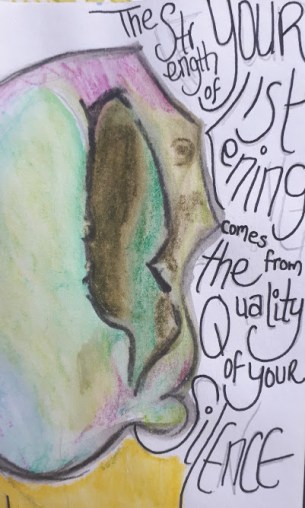
Small watercolour of a whale’s ear bone from the intergalactic spaceship that is my desk. Because of the complexity of their hearing, whales’ inner ear bones are contained within a separate chamber, not encased inside the skull as ours are. It amazes me how much this bone looks like a shell. If I held it to my ear, would I hear the sound of the sea?
It’s not up to me to answer these questions. I can only speak from the lens of my own experience, my own perceptions. In lieu of that, I can say with certainty that this winter’s dreaming I’ve been luxuriating in, this kana I’ve been walking in my own life, feels absolutely essential to the future that comes next. I can say—if I may speak with authority based on the way things feel from the intergalactic spaceship that is my writing desk this afternoon—that it HAS been absolutely necessary. That nothing is currently more important. Oh, the great irony that ‘doing the work’ this winter has actually meant ‘doing less work—!’ (Is that an exclamation mark or is it kana? You decide.)
So, in the spirit of wonder being the gateway to possibility, I’m issuing a little dare to myself. Actually, it’s not little at all. On Feb 17, I’m offering a one day workshop called Lightning Seeds: Opening the Gateway of what’s Possible, in collaboration with my dear friend, animal listener and translator Guliz Unlu. Come play with us as we walk kana in the company of the horses and other animals at Mountain Horse School, and court wonder through a combination of equine guided learning, animal communication, intuitive herbalism, earth wisdom, and soul craft. Curious to know more? Please visit our website or facebook page for all the juicy details!
Bittersweet times are upon me these days as my personal stock levels of fresh garden produce dwindle down to the last survivors. Luckily seed ordering is in full effect to keep the dream alive! Yet, even though the light at the end of the winter tunnel grows brighter every day, you can still guarantee there will be times when we feel the need to: bundle up, get adventurous, come home and devour a hot bowl of soup.
But I’ll reiterate before continuing that… #summeriscoming.
Feeling inspired from an Instagram post by my “neighbor” Anna for a mega hearty vegetable broth and a recipe from My New Roots, I set forth to honor my last butternut squash with a soup so full of nutritional goodness that would make the new Canadian Food Guide salivate.
• Once you’ve got all the goods simmering away go out and adventure for a few hours then come home to the most AMAZING smell, ladle up yourself a cup and savor the goods! Freeze what you don’t use in different sized containers for later. (I added in some carrot and celery because I had it on hand and well, I’ve never made a stock with out either!)
Step Two: Start making the soup.
Butternut squash, peeled & diced into ½“ pieces (approx. 3 cups), roasted at 375°F with some coconut oil, salt and pepper – one medium sized onion, diced – 3-4 cloves garlic, minced – 2-3 Tbsp fresh grated ginger (I keep mine in the freezer for easy grating and its keeps longer) – miso paste (Fuji Market in Whistler has a great selection, I used AWASE Miso)
Add some coconut oil into a Dutch oven over medium heat, then add the onion and cook until translucent then add in the garlic and ginger; allow everyone to mingle until fragrant. Then add in the butternut squash and cook for 5 minutes to absorb the flavors. Top the lot with the veggie stock and allow to simmer for 10-15minutes. Use one cup of water and combine with ¼ cup miso paste, whisking to combine then add to the pot. Remove from the heat and use an immersion blender to smooth out the soup. Add more stock or water to obtain your desired consistency and season with salt & pepper.
Step 3: Wasabi cream.
1 Tbsp wasabi powder – 1 Tbsp water – 2 Tbsp mayo – squeeze lemon or lime juice – dash of tamari
Whisk everything together and get ready to be addicted, and willing to putting this sauce on everything.
Step Quatro: Eat the soup.
Serve the soup drizzled with the wasabi cream, sprinkled with black sesame seeds and topped with some pea shoots, micro greens or whatever is on hand. That is all.
Simple. Delicious. Nutritious. Most importantly: made and grown with love.












 Traced Elements