My small scale efforts of container planting and tending a small plot in a community garden make me even moregrateful for the more productive labours of others. My horticultural failures are frequent but also fairly inconsequential in the long-run. One of the great fortunes of living in this region is our proximity to those who are growing food for a living (especially in the summer months). We drive by their roadside stands, support them at farmers markets and most of us personally know farmers or food-providers through one connection or another. It feels easy to connect the dots and appreciate their effort.
Growing the circle of gratitude beyond the local farmers feels a bit trickier… how to start when the origin of the food can feel mysterious, layered, even dubious?
As an experiment: I tried for a season to pause before meals and acknowledge the chain of events, sometimes even the ongoing industrial churnings which worked together to bring me to that particular meal. I’d extend a quick, internal thank you to everyone, thing and place involved (well… the ones I could easily come up with that is). And within moments the world had shrunk down to fit the size of my bowl & cup.
An ‘easy’ meal of morning oatmeal and turmeric milk had me visualizing oat-farmers, threshers, packers and transport-truck drivers. People building the machines that made the farming possible. Cinnamon grown in tropical heat and harvested by who-knows-who. Sunflower seeds and hemp hearts sprinkled on top brought to me by the Local Goods Company based out of Squamish. I visualized the sunflowers that grew those seeds planted by the farmers who chose to pursue organic certification, grow the flowers and then find a market for those particular seeds. I pour blueberries from Pemberton on top, grown by an ex pro-skier and the best I’ve tasted in years. Mix in the turmeric grown in India and sold in Nesters. Many hands along the way to bring it to my table. Someone picking the medjool dates that I add to the blender, someone else cleaning them, another person packing them, another loading them into boxes, another onto barges, another onto shelves.
One million thanks required. Photo by Asta Kovanen
One meal and my mind is slightly melting. I’m both hungry and amazed.
Having worked at one point picking and packing apples, pears and cherries for export to Japan, I have seen the many labourers required at each step. And having been one, I know that the pay isn’t always the best. The chance to eat locally grown food is a privilege in this region and when possible I am happy to spend my money supporting the people doing the hard work to cultivate brussel sprouts and melons right here in Canada.
However, all the other groceries (noodles, rice, spices, crackers) become more meaningful to me when I pause and consider how it made it to my cupboard. Some I won’t buy due to food justice or environmental concerns (palm oil or suspect meat) but even my vices like dark chocolate and ice-cream have lessons for me, some tasty, some not once you start digging through the chain of events.
OLYMPUS DIGITAL CAMERA
And sometimes that minute of foody reflection will simply bring me awareness and other times, it has helped guide me towards a different, more local, more compassionate choice.
“Innumerable beings brought us this food. We should know how it comes to us.” Buddhist grace, as recalled by Benedictine monk David Steindl-Rast
This is a guest post by Cindy Coughlin, a Pemberton-based HR professional, coach and facilitator, who operates Thirst for Change Coaching, where she blogs knowledgeably but equally engagingly about things other than gardening. When she told me recently she had unexpectedly become a happy garden-sitter, I begged her to write about it for Traced Elements. I had literally just seen Dawn Johnson that morning, and learned that Dawn’s squash plants grew over the wheelbarrow, obscuring it entirely, as it awaited Dawn to return from a camping weekend and get to the garlic harvest. So I share Cindy’s awe for this Eden in which she has apprenticed herself. So happy to welcome Cindy to the Traced Elements community. ~ Lisa
+++
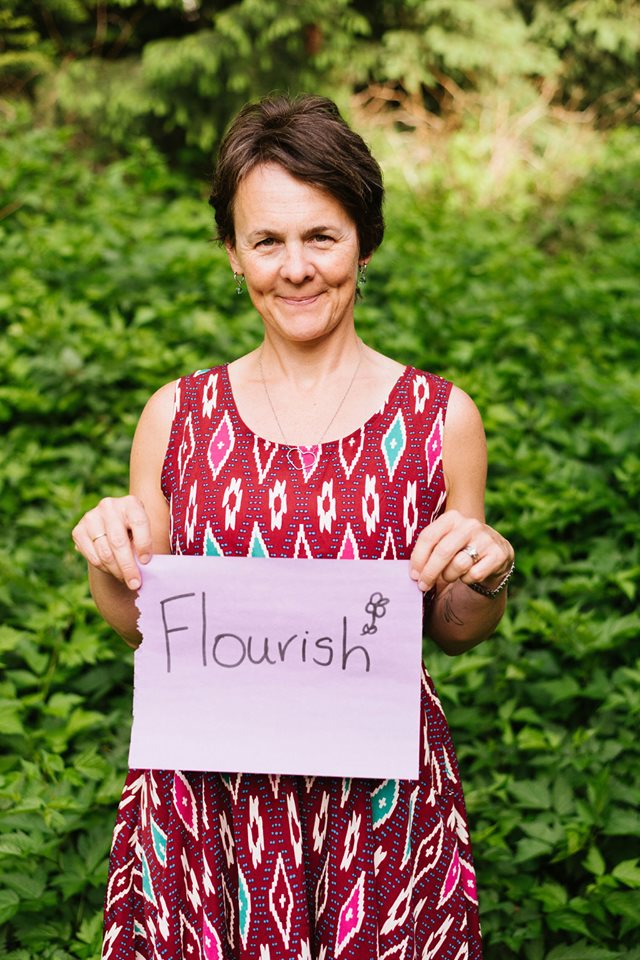
Flourish. This is my word this year. It originally started as part of a peer mentoring group where my main focus was on getting my consulting business up and running. We had to come up with a theme or a word. I picked Flourish. Well, actually I picked “Nourish to Flourish” – the idea being that I put in the care and attention to help build up my first year of going it solo.
Cindy Coughlin chooses to Flourish. Photo by Cathy Goddard
Nourish, according to the dictionary, means to cherish, foster, keep alive, to strengthen, build up, or promote.
Flourish is to thrive.
And this mantra, this intentional approach has quite naturally carried over to other aspects of my life.
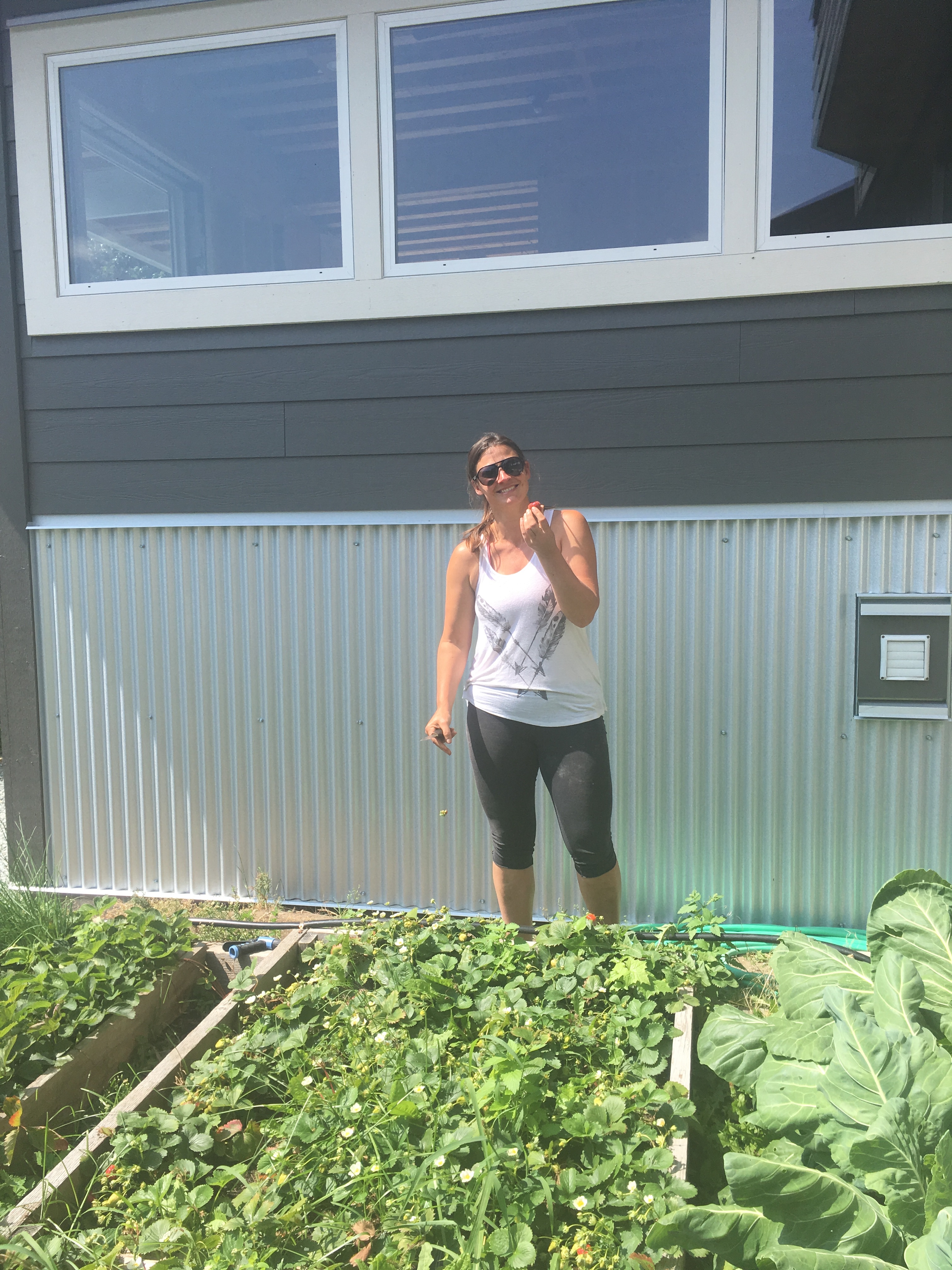
I’ve been working with my awe-inspiring, plant-whisperer neighbour and friend, Dawn, in her spectacular garden. I approached her in the spring and asked her to put me to work. Now to give you some context as to how outside my comfort zone this is – when I was younger and had the list of chores split with my sibs, I’d be adamant about staying inside and doing the laundry, vacuuming, etc. When I moved to Whistler and started off as a lifty, it was the worst job I could imagine. I hated working outside (I know weird, right, cuz I love riding and skiing and playing outside). I also really hate big bugs – especially of the 8-legged nature.
Plant-whisperer Dawn Johnson. Photo by Cindy Couglin
But this spring and summer, working in the garden, have nourished me in the best ways.
Here are three things I’ve learned about getting dirty:
Paying Attention
I need to be paying attention. I’ve been reading books about trees, books about bears, books about over-tourism. I’ve been watching tons of the stunning newsfeeds on the climate emergency. All of these are asking me, begging me, to step up my game, consider my impact, take some type of action – start somewhere. And now I feel the pull to pay attention. To pay attention to my food. To pay attention to how nature provides. To pay attention to the interconnectedness.
Recently I was trying to cut some lettuce, quite close to a flower which had a busy bee in it. I could see the bee was getting agitated with me being so close. So, instead of wildly flapping my arms to scare away the bee, I just stopped and watched. The bee did its bee thing in the flower and then moved on. I felt so filled up. Co-existing and working with nature.
Feeding my Soul
Dawn and her family went away for a week and I was trusted with taking care of everything while they were gone. Isn’t that incredible – I was TRUSTED to take care of a garden – my mom would literally think I’d been taken over by aliens.
And it was incredible. Everyday I’d check on the budding plants. I’d chat with the chickens and bees. I’d cut some lettuce and some yellow little squashy thing for dinner salad. I’d find that zucchini hiding under a massive, prickly leaf – happily earning my stripes by scratching my arms while I cut the stem. I’d just stand and stare and admire. I’d thank the garden for everything. I’d tell the garden how beautiful it was.
I tend to just take. Take from this earth. I feel like I’m starting, albeit in a small way, to give back. I’m starting to see, really see. And by seeing, by paying attention, I am feeding my own soul. I am seeing the interconnectivity. I am part of the impact and I can make new, different choices.
And I’m learning. Dawn to me is like Yoda was to Luke. Like Mr. Miyagi was to the Karate Kid. Her wisdom and unwavering passion is a gift to this world. And I feel so filled up as I watch, listen, try things out and learn. I’m learning how to garden. I’m learning to care for my food. I’m learning to take only what I need. I’m learning about eating food that is in season and waiting, anticipating, for things to come back next season. Meaning, going without in the off-season – oh the anticipation will make it so much sweeter.
All the Good Eats
The little yellow squashy thing that I thought was just an ornament has this beautiful mild flavour with just the right amount of crunch. The edible purple flowers that my Albertan-meat-and-potato husband is welcoming in his salad – taken in very small quantities because the bees love them so much – are so good. The cukes and zukes that seem to grow 5 inches overnight – no one believes me – but I think if I sat and watched them for 24 hours, I’d actually witness them growing. And the flaves from these are incredible!
I’m completely impatient for the carrots and so am happily pulling them as babies in service of giving space for the others to grow nice and big and sweet. Have you ever pulled a carrot from the earth, dusted it off and ate it right there? Nothing tastes better.
And the pièce de résistance, the biggest surprise of all has been the asparagus. Dawn simply broke off a piece and handed it to me right in the garden while she took a mighty crunch from her own piece. No salt and pepper, no butter. I took a tentative bite and was shocked to find out this is what asparagus actually tastes like. Almost 50 years old and I have just experienced what asparagus is supposed to taste like for the first time in my life.
If I can do this, anyone can do this. I am getting dirty. I am working it out with the 8-legged-who-shall-not-be-named. I am learning. I am growing. I am nourishing. I am flourishing.
In the spring, I sprinkled a small mason jar of biodynamic preparation 500 under my fruit trees and around my garden beds, just as Anna Helmer had shown me. There didn’t seem to be a very specific science to it, although I videoed her doing it and watched it over several times to make sure I had the insouciant wrist flick just right.
It seemed kind of random and messy, which should suit my style to a tee, but I felt weirdly anxious that I would screw it up by flinging the droplets around too wildly, causing the cosmic magic that had been channeled into this precious jar of “water” to elude my little patch of earth.
When Helmer’s Farm hosted an open house in late April, I was there, dragging the kid and his best friend, who amused themselves for hours, eating potatoes cooked over a fire, gently terrorizing the ducks, and eventually holing up in the sandpit.
They also took a turn stirring the great vat of biodynamic preparation, which I suspect was part of the Helmers’ agenda for hosting an open house – to crowdsource some sweat equity from the farm visitors.
I took my turn with the stirring stick, thinking I was really helping things along until Doug Helmer took over and showed me how it was really done, the vigorous stirring that must take place for several hours, creating vortexes, then disrupting them by swirling the water the opposite direction, channeling a winter-buried cow horn full of celestial magic into a kind of homeopathic preparation for the soil.
Once again, as I yielded the stick and accepted a small jar of preparation, it became apparent that I was benefitting a lot more than I was contributing. But as my farmer friends keep reminding me: if there isn’t a willing consumer at the other side of the field, their work is for naught. It might feel imbalanced, when I see how hard they work, but supporting that work makes you an important partner.
Charles Massy is a 60-something year old Australian pastoralist, self-professed shit-disturber and the author of Call of the Reed Warbler, who has become a growing voice for regenerative agriculture. He contends that, given agriculture influences several major earth systems, adopting a more regenerative approach offers the biggest potential to save the planet from the climate crisis. Regenerative farming is “nearly two and a half times better at burying carbon in the ground than anything else” in large part because of its commitment to nurturing soil health and rebuilding soil organic matter.
He came to these views from the near-decimation of his family farm, and its slow recovery into a commercially thriving business, through the trial and adoption of many regenerative practices. A PhD in his 50s helped provide a framework for his ideas.
Massy sees regenerative agriculture’s success as being dependent on farmers who shift their practices to become part of this solution. But equally, it’s on consumers. The movement will only work if the farmers’ products are supported by the urban community. “It’s a two-way partnership.”
Anna Helmer and her family have been growing for Farmers’ Markets for 20 years. She acknowledges that it’s easy for consumers to hit the weather-insulated grocery store or order up home delivery from SPUD, but contends that farmers’ markets offer one key advantage – something she has come to think of as ‘mutual appreciation.’ She writes, “This is an energy generated at the point of contact between primary producer and end consumer at market, notably at the transaction stage. I take your money, you take my potatoes. We are both appreciative of the other. The feeling builds each week, from season to season and year to year and really can’t be re-created in other retail environments.”
It’s the spark of contact that makes magic. Direct, human to human, contact. Built into that transfer of energy – my money, your product, eye contact, appreciation – is the recognition that we are interdependent, that through this simple interaction, we are defending the life force, and creating a more beautiful planet together.
Every Friday, from June until October, the Pemberton Farmers Market offers the opportunity for these kinds of sparks to fly. Helmer’s Farm is there, as well as Four Beat Farm, Devine Gardens, Willowcraft Farm, Blackwater Creek Orchard, Spray Creek Ranch and Rainshadow & Seed to Culture. The Square Root Food Truck is back, alongside Whistler Elixir, Nidhi’s Cuisine, Rosalind Young’s gypsy wagon the RomniBolta (Rosalind Young), Birken House Bakery, and new this year, Lori Ternes. You can also pick up From the Garden Shed’s lavender, herbal remedies from Evelyn Coggins, enjoy a massage from Inner Space Massage, or browse PawWow Pet Products, Rock the Feather, Gallup Pottery, Oh Suzana’s glassware, Betty Mercer’s repurposed silver and Aenahka Creations’ leatherwear.
But it’s not just about shopping. With community groups setting up, live musicians playing each week, and a host of special events, from Bard in the Barn, to the Zucchini Derby, Slow Bike Race and Stone Soup celebration, the magic of the Market is really in the gathering.
“Our vendors work together almost like a family and the overall community spirit makes it a welcoming event,” says Market Manager Molli Reynolds. “The barn is such a lovely structure that eliminates the need for individual tents and that brings us all together ‘under one roof’.”
That community vibe was recognized last year when the Pemberton Farmers Market was awarded Farmer’s Market of the Year 2018, in the medium category, from the BC Association of Farmers Markets. Yes, our little community Farmers Market is the best of its size in BC.
Because magic is a joint effort. Creative sparks, like any kind of new life, require the DNA of more than one human to come together. Which is why Fridays under the Barn are one of my favourite kinds of gathering. The raw ingredients are all there – fresh produce, food and drinks and treats, live music, play zones, community organizations, great people. Just add yourself, and see what happens.
I started my tomato seedlings on March 24th which is at least two weeks later than usual. It wasn’t until the snow really started to melt that I felt motivated, but better late than never.
My Dad is the self-titled Second Best Tomato Grower in West Vancouver. I can’t vouch for whether #1 deserved the title as I never met him, but as far back as I can recall, my Dad has grown tomatoes. Not the weird multi-coloured heirloom ones, just the basic varieties of Big Beef, Early Girl and red Cherry tomatoes, that look like, you know, tomatoes. My Dad is known as Tomato Grampa to his Grandkids to differentiate from the other Grandpas; not sure if they were lucky enough to have nicknames.
I remember the first greenhouse Dad built in the house I lived in until I was 24. It had poly sheet walls on a thin frame, and a plastic corrugated roof. My mother, sister and I were instructed to donate any pantyhose that had runs, as they made wonderful flexible slings for vines and fruit; this is back in the day when women wore pantyhose at work and most other places so there was an endless supply. After I left home, my parents moved into a new house and Dad built a hot tub inset in the raised deck off the kitchen; the heat from the tub heated the enclosed glass greenhouse he built under the deck. It was ingenious and the tomatoes flourished.
When I lived in various apartments in the city, I always had a tomato plant on my deck donated by my Dad. When I moved to Pemberton, I finally had room for a garden, so started my own plants from Dad’s seedlings. As he did, Dad taught me to save the seeds from the biggest and best fruit by placing the seeds onto a paper towel and letting it dry. Label it, fold it up and put it someplace you’ll remember. No cleaning or fancy storage required. For many years, I have grown the babies from my Dad’s original plants, and I still save my seeds the same way. I hope one day to pass along their progeny to my son.
Last year I started 72 plants, and all but two came up. Of those 70, 6 didn’t survive the transplant into the ground (I don’t have a greenhouse, yet…) so I asked my husband to pick up 6 to replace them. He came home with a flat of 36 instead. They were so cheap, he says. This happens every year as my husband has little faith in my leggy and straggly transplants, but by the height of the season they have stalks as thick as my thumb. Unlike my Dad’s orderly greenhouse rows, my boxes are overcrowded, a Tomatazon rainforest. My carpenter husband builds straight and orderly trellises with end cuts for his bought plants, while I pick up weirdly-shaped deadfall from the woods, as pantyhose are no longer a staple of my wardrobe. My boxes are whimsical and interesting; his are uniform. Nevertheless, all our plants do well, so I spend a good part of my fall canning, drying and giving away tomatoes. I always complain about having too many but every year I still start 72 plants, in case half don’t make it, and every year my husband buys more.
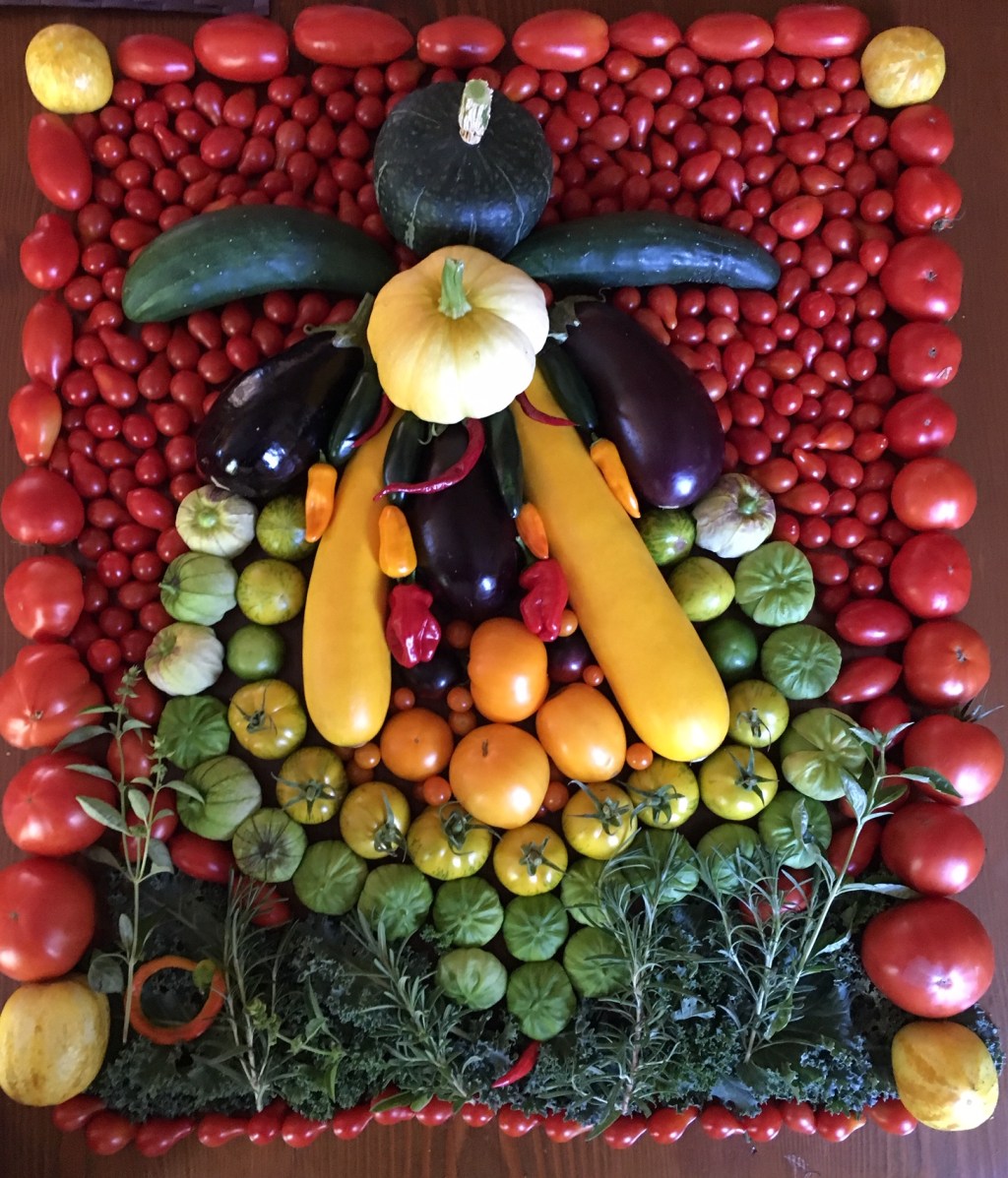
When life gives you an abundance of tomatoes, make art. Photo, and vegetable art, by Nancy Lee.
When my parents moved into their current seaside apartment, Dad gave up starting his own plants. Now I donate a plant or two, some of which I get the side-eye for (Green Zebra, Big Yellow, Indigo Cherry or Roma) as he prefers the basic round red tomatoes you can slice and put on a sandwich. He also buys a plant from the local nursery, since my garden tomatoes don’t seem to flourish as much in the ocean breeze as in the Pemby heat.
As I write this a week after planting, most of my seedlings are starting to pop up, and I expect we’ll have another bumper crop. I have a heavy heart though, as Dad isn’t doing well, and likely won’t be here to enjoy tomatoes this summer. I will always be thankful for all you taught me Dad, and every time I eat a warm tomato fresh from the vine, especially the round red ones, I will think of you.
“What’s this?” asked my clutter-resistant husband, observing the giant mason jar of oily plant matter on the counter.
“Ohh, it’s medicine! It’s called Balm of Gilead,” I explained.
“Oh. But what is it?”
“Cottonwood tips in oil.”
“Hmm. And what’s it good for treating?” he asked, in an impressively neutral manner, eyes scanning to the brand new bottle of olive oil next to the stove that was now suddenly, dramatically, near-empty.
I reamed off a list of benefits from Balm of Gilead, the old herbal remedy – that I’d just copied out carefully into my new Plant Allies notebook – using information I gleaned from Natalie Rousseau’s blog. The resinous buds are rich in salicin which your body converts to salicylic acid, the active ingredient in aspirin. Good for sore muscles, rheumatic conditions, simple wound healing, as an expectorant chest rub to treat a boggy spring chest cold. Bees also use the resin to protect their hives.
“Plus,” I enthused, “it’s helping me be more in tune with this place, with the seasons, and what’s outside our door.” He’s knows that “tuning in to the deeper rhythms” is kind of my jam right now, so, even though I could see his brain calculating the cost per millilitre of this little experiment, as compared to the cost per unit of a bottle of generic aspirin tablets, as weighed against the likelihood of me ever 1. completing this project and 2. treating anything with it, he nodded quietly, and put the jar back on the counter.
Since moving to Pemberton from the land of eucalypts and snow gums, I had acquired the habit of thinking that black cottonwood (Populus balsamifera ssp.) are kind of junk trees – the wood is too wet to burn well, the snowfall of the seeds in May wreak havoc on friends’ allergies, and the branches crash to the ground, making them kind of hazardous to live directly under under. Even though wonderful plant mentors like Evelyn Coggins,Dawn Johnson and Connie Sobchak have offered me other ways of thinking about cottonwood, thanks to their contributions to The Wellness Almanac – great bird habitat! good for erosion prevention! great shade in a sweltering Pemberton summer! a beautiful scent! a medicine! – those attributes felt like supplementary prizes, making up for basic deficiencies in character.
Then, in February, I joined Kera Willis and Guliz Unlu for an all-day workshop, offered through Mountain Horse School, “Lightning Seeds: Opening the Gateway of What’s Possible.” The hook had been set, when Kera asked:
What happens when we invite natural rhythms, cycles and energies to help us create the changes we wish to see, in both ourselves and the wider world?
What if we could get out of our own way?
What if we could remember ourselves into a state of embedded belonging within the natural world?
“In the same way a lightning strike may ignite an instant blaze or slow burn that smoulders for months, these awarenesses and experiences may take root eagerly within us, or they may take months (or even years!) to percolate down through our soil,” wrote Kera.
Befriending my tree neighbours has been an outcome with a long slow germination. First there was ignorance, curiosity, longing, admiration of those with more knowing. Years of that.
Lightning Seeds beneath a big old cottonwood. Photo courtesy Kera Willis/Guliz Unlu.Besa. Photo courtesy Kera Willis/Guliz Unlu
Then, facilitated by Kera and Guliz, a group of us were invited to stand in the crunching snow in the shelter of a cottonwood and consider: what is the smell of lighting? what is the sensation of green? what secret desire might we share with a horse, a tree, a non-verbal witness? How might be hold ourselves if we courted wonder, if we invited animals to approach us, instead of steam-rolling our way into the thick of things, without waiting, without listening, without receiving?
We ended our explorations at the mixing table, hands-on, pouring melted beeswax and cottonwood oil into containers, inhaling the aroma. Connecting with our senses. Relating.
A month later, on the first day of spring break, I found myself at the base of a massive cottonwood that grows beside the creek behind my house. I wouldn’t have known it was a cottonwood. But I was sniffing around the ground like a truffle pig, and when I found dropped branches with the tell-tale resinous buds (quick sniff for confirmation, month-old memory of sitting at Kera’s table still fresh), I gazed up, to locate the source. Oh. There she is. Wow. Your majesty. I couldn’t help but bow. Her crown was stunning. So different from the conical tops of the Douglas-fir and red cedar that have filled my winter days.
I picked the buds from winter-fallen branches, taking in the scent, and I kind of chatted away to the tree. First, I acknowledged her presence. Big step. I’ve walked by plenty of times, head in my own thoughts, brushing by like strangers. So we began the dance of becoming friends. I accepted her, without assessing her worthiness, just as I do when I become friends with someone. And I offered myself as a potential friend, and complimented her on her lovely qualities – like the fact that the branches she drops in winter storms are rich with buds that are full of medicine for spring coughs, muscle aches and pains, wound healing. I accepted the offering.
She’s a local here, (a coastal dweller, her kin are native to western North America) and the flood plain is her habitat – she can take root in pure sand or gravel along riverbanks, and absorbs water through her roots to help control flooding.
I’d brought the wee lad with me, beckoning him outside with the promise of a “creek patrol.” I had showed him Natalie’s blog post, with her step by step photo instructions of making a poplar salve, and explained what I was wanting to do. I pulled out my little jar of salve from February and we both inhaled it. He absorbed it all quietly, then ran to find a basket for me, and his raspberry picking container (yogurt container with string to hang around the neck) from the bottom drawer.
As I plucked the buds from fallen branches he hustled back and forth between the creek and mother tree pouring water on it as “an offering.” Also leaving branches against its trunk in case it felt compelled to be a Fort anytime soon. It has been almost a year since we last talked about the idea of offering thanks to the trees and living things around us – and maybe we owe it to Wild Kratts, but he’s bought into that idea completely.
(Cut to last night’s first fire, with deadfall we collected from the forest floor.
Dad: “trees are so awesome because they give us firewood!”
Boy: “No, trees are awesome because they give us oxygen. That’s more important than fire wood. If you don’t have oxygen, you can’t LIVE!”)
Making offering. Moss, dirt, creek water.
This is the seed I want to plant in his heart, I thought, as I was collecting buds from the forest floor : there is so much abundance here as long as we remember to acknowledge and give thanks and give something in return. This is the dawning that is, at last, awakening in me.
The smell of cottonwood resin, which I found kind of medicinal and stenchy in February, is now something I inhale with intention and gladness. (Especially given that my hands are covered with it, right now, after I opened the lid of my brewing jar to see how things were looking. Word to the wise: when they say, “only fill your jar 3/4 full, because the buds will swell”, they mean it. Oh grasshopper. So much to learn.)
Now that I have begun to enter into relationship with that great tree, I see her – from my window, out in the yard, walking the creek – all the time, and it doesn’t make sense to not nod in greeting. After all, we’re friends. Even if I never use the oil, medicinally, some “medicine” has been gained, in this, small glimpse at the significance of the phrase I have heard my Lil’wat neighbours use: all my relations.
Using a ratio of one part buds to 3 parts vegetable oil (I use olive oil), soak the buds for at least three weeks, stirring gently once a day to expose all bud surface areas to the solvent.
I use 500 ml canning jars and cover the tops with paper towel secured with canning rings. This prevents stuff from falling into your oil but also allows the moisture from the buds to escape. Keep the oil in a warm place (in the oven with the oven light on) to help gently dissolve the resins into the oil.
When your soaking is complete, allow the jars to sit at room temperature overnight then strain out the buds. Let the oil sit covered with a clean tea towel for another 24 hours at room temperature and then decant it into jars, cover tightly, label and store in a dark place.
You can apply it to sore spots as is or mix it with other infused oils and essential oils, add some melted beeswax and presto: an absolutely fabulous homemade version of “Tiger Balm”.
On my desk right now is a gorgeous little collection of essays called Wonder and Other Survival Skills, put together by the editors of Orion magazine. On its cover, a young girl presses her hand against the surface of a lake: skin of girl meeting skin of lake. From this meeting, a ripple moves.
“Is wonder a survival skill?” H. Emerson Blake asks in the foreword. “The din of modern life pulls our attention away from anything that is slight, or subtle, or ephemeral. We might look briefly at a slant of light in the sky while walking through a parking lot, but then we’re on to the next thing: the next appointment, the next flickering headline, the next task…Maybe it’s just for that reason—how busy we are and distracted and disconnected we are—that wonder really is a survival skill. It might be the thing that reminds us of what really matters, and of the greater systems that our lives are completely dependant on. It might be the thing that helps us build an emotional connection—an intimacy—with our surroundings that, in turn, would make us want to do anything we can to protect them.”
By my own definition, wonder is the ability to travel beyond attention, beyond mindfulness–to truly make an encounter with the world in a way that, for the slenderest of moments, lifts us out of ourselves and returns us back with something more. Something of the ‘other’ we’ve encountered travels with us. A little of the world comes into the interiority of us and lodges there. Permeates.
Winter is a season of rest for most of us land-based folks. A season of living in a place of dreams and visioning (literally, as we get caught up on sleep, and plan for the year ahead.) This is the first season I’ve stopped teaching completely. I felt the need to let the work do a deep dive into silence, and (beyond the day-to-day chores of keeping animals, which never go away), to truly let myself drop out of time. I sleep when I’m tired. I wake up when I wake up. I have breakfast and a cup of coffee, before I go out to do chores. Which sometimes makes me feel like a slacker, but it also feels… luxurious. Luxurious in a simple way I haven’t allowed into my life before. A spaciousness that holds its own kind of wonder.
The other reason I decided to stop teaching completely once the snow hit in December, was I wanted my horses to feel like they belonged to me again. 2018 was our busiest year teaching together (THANK YOU, PEMBERTON!) but I wanted a chance to ride when I wanted to again, instead of working a horse so they would be ready to say ‘yes’ to a student. I wanted to WANT to ride again. To wander about aimlessly bareback with nothing but a lead rope joining me to my horse’s mind. I wanted the horses to be able to choose who came out to play with me, whenever I showed up at the gate with a halter or a bridle.
What’s emerged out of this unravelling is that I was finally able to back Besa, my big paint/Friesian mare. When she came to me 18 months ago, she was an untrained 6-year-old, freshly weaned from being a mamma to a feisty filly. She made it very clear to me- in her lack of desire to be caught and her extreme reactivity, power and athleticism- that I’d have to take my time with her. Given space and the permission to approach me (instead of me expecting to approach her and do what I wanted), she decided that humans were worth being curious about. Her curiosity flowered into full-blown affection. She’s the first horse to come to anyone out of the field now, and she sometimes chooses to pull me (or whoever I’m accompanying into the field) in against her chest with her muzzle, the closest a horse can come to giving a hug.
Besa’s been asking me to do things with her for months (Proper things! With a bridle and tack like all the other horses!) and all summer and fall I just didn’t have the capacity. But these last few weeks I’ve slipped onto her back and let her carry me around our little maze of snow paths in a mutual exchange of trust: I will trust you with my body, if you will trust me with your body. The ‘training’ part of it can come later. For now, all I want is her to turn her head to me, so she can look at me fully out of her huge dark eye: Oh. So now you’re up there now. So that she can yawn and snort and let all the tension go out of her nervous system, and get used to this strange new way that horses and humans can be together.
Perhaps it’s me she’s been waiting for all along. Perhaps I needed to drop into this spaciousness for us to find this way to trust each other.
There’s one essay that stands out for me in this slim little collection that sits on my desk. It’s Chris Dombrowski’s Kana: a father grasps at the nature of wonder. In it, he defines Kana as “a word or figure the Japanese haiku poets used as a kind of wonder-inducing syllable (it translates loosely into English as an exclamation point.)… that heart-stutter we receive when an image of the world takes root in us…”
His essay shares the spell of a day spent morel hunting with his twenty month old son. The way the boy wanders across the face of the burn, trailing a whitetail’s antler behind him, carelessly decapitating the very mushrooms he’s hunting for:
…he is either in a daze of boredom or he is walking kana, penetrated each step by the world, not penetrating it. It’s tempting to call this spirit naïveté, but it’s not: it’s wisdom we lose along the way.”
Perhaps that’s what I’ve been courting this winter: wisdom I’ve lost along the way as I’ve been coerced into ascribing to linear time, to capitalism, to the many demands the constructs of being human impose upon us. There is gentleness here, in this wonder, that doesn’t feel rushed or imposed. A hand resting against the surface of a lake.
I’ve wanted to broaden the scope of my horse and nature based teaching practice to include workshops for adults since I started Mountain Horse School in 2012, but I’ve shied away for a long time. I’ve always felt comfortable with kids because they’re so immediate, so open still to this touch of the world upon them. Grown-ups’ responses are layered. More conditioned. We need more language to access understanding, and experiences that can operate like keys opening the locks of ways of perceiving we’ve long put away. Grown-ups want reasons to pacify our rational, linear ways of thinking, and we want to know if playing with opening the doors to wonder, if walking Kana is ‘worth the investment’ of our time. We’ve become used to being sold meditation through a list of its benefits. A walk in the woods has become a thing we could pay for. Forest bathing, it’s called in the brochures.
What if wonder is the gateway to possibility? What if it’s the only skill that will give us the tools, insight, and power we need to move into (here I am, throwing another book title at you!) The More Beautiful World That our Hearts Know is Possible? What if the benefits of wonder—similar to its more lauded cousin, gratitude—might be the resurrection of a life woven into belonging with the wider world that sustains us?
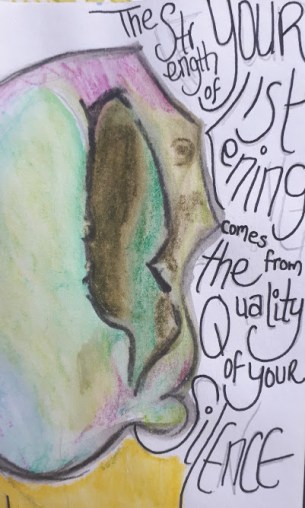
Small watercolour of a whale’s ear bone from the intergalactic spaceship that is my desk. Because of the complexity of their hearing, whales’ inner ear bones are contained within a separate chamber, not encased inside the skull as ours are. It amazes me how much this bone looks like a shell. If I held it to my ear, would I hear the sound of the sea?
It’s not up to me to answer these questions. I can only speak from the lens of my own experience, my own perceptions. In lieu of that, I can say with certainty that this winter’s dreaming I’ve been luxuriating in, this kana I’ve been walking in my own life, feels absolutely essential to the future that comes next. I can say—if I may speak with authority based on the way things feel from the intergalactic spaceship that is my writing desk this afternoon—that it HAS been absolutely necessary. That nothing is currently more important. Oh, the great irony that ‘doing the work’ this winter has actually meant ‘doing less work—!’ (Is that an exclamation mark or is it kana? You decide.)
So, in the spirit of wonder being the gateway to possibility, I’m issuing a little dare to myself. Actually, it’s not little at all. On Feb 17, I’m offering a one day workshop called Lightning Seeds: Opening the Gateway of what’s Possible, in collaboration with my dear friend, animal listener and translator Guliz Unlu. Come play with us as we walk kana in the company of the horses and other animals at Mountain Horse School, and court wonder through a combination of equine guided learning, animal communication, intuitive herbalism, earth wisdom, and soul craft. Curious to know more? Please visit our website or facebook page for all the juicy details!
Every October I sort of lose my mind. I could choose to call it seasonal affective disorder, depression, pieces of shadow I have not eaten. But I am careful not to put it into any of these neat little boxes, because then I would stop extending my most compassionate curiosity toward this strange seasonal storm. I want it to remain a wild thing, an unknown tempest of fury and flying sticks, because every time it shows up it serves a purpose. I’d even go so far as calling it sacred, because each time I allow it to sweep my floor clean, something I have been praying for enters.
There’s a pattern here. A seasonality. Every October, I used to migrate like a swan. As soon as the last of September’s warmth sank over the horizon, I blew up my life, put the pieces in a backpack, and left. Later, when I stopped traveling to far-off countries and instead moved in a series of lunges across the North American continent, October became the month I put everything I owned into my car (or my truck, or a suitcase in the underbelly of a Greyhound bus) and drove until I hit a coast and had to stop.
Now that I’ve rooted myself in the kind of life that contains four horses, one sheep, one pig, one dog, twelve ducks and two roosters, the ferocious energy of THE MIGRATION THAT SHOULD BE HAPPENING no longer blows me across the continent. Instead, it bowls me over. This year, I looked out over the crazy abundance of harvest season, my belly full of squash and roast duck (all the incredible generosity of the natural world!) and was so irrevocably angry that nothing made sense anymore. The anger burnt until there was nothing left but nothingness. While all around me trees dropped their leaves in an incredible display of letting go, I was furious at them for making it look so easy. This is insane, no?
How does this connect to Pemberton food culture, you ask? Well, it doesn’t. But it does. Because a couple of days ago, before this year’s particular loss of mind levelled out and let me think with something akin to clarity, I opened my medicine cabinet and saw this:
“This” is the library of wild-foraged tinctures I’ve created over the past 4 years. (Their labels are double-sided, so the essence of the words can seep into the medicine.) As I read their labels, I realized something: I created each of these medicines in October. Each was created as a support for weathering that particular year’s energetic storm. As I felt into their contents, I realized that looking at the interior of my medicine chest was like looking at the growth rings of my own evolution, as well as my connection to this wild part of the world I call home.
2015: Love, Compassion, Congruence. Usnea longissima: the long, delicate single strands of lichen that hangs from trees like the animate glowing trees in Avatar. Potent antiviral and immune support, grows only where the air is pure and the forests contain old growth.
2016: Changes toward Infinite Potential. Again Usnea longissima, this time with Lungwort Lichen (Lobaria pulmonaria.) I was still working with air beings, still striving for lightness. This one recognized the animus of the invisible transmission of air as connector between the animal and plant realms and between all beings. (If I breathe in air a tree exhaled and then YOU then take in the air I breathed-)
2017: Liberation. Atonement. Unity. This was a graduation ceremony from air to earth, something I created specifically when I moved from Squamish Valley to Pemberton. Devil’s club root and bark (adaptogen), willow bark (for deep pain and calling in receptivity and remediation).
2018: Belonging, Lightness, Radiance, Love. This one I made in secret after hiking up to Tenquille Lake with Pemby herbalist Evelyn Coggins this summer. We were not supposed to take any plants. (Evelyn, I am sorry I am so terrible at obeying rules.) There’s a chance a few flower heads of Valerian and River Fireweed (along with a few hemlock tips, a piece of old man’s beard (another Usnea!), and a piece of quartz may have made their way into my pocket on this hike. (Barely a handful of plant matter, I swear…) Covered in 100 proof vodka and shaken every day for 20 days, this one is light and floral but POTENT. Holy $^%&. The first time I tried it I almost fell asleep in the library. It’s for taking before bed, to encourage new neural connections to form through dreams…
Then I had a conversation with myself that I’m embarrassed to disclose. But I will anyway, because I think we all have these sorts of conversations from time to time. It’s just not something we talk about.
“Well Kera, you should try to remember to take some of these. That was the point of making them.”
“Humph.”
“??”
“Oh, right. Okay, okay.”
“And you know that St John’s Wort tincture you have in a mason jar under the kitchen sink? You should take that too. Because you made it SPECIFICALLY for coping with Octobers. Remember?”
“Um, yeah. Yeah I did.”
I did. I do. I am. Taking them. Ten drops in the morning of Liberation/Atonement/Unity and 6 drops of Belonging/Lightness/Radiance/Love before bed. Could the prescription be anymore poetic?
Pharmaceutical companies, take note. You could do better.
This is a story about the founding of the Wamhily CSH (Community Supported Homestead). What that is and why, is held in the story below. I hope this tale speaks to you and reminds you, as Field of Dreams profoundly taught us all: “If you build it, they will come.”
I bought my acreage in a very tumultuous and vulnerable time. I’d been working in social and environmental justice organizations my entire career and had just transitioned into a role in Vancouver’s tech scene. It was what I felt I needed to do, but left me with a void inside and some major guilt for having transitioned to a life “for profit”. For the first time, I was dedicating my daily toils to the system that I knew was broken and only compounding the things about this world that are hollowing us out from the inside.
It took three years working in high-paced tech sales for me to hit my wall. I was anxious, I was demoralized and I was becoming more and more disillusioned by the day.
And then I found Pemberton.
It happened as a result of a panic attack. Something that was totally foreign to me. I found myself hyperventilating under my desk in my office, overlooking the ferry boats of Granville Island with its happy tourists going about their day in the sun in one of Vancouver’s most beautiful locations. Who has a panic attack in Vancouver’s happiest place?
I fled the office, got in my truck and ‘drove’. I say ‘drove’ but if we’re being fully honest it wasn’t driving, it was running. I ran up the Sea-to-Sky, I ran past Squamish and past Whistler, further than I’d ever been in this direction. I ran, only to find Pemby.
It wasn’t until I hit this quiet mountain town that the anxiety lifted and I was able to breathe again. I felt it deep inside and I knew. This is it.
It took me a few months of weekend visits and some persistence from my realtor, but I found it. I found my acreage. I found my blissful slice of paradise. I found Wamhily – five wild acres in the mountains outside Pemby that lacked cell reception. Perfect.
For those of you who get it, this won’t be news to you. But for me, it was a revelation — the peace, the strength and the levelling and grounding power of these mountains. Of the land between them. And of what they can evoke in even the most desperate and hollowed out of us. So much so, I quit my job, left the upward trajectory of a stellar career and never looked back.
I named my acreage Wamhily. It’s a long story, too long for this piece, but the short story is that the calm steadfast mountains, our deep rich forests and the serene lakes that make up our magical home manifested. Wamhily, an acronym for With All My Heart I Love You. And I do.
Having worked in the political and not for profit trenches with others who wear their passion on their sleeves and who have been able to withstand the heartbreak that this world throws at us, things crystalized. Wamhily was built to open its arms to those still doing that great work, as a respite, as an oasis, and as a hub for support and connection between those who are able to continue the fight. A quiet place away in nature, far from the social and environmental fights we wage on behalf of others and our collective selves. A safe place in nature that is always here for you.
Unfortunately, real life creeps in, and reality is: no acreage is an island, as much as we wish it could be so. There are bills, taxes and the costs that come with participating in greater society. And after four years, Wamhily has been forced to evolved.
To say Wamhily was a one way street providing for the community that needed it would be a lie. After four years on the acreage, building my mini homestead, the community it fed has showed up. It has built gardens with me, it has tended bees, it has mourned their loss to bears getting fat for winter, it has supported the dream and revelled in its escapism. Now, it has moved to helping further, with supporting me in my homestead dreams and making sure the bills get paid to keep this place afloat for us all.
This brings me to the Wamhily CSH.
What is a CSH (Community Supported Homestead)?
To be honest, I’ve never heard of another one. The idea came from the intrepid farmers out there running CSAs (Community Supported Agriculture), making their way with the help of their neighbours, friends and those that believe in local farming. Participants pay a fee at the outset of the season and reap the benefit that harvest season holds.
The inaugural Wamhily CSH is the first time a monetary value will be placed on the gift that Wamhily is to me and those that draw upon it. It feels weird to bring money into this beautiful ecosystem of love and support but it came at the behest of its community, now demanding to pay into the work I do and the dream it supports in us all.
In spring, we harvest garlic scapes from the garden and make pesto. Summer brings: beets, beans and cucumbers for pickling; tomatoes for drying and sauce; peppers and onions to add for salsa; berries for jam; cabbages for sauerkraut; herbs and kidney beans for drying; seeds for saving; and other garden delights that find their way into jars. Down time manifests vegan soaps made from scratch with exfoliants like lavender grown and dried here, and knitted dish rags so you can say goodbye to disposable j-clothes, among many other gifts.
Before the costs and toils of the season are upon me, I know I have the support of my community. Not just in spirit, but in the currency of our culture, dollar dollar bills y’all. Those who believe in what I’m doing buy in at the outset and set me up to be able to manifest the season’s bounty into what we need to get by throughout the year. A jar of raspberry jam, still smacking of the sunshine it was harvested in, shining through in the bleak grey of February.
In short, a CSH is a community supporting an alternative “back to our roots” lifestyle, supporting a person and supporting a belief that together we can grow, make and provide for ourselves. I’m not just preserving food or making my own cheese — we’re preserving a way of living that our existing consumerist and capitalist system have thrown to the wayside and devalued.
Wamhily’s CSH is more than just the monetary support to be able to provide healthy and love-filled food and household items. It’s the understanding between us that there is value in where we’ve come from and the knowledge passed from generation to generation. There is innate and deep importance in hands covered in dirt, arms torn up by blackberry brambles, wax from my hives dipped into tapers.
The Wamhily CSH is the manifestation of love into action. A divergence from the corporatized and prescribed path to a more connected and nurturing one. Of my community saving me and I hope, in a small way, me saving them.
It comes not from a place of judgment of what we’ve inherited and is easy, but of what we can do when we set our minds to it and believe that we are capable. Capable of a different narrative, capable of doing more with less and capable of knowing deep in ourselves that we don’t need the system handed to us.
This season, with the support of my community, I go to bed each night knowing that Field of Dreams was right. When you build it, they will come. At least when you build it together.
“Seeds are software, and we have the seeds” -Representative of the chemical giant Seminis, just before selling out to Monsanto
Usually, plantain is a quiet, unobtrusive little plant. She is known for her excellent healing properties, her usefulness as a spit poultice, and her excellent nutritional properties. She is generally soft spoken, and most people are surprised to notice she has been underfoot all along. She is like coffeeshops in Vancouver: ubiquitous. But lately plantain, sometimes called ‘white man’s foot’ for the way she has followed our footsteps across North America, has been shouting at me. She is poking me with her seed spears. Every time I turn around, there she is. Usually when this happens it means the particular plant that is ‘shouting’ has some particular medicine I need to pay attention to. My resistance is generally high. You think I would actively cultivate some sort of porosity towards these sorts of encounters, but no. When a plant is trying to get my attention (or most things, for that matter) my first response is resistance. When I finally let plantain in all I do is look at her for a moment, but that look takes a photograph that embeds her in my mind and from there she begins to communicate with me.
Plantain
Because of the way the summer has gone- hot and dry- Plantain is setting seed earlier than usual, and with an abundance I did not notice last fall. Perhaps she is foretelling the future, but it is more likely her actions are a reflection of the present. (When a plant is stressed, their seed production tends to be prolific. Cue the fallen black cottonwood I stood in the ruins of this past spring, who released her white parachute fluff designed to float her future progeny over the entire province OVERNIGHT WHILE SHE LAY DYING ON THE GROUND, while most of the trees were barely starting to open their little seed casings.)
But that is not what I want to tell you. What I want to tell you is that I want to cry. Each time a Plantain seed spire touches my ankle it is a reminder that things will never be the way that they were. A reminder that I do not have the time and that I am doing too much, too fast, to really listen, to really hear, to really feel any of it. There is grief in these too-early seed spires. Grief that the world is burning; that part of the morphic field of these seeds will always contain the memory of smoke.
I believe a plant is a part of a specific ecosystem’s innate intelligent awareness made incarnate, and that a seed is the plant’s answer to the questions of its times. And the answer will be different, even among similar species, if they are growing in different locations. A seed is this wild intelligence made portable, designed for dispersal, a portable currency of consciousness.
So if we really want to rejoin the dance, if we really want to be a part of what is going up in flames around us, what is burning and the new seeds that will be born out of this fire, we need to eat of the wild, NOW. We need to take a little of the otherly intelligence that is the essence of the natural world into our bodies so that we can start to belong to the place in which we are standing. Perhaps this is the beginnings of true reconciliation. Or at least the seeds with which to begin.
Please don’t think I am being trite. I am not making small of atrocities that have been committed both by and against humanity. I am not saying that by taking yet another thing from the wild we can heal from the many woundings of the entitlement we have been taught to assume. I am saying that we need to begin to build a bridge to another way of being, of living, of feeling, and that if we can ingest the local wild plants that are doing that all around us in the places where we live, who have not cut themselves off from the responsiveness of the wild innate intelligence of their own sovereignty, then we begin to take those transforms of meaning into our cells, and that begins to alter us.
Do you remember at the beginning when I said Plantain shouted at me? Well obviously she didn’t, at least not in words. But when I started to pay attention- when I started to unravel the thread of meaning she held for me- she led me here. When I went out to shoot the pictures for this post I stripped a handful of her seeds from their spire, winnowed their husks away by breathing into my palm, put them into my mouth and chewed. They popped between my teeth like chia seeds, and had a similar mucilaginous texture. They didn’t really taste like much but maybe that’s a good thing. Something about pulling the seeds from their stalk felt familiar, the way I sometimes recognize the face of a stranger I have not known in this life.
Plantain- the tall darker seeds stalks are ready to be harvested
Plantain seeds, slightly winnowed by blowing into my palm
Beside the Plantain (and remaining mostly quiet all this time) was a stand of Dock, with seeds also ready for harvest.
Dock seeds dried on the stalk and ready for harvest
Dock seeds close up- note their papery hulls which do not need to be winnowed- they can be ground along with the seeds
So here is where we get to the practical and super-actionable and amazing part of this post: you can make flour from both these seeds. Yep, that’s right. SUPER SOVEREIGN INTELLIGENCE WILD MORPHIC FIELD FLOUR WITH BONUS SUPER NUTRITION! (Or as we more quietly call it, Plantain/ Wild Dock Flour.)
Plantain/Wild Dock Flour
Simply go out and gather as much Plantain and Dock seeds as you have the patience for, checking that the ground the plants grow in is free from contaminants and roadside pollutants. There is no need to winnow (separate) the seeds from the hulls as from both kinds of seeds’ hulls are edible and add extra fibre to your flour, as would happen if you added rice bran. If the seeds do not pull off the seed heads easily when you are harvesting, they are not ripe yet and should be left on the plant to mature. As with all wildcafting/foraging, be considerate of the plant’s needs to reproduce and other animals who may depend on the seeds as a food source. (A good rule is to not harvest more than 25% of the yield of a patch, but in the case of weeds like Plantain and Dock (which are prolific) you can sometimes take a little more without ill effects.
If you wish to increase the nuttiness of the flavour of your flour (OR if you are worried about bugs, OR if you are not sure your seeds are completely dry) you can roast your seeds on a cookie sheet in the oven, stirring several times at 200 degrees until seeds have darkened slightly.
Store whole in airtight containers until ready for use. Grind seeds and hulls in a coffee grinder until they reach a flour like texture. Substitute 1 for 1 to replace up to 1/2c of flour called for in the recipe to add extra nutritional value and wild intelligence to whatever you are baking.
Author’s note: The seed harvesting in this piece was originally inspired by Katrina Blair’s book ‘The Wild Wisdom of Weeds: 13 Essential Plants for Human Survival” which is an excellent resource for anyone wanting an accessible way to learn to incorporate edible weeds into their diet!
The bell rings to start the market day. Relentless and demoralizing rain has been falling since the tents came out of the trailer and we began the set-up, two hours ago. The gutters now strung up between the tents are working well, emitting a steady stream of water into the growing pool along the back curb and the tent side walls keep us relatively rain-free inside the stall. The very air seems wet, however, and little can be done about that. Tough morning at market so far.
I’ve been selling my family farm’s produce at Vancouver farmers’ markets for 20 years, so I know how to sell potatoes in the rain. It’s just like how to do it in the sunshine, except it seems mentally harder. The difficulty lies in keeping the stall in a high state of readiness, even though it might be empty and you would prefer to be warm and dry elsewhere. Every sale matters- especially in the rain, if your farm depends on farmers’ market sales
I squeeze my way past the bins of backstock in the trailer where I have been changing out of sopping wet clothes. I have already traded a few hellos with the neighboring vendors, people I’ve seen every Saturday morning for years, but there’s been no time for more than that. I glance around to make sure all the signs are up and that the display is full: we’ve finished in time. It takes just as long to get set up in the rain as it does otherwise. Longer, of course, if you waste time regretting the situation.
The potatoes look good today, the red Chieftain and yellow Sieglinde sort of glowing in the dim light. My staff, who are making up $5 bags of potatoes and carrots, wisely refrain from discussing the weather. The vast, dripping, emptiness out in the market fairway which would normally be filled with customers eager to start shopping, lining up in advance of the opening bell, is obvious enough.
It is undeniably deserted, and despite the potatoes doing their best to provide sunshine, it feels disheartening. I give my head a shake because I think it’s too early to write this one off.
The first customer materializes- she’s a rain-or-shine regular who gave up on regular grocery stores quite a few years ago. She is followed by another I don’t recognize. A chef splashes his way in. I make sure his 20lb bag weighs at least 25. At the till, we’ll be rounding down more than usual. The customers might not notice but I don’t mind. I am feeling very benevolent towards anyone who turns up this morning.
Before I know it an hour has passed, and I realize that the potato display tables are hidden from view by the backs of customers filling bags. The stack of now empty bins in the back has risen to a level I hardly thought possible when the opening bell rang. It’s going to be a solid day, despite the rain, which might even be easing up a little.
One of my staff has been coming to market ever since she was a baby, and her mom worked for a farm vendor here before that. She’s on the first till, and I jump behind the second one, a line-up having formed of dripping wet customers who thank us for being here today when they get to the front.
It bears repeating: the rain-soaked customers are thanking us and giving us money for potatoes. In fact, now it’s so busy they are lining up to do so.
This, right here, is what makes farmers’ markets tick. People choose shopping in the rain over going to a grocery store. Farmers choose marketing in the rain over selling wholesale.
It’s what leads to the fact that farmers can make a living on an acreage that would otherwise be insufficient because they can get full retail for their produce.
The customers keep coming back for more because…well…I just don’t know. Is it the quality of the product? The contact with an actual farmer? The coffee and crepes? It might be magic. Whatever the cause, it provides me motivation to keep farming, and to keep customer service and marketing standards high. It seems like a practical way of showing the customers that I really appreciate their business.
I love being a part of this special relationship, but I worry that it won’t last. It’s so much work, there is so much to learn, and there is so much competition for customers- and surely, they won’t keep coming? I mean, sometimes they must quietly wonder if it is really all that great? The weather, the effort, the cost. All that cooking.
Customers. We need customers to make markets successful. We need to retain existing ones and win new ones who might also shop in the rain. The good news is that we are only tapping a tiny fraction of the people who buy food, so there are plenty more to be had. The bad news is that the competition out there is absolutely fierce, and nowhere else other than at farmers’ markets are customers asked to go out shopping in all sorts of weather, probably park far away, and spend perhaps a little more than they really meant to.
Farmers’ markets enjoy one major competitive advantage however, and that is something I have begun to call “mutual appreciation”. This is an energy generated at the point of contact between primary producer and end consumer at market, most notably at the transaction stage. I take your money, you take my potatoes. We are both appreciative of the other. The feeling builds each week, from season to season and year to year and really can’t be re-created in other retail environments.
The farmer can do much to cultivate the feeling of mutual appreciation in the stall. It’s about a lot more than saying “thank you”. Developing good customer service and merchandizing skills is of prime importance- pre-market preparation, and of course years of practice help too. In my opinion, it is important to put as much effort into selling the food as you spend growing it. These customers deserve that.
The farmer makes the magic that the people are coming back for. If you can also create this feeling of “mutual appreciation” in your stall, I think you’ll be able to have both tills busy, even in the rain.
Anna Helmer farms in the Pemberton Valley with her family: friends and relations. Her book is called: A Farmer’s Guide to Farmers’ Marketsand is available on amazon.com.
















 Traced Elements