We are fortunate to have a freezer full of moose meat from the Yukon. A beautiful moose that my spouse and his sister bagged in September (after 3 unsuccessful hunting trips in the past few years).
So we have moose sausages and stew meat and, of course, ground. I was craving meatballs so I searched my cookbooks for some recipes. One recipe from Sheila Lukins’ All Around the World Cookbook – called for allspice and nutmeg. No thanks! I do not enjoy nutmeg at the best of times, and certainly not in my meat.
So I charted my own course.
My thoughts on wild game are that one should not try anything too wild. The meat is wild, so when experimenting, go tame. That said, pecorino is a sharp and dramatic flavour but it worked. (I want to take a moment to thank the AMAZING Pemberton Valley Supermarket that always has pecorino in stock. PVS – you are the BEST.) As for spices, I went for dry mustard, paprika, S&P, oregano and basil – and not too much of any. And of course parsley. I rarely make anything that does not call for parsley or cilantro, my faithful culinary companions. When I do not have any of these two in my fridge, sure enough, I embark on a recipe that calls for one of them. So those two are always, always on my grocery list. Serve these meatballs with Pemberton mashed spuds and some broccoli or another green veggie. A good and satisfying fall dinner! Fall cheers to the hunters and the farmers! And thank you to Lisa always for being the amazing host of this food blog site!
Method: put all ingredients, except for olive oil, in a large bowl. Mix well and form into 1 tbs balls.
Heat 1/3 cup pure olive oil in large skillet with sides at least 4 inches high (oil splatters). Heat oil on medium heat. Gently place meatballs in pan. Do not rush but gently rotate the balls so they brown and cook thoroughly.
Serve with Pemberton russet mashed potatoes and a green steamed veggie. Enjoy!
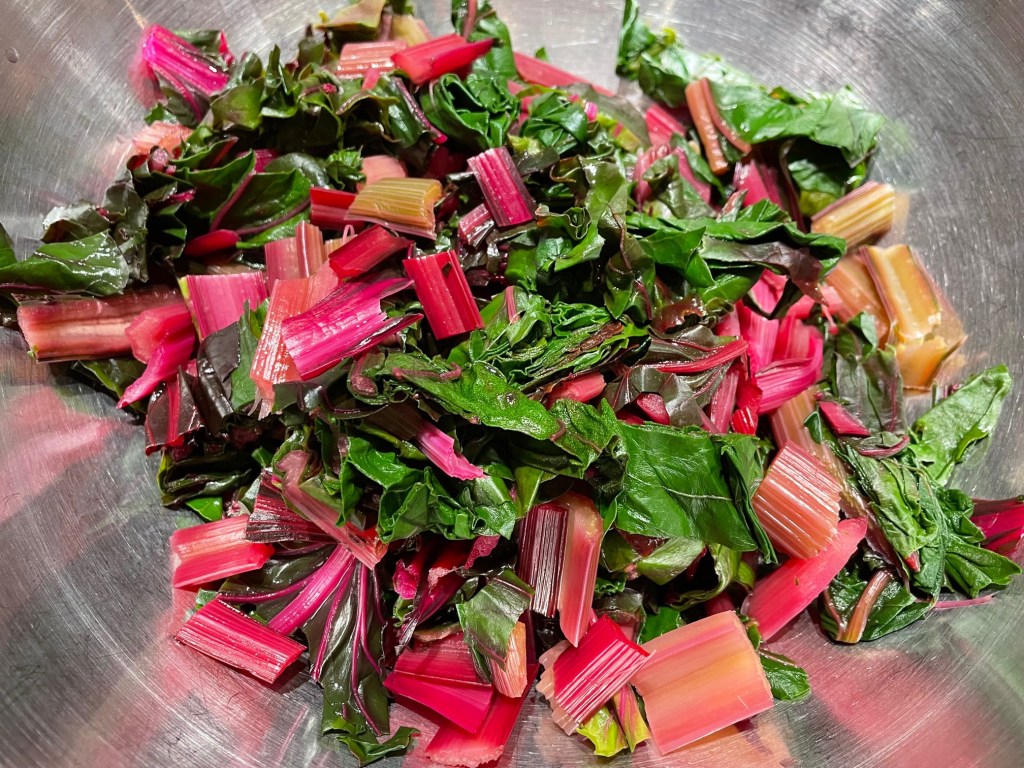
Back at home after most of the summer on the coast, I am now blanching and freezing veggies from my in-laws’ garden. Chard and zucchini. The chard is a welcome addition to my chilli recipe, as well as the deer lentil soup that I make regularly in winter. The zucchini does an amazing job of fibre-ing up chilli, shepherd’s pie and other soups.
I have mentioned blanching before but I wanted to share my storage technique which I just came up with. Instead of using medium ziplock bags for each portion, I decided to get away from the plastic and wrap 2-cup portions of chard and zucchini in parchment paper. I fold the parchment around the 2-cup portions and once wrapped nicely, place them in a large labelled ziplock. Thus, the ziplock stays clean and I much prefer my freezer food to rest on parchment paper. This is going to greatly reduce my use of ziplock bags, yet I still have the large freezer-weight ziplock to protect the food. As I work to de-plastic my lifestyle, I still want to have convenience and I think this technique will be useful.
Happy fall preserving everyone! (The next level up is canning – we will see!)
Yes, it has been a weird year. And these are the shortest and darkest days of the year to boot. Right now I am craving calorie-laden stodgy food and damn the consequences. Lighter fare will appeal when the days brighten up.
I have made this casserole with some good Pemberton veggies but the mayo, sour cream and cheese do not put this casserole in the healthy category. But dark days plus face mask-wearing at all times? Sign me up for a retro casserole.
Here is to hugging family and friends in 2021 and to our Pemberton library being open for real – SOON! Happy Christmas to all!
Chicken Casserole with Pemberton Veggies
4 cups cooked Pemberton-raised chicken, diced
2 tbs pure olive oil
1 large yellow onion, diced
2 cups blanched Pemberton-grown Swiss chard, chopped (Do NOT add raw – it MUST be blanched first)
1 cup Pemberton-grown corn kernels
1 cup chopped cauliflower
2 cups chopped celery
1 cup chopped cilantro
1 cup diced tomatoes
2 tsp dry mustard
1 tsp cumin
1 tsp paprika
1 tsp sambal oelek
1 tsp salt
1 tsp pepper
½ cup mayonnaise
2/3 cup full-fat sour cream
1 8-oz package Pad Thai noodles
1 cup mozzarella, shredded
Method:
Sauté onion, corn, chard, celery, cauliflower and cilantro in olive oil in a large cast-iron Dutch oven. Sauté until well caramelised. When caramelised, add cumin, paprika, dry mustard, sambal oelek, salt and pepper, tomatoes, and diced chicken. Mix well.
Cook Pad Thai noodles by pouring boiling water over the noodles and leave immersed for 5 minutes. Drain well.
Add cooked Pad Thai noodles and mayo and sour cream to veggie mixture. Mix well. Sprinkle top with cheese.
Thanks to Belinda Geisler, the program coordinator for Stewardship Pemberton’s Feasting for Change initiative, for putting together this reflection of this year.
This spring I was so nervous, wondering if it would be possible to run any of the Feasting for Change programs, as for this I was asking people to come together, voluntarily, and work together to help grow, and gather food that could help feed us all. Suddenly though, the need to feed ourselves without bringing that food in from outside became a priority, not just for me personally, but for our community as a whole.
I looked at all our projects, the Fruit Tree Project, Grow it Forward Garden, Seed Library and Crabapple Project, and thought hard about how to make it all work, eliminating all the indoor workshops and focusing on the bare bones of our projects: keeping bears wild, while feeding our community.
What I didn’t expect was the number of people that were not only willing but wanting to donate their time and energy to our projects. We’ve always had an amazing rotating crew of volunteers, some that have been with us from the beginning and some who are still, to make it to a fruit harvest, or garden workshop. But this summer we had a bunch of fresh faces join us and stick it out to the end. At our 22 fruit tree harvests, we had 45 different volunteers gift us their time, many of them came to several harvests, (be warned, it’s addictive) and we ended up counting 124 “volunteer occurrences”.
The grand total of 3,364 lbs of fruit is proof of all the hard work our volunteers put in, not to mention the trust that tree owners showed in allowing us to come to their property and harvest their trees. We had several firsts this summer that need to be celebrated in and of themselves: We took on our first farm, harvesting over 300 lbs of blueberries from a farm that struggled to get their usual crew of workers in to manage them.
We also had one of our largest ever harvests where we took on 11 trees, in a single harvest, getting over 600 lbs of apples and pears. As our final harvest of the year it felt like the perfect covid friendly fruit party: 26 adults and 10 kids all keeping to their bubbles by taking on a tree each, happily chatting from between the branches, while the owner was blown away that we got them all cleared in a single morning.
It’s possible that as people were working from home, more bears got caught in the act of accessing fruit trees, and so we got several new properties signed up to our fruit tree project. This kept me on my toes, as each property needed a plan. However, it also meant we could flow from cherries, to apples, to blueberries, to plums, grapes, back to apples, crabapples, and finally pears and more apples. Those that came to multiple harvests now have wonderfully full freezers full of local free fruit. The project works quite simply; we pick the fruit and split it 3 ways, one third goes back to the owner of the tree, one third goes to the volunteers that pick the fruit, and one third gets donated to be shared further.
Usually we try to have a network of local social groups (like the seniors) who can take fruit from us after a harvest and then divide it up and distribute it. With the restrictions in place this year we scaled back and focused on donating to the Food Bank.
The Food Bank needs to be celebrated to the fullest here, expanding and attempting to reach and fill the needs all over our community and into the surrounding areas. We are so, so lucky to have such a dedicated crew able to adapt and address the needs that arise. Without them, our community simply couldn’t thrive.
The bi-weekly harvests from the Grow it Forward Gardens became quite the social morning (in a safely monitored, spaced out kind of way). Last year we had 18 volunteers over the course of the season, this season we had 38. The garden itself always provided a fun treasure hunt. I think some of our volunteers came just to see where the cucumber vines had wandered off to next, or if the beans or toddlers had grown more in the 2 weeks between harvests! Either way, they put in the efforts and we reaped the rewards. This summer we donated a record 650 lbs of fresh locally grown vegetables of the food bank. While we always offer food from the garden to our volunteers, most were content to take home the “weeds” and try out things like purslane smoothies, or chickweed and carrot top pesto. I know that without the dedication of these guys (you know who you are!) we would not have had nearly as successful of a season. Even on the muggy, buggy days they were there, working hard, periodically jumping in the air and running out for a bug break, or slapping ourselves with rutabaga leaves to keep going “Just to weed to the end of this patch”. They were true garden heroes.
With the library closing down right in the midst of planting season and seeds running into short supply, I rescued the Seed Library and attempted to create a virtual inventory and contactless pick up system to make sure that this project could continue to make food-growing an option for everyone and anyone. What I didn’t expect was that again this community saw it as an opportunity to fill the need, and ended up donating almost more than was given out from the library. (Which is perfect, as the seed library depends on people ‘returning’ their seeds to keep it stocked for the next library patron). We always try and include seed harvesting in our grow it forward garden harvests, which helps to keep the library stocked.
Most in jeopardy was the re-invented crabapple project. While we may not have crabapple trees lining our main street (I’m looking forward to experimenting with lilac jelly btw), we do have a number of them in backyards. Last year we helped keep the bears out of harm’s way by harvesting the crabapples, but we inundated our fruit distributors and saw the potential for a scaled-down version. While we made close to 500 jars of jelly, unfortunately, we were unable to include volunteers and people dropping in to investigate the smells of jelly-making. We’re hopeful that the jelly travels further than we can right now and maybe encourages other communities to start looking at their fruit trees more as an asset than an inconvenience. As there’s limited supply of jelly this year, I’d recommend stocking up!
The support these projects get not only from volunteers but also from partners and sponsors keeps them ticking along, evolving, growing, and changing. These include the Whistler Community Foundation, The Pemberton Wildlife Association, Sea to Sky Soils, West Coast Seeds, the Pemberton Legion Branch 201, Bluehore Financial (Donation Program), the Fall Clothing Swap, Pilates Integrated, and the donations from the blueberry harvest. Each of these places has donated various amounts to various projects – together they make all our Feasting for Change Programs possible.
As I’m looking into winter, I’m so grateful to be here, in this community, where so many people are willing to come together to help us all – the people, the wildlife, the community as a whole – to grow, and harvest our own food, and, of course, eat jelly!
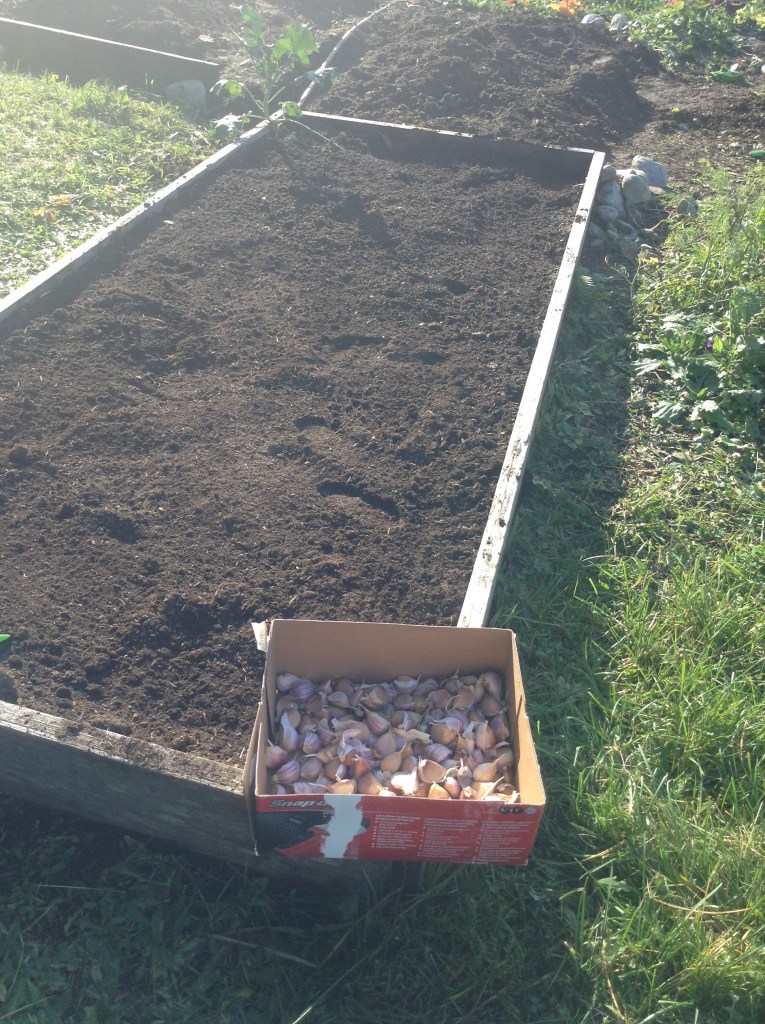
I guess I always did say a kind-of prayer when I planted garlic – “okay then, do your thing.” I’d brush my hands clean of the moist black soil and feel again the improbability of all this growing business – stick clove in soil, anticipate its budding five or six months from now. I mean, how the hell does that even work? Shrug.
“Over to you guys. Here’s hoping.”
And there was a certain kind of hope in the action, a brave kind of reclaiming my right to grow my own garlic and feel a bit empowered, but the prayer itself was largely a faithless one – a parcel dropped by my suspicious feet, with no address, beyond a scribbled “To whom it may concern”.
I am always caught by surprise by the little nubs of green shooting up through the mulch in the spring. It inspires wonder… but the wonder of the doubter… like, “that’s wonderful, but I can’t really believe it actually worked. There must be some trick to this Life business.”
I think the difference is that this year, there’s a new word in my vocabulary. The Underworld.
Says the Google:
Hidden deep within the bowels of the earth and ruled by the god Hades and his wife Persephone, the Underworld was the kingdom of the dead in Greek mythology, the sunless place where the souls of those who died went after death.
It’s a word that kept coming up this year, from some of the thinkers I follow, folk who try to parse meaning from news headlines, whose idea of bigger picture involves mythology and ancestors and cosmic time.
What I gleaned from those thinkers is that we could possibly think of this pandemic time, this “lockdown Lite” (as it’s been in BC) experience, as an opportunity to be initiated. An invitation to take things seriously. To go deep. To be confronted. To stop running around like the White Rabbit (“I’m late, I’m late, for a very important date”) and turn bravely and acknowledge Death. To shed some stuff – some of the ego’s favourite props. To emerge out the other side a little wiser… rather than just annoyed and anxious to reclaim my old life, exactly as it was.
The climate emergency is the real event horizon that looms large. Maybe, I thought, COVID-19 might teach us something that can help us approach that bigger drama, treat this as a threshold into a different way of being, instead of just an interruption to our regular programming.
Garlic planting with my helper in more innocent pre-pandemic days
So when there was a brief window through which I could race out to the garden, clear a few beds, and insert cloves, I was in a different frame of mind.
What has happened, strangely, in this last year, is that I’ve been invited by wonderful meditation and wisdom teachers, (thank you Susan Reifer and Natalie Rousseau) to allow myself to feel supported. Like, literally, to sit and close my eyes and feel my bones on the ground and the floor meeting me, and all the bits of my house holding things up and the earth beneath that… everything that rises up to meet the parts of me that settle down.
And whenever I felt the lonely weight of all my feelings throughout the spring and summer, as we practiced physical distancing and hunkered in our wee bubble and I lamented all the things and people I was missing, the falling away of all the things that used to prop my ego up, the shock of lost momentum, the loss of all that had suddenly been cancelled, I walked outside and sensed the trees creating a kind of open-air church around me, all steadfast and able to contain the leakages of my emotions.
And when I got curious about the idea that my great-grandmothers probably lived through pandemics, and did a little ancestry research, I arrived at this powerful sense that I am now the garden, I am now the physical matter in which my ancestors have the opportunity to flourish. I am the place of bloom. I am the landscape of Life and vitality, and they are all informing that, nourishing that, infusing that with richness, with the compost of their own lives.
In short, instead of working in this hopeful-but-not-really-convinced state of reclaiming life, growth, gardening and garlic, I became reclaimed. I was reclaimed by my ancestors, by the soil, by the life force, by the trees around me.
I planted the garlic this year, and I knew, without doubt, that those little cloves were not being cast out into an uncertain future, but that they were being offered back to Life, returned to soil that I tend with care, that I nourish with compost that has been generated from a combination of yard waste, our food scraps, wonderful worms and a host of other microscopic life. I understand that under every foot of soil, are gazillions of microscopic living beings. It is not me, kinda hopeful, against the emptiness. It is me settling down and receiving an immense amount of support that rises up to meet me, from every imaginable direction. Invisible, sure. But, even though I don’t see it, I sense it. I sense it now.
I pushed the garlic into the Earth, and tucked them in for their winter sleep, their journey to the Underworld, beneath a blanket of maple leaves that I scraped up from the yard.
This year, I have come to believe in the Intelligence of All Things, an intelligence that is encoded in all of us, a deep Knowing of what to do. The garlic will lie in its depths through the Dark Season, as the wheel of the year rolls from Samhain (pronounced sow-en in Celtic, the pagan precursor to Halloween) through to Solstice and over into Imbolc, the spring, and then they will rise again.
And it won’t be a surprise. Because this is what Life does. It returns. It sprouts forth, it blossoms, it revels, it fruits, it pares away, it dies, it is absorbed, and it returns.
So I tucked them in to the bed, and I offered my prayer, and this year, it wasn’t: hope you know what to do now… It was “thank you, thank you, sleep well and I’ll see you in the spring,” silently uttered with a little tearfulness and the deepest kind of gratitude and reverence I know.
As a child I avoided eating vegetables as if they were toxic. The final scene of many dinners was a stand off between my parents and I over an untouched side of raw carrots. Eventually they surrendered, not willing to torture me or forego sleep to prove a nutritional point. For many years after these victories I avoided vegetables altogether. It is a strange turn of events that today I am working on a small organic vegetable farm.
Like many people in British Columbia, I am not from here. I have the indistinct story of being from Ontario. After graduating from Dalhousie University last spring, I moved back home to work for my parents and save some money. When the fall came around, I built a bed in my car and set off for a road trip through the United States. I had a ski pass and a National Parks pass, and I was going to see the natural splendour that is so celebrated.
As I approached the end of my trip and the bottom of my bank account in the early spring of 2020, I had to decide what to do next. Rounding the turn and heading north from California, BC appeared to be a natural conclusion. In the past, I had spent my summers working on golf courses. I wanted to continue working outside, this time putting my efforts towards work I felt was part of a solution, environmentally and physically. I went on GoodWork.ca, a jobsite connecting eco-minded workers with sustainable work.
One posting caught my eye: Laughing Crow Organics in Pemberton, working as a farmhand. I emailed Andrew Budgell and Kerry McCann, the owners and operators of the farm. A few days later, I had a Skype interview from the visitor’s centre in Yosemite Valley, and they offered me the job. I started looking for a place to live that would also be financially sustainable.
Kerry McCann, Laughing Crow Organics’ co-owner: “People need to eat.”
But soon after this, the world entered a pandemic, and suddenly every plan was on shaky foundation. No one had any idea what would be possible a week, a month, a year from now. I was in Lake Louise staying with a friend from home when COVID hit, planning to continue west. He had been laid off from his job at the hotel, and we both decided to head east and wait things out.
I got in touch with Kerry. Would there still be a job for me? People still need to eat, she said. “We will be growing plants and feeding people and we will need your help.” A month after my first cross country drive, I turned around and headed back west.
Immediately I knew I had made the right decision. Even in May, at the height of COVID confusion, Pemberton was a pocket of normalcy. The next month, when Black Lives Matter demonstrations erupted across North America, the events of the world felt even further away. In both instances, I wondered what part I played in it all. What is my responsibility?
Farming was an attempt to answer this question. Our food systems are some of the most oppressive systems we have, environmentally, socially and economically. Like many others in the capitalist mindset, optimization has been focused on profits, rather than quality. As a result, large scale agriculture has sterilized the growing process in an effort to grow more food for less money. These costs do not evaporate. They are passed down the line onto the health, the environment, the worker, and the consumer.
When I was on the road, I did most of my shopping at Walmart. It was the cheapest option, and they let me sleep in the parking lot, so it was convenient, but I knew there was something wrong with this decision. By spending my money on cheaper food, I was inevitably supporting practices I do not believe in. Cheaper food is cheaper because it exploits workers, and abuses the environment.
Eating is a completely different experience on the farm, one I am very fortunate to have. The work is fair, the pay is honest, and our relationship with the land is respectful. We give it what it needs, and it repays in kind.
Unfortunately, there is an observed problem of access to good food, one that can often be drawn on lines of racial inequality. Buying organic is often out of reach, and Walmart or McDonald’s appears to be the best or only option. But when I go to market, and see what our customers get for $30, in quality and quantity, I cannot believe I shopped at Walmart. If I were a customer, which I have no doubt I will be in the future if I am not still an employee, I would be proud to be supporting better practices, and to be receiving a better product.
To be an activist does not necessarily mean you must be on the front lines with a picket sign. It can be as simple as making more informed choices at the grocery store. By supporting local, small scale sustainable agriculture, we are supporting the health of the earth, the health of ourselves, and the health of society. It is an act of liberation and solidarity. The more we choose to buy from farmers who are doing the right thing, the more this opportunity will be presented to others.
I needed to find myself on a farm before I truly grasped this, but awareness is free to anyone, and it is often the most powerful thing we can do.
South of the border, Dr Fauci has the same warning: “We need to hunker down and get through this fall and winter, because it’s not going to be easy.”
That said, in Australia, which is coming towards the end of winter, social distancing and a big uptake in flu vaccines, has led to the lightest influenza season experienced in memory (literally 107 cases down from 61,000 last year.)
So, get prepared for what could be really terrible, or what could be really fine – there’s no way to know and hence, how do you prepare for that?
This is what has stalled me out from that 72 hour emergency preparedness kit (am I outfitting myself for an earthquake? a fire? a power outage? zombies? do i need chocolate, a water purifier or an arsenal of weaponry?), and it’s what was swirling through my brain for a lot of May and June… but then the sun came out. And it felt nice to just go outside, and relax.
And now, this thought is coming back, this great moment of clarity I had… “how can I be prepared for the fall/winter?” is not the best question. It leads to a hunker down in the bunker mentality, an immediate need to stockpile and hoard, because preparedness feels like fortifying things… BUT if the shit doesn’t hit the fan, it will feel like a waste, an overreaction, almost an embarrassment. So, it feels as if I have to buy in to the actual likelihood of terrible things happening, in order to make preparations to survive them…
The question that opened up a more generative response was when I wondered, “what can I do to resource myself?”
Resourcing myself feels like an interesting inquiry, a wondering, it feels generous and creative and fun, because it
1. involves taking a moment to ask what do I love? what brings me joy? what makes me feel well? and
2. it doesn’t feel like wasted effort if the worst possibilities don’t transpire. I’m not suddenly sitting on a stockpile of inedible army surplus MREs. I have some nice jigsaw puzzles to do, and a lovely selection of teas.
Being well-resourced, to me, means having some trusted friends I can reach out to when I need it, means having some go-to responses when I feel a little overwhelmed, means having plenty to read and some trees to go hug. (It also means having farmer friends who give me gardening advice when I text – thanks Anna!) So, part of resourcing myself for an unknown fall/winter has meant dealing with my phone-phobia, and connecting with a handful of people who I really enjoy talking with, but can’t simply assume I’ll run into. It has meant getting sober-curious, and seeing if teas, tisanes and tinctures at the end of the day can become part of my ritual to replace a glass or two of vino. It has meant investing in books and cookbooks. And carving a little path in the grass of a regular route around my yard, where I stand with a few trees. I’ve also been pickling and preserving and seed-saving – not in any fashion that is going to save my life – but just enough to feel deeply immersed in the season, to develop a felt sense of abundance (nothing does this more than tickling the dried seeds off a herb or flower and realizing you now have more than you will possibly ever need), and growing a little bit of know-how.
Drying flower petals for teas might not save my life, but it sure felt nice.
I don’t think we can be “prepared” given the curveballs life throws our way… and because I don’t want to squander my imaginative energy trying to conjure all the possibly scenarios. But this unfolding experimenting in being better-resourced, as a human, has been enjoyable. I recommend it. 🙂
And tell me, do, what makes you feel well-resourced?
From 20 hives, our own Nurture in Nature bees have been busy buzzzyy…
Our own honey is now available in our Farm-acy Stand and with the wax caps from the honey combs, came an exciting learning day of rendering the wax and the extra honey, that had been extracted by our beekeeper Joel.
Feeling like a hungry bear, I scooped up handfuls of the wax, dead bees and honey from the large tub into the slow cooker and like a bear, licking my paws was so good and irresistible! (I did wash them of course before continuing).
Good thing Mr Bear didn’t smell it from afar because the bees certainly did and tried to come join me to claim it back!
Once melted, I filtered it through cheese cloth so the wax dripped through into water, cooling immediately to form pure wax while the slum gum (unwanted material) was caught and the rest of the honey settled at the bottom of the water. Amazingly once the water was drained off as much as possible, 7 more jars of cooking honey were filled. Yay!
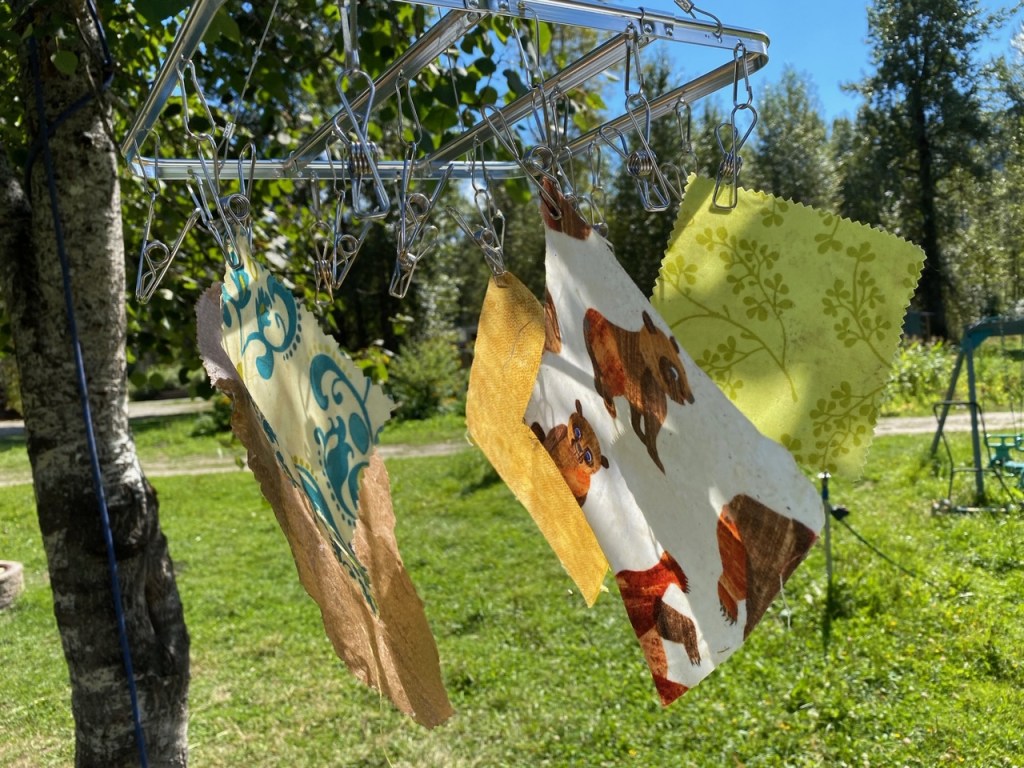
For our Friday workshop, we decided to use the wax to create wax food wraps and for those not familiar with them, we dip or paint some lovely cotton material, the melted wax which when hardens can be shaped around a pot, used to wrap lunch sandwiches in, and any other use that can be thought of. (Thank you Carin in your guidance in making these and provision of the cloth).
Though many pieces were made by many hands, making it easy work to process lots of wraps, we realised we did not mention that in coming to our workshop, our philosophy is that we are here as a community, learning and sharing together, so though one person may make many pieces, that does not entitle them to claim those pieces as their ‘own’. Rather they are learning by helping, giving something back but do get to keep an item they make.
This leaves all the other wraps to be sold in the Farm-acy Stand which brings funds back to the community garden, (and to those happy hardworking bees)….so lets please say a thank you to all our local bees out there for providing us with some wonderful products to enjoy!
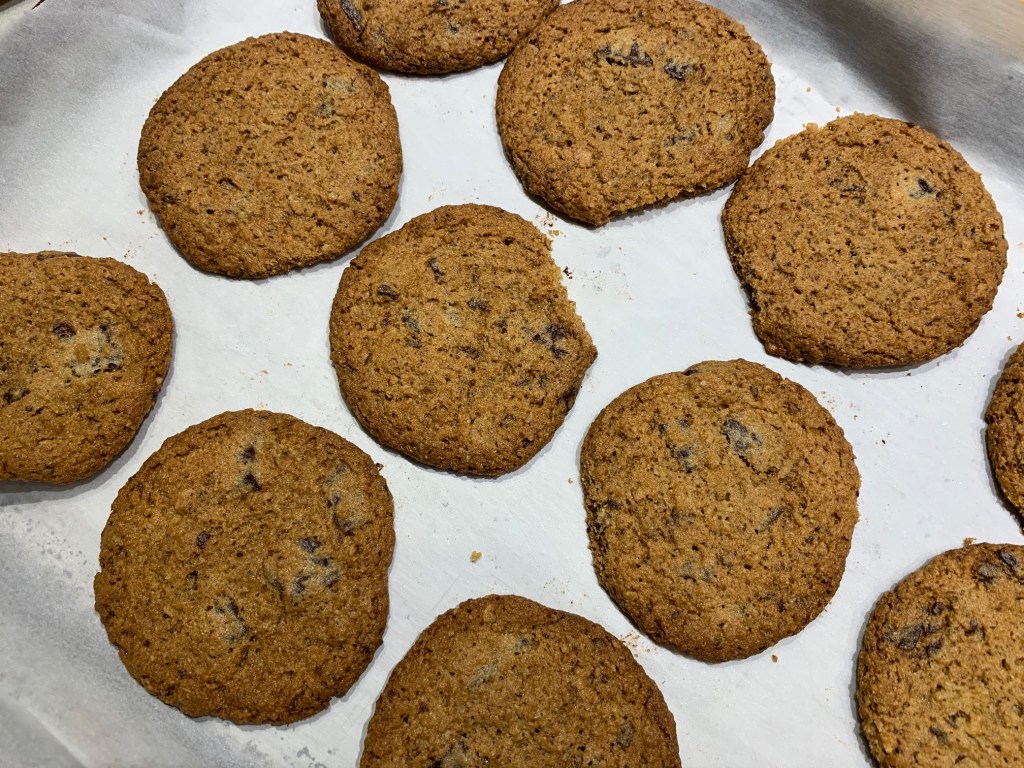
Torrential rain here in Pemberton today. A good day for baking. These cookies I adapted from a John Bishop recipe from his cookbook At Home. They are great for road trips. I have not had luck with PB cookies lately and have been disappointed with the recipe in the Joy of Cooking (both the original edition and the updated version published about a decade ago). This one is very good! John Bishop’s recipes have good bones…
Not a recipe high in Pemberton ingredients this post except for the Pemberton egg – only the best!
Gluten-Free Peanut Butter Chocolate Chunk Cookies (yield: 2 dozen)
½ cup unsalted butter
½ cup natural chunky peanut butter (I used Western Family brand)
1/3 cup white sugar
¾ cup coconut sugar
1 Pemberton egg
½ cup pulverized gluten-free oats (pulverize in Cuisinart until oats are the consistency of flour)
1 cup almond meal
½ tsp baking powder
¾ tsp baking soda
¼ tsp salt
4 oz Lindt 90% dark chocolate, chopped
Cream butter and peanut butter in mixer. Add all other ingredients. Blend well. Stir in chocolate chunks. Use a 1.5 tbs-sized spring-loaded cookie scoop and use it to drop dough onto 2 parchment-lined baking sheets (these cookies spread quite a bit). Bake at 375C for 12 minutes. Cool and enjoy!
The Birken / D’Arcy corridor is unique to the Sea to Sky Region. Unhurried, non-commercial, safe, sparsely populated and relatively unchanged throughout the nearly 3 decades I’ve lived here. In fact, there is less here now than there was back then. Its downtown consists of an old resort at Gates Lake, open for a few months, and a telephone booth (there is no cell service). The Demographic is also interesting. It’s more affordable and out of the way and therefore attracts misfits, homesteaders, bohemians, red necks, hermits, draft dodgers, hippie relics, adventurers and commuters to Whistler. There are few, if any, employment opportunities, therefore those who stick it out have become resourceful, artistic and enterprising.
The climate is more arid, being on the cusp of the interior and in the rain shadow of the Coast Mountains. Spring comes early. We see more sunny days, warm days, and cool evenings. Its narrow valley is protected by steep mountains. It is not a conventional farming community like Pemberton with acres of flat tillable ground. It is however a great hobby gardening area. Its soils are well drained, mineral rich and ideally suited for fruits, berries, and garlic. Its waters are crisp and clean. I don’t believe a single person uses pesticides. It is sought after for bee keepers for this reason as well as its natural bio-diversity.
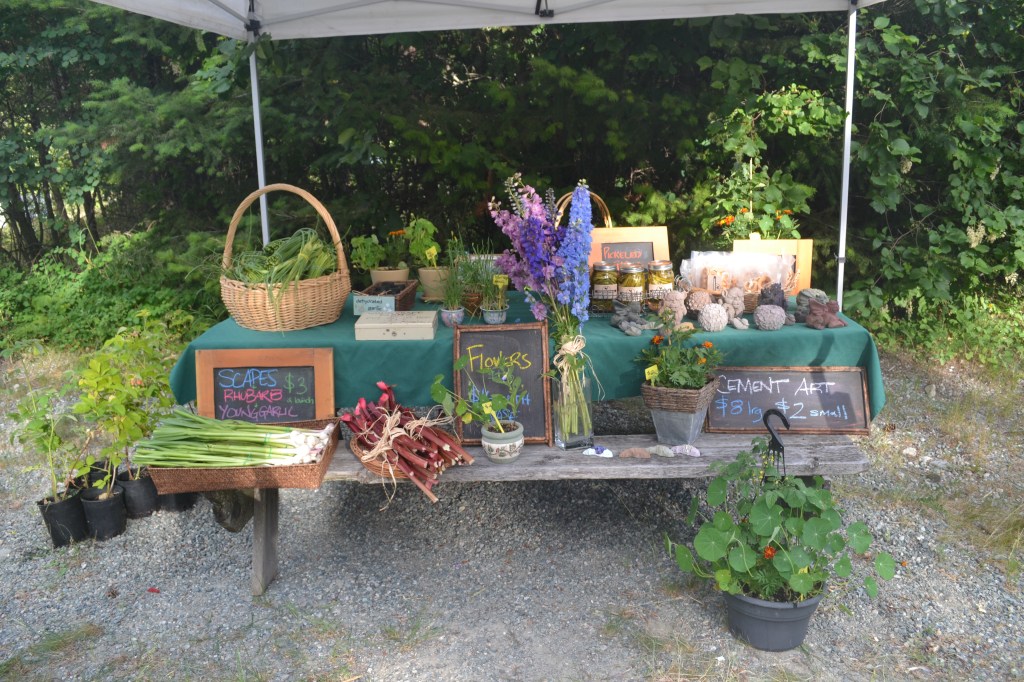
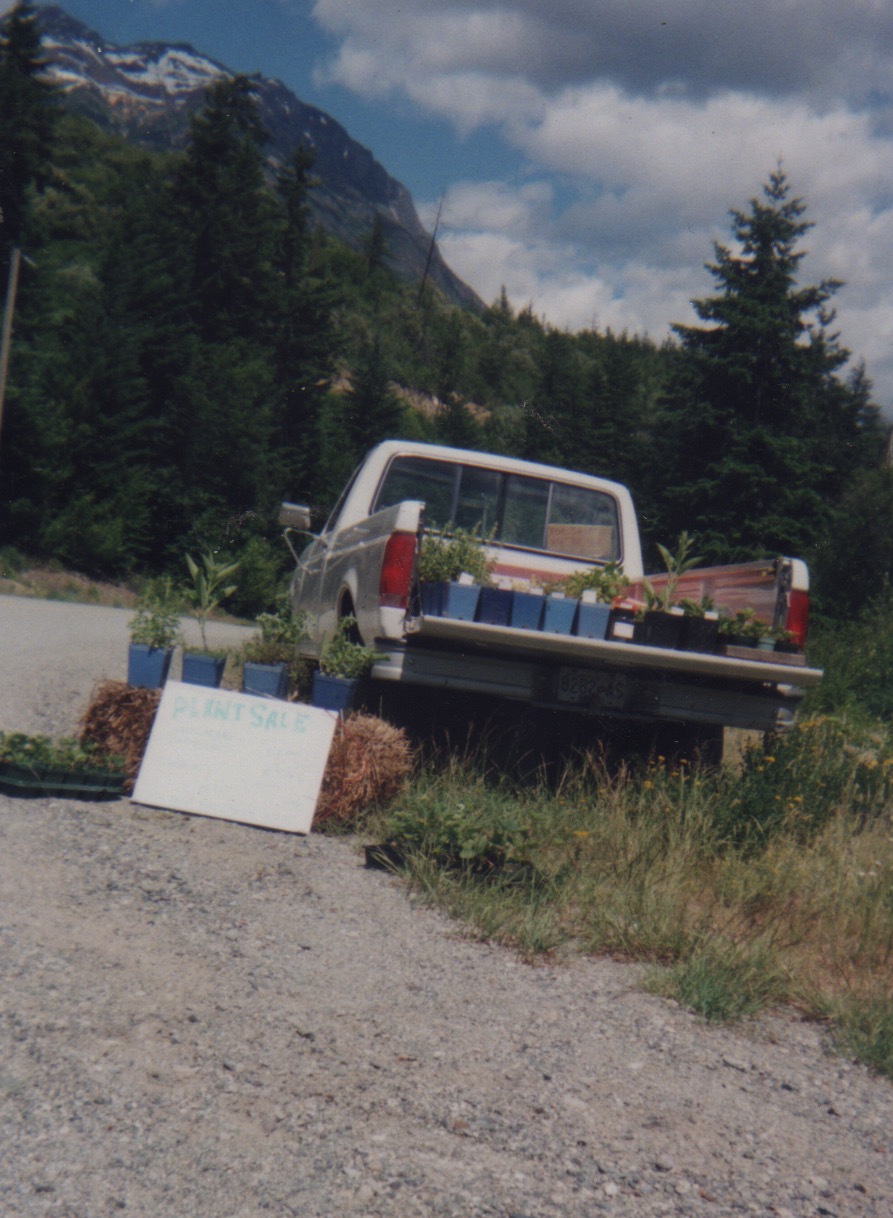
I started putting plants and surplus veggies at the top of my driveway with a jar for cash many years ago, mostly for my neighbours. The above photo is circa 1995. I called it the Beer Stand back then. If I had enough for a case for the weekend it was a successful week. Over time it got consistently busier and we added more products. It became the Entertainment Stand where, in good weeks, we could go to a restaurant or even a concert. Our farm is now a registered business and after a good year we can take a vacation at the end of the season. Keeping it stocked is now a part-time job (farming, of course, is full-time), but I have to say it’s the best job I’ve ever had. I joke when being leisurely that I’m currently working my job . The operating costs are extremely low so every sale is a bonus. Farming itself is extremely labour intensive with a low profit margin and high risk. We could never afford to pay someone to sit and serve customers. It’s really the only viable way of doing business in a rural area. If we bring perishables back from the market they quickly go up there in the fridge. We can offer an ever-changing wider selection of items than we would at the farmers market, can keep things fresh and pass our cost savings on to the customer. Win, win, win!
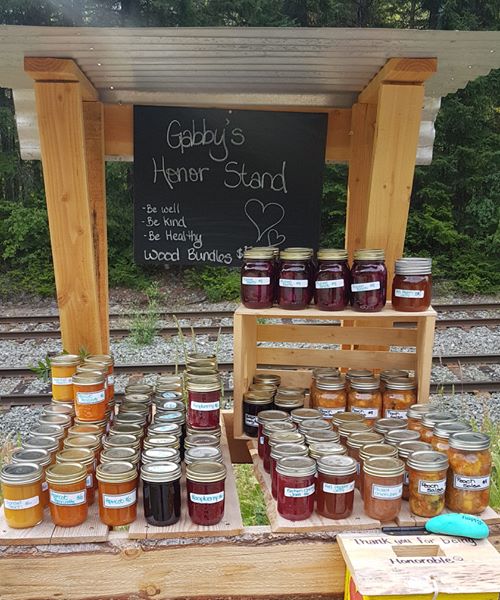
Generally people are honest and since it’s the honour system, we accept e-transfers and IOU’s. Someone, who we caught pinching out of the change jar, returned years later with a letter of apology and a $50 bill. This restored our faith in humanity and the honour system. What comes around goes around.
Birken has now become a valley with many honour stands offering everything from jams to fresh pasta to firewood. It’s a place of cottage industries, where hobbies help many with spare cash. They range from tents, and permanent shelters to coolers. Many interested in setting up their own stand have contacted us wondering if we would be offended by the competition. We look at it the opposite way. The more the merrier! It has started to become a destination place for a casual drive picking up things along the way. Those coming up for a swim in our many lakes can grab some fruit to munch on. Campers and boaters can pick up a fresh bouquet and something to add to their dinners on the way home. We’ve had nothing but positive feedback. It reminds many of their country childhoods and a simpler time when everything was local and fresh and neighbours shared.








 Traced Elements