Category: farm story

  • Making a difference one seed at a time…

    Making a difference one seed at a time…

    IMG_0349
    wemadethishome.com

    As Master Gardeners in Training, we are committed to volunteering our time in our local community to educate and answer gardening questions. We use science-based facts and we only share organic garden solutions. Our backgrounds and experience vary, but we all have something in common: the love for plants and gardening. Our title indicates that we are all-knowing… well, some of us are, and the rest of us continue to unearth the facts about all things botanical.

    In early June, I was asked by Sarah Jones from Stewardship Pemberton Society if I would speak about collecting vegetable seeds and pollination at one of their free garden seminars at the Pemberton Public Library, the library is home to the Seed Library for Pemberton. Immediately said “Yes!!!” The only caveat was my experience in seed collecting was pretty much, well, non-existent. However, that did not stop my enthusiasm to dig deeper into a topic that I am sure would come up one day at one of our Master Gardener Clinics.

    After much research and discovery, my confidence in the subject was better, but what impressed me more, was the significance of collecting seeds.  I had no idea the socio-economic impact that seed collection had on creating healthy food systems and people.

    Did you know collecting seeds helps to maintain seed health & resilience, better genetic diversity in our gardens, farms & kitchens, and can save you money?  It’s no wonder as a child, my grandmother was mortified when she found us playing with her seeds; destroying hours of painstaking work, not to mention affecting her ability to grow the lovely veggies we enjoyed throughout the year.

    IMG_0517
    Photo by Burcu Asvar

    Many of us buy seeds from seed catalogues or at our local garden centres.  Most seed companies nowadays sell F1 or Hybrid seeds that may produce seeds that are sterile or no seed at all.  If they do produce seed they may not produce true to type.

    If you can, choose to buy seeds that are open sourced; these are seeds that are not restricted by patents or other intellectual property rights.  This keeps our food supply secure for future generations (this is where the socio-economic impact comes into play).  Or better yet, take advantage of seed libraries in your community (i.e. Pemberton Seed Library).

    Open pollinated seeds are non-hybrid plants which are more genetically diverse, have a greater amount of variation within the plant population, and they allow plants to slowly adapt to local growing conditions & climate year to year.

    Collecting seeds requires some good planning as well as understanding the fertilization process.  Pollination is key for fertilization, and it’s different depending on the type of plant.  Some plants can self-pollinate (i.e. beans), while others depend on insects (honeybees being the most efficient) or by wind (i.e. corn).

    Before you start to collect seeds, you need to ask yourself the following questions:

    When it comes to Pollination…

    • Will these plants cross with any others? Is this good or bad? (usually bad)
    • How does this happen? (wind or insect)
    • What can I do to control this? Do I need anything?
    • Do I need a minimum of healthy seed? (do they breed as a group?)
    • Do they pollinate on their own and self-pollinate (need one only?)
    • Have I chosen the right plant for the seed?

    When it comes to seed extraction and drying….

    • Do I need to do anything special to the seed?
    • Is my seed well dried and labelled?

    The answers to these questions are different for each vegetable, and my recommendation is to get a good reference book on seed collection that will answer all these questions in greater detail. I have listed a few websites, and a couple of books at the end, that the Pemberton Library has ordered for its book collection.

    The process of collecting seeds is easily summed up in the diagram below:

    image005

    image007
    Diagram via real seeds.co.uk


    To maintain purity of seeds, they may require isolation through distance to prevent insect or wind contamination, time (being planted in stages so that the first crop sets its seeds and stops shedding pollen), mechanical isolation (i.e. using physical barriers to prevent unwanted pollen, like cloth bagging or caging), and/or hand pollination, which is the most commonly used method to produce pure seed.

    Choosing seed comes down to observing the whole plant and not just the fruit, checking for disease & insect resistance, drought resistance, trueness to type, colour & shape of fruit, flavour, etc.  Other factors include vigor and population size (saved from the greatest possible number of plants).

    The process of removing and cleaning seeds can include washing, drying; and some plants require fermentation first.

    Washing seeds (tomatoes) requires placing the collected seeds in a bucket of water, stirred with vigor to help separate viable seeds, strained, and dried on a non-stick surface (glass or ceramic dish, cookie sheet, or screen – not paper towel).

    Plants that produce seeds in pods (peas) or husks (corn) are usually harvested dry, threshed to break the seed from the covering, and any chaff or debris is removed by a process called winnowing (wind).

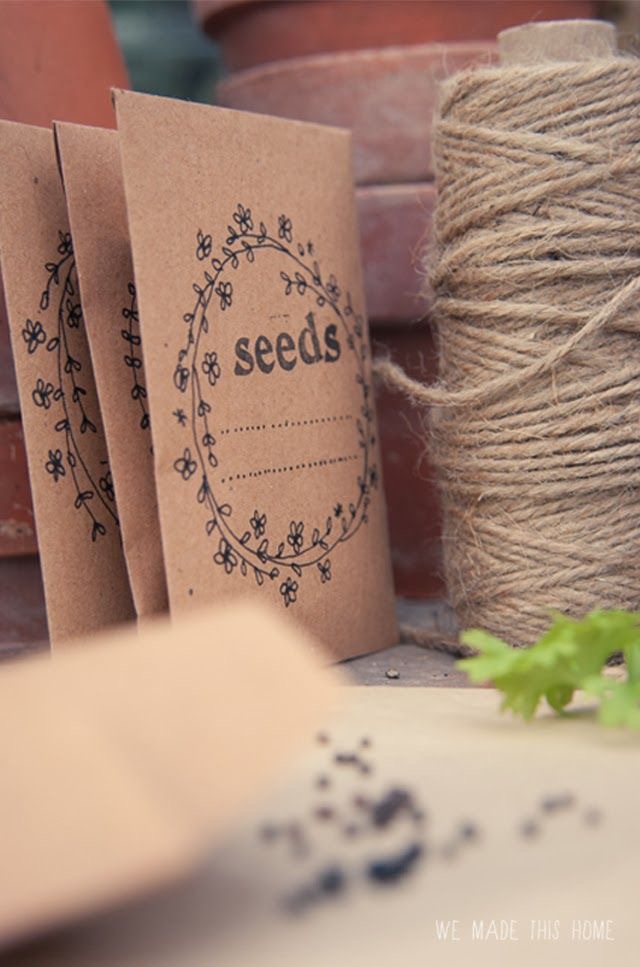
    Storing seeds is the final stage of the process. Glass or metal jars, zip lock bags, paper envelopes provide air tight homes, and make sure to keep the seeds away from heat or moisture. Ensure they are clearly labelled and stored in a cool, dark place where there is minimal temperature fluctuation.

    IMG_0518

    I want to thank Sarah Jones (Stewardship Pemberton Society) and Lisa Richardson (Traced Elements) for asking me to share my new-found appreciation and knowledge about seed collection. I have an utmost respect for those gardeners and farmers who have been collecting seeds and who are able to pass down their seed from generation to generation. According to the United Nations Food and Agricultural Organization, we have lost 75% of our diversity in our agricultural crops since the beginning of the last century. Having a seed library and sharing our seeds within our community plays such a significant role in the health of our food systems, and is good for our mind, body and soul.

    Happy Seed Collecting everyone!

    Resources:

  • Mutual Appreciation: the farmers’ market secret sauce

    Mutual Appreciation: the farmers’ market secret sauce


    The bell rings to start the market day. Relentless and demoralizing rain has been falling since the tents came out of the trailer and we began the set-up, two hours ago. The gutters now strung up between the tents are working well, emitting a steady stream of water into the growing pool along the back curb and the tent side walls keep us relatively rain-free inside the stall. The very air seems wet, however, and little can be done about that. Tough morning at market so far.

    helmers-e1431620796552

    I’ve been selling my family farm’s produce at Vancouver farmers’ markets for 20 years, so I know how to sell potatoes in the rain. It’s just like how to do it in the sunshine, except it seems mentally harder. The difficulty lies in keeping the stall in a high state of readiness, even though it might be empty and you would prefer to be warm and dry elsewhere. Every sale matters- especially in the rain, if your farm depends on farmers’ market sales

    I squeeze my way past the bins of backstock in the trailer where I have been changing out of sopping wet clothes. I have already traded a few hellos with the neighboring vendors, people I’ve seen every Saturday morning for years, but there’s been no time for more than that. I glance around to make sure all the signs are up and that the display is full: we’ve finished in time. It takes just as long to get set up in the rain as it does otherwise. Longer, of course, if you waste time regretting the situation.


    The potatoes look good today, the red Chieftain and yellow Sieglinde sort of glowing in the dim light. My staff, who are making up $5 bags of potatoes and carrots, wisely refrain from discussing the weather. The vast, dripping, emptiness out in the market fairway which would normally be filled with customers eager to start shopping, lining up in advance of the opening bell, is obvious enough.

    It is undeniably deserted, and despite the potatoes doing their best to provide sunshine, it feels disheartening. I give my head a shake because I think it’s too early to write this one off.

    The first customer materializes- she’s a rain-or-shine regular who gave up on regular grocery stores quite a few years ago. She is followed by another I don’t recognize. A chef splashes his way in. I make sure his 20lb bag weighs at least 25. At the till, we’ll be rounding down more than usual. The customers might not notice but I don’t mind. I am feeling very benevolent towards anyone who turns up this morning.

    Before I know it an hour has passed, and I realize that the potato display tables are hidden from view by the backs of customers filling bags. The stack of now empty bins in the back has risen to a level I hardly thought possible when the opening bell rang. It’s going to be a solid day, despite the rain, which might even be easing up a little.

    One of my staff has been coming to market ever since she was a baby, and her mom worked for a farm vendor here before that. She’s on the first till, and I jump behind the second one, a line-up having formed of dripping wet customers who thank us for being here today when they get to the front.

    It bears repeating: the rain-soaked customers are thanking us and giving us money for potatoes. In fact, now it’s so busy they are lining up to do so.

    This, right here, is what makes farmers’ markets tick. People choose shopping in the rain over going to a grocery store. Farmers choose marketing in the rain over selling wholesale.

    It’s what leads to the fact that farmers can make a living on an acreage that would otherwise be insufficient because they can get full retail for their produce.

    The customers keep coming back for more because…well…I just don’t know. Is it the quality of the product? The contact with an actual farmer? The coffee and crepes? It might be magic. Whatever the cause, it provides me motivation to keep farming, and to keep customer service and marketing standards high. It seems like a practical way of showing the customers that I really appreciate their business.

    I love being a part of this special relationship, but I worry that it won’t last. It’s so much work, there is so much to learn, and there is so much competition for customers- and surely, they won’t keep coming? I mean, sometimes they must quietly wonder if it is really all that great? The weather, the effort, the cost. All that cooking.

    resampled_big_helmers 6

    Customers. We need customers to make markets successful. We need to retain existing ones and win new ones who might also shop in the rain. The good news is that we are only tapping a tiny fraction of the people who buy food, so there are plenty more to be had. The bad news is that the competition out there is absolutely fierce, and nowhere else other than at farmers’ markets are customers asked to go out shopping in all sorts of weather, probably park far away, and spend perhaps a little more than they really meant to.

    Farmers’ markets enjoy one major competitive advantage however, and that is something I have begun to call “mutual appreciation”. This is an energy generated at the point of contact between primary producer and end consumer at market, most notably at the transaction stage. I take your money, you take my potatoes. We are both appreciative of the other. The feeling builds each week, from season to season and year to year and really can’t be re-created in other retail environments.

    helmers_farm

    The farmer can do much to cultivate the feeling of mutual appreciation in the stall. It’s about a lot more than saying “thank you”. Developing good customer service and merchandizing skills is of prime importance- pre-market preparation, and of course years of practice help too.  In my opinion, it is important to put as much effort into selling the food as you spend growing it. These customers deserve that.

    The farmer makes the magic that the people are coming back for. If you can also create this feeling of “mutual appreciation” in your stall, I think you’ll be able to have both tills busy, even in the rain.

    Anna Helmer farms in the Pemberton Valley with her family: friends and relations. Her book is called: A Farmer’s Guide to Farmers’ Markets and is available on amazon.com.


  • Irrigation Irritation. Don’t raise your plants to be spoiled brats.

    Irrigation Irritation. Don’t raise your plants to be spoiled brats.

    Someone once asked me when the best time to irrigate was. My cynical answer was when it’s raining!

    Technically the best time to water is before plants get thirsty and this is usually the morning. Watering in the evening is less ideal, as it leaves time for mould and diseases to develop. Simply sprinkling after a hot day is better than nothing, but no more than a band aid solution. Besides keeping seedlings constantly moist, the general rule for established plants is water “deep and infrequently” — kind of like an old married couples’ lovelife. But seriously, the average rainfall soaks in a just a couple of inches, so you can’t really count on it. So watering in the rain makes sense, so you can pay more attention to the younger shallow rooted vegetation when the weather clears up.

    Different plants have different water requirements, and this too changes throughout the season and its life cycle.

    Blueberries, for example, are a shallow rooted bog plant and love as much water as you give them. An established fruit tree, on the other hand, can have a root system as big as its crown, and may only need a good soak in a dry spell. Also, if you spoil your plants with constant watering, they will do what spoiled kids do for themselves… very little. You must let your plants search for that deep water, which is also where the most minerals are. Also a slightly stressed plant will tend to produce more, thinking its reproductive cycle is in jeopardy. This is a fine line that good gardeners closely monitor.

    On the most basic level, plants need three things to survive besides light, a daily given. These are air, nutrients and, of course, water. Without water, there is no life whatsoever. Water is essential for delivering the nutrients to the roots.

    Too much water for too long will suffocate the plants by filling in the air pockets in the soil. Too little and the cell walls dehydrate, causing wilting. Prolonged or frequent wilting will compromise or kill your plant.

    Automated sprinkler systems are great for the suburban landscape and lawn, but are not practical for the small scale hobby farmer over several acres. A good gardener has an  intimate relationship with his or her dependents’ needs. As I mentioned previously, these  watering needs change from plant to plant and season to season. Grouping plants with similar watering needs is wise. Automation is convenient for a small area if you’re going away for a bit, but it’s like leaving your teenagers home with a stocked fridge. I prefer drip systems — they conserve water and you can let them run for a whole  day to get that deep watering. Overhead sprinklers are prone to clogging, evaporation, uneven distribution, wind and even sun damage from magnifying the water droplets.

    Growing plants is often like raising children. They need lots of attention when they are young, but eventually you need to quit spoon-feeding and let them find their way. You should still check on them when they’re grown up and offer a care package every now and then.

  • RJ

    RJ

    IMG_4330

    AKA Mr. Moran, Randal John, Miracs or simply – dad.

    My green thumb has been inherited through a long line of amazing gardeners. I am just barely starting to scratch the surface of my mom’s flower power, but I’ve been in deep with my dad’s veggie garden sense for longer then my subconscious knows. Most likely my conception is the root of my problem, this gardening obsession of mine.

    RJ, as he’s known to most, is a “retired” teacher: one of the best. His forte is math; a subject I grew up hating, which inevitably led to a few tears at the kitchen table over algebraic equations. Overall I did well at. It’s also not a coincidence that my initials are 3 M’s. He is full of dad jokes, he is an athlete, he is highly involved in the community, he landscapes on Lake of the Woods with his other “retired” friends during the summer and he’s always up for a good time.

    When it comes to gardening dad is a full experimenter.

    Like father, like daughter.

    Since being gifted a pocket calculator or I mean cell phone, RJ’s “we’ll see” experimental attitude has become even more evident and I love it every bit of it. (Small back-story; dad used to drill my brother, our friends and I with math problems because a calculator in our pocket was something we’d never have… so, this is a big HA! told you so moment that I’m taking full advantage of.) Really there is too much awesomeness to share and well… perhaps it’s best we keep some family secrets but allow me to enlighten you with a couple excerpts from text messages complete with photos.


    “Trying something new grinding egg shells and coffee grounds putting them in the tomato holes.”

    “Also tried some with an egg in the hole. Keeping track of which ones got what.”

    “Planted some corn and am experimenting with Epson salts on every second row – again, we’ll see…”

    “And finally my parsnips from last year that I leave in all winter – so yummy!!!”


    Of course, there are the show-off photos. Dad and I have been firing pictures back and forth of what we’re growing and what’s ready to eat regularly. Rj’s last photo was of what he collected for a TRUE garden salad for dinner, claiming that icicle radishes might be his favourite at the moment but he’d like to try growing the spicy purple daikon variety I‘ve got in my plot. I’ve even been able to share video walkthroughs of my garden. Basically, we each get to live what’s in our respective gardens in a matter of seconds even though we are 2,427km away from each other: technology is very cool.


    IMG_4281
    RJ’s TRUE garden salad


    Perhaps the best part of RJ’s massive garden is that it’s always open for foraging to neighbors and friends. Growing more then he and mom can eat really goes to show that when you’re passionate about something and you can share it with others you get the best of both worlds.

    I already know that I’ll have a lot of vegetables to share this summer as I have planted more than two of us can eat, but I’m happy to carry on this family tradition out west.

    After all, I’ve been taught by the best.

    IMG_4333


  • If It Ain’t Broke It Will Be

    If It Ain’t Broke It Will Be

    Farming is not for the faint of heart.

    Oh sure, as you drive up the valley and see all those beautiful farms, crops growing, people happily hoeing, tractors making the rounds, it all seem so peaceful and idyllic.

    There is a behind the scenes though.

    All that machinery and the tractors that pull it can pose a mechanical nightmare for farmers. They will most likely blow a gasket when you need them the most. Farming is an occupation that consists of a lot of frustration tempered with an equal amount of patience. There are times, I’m sure, when all of us have wanted to burn it all down.(Metaphorically speaking of course).
    IMG_1359

    What can go wrong will go wrong. That seems to be the motto here at Shaw Creek Farms these days. Spring has sprung, summer is almost upon us and we have been faced with one mechanical disaster after another this spring.

    IMG_2027

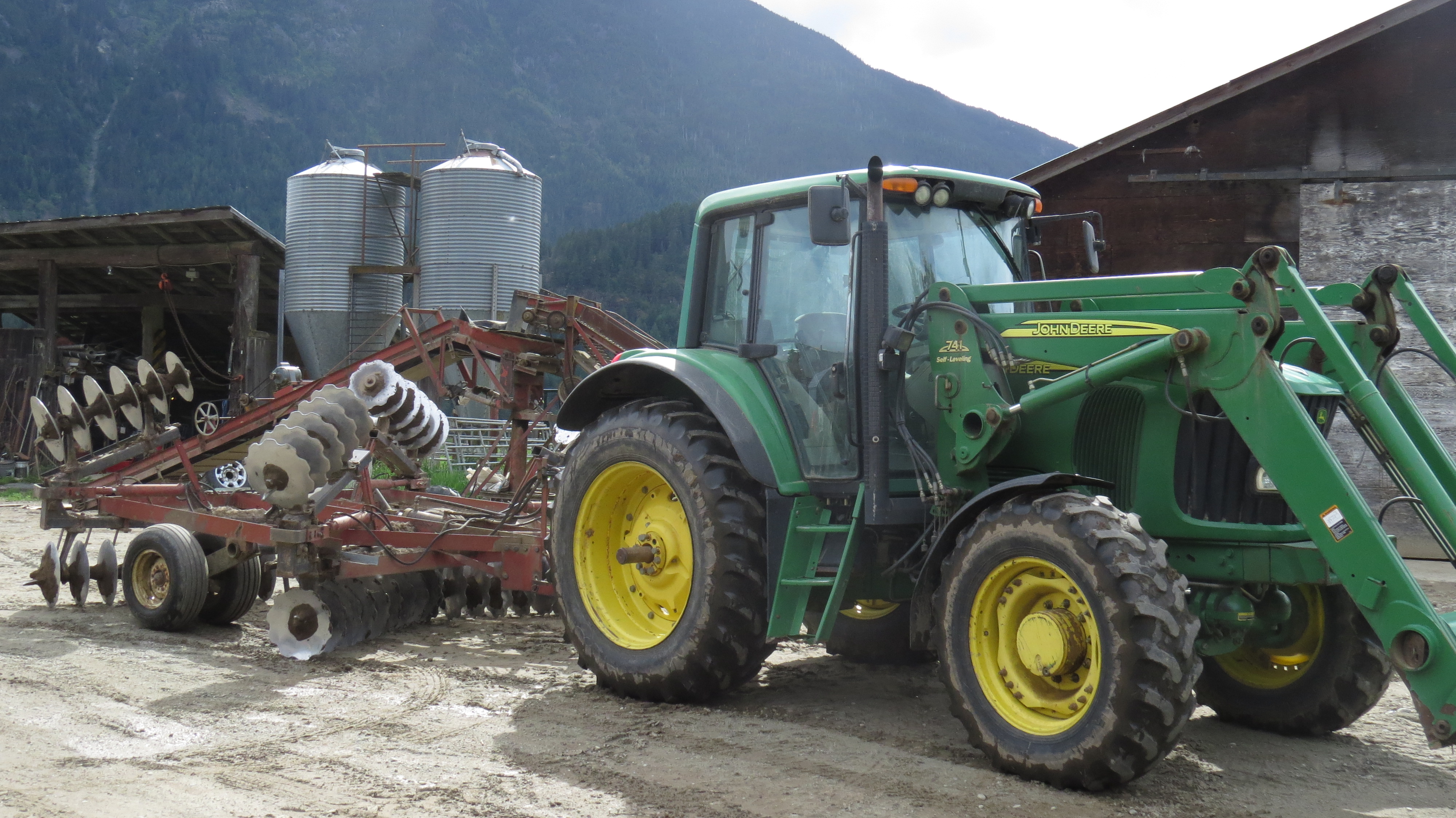
    First it was the tractor. A behemoth of a machine. Needed for damn near every job on the farm. The doohickey that connects the whatsit to the thingamabob broke. That is about as technical as I get. When my husband talks to me about tractor parts I know I should be paying close attention but all I really hear is the teacher’s voice from Charlie Brown. After numerous calls to the John Deere dealer the doohickey was ordered and picked up, in Kamloops, by my son and me.

    IMG_2025

    The rotavator was the next to go. We had two fields left to till when smoke started pouring out of it.  Never a good sign. The parts for this machine are so expensive they will be referred to in this paragraph by $$$$. Another call in to a different dealer followed by emails with photos and the $$$$ was ordered. We have to wait two weeks because, apparently these $$$$ have to come from the ends of the earth.

    IMG_2026

    Next up, the fertilizer spreader. The thingy that wings the fertilizer out onto the ground disintegrated. Need a new one. Call in to John Deere again who then has to call Vicon, maker of said spreader. They then send it to John Deere, who then sends it to us. Thingy picked up and put back on. Spreader winging fertilizer again. But wait… not an hour later and here comes the tractor, backing the spreader into the shop. I know my husband is at the end of his rope because when I ask what’s wrong he silently points to the arm thingy that spins the wingy thingy. Off it comes and into the truck with it he goes. He’s not even calling the dealers now. He’s just heading straight to a neighbour’s farm to see what he’s got. Nope, the one the neighbour has is the wrong one. BUT WAIT. Up on the wall of the neighbour’s shop! There it is, hanging there. The part he needs! Praise be to Thor, God of tractor parts! (It’s got to be him right? He does carry a hammer.)

    IMG_2081

    I really hope our run of bad luck is at an end.( I didn’t even mention the tractor tire that was one lug nut from falling off.) They say bad luck runs in threes. Ours just happen to be multiples of three. We’ll get there, the potatoes will get planted and they will be up out of the ground. Then this ‘springus horriblus’ will be but a memory.

    In the meantime… patience.

    *Michelle Beks is having a hard time getting anything done with her fingers crossed.

  • How Farming Chose me

    How Farming Chose me

    The awkward question often arises when meeting people: “What do you do?”

    While in any given day I could list at least a half a dozen of the different things I have accomplished, I’m always hesitant to call myself a farmer. How did this happen to me? I certainly didn’t foresee this while in University studying Landscape Architecture. Problem is I couldn’t sit still at a desk. I needed to be in the dirt with a shovel in my hand rather than a pencil.

    I do come by it honestly having spent my entire adult life landscape gardening. It’s in my blood. I started mowing lawns and gardening at 15. My company was called “Shovels and Rakes.” Researching 400 years of homesteading history in Canada, almost all my ancestors’ occupations are listed as “cultivator”. I’m programmed to grow and nurture plants and be a steward of my little piece of this earth – my attempt at some form of authentic sustainability. It’s my happy place, my spirituality.
    But farmer as occupation is just not glamorous (except at the Farmers Market). As a business model, it rates as one of the lowest paying, highest labour and riskiest endeavours. Unless you are part of the mega-agribusiness, (no thank you), the odds are against you and the competition is fierce. There is no salary, no pension, no paid holidays, no insurance, no benefits or any security whatsoever. You are at the mercy of nature’s elements.

    So why? I know I could use my skills elsewhere, make good money set myself up. The reality is that I have to accept that this life chose me. I am set up! I breathe clean air , access the best water, have a family that is awesome and involved. We eat the freshest food, and spend our days just making a living in the purest sense.  It is not a job, it’s a lifestyle. Oh, and by the way in the winter months, I’m a snowcat groomer. 27 years as a snow farmer as well.


  • It’s time to talk Farm Fashion

    It’s time to talk Farm Fashion

    The time has come for a column on farm fashion. All the chick farm columnists eventually get around to a “what to wear” piece, don’t they? This one is all about what happens when fashion is slave to function and haute couture ain’t in it.

    When choosing an outfit for the day, I consider the potential for getting dirty, wet, cold, greasy, dusty, sun-burned, heat-stroked, or photographed for Elle magazine.

    Helmers1_S6A3181
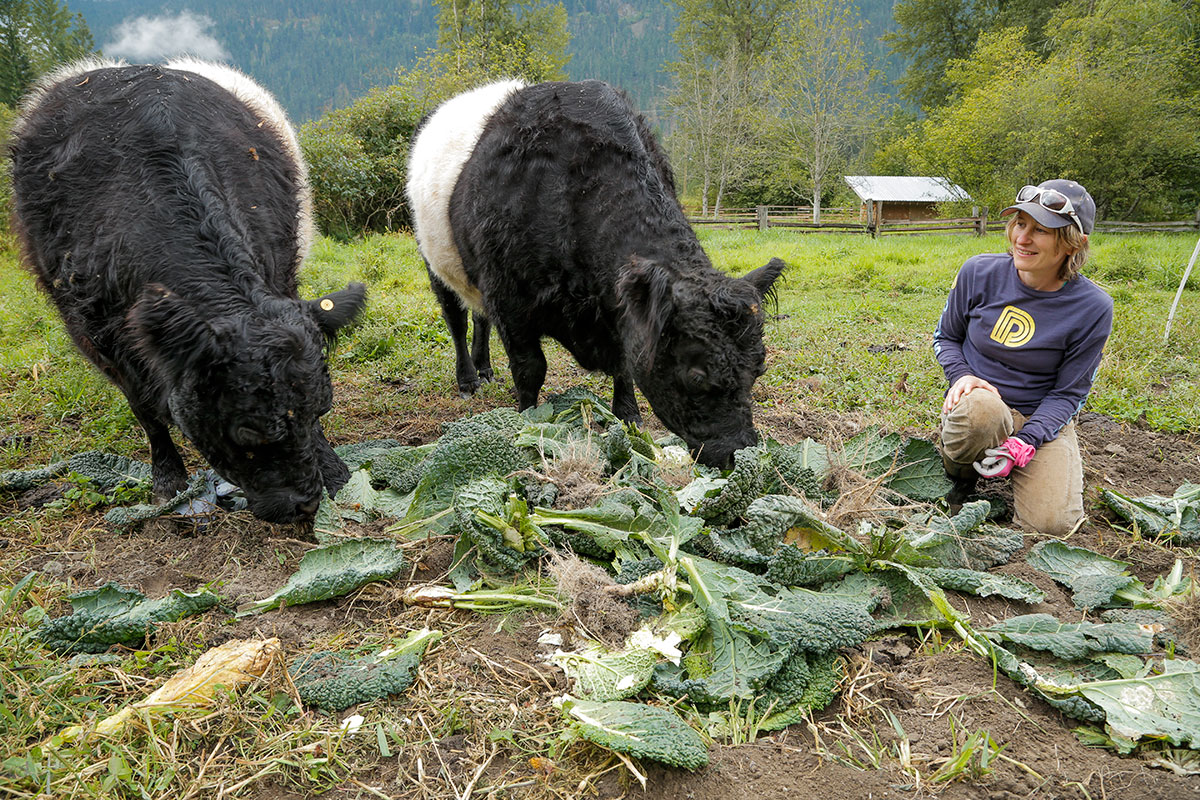
    The cows have very exacting standards. In forage. In fashion, they’re a bit more chill. Unless, of course, you’re wearing leather.

    Evaluation complete, I don yesterday’s work pants, (hopefully, but unlikely) complete with small crescent wrench and pen-knife in the pockets, clean work shirt, work boots (rubber or leather), and make obvious weather-related adjustments. A seasonal ball cap or toque, with occasional forays into wide brimmed sun hats, offers warmth, shade, and hair control. I don’t bother with make-up.
    There are two items in my functional farm-chic wardrobe to which a more detailed examination is due. They score particularly low on fashion but shoot the lights out on functionality; a by no means unusual description for just about everything I wear out there. Let us then consider coveralls, and the mosquito bag net.

    13124927_10153945295231311_8492489048310326032_n
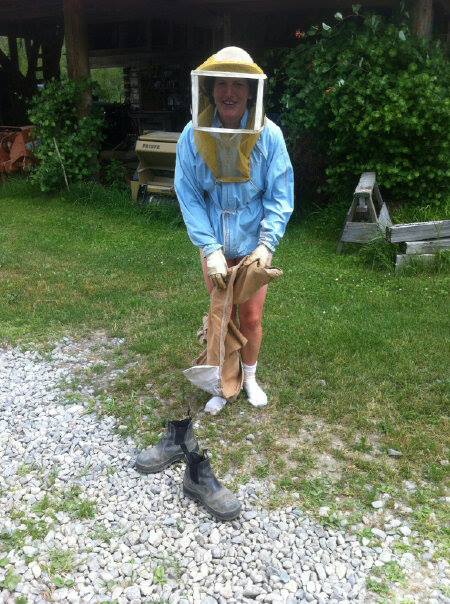
    Anna Helmer gets into her bee-suit, and someone takes a photo and puts it on Facebook.

    Until I went to welding class in the city, where we were required to wear coveralls, I had decided against that look for myself.  I tried wearing them a few years ago and felt about as alluring as an old hockey bag. Never having been what you might call an instinctively feminine dresser, I felt wearing coveralls would sever completely any connection to my embattled femininity. I had to draw the line.

    In welding school I was not given any choice in the matter and I initially bemoaned my baggy figure. Eventually however, I noticed that my good jeans (worn mistakenly to class) stayed clean, protected by the Big Blues (pet name for my coveralls) which got sooty and smoky. Perhaps, I began to think, there was yet wine to be squeezed from this stone.

    rootdown-organic-farm-2
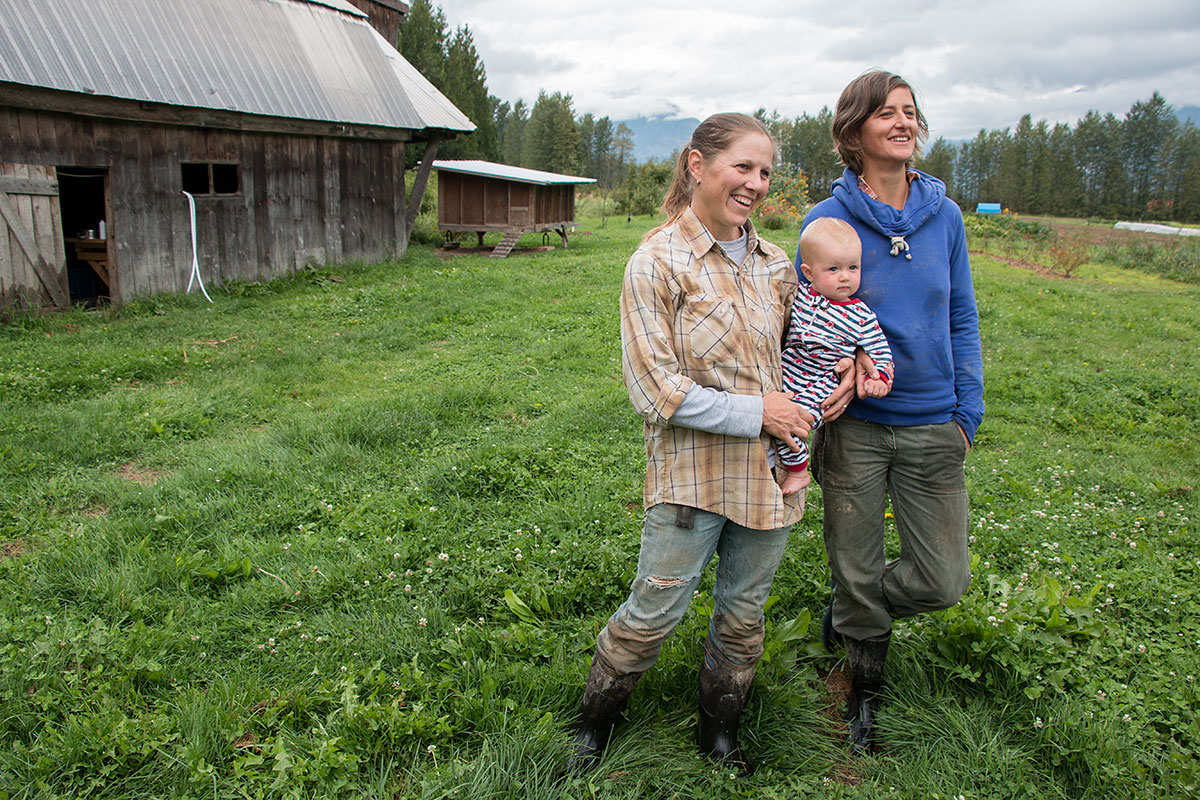
    Sarah and Simone from Rootdown Organics demonstrate the key farm fashion accessories: soiled pants, rubber boots, cute baby who is actually in charge.

    I have come to realize that the coveralls represent a new opportunity for me. I can stay a little cleaner on the farm, and not arrive home resembling a diesel spill in a dust bowl. Not only can I look presentable at the end of the day, but if Elle magazine does happen to show up for a photo shoot, I can be assured of a clean outfit underneath. They will still have to bring their own make-up person.

    plentywildheader
    Alyssa and David from Plenty Wild Farms must have had enough time to shower before their photo shoot. Do farmers really ever look this clean when out in the fields?

    Turning now to the mosquito bag net; my choice for most essential farm fashion accessory.

    In my net I am bug-free; I blithely disregard the scornful sniggering of other slaves to fashion on the farm, slathered as they are in dodgy chemicals, and/or in a high state of denial over the level of torment they endure as bag-less labourers in mosquito country. There is no bigger slap in the face to high fashion than dropping a bag over your head, but neither can I countenance flies in my eyes.

    acrosscreekheader
    Bruce Miller models the ultimate in Pemberton farm fashion, the Slow Food Cycle Sunday t-shirt.

    To conclude, it would be nice to point to an item in my farm wardrobe that is more fashion than function, but I am at a loss. I suppose my pink John Deere ball cap tilts the balance slightly in favour of glam, but looses ground as its grubbiness increases with every passing day of summer. In an uncharacteristic eruption of reckless consumerism, I have purchased a brand new one for this summer.

    Anna Helmer believes farmers are under-represented on the fashion run-way but sort of sympathizes.

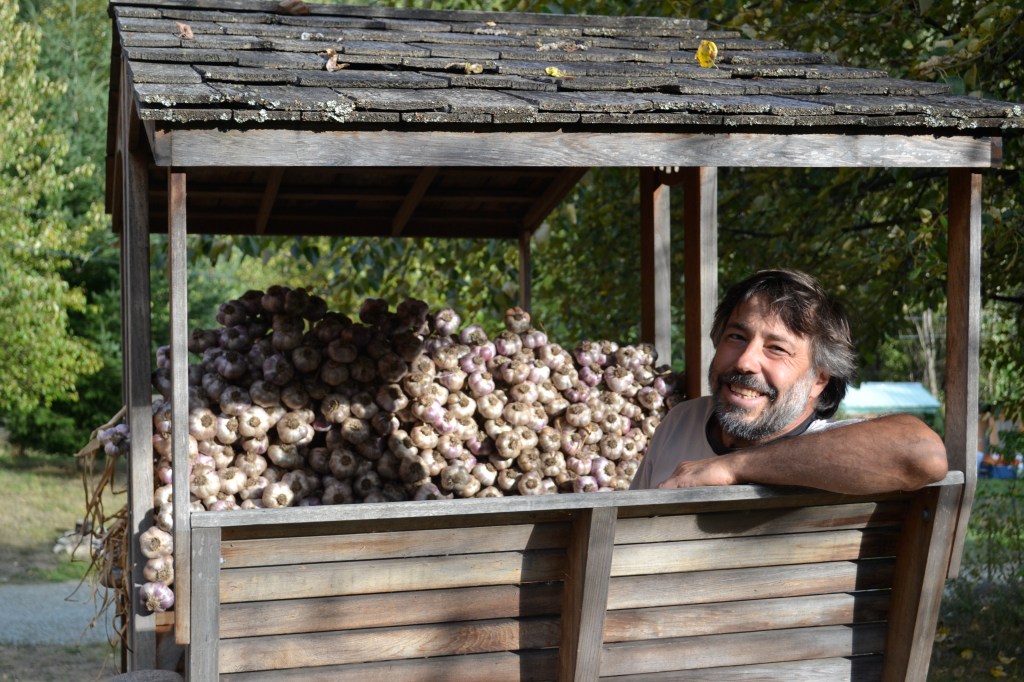
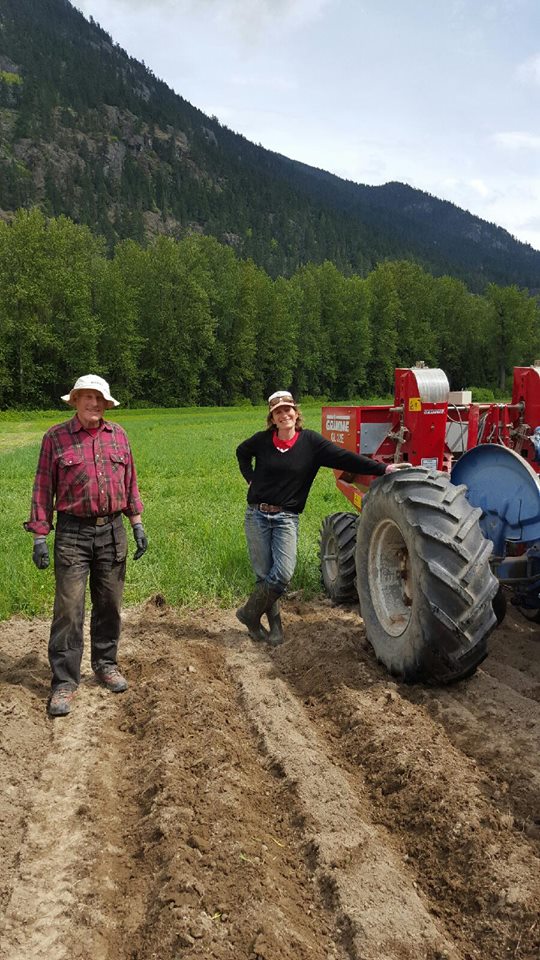
    Not being able to stage a photo shoot of Anna’s farm fashion moments during planting season, we’ve poached these illustrative photos of Pemberton’s organic farmers in their sartorial best, from BeyondYourEye.com photography, via the BC Organic Farmers.

  • Bees?   Why not!

    Bees? Why not!

    Several years ago my Aunt had honey bees. My sister Lia, @pembeehives, was cuckoo about those bees. I thought they were pretty cool until I started walking up to the hive and had a massive panic attack. I was certain they could feel my fear and that the whole hive would ascend on me and sting me to death. Death by bees, no thanks!! Since then I have had ZERO interest in raising bees. My sister, on the other hand, has only grown more fond, more bee crazy.

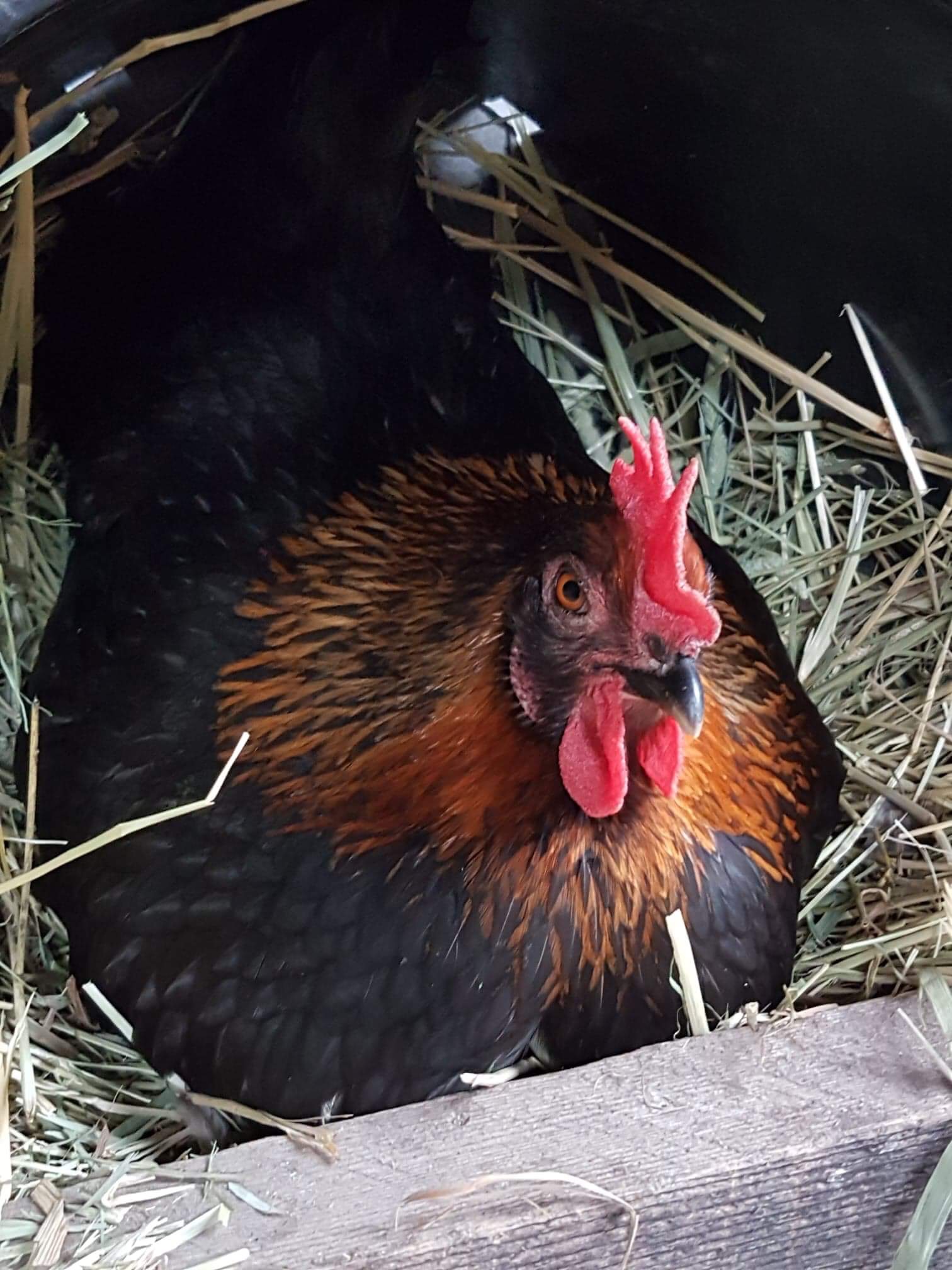
    Last fall, my kids and I moved back into my childhood home. A little house on 2 acres. A small green patch of freedom to plant, grow, raise, and love. I brought my chickens, added a few more to the flock, and then a few more and maybe a few more after that! I also got 2 more horses so that my boy Banjo wouldn’t be lonely.

    B1E27E28-83AD-42F7-93F9-FC24B9F49373

    Horses and chickens, dogs, cats, rats and kids. I was set, and I am busy!!  Then I had a thought. My sister loves bees, maybe she would like to get some bees and they could have a little spot here and she could be the crazy bee lady and I will be the crazy chicken lady and everything would be fantastic!

    Bees? Why not!!

    I forgot about the fact that I was terrified of a colony of bees coming after me while I weeded my garden or fed my horses, stinging me while I was just minding my own business. Lia, @pembeehives, was all in! She was already dreaming of hives, long before I offered.  She and Alex built hives, they brought them up and she painted them with my kids.

    DD4B840E-22C3-4837-9183-7452E7E6B4DF

    The 2 nucs (boxes of bees) were ordered and the site for the hives planned, changed, replanned, changed and planned again. Still, here I am scared of bees. Terrified.

    604D0238-4D5B-40E3-B555-077B48827A2B

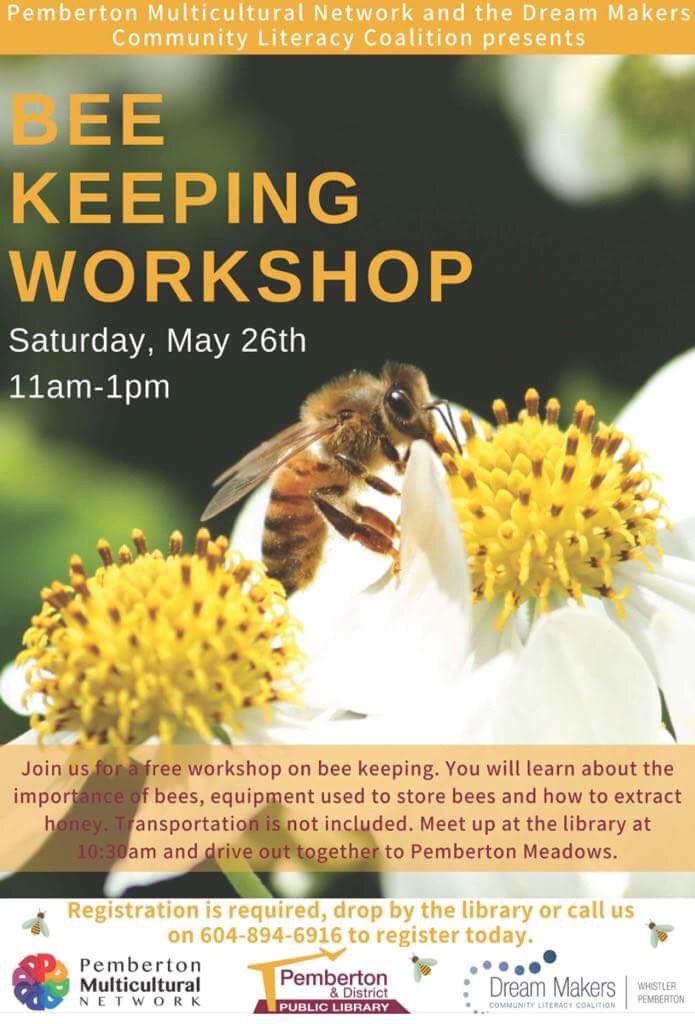
    On Saturday, Lia and I went up to Delores’ for a bee keeping workshop. A few hours of listening to Delores talk about bees, watching her take the hives apart, standing closer to a swirl of bees than I ever thought I would, and I discovered that I am no longer afraid of bees!  They are fascinating!

    9A1E2AB7-B7FF-421A-9729-4E6FC3662614

    When I first put our names down for this bee-keepers’ workshop, I was going into it as a non-interested party. I was going for my sister, so that when she wasn’t around I would have a bit of knowledge and if anything needed to be done while she was in Vancouver I could help the hive out.

    In the end, I have had the chance to face my fears and now I can go into this as a partner, not just a watcher. I can go into this beekeeping adventure with less fear and more enthusiasm, though I think I will let Lia hold the reins, and stick, for the most part, to being a crazy chicken lady.

    2F4C3888-B17D-4BD2-91D0-982037710278

    Meg
    Once a farm girl, always a farm girl.

    Follow my farm adventures on Instagram @once_a_farm_girl


  • Wildflower Gummies!

    Wildflower Gummies!


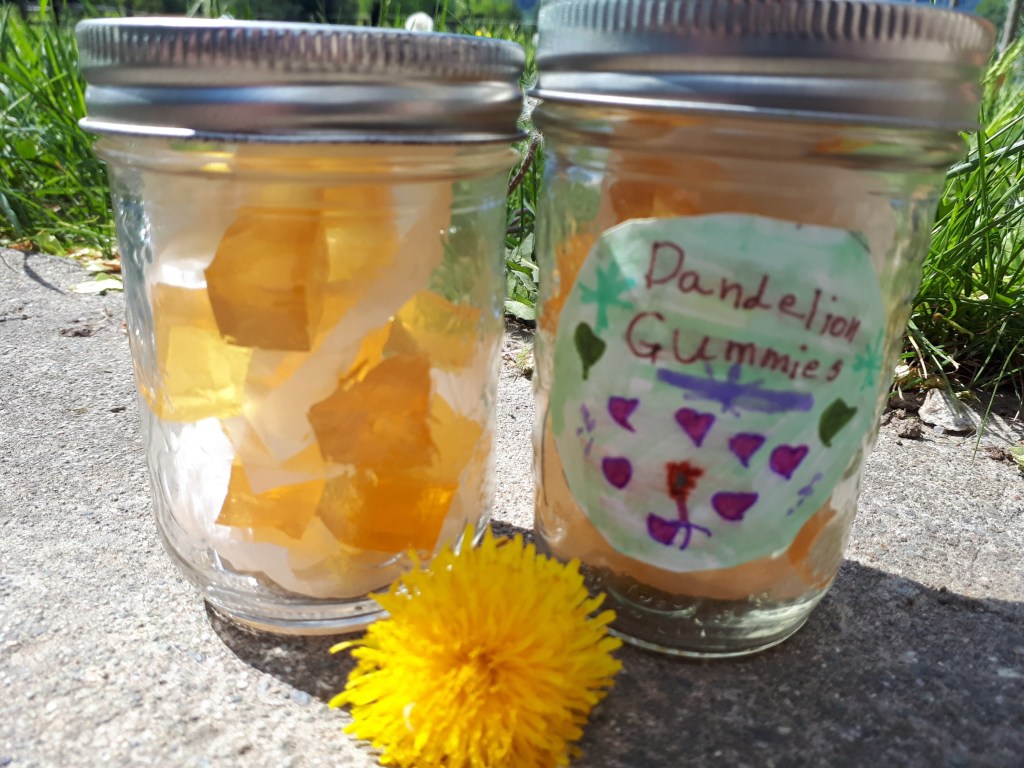
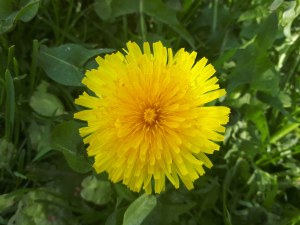
    20180509_1701241On May 11, I hosted a camp where we were supposed to make dandelion jelly. I had all these beautiful ideas in my head about the kids picking a huge bowl of blossoms out in the back field with the bees and other pollinators, their, fingers becoming stained yellow with pollen… how romantic. Of course, this is not how it happened in real life.
    “Jelly, what’s that?” one of the girls asked.

    “Well, it’s like jam, except there are no chunks in it, and we can make it from flowers!”

    “THAT SOUNDS GROSS!!” They replied in chorus. “EWWWW! WE ARE NOT MAKING THAT!! DISGUSTING!!”

    Well, that stumped me. For a moment.

    “Wait… we could make dandelion GUMMIES. Would that be better?”

    “YES!!” It was unanimous. GUMMIES were obviously WAY better than jelly.

    While we were waiting for our gummies to set in the freezer, we went outside and picked dandelions in the front yard. I showed the girls something my dad taught me when I was a little kid: that if you pick the largest dandelion stem you can find and take off its flower, it makes a noise like a kazoo! It takes a bit of patience to find the right stem, and sometimes you have to break it shorter and shorter before it will start to make  noise. It’s some kind of magic that happens when the dandelion milk in the bottom of the stem starts to vibrate, so it helps to have a juicy one! Two of the girls got bored and wandered away to play tag with Vinnie the sheep. But Avery was very excited about playing dandelions. “This is the best day of my life!” she exclaimed. “Now I can annoy everyone FOREVER!”


    20180511_142337
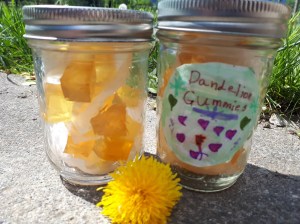
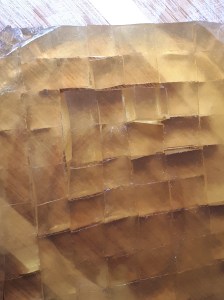
    Our gummies after being cut into bite sized morsels!

    As we cut up, divided up and packaged our very own homemade dandelion gummies, I realized this gummie making is an incredible way to get even the most squeamish of kids interested in the world that is growing all around them. If seasonal edible flower gummies can lead them to being able to identify a few species growing in their own back yard, then they learn to have a relationship with that particular plant, and that relationship can be a gateway to curiosity. In what other ways that plant can be used? What kind of environment does it like to grow in? Knowing a single plant intimately is enough to make the natural world come alive. I bet that even from reading this post you will notice dandelions more. Your awareness of them will become sharper, more open. And this kind of curiosity- this relatedness- is precious. It leads to a sense of belonging to the maze of green abundant life that exists outside our windows, the same way that knowing a friend in a crowd makes being amongst that many strangers less overwhelming. So if all we need is a few cups of cane sugar to kindle this relationship, then so be it!

    20180511_1432542
    Posing with our finished product!

    And don’t worry, I am going to give you recipes. I am also going to acknowledge I am leading you on a little, as dandelion season is almost completely over in Pemby. Don’t worry, you can use any edible fragrant flower to make your gummies. That means, lilacs = yes. Peonies = yes. And those wild roses that are just starting to bloom? Yes, you can use those too!!

    First, you need to make a flower syrup. I make mine in big batches, as I like to be able to keep some to make into summer drinks (a few tbsp and a bit of mineral water over ice on a hot day = heavenly). Please note that the syrup recipe is not intended to be canned, as the proportions are not tested for safety. So please keep your syrups in the fridge! I am confident you will use them up before they have a chance to go bad. This recipe makes about 6c of syrup, which is quite a lot. You can always halve or quarter the amounts if you want to make a smaller batch.

    Wildflower Syrup:20180509_165901

    2c flower petals

    4c cane sugar

    5c water

    1 organic lemon, sliced

    1. Prepare your flowers. It is best to harvest them in full sun at the height of the day. (From noon to 3 pm.) That way the flowers will retain the most potency and fragrance. Whichever kind of flower you are using, do your best to use only the petals. (In the case of dandelions, this means removing the green base of the flower.) Use flowers as close as you can to the time of harvest, as they will lose potency as soon as they are picked.
    2. Bring the water to a boil and add the cane sugar and stir until dissolved.
    3. Add flower petals and sliced lemon and cover your pot or bowl with a tea towel or cheesecloth to keep out flies, and leave out at room temperature to infuse for 2-4 days, stirring once per day. You want to optimize the length of your infusion without your syrup starting to ferment. If you see lots of bubbles or you are happy with the flavour, it’s time to move onto step 4…
    4. Strain and bottle your syrup. Enjoy!


    Wildflower Gummies 20180511_1440321

    1c flower syrup

    3pkj (3tbsp) gelatin*

    1. Find a mould for your gummies. I used the bottom of a tupperware container and cut them into squares, but you could get super creative here. You don’t need parchment or non stick spray or anything.
    2. Heat your flower syrup until just before boiling. Separate 1/4 -1/2 c of syrup and shake or whisk the Gelatin into it. (I used a small Mason jar and shook it to combine the gelatin, then strained out the residual lumps using a tea strainer as I feel you get less foam this way.)
    3. Add the gelatin mix to the rest of your syrup, stir well to combine, then pour it into your mould. If foam has accumulated on top of your gummy, skim it off with a spoon.
    4. Let your gummies set. I put mine in the freezer, but if you are not in such a rush you can just leave them out.
    5. To get your gummy out of the mould, dip your mould into warm water for a few minutes (being careful not to get water on your gummy). Then run a knife around the edge of your mould and you should be able to pull it right out. Don’t be afraid to use your fingers to pull it out of the mould- you won’t wreck it.
    6. Now you can cut your gummy into shapes with a sharp knife or cookie cutter. You could also roll them in sugar and leave them out for a few days is you want a chewier texture. I was happy with mine as they were as I found them already quite sweet. If you don’t go the additional sugar method, I would keep your gummies in the fridge as they do have quite a bit of moisture in them and will mould if they are not devoured within the first few days. Enjoy!

    *I used Knox Gelatin which comes pre-portioned in little paper packages, but I saw Stay Wild has boxed gelatin that is also gluten free!